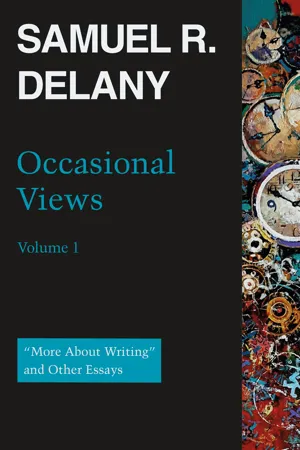
Essays, lectures, and interviews from the iconic, award-winning author and critic.
Samuel R. Delany is an acclaimed writer of literary theory, queer literature, and fiction. His "prismatic output is among the most significant, immense and innovative in American letters," wrote novelist Jordy Rosenberg in the
New York Times in 2019. This anthology of essays, lectures, and interviews addresses topics such as 9/11, race, the garden of Eden, the interplay of life and writing, and notes on other writers such as Theodore Sturgeon, Hart Crane, Ursula K. Le Guin, Hölderlin, and an introduction to?and a conversation with—Octavia E. Butler. The first of two volumes, this book gathers more than thirty pieces on films, poetry, and science fiction. These sharp, focused writings by a bestselling Black and gay author are filled with keen insights and observations on culture, language, and life.
"An incredibly generous entry point to Samuel R. Delany's pioneering insights about the intersections of genre, race, sexuality, Science Fiction and what it means to live through and amongst those categories. As he states, "What we need is not so much radical writers as we need radical readers!" This collection helps us satisfy that deeply necessary and timely cultural need." —Louis Chude-Sokei, author of
Floating In A Most Peculiar Way: A Memoir
"By turns gutsy and erudite, challenging and gracious, Delany's
Occasional Views gives illuminating glances of his mind's life journey. How lucky we are to have these proofs of the resonant truths he has discovered along the way!" —Nisi Shawl, author of
Everfair
"Delany has such an intoxicating, prodigious, conversational mind, and
More About Writing and Other Essays is a delicious journey into his brilliance. Whether he is unveiling how he navigates the terrain of being a science fiction writer; or introspective reflections on race, class, sexuality; or trusting his listeners as he gives wide ranging, honest answers in his interviews, responding with exacting humor to his critics, remembering Clarion teaching experiences, regretting missed sexual encounters with favorite writers, creating space for the complexity of holding love and questions in the same breath—we see how thoroughly he thinks about everything, and how vibrant and multitudinous the web of connections is in his memory and imagination. Reading Delany will make you a better writer. (I was particularly enthralled to read the dialogue with, and later introduction of, Octavia E. Butler right as she's finishing
The Parable of the Talents!)." —Adrienne Maree Brown, co-editor of
Octavia's Brood
- 137 pages
- English
- ePUB (mobile friendly)
- Available on iOS & Android
eBook - ePub
About this book
Information
1
More About Writing
The Life of/and Writing
“The Life of Writing” is a phrase we associate with the eighteenth-century writer, Dr. Samuel Johnson—responsible for compiling the first comprehensive English language dictionary. He also wrote a fantasy, Rasselas, that now and again appears from various contemporary paperback houses attempting to add some tone and history to their science fiction and fantasy lines.
When Dr. Johnson used the phrase, the life of writing, it meant, of course, the literary life—and referred to the kinds of things an eighteenth-century writer might be occupied with in the course of an eighteenth-century day, from sharpening goose quills, grinding ink stones, and debating in coffee shops what historical material would or would not make successful subject matter for a profitable poetic tragedy, to negotiating with booksellers (what the eighteenth century had in place of publishers) as to what percentage of the costs you might put up toward printing your most recent profitable poetic tragedy—as all publishing at the time was more or less vanity publishing—though most of your time, money, and energy might be reserved for putting out polemical pamphlets on any subject from the foppery and decadence of women, the nobility, or the young to meditations on taxes, fashions, or God, for which opinions you risked fame, notoriety, or (sometimes) jail.
The life of writing has changed drastically in three hundred years.
But, as the phrase fades into the memory of literary antiquarians, it passes through a strangely luminous moment, when, as its historical meaning verges on the obsolete, it opens up to a host of other possible meanings, comic, surreal, suggestive: in 1970, the poet Judith Johnson Sherwin published a book of experimental short stories with Atheneum, The Life of Riot, the title of which clearly takes its resonances from Johnson. And it does not take much for us to read in the original phrase, The Life of Writing, the notion of what, in any piece of writing, makes that writing lively: the life (or liveliness) in writing. And if we look at “life,” not as referring to general liveliness, but to the range of everyday life, then, with only a little catachresis, we can read “the life of writing” as meaning the way everyday life is reflected in writing. Thus, as we multiply and survey the possible—if sometimes improbable—interpretations we can unpack from this most unassuming phrase, finally we have to admit that, buried in its text is pretty much every possible relationship that we can conceive as existing between “writing” and “life”—that is, “writing” in any of its meanings and “life” in any of its.
Sometimes I try to suggest that range and multiplicity by taking that weakest of English prepositions, “of,” and placing behind it a slash, that, like a slant mirror, reveals that what can be hidden in that loose and lax preposition is the strongest of English conjunctions, “and.” Indeed, the “of” and the “and,” on either side of that virgule, mirror each other and, I hope, problematize our original phrase out into an infinitude of possible relations between world and text, word and world, action and articulation:
“The life of/and writing …”
What are some of these relations?
Teaching at various writers’ workshops for more than forty years now, certainly I can remember when some of the complexities of this relational complex were first brought home to me.
A young writer of seventeen or so had handed in a story that struck me at once as both extremely talented and deeply flawed.
In the course of the tale, a young man (of seventeen or so) goes walking along a beach one evening. He comes across a group of some dozen bikers and, there, laughing and being hugged now by one, now by another is … his girlfriend!
The young man pauses a moment, then calls to her to come to him. She looks at him scornfully—and laughs. Angrily, he marches in and tries to pull her away, whereupon the bikers proceed to beat the living daylights out of him and, leaving him bloody on the sand, get on their motorcycles. With the young woman on the back of the leader’s, they ride away. Painfully, the young man goes to the water, washes his face in the sea, and limps off.
The successes of the story were in the physical evocation of surf and sand and evening light. Its failure was in—how shall I say?—a certain emotional extremity. An intelligent, slender young man of seventeen—with glasses—usually does not throw himself into such an obviously suicidal fray quite so easily, quite so unthinkingly, even under the goad of love. It just wasn’t believable.
When, in conference, I pointed this out to young Shakespeare, he pulled his manuscript sharply back into his lap, assuming a position of overtly Freudian self-protection, and declared: “This story is true. And if it’s unbelievable, that’s just because—I guess—sometimes reality is unbelievable. It all happened. And I put it down just like it was.”
What could I say?
As is so often the case, I didn’t think of anything to say until three hours after the conference was over. Nor did I get a chance to say it until the young man handed in a second story. This one was an SF tale—and was just as talented, though it still had some problems.
“But I want to go back,” I said, “and talk about your first story for a minute. Maybe we can throw a little light on the believability problem in general—that was the one about you, and your girlfriend, and the bikers on the beach. Now this, you say, is your account of something that really happened. I want you to think back to the original incident. And tell me exactly what occurred.”
“Sure,” said unsuspecting Sophocles. “It was on the beach—it’s on part of Lake Michigan. I was there last summer. And it was evening. I was walking along, when I saw my girlfriend. She was down the sand, with some guys.” Here he fell silent.
So I asked: “How many of them were there?”
After another few moments, he said: “Two.”
“Bikers,” I said. “With motorcycles.”
“Bicycles,” he said. Then, after another moment: “One of them was wheeling a bicycle.”
“Two,” I said, “with one bicycle. What did you do?”
“I didn’t do … anything. I just stood there.”
“Was she laughing and having a good time?”
“She had her back to me—so I couldn’t tell. The three of them, they were just walking on the beach … like I was.”
“What was she wearing?”
“White shorts, I think. And a bathing suit under it. Blue, maybe green. Well, I guess she wasn’t really my girlfriend—I’d talked to her a couple of times in town … so maybe she was just my friend.” Then he said: “But I’d thought about her being my girlfriend! A lot! And one of the guys had a beer can—or maybe it was a soda. I wasn’t too close.”
“Did she see you? Did you say anything?”
“No,” he said. “I don’t think she did. I just turned around, after a couple of seconds, and went the other way…. But then I got real upset—like I couldn’t breathe, or I was going to cry or something. So I went down and washed my face in the water.” After another few moments, he said: “But you see, it’s based on the truth, on something that really happened—basically it happened.”
“Basically,” I said, “the twelve bikers, this supposed girlfriend of yours, her scorn, the fight, and her laughter, are a lie. They’re a lie you’ve told yourself to make you feel better about having gotten upset. Now there’s nothing wrong with telling lies in fiction. That’s what it’s all about. I just want to point out that in this case you happened to tell one I didn’t believe. And it’s often when we’re lying to ourselves that we tell the most unbelievable whoppers. You have to watch out for that in your writing. It’s possible—though I can’t guarantee it—you might have had a better story if you’d told about what you really saw, what the young woman’s relationship to you really was, and how that got you upset when you saw her with two of her friends—then how you went and washed your face.”
“I thought,” he said, “I did …”
But of course the language, which is far more truthful than we are, often reflects more things about those of us who use it than we are prepared to show: sometimes it reflects whether we are lying or speaking the truth; or (which I believe is more important than either, because it has not an easy, but a critical, relation to both) whether we are working to put together a rich and rewarding tale.
The notion of language as a mirror has a venerable history in the life of writing (if we may unpack still another meaning from our parent phrase: the life of writing as the history of writing). One of its most famous moments is from Shakespeare’s Hamlet, Act III, scene ii, when Hamlet exhorts the players who will be speaking his lines, “to hold, as ’twere, the mirror up to nature, to show virtue her own feature, scorn her own image, and the body of the time his form and pressure.” It’s worth noting here that the Elizabethan audience would have probably heard the word “pressure,” in this context, specifically as a printing term, meaning (here) imprint or printed illustration—that is, the term, through typography, comes from the life of writing. Perhaps the second best-known moment is when the French novelist Stendhal borrowed Shakespeare’s image and gave back his own reflection on it, his own interpretation of it, when in the 1830s he declared that the task of the novelist was to hold the mirror up to nature as one traveled along the road of life.
Of course, what is missing in both of these moments for us today is that mirrors in the 1830s, and even more so in Shakespeare’s day, tended to distort.
What about the mirror’s—or the mirroring virgule’s—slant?
What kind of distortion is invariably involved with, and inescapable in, the artistic process of reflection, is built in to the very notion of reflection? For even while we sit, giving out our writerly advice to young Balzac to cleave more closely to truth in the tale of his epiphany on the beach, no writer who has examined her or his own process can fail to see something of her- or himself in that very young and very talented liar.
So that even for me to recount the tale of our Clarion conference as I did above is finally to tell a lie to myself—a lie that says, even for the moment of the tale, that in my greater knowledge I am somehow distinct and different from him; I am his opposite, as left is the opposite of right, as a reflection in a mirror is the opposite and the inversion of what is there in life. For it is precisely in the words with which I suggest this that I am obscuring the troubling truth that, again and again and again (indeed all too often), I am, in too many ways, his double.
Certainly one of the finest meditations on the relation of art to life in the last century is the dense and articulate prose-poem, “Caliban to the Audience,” the centerpiece of W. H. Auden’s The Sea and the Mirror, a 1944 poetic meditation on Shakespeare’s Tempest. In that prose-poem Auden returns, for a moment, to Shakespeare’s mirror, Shakespeare’s pressure (that is, Shakespeare’s illustration), having his audience through the voice of Caliban address the ghost of Shakespeare:
You yourself, we seem to remember, have spoken of the conjured spectacle as “a mirror held up to nature,” a phrase misleading in its aphoristic sweep but indicative at least of one aspect of the relation between the real and the imagined, their mutual reversal of value, for isn’t the essential artistic strangeness to which the sinisterly biased image would point just this: that on the far side of the mirror the general will to compose, to form at all costs a felicitous pattern, becomes the necessary cause of any particular effort to live or act or love or triumph or vary, instead of being as, in so far as it emerged at all, it is on this side, their accidental effect?
In the world of art, because pattern and plot, economy and purpose are the method, all incidents are selected (or rejected) with some attention to pattern, order, meaning.
In the world of reality, when pattern or its handmaid insight emerges at all, it is the accident, an excess, mere happenstance.
Thus, because the context of the two worlds is entirely different, the meaning of every incident in an art work is subtly shifted, so that—on the level where it counts—there is finally no possibility of congruence between the meaning of an incident in an art work and its meaning in the world. Art is rich and strange, and we shouldn’t even try to deceive ourselves by searching in it for the familiar, much less the truth; in art, truth (in the sense of truth-to-life) is the happenstance, the excess, the accident.
For isn’t the world of art, Auden tells us in that same prose poem, “a world of freedom without anxiety, of sincerity without loss of vigor, feeling that loosens rather that ties the tongue”?
After all, the world of art is the world in which a young man calls to his beloved, fights for her (or his own) honor against ludicrous odds, and—chastened by defeat and disillusion—looks out over the water, tears and the sea indistinguishable on his cheeks, with new and ineffable knowledge.
The world of art is—certainly—the world of this essay, where I can dispense writerly advice to young Kafka with all the eloquence of hindsight, but without stuttering, without having to begin half my sentences over, without having to scratch my ear violently in the middle, and without being so concerned with what young Hemingway before me is feeling—about me, about his story—that I lose my train of thought three times and only manage to mumble something to which, out of kindness or terror, he nods, blurts, “Yeah—I see,” and hurries off, in a welter of misunderstanding, to nurse his fear and incomprehension at my fear and incomprehension.
Yet, somehow, sometimes, both in life and in writing, ideas emerge that resonate with eloquence and force, even when they are ideas about hesitation, disillusion, and failure.
Picasso said: “Art is the lie that makes the truth bearable.” Some years later, science fiction and fantasy writer Ray Bradbury put much the same point into a poem: “We have our arts so we won’t die of truth.”
Me, I’ve always found this a shocking idea. Possibly because I’m a writer, and because writing takes place in time, I’ve preferred to see art as a self-corrective process, a process of self-vigilance, in which we go back and rethink the tale again, even as we tell it. I sometimes think that process, alone as it is reflected in language, is what constitutes the “truth effect” of language. That, along with beauty, is its greatest worth.
Just after the start of the Great War, two very different thinkers in two very different situations came up with remarkably similar statements about the relation of art to life. In his first book, The Theory of the Novel, the twenty-five-year-old Hungarian critic Georg Lukács wrote, “The novel is the only art form where ethics is the aesthetic problem.” And a year later, in 1916, the year The Theory of the Novel was published, the twenty-seven-year-old philosopher Ludwig Wittgenstein, while on a vacation trip to Norway, jotted down in his notebook, on the 24th of July, “Ethics and aesthetics are one,” a comment he retained two years later, in 1918, for the single book he published in his lifetime, Tractatus Logico-Philosophicus, which appeared in 1922, the same year as the greatly publicized discovery of Tutankhamen’s tomb, the same year T. S. Eliot published his brooding construction of fragments, The Waste Land, the same year James Joyce published his episodic novel of a single day in Dublin, Ulysses, all of which helped to usher in the period of High Modernism, with its highly problematic relation to history and the past.
Up till now, the slant of our mirror has generally emphasized a fundamentally playful relation between life and writing. But when we turn to look at statements such as, “The novel is the art form where ethics is the aesthetic problem,” and “Ethics and aesthetics are one,” we enter a field where it is all but impossible not to begin to overvalue the relation between writing and life.
In Western Europe what is generally considered Lukács’s greatest book is History and Class Con...
Table of contents
- Cover
- Title Page
- Copyright
- Dedication
- Contents
- 1 More About Writing: The Life of/and Writing
- 2 Algol Interview: A Conversation with Darrell Schweitzer
- 3 Liner Notes, Anecdotes, and Emails on Theodore Sturgeon
- 4 Star Wars: A Consideration of a Great New SF Film
- 5 Samuel Delany, Settling Future Limits: An Interview
- 6 Introduction to the Graphic Novel Empire
- 7 The Gestation of Genres: Literature, Fiction, Romance, Science Fiction, Fantasy …
- 8 Theodore Sturgeon, In Memoriam
- 9 Note on Le Guin: The Kesh in Song and Story
- 10 Eden, Eden, Eden: Genesis 2:4–22
- 11 How Not to Teach Science Fiction: Thoughts on Sturgeon’s “Hurricane Trio”
- 12 Letter to Science Fiction Eye: Some Impertinent Rebuttals
- 13 An Antiphon
- 14 Atlantis Rose … : Some Notes on Hart Crane
- 15 Afterword to Theodore Sturgeon’s Argyll
- 16 Interview: Questions
- 17 The Loft Interview
- 18 Note on Robert Hayden’s “Middle Passage”
- 19 Beatitudes
- 20 Dialogue with Octavia E. Butler
- 21 Racism and Science Fiction
- 22 Some Queer Notions about Race
- 23 The Star-Pit Notes
- 24 Note on Bruce Nugent’s “Smoke, Lilies and Jade”
- 25 Introducing Octavia E. Butler
- 26 Poetry Project Interview: A Silent Interview
- 27 How to Do Well in This Class
- 28 His Wing, His Claw Beneath the Arc of Day
- 29 Student of Desire
- 30 A Centennial Life from the Roaring Twenties: The Broken Tower: The Life of Hart Crane
- 31 9/11: Echoes
- 32 Eleusis: A Note on Friedrich Hölderlin
- Acknowledgments
- Index
- About the Author
Trusted by 375,005 students
Access to over 1.5 million titles for a fair monthly price.
Study more efficiently using our study tools.
Frequently asked questions
Yes, you can cancel anytime from the Subscription tab in your account settings on the Perlego website. Your subscription will stay active until the end of your current billing period. Learn how to cancel your subscription
No, books cannot be downloaded as external files, such as PDFs, for use outside of Perlego. However, you can download books within the Perlego app for offline reading on mobile or tablet. Learn how to download books offline
Perlego offers two plans: Essential and Complete
- Essential is ideal for learners and professionals who enjoy exploring a wide range of subjects. Access the Essential Library with 800,000+ trusted titles and best-sellers across business, personal growth, and the humanities. Includes unlimited reading time and Standard Read Aloud voice.
- Complete: Perfect for advanced learners and researchers needing full, unrestricted access. Unlock 1.5M+ books across hundreds of subjects, including academic and specialized titles. The Complete Plan also includes advanced features like Premium Read Aloud and Research Assistant.
We are an online textbook subscription service, where you can get access to an entire online library for less than the price of a single book per month. With over 1.5 million books across 990+ topics, we’ve got you covered! Learn about our mission
Look out for the read-aloud symbol on your next book to see if you can listen to it. The read-aloud tool reads text aloud for you, highlighting the text as it is being read. You can pause it, speed it up and slow it down. Learn more about Read Aloud
Yes! You can use the Perlego app on both iOS and Android devices to read anytime, anywhere — even offline. Perfect for commutes or when you’re on the go.
Please note we cannot support devices running on iOS 13 and Android 7 or earlier. Learn more about using the app
Please note we cannot support devices running on iOS 13 and Android 7 or earlier. Learn more about using the app
Yes, you can access Occasional Views by Samuel R. Delany in PDF and/or ePUB format, as well as other popular books in Literature & Literary Collections. We have over 1.5 million books available in our catalogue for you to explore.