A groundbreaking history of how the Black Death unleashed revolutionary change across the medieval world and ushered in the modern age
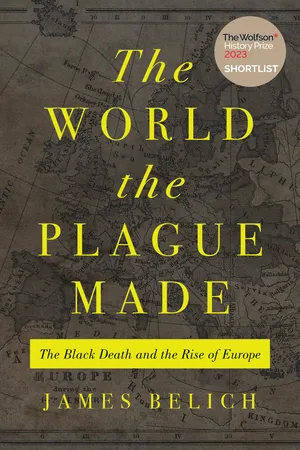
In 1346, a catastrophic plague beset Europe and its neighbours. The Black Death was a human tragedy that abruptly halved entire populations and caused untold suffering, but it also brought about a cultural and economic renewal on a scale never before witnessed. The World the Plague Made is a panoramic history of how the bubonic plague revolutionized labour, trade, and technology and set the stage for Europe’s global expansion.
James Belich takes readers across centuries and continents to shed new light on one of history’s greatest paradoxes. Why did Europe’s dramatic rise begin in the wake of the Black Death? Belich shows how plague doubled the per capita endowment of everything even as it decimated the population. Many more people had disposable incomes. Demand grew for silks, sugar, spices, furs, gold, and slaves. Europe expanded to satisfy that demand—and plague provided the means. Labour scarcity drove more use of waterpower, wind power, and gunpowder. Technologies like water-powered blast furnaces, heavily gunned galleons, and musketry were fast-tracked by plague. A new “crew culture” of “disposable males” emerged to man the guns and galleons.
Setting the rise of Western Europe in global context, Belich demonstrates how the mighty empires of the Middle East and Russia also flourished after the plague, and how European expansion was deeply entangled with the Chinese and other peoples throughout the world.
- 624 pages
- English
- ePUB (mobile friendly)
- Available on iOS & Android
eBook - ePub
About this book
Information
Publisher
Princeton University PressYear
2022Print ISBN
9780691219165
9780691215662
eBook ISBN
9780691222875
Topic
GeschichteSubtopic
Europäische GeschichtePART I
A Plague of Mysteries
FOR ALL WEST EURASIA’S underestimated cohesion, traditional divisions remain important: Western Europe, dominated by Latin Christianity, Eastern Europe, mostly dominated by Orthodox Christianity, and what we will risk calling the “Muslim South”, comprising the Middle East, North Africa, and varying chunks of southern Europe (see map 2). It was the Romans who came closest to uniting the three regions. Their empire included most of Western Europe and much of what became the Muslim South, except for Iran and Arabia. In addition, their economic and cultural “world” reached deep into Eastern Europe.1 In the fifth century CE, Western Europe “escaped from Rome”2 only to fall victim to other invaders, some from outside West Eurasia, some from its own non-urban margins. Among the former, Huns and Alans led the way, with the related Hepthtalites, or “White Huns”, devastating much of Iran. Among the latter, Germanic invaders predominated, great gangs whose names suggest they were newly formed for the purpose: Franks (“Brave Men”), Allemanni (“All Men”), and Goths (just plain “Men”).3 These “barbarian” invasions are well-known. What is less well understood is that they did not stop with the dismemberment of the Western Roman Empire, but continued to afflict West Eurasia for a thousand years, before suddenly ceasing around 1400.
Slavic groups, possibly from the northern Ukraine, dispersed throughout Eastern Europe from the sixth century.4 Turkic Avars and Bulgars from the steppes carved domains along the Danube and the Volga in the sixth and seventh centuries, reaching a peak in the ninth to eleventh centuries. A succession of Turkic groups invaded the Middle East, or took over regimes they had served as “slave” soldiers, culminating in the empires of the Kwarezmshahs and the Seljuks—the latter inflicted a disastrous defeat on the Byzantines in 1071, which helped prompt the Crusades.5 In the ninth and tenth centuries, Finno-Ugric Magyars from the steppes seized Hungary, and raided Western Europe as far as Spain and Italy. Scandinavian Viking raids, trades, and settlements flourished at the same time, going east and south down the Russian river system as well as west across the ocean, reaching the Mediterranean and Caspian Seas, as well as Iceland and Greenland. A second pulse of Islamic expansion joined the action, seizing the Balearic Islands, Crete, Sicily, and parts of Southern France in the ninth and tenth centuries.
The greatest invasion of all, and almost the last, was that of the Mongols, led by Chinggis (Genghis) Khan. He united the Mongol tribes, who even so totaled only one million people, in 1206, and created a vast empire stretching deep into all four old worlds. The Mongols and their subject allies, Turks in particular, conquered the Middle East, including Iran; the European steppes, in what is now southern Russia and the Ukraine, and Kievan Rus’, in northern Russia between 1220 and 1260. Kievan Rus’ was “highly urbanized by the standards of contemporary Europe”—indeed it has been described as a loose confederation of city-states.6 It was more prosperous, and more integrated into the European economy further west, than was once thought.7 The Mongols also devastated Hungary, together with parts of Poland and the Balkans, reaching the Adriatic in 1242.8 They did not invade Western Europe, perhaps because it lacked the necessary vast pastures for their horses,9 and they bounced off the formidable Mamluks of Egypt, so sparing North Africa as well. The Mamluks continued to prosper (see chapter 8), despite frequent succession crises. By 1345, they controlled Greater Syria, including Palestine (the Christian Holy Land), and also the Hijaz (the Muslim Holy Land). Further west, in the Maghreb, the Moroccan Marinid Dynasty, which had replaced the Almohads in the previous century, mounted a last invasion of Spain in the 1330s. Their rivals included the wealthy Hafsid Dynasty of Tunis, home to the greatest historian of the period, Ibn Khaldun, both of whose parents fell victim to the Black Death.10
The Mongol empire soon segmented into four khanates—the great khanate of China and Mongolia, the Central Asian Chagatai khanate, and two in West Eurasia: the Ilkhanate and the Golden Horde. The former was based on Iran, and fragmented in the 1330s into various polities, mostly Turkic. The Horde, based on the European and Kipchak/Kazakh Steppes, was overlord of northern Russia, and often of states in the Balkans too. Though it is hard to tell from the history books, it was Europe’s largest and most powerful polity, 1260–1350, and perhaps its most urbanised too. It featured between 100 and 140 towns, including a string of cities up the Volga: from Astrakhan on the Caspian to Kazan in the Middle Volga. Its capital was New Sarai: “conservative archeologists estimate its population in the first half of the fourteenth century at around 100,000”.11 The Byzantine Empire was already in steep decline before the Mongol advent. In 1204, an off-course Christian crusade had sacked Constantinople, its great capital—historians still almost come to blows over who was to blame.12 The Byzantines survived, and regained the rump of their empire in 1261, but were thereafter no more than a regional power. The Mongol invasions were undeniably devastating.13 While many empires deployed exemplary terror to discourage resistance, they were masters of this dire art. They are said to have destroyed 180 out of 200 towns in Central Asia, and to have reduced the population of Hungary by anywhere between 15% and 50% in only two years.14 Yet they did not inaugurate a dark age for the conquered regions. Economic and demographic recovery, with some exceptions in West Central Asia, began within decades, along with some cultural absorption of Mongols by their subject peoples.15 Both khanates converted to Islam by the early fourteenth century. After initial disruption, the Mongols rewired and perhaps intensified West Eurasia’s overland connections with the other three old worlds.16
While few rank them with the Mongols, some historians see Western Europeans too as high medieval expansionists, or at least as laying the groundwork for later expansion. “There is a consensus in historical scholarship”, claims a book named Why Europe?, “that many of the developments typifying Europe’s ‘special path’ (Sonderweg) arose in the eighth and ninth centuries”.17 Others say that it was the tenth or the twelfth century in which “the foundations of Europe’s future predominance were laid”, which rather undermines the consensus.18 It might be true that “between 950 and 1350, Latin Christendom roughly doubled in area”.19 But this was mostly due to the voluntary conversion of Slavic, Magyar, and Scandinavian princes, and could be seen as part of a wider emulation of monotheism by monarchs who equated one god with one king, or felt a need to fight like with like. We have noted that various rulers voluntarily took up Islam beginning in the tenth century. The Khazars and the Uighurs respectively adopted Judaism and Manichaeism in the eighth century.20
Latin Christendom’s expansion by force was actually modest and took place mostly within Europe. Castile reconquered most of Andalusia in the thirteenth century, leaving the rich but small emirate of Granada as the last vestige of Muslim Iberia. German eastward expansion (Ostsiedlung, Ostkolonisation) has been exaggerated in legend.21 It did create a remarkable religious state, under the Teutonic Knights, in northern Poland (Prussia). But this was small, with a total population of 220,000 in 1300.22 The knights’ expansion was more than matched by that of their chief rival, Lithuania, which was neither western nor Christian. It remained a powerful pagan holdout until 1386, when its prince converted in exchange for the crown of Poland. The adoption of German civic law by Slavic cities did not imply German control. The most substantial attempt at expansion outside Europe was the crusades to the Levant, 1098–1250.23 In these, Latin Christendom did show impressive power, commitment, and cohesion for so politically fragmented a region, mustering large armies, sustaining them overseas, and establishing four small settler states. But the crusaders failed in the end, defeated by Saladin in the late twelfth century and stamped out by the Mamluks in the thirteenth. The last Latin stronghold, Acre, fell to the latter in 1291. The loss of the Holy Land haunted Latin Christians for centuries, their own special Original Sin. Over a longer period and on a much smaller scale, Europe’s other overseas settlement, Norse Greenland, also failed. If Latin Europe did have a “special path”, it led nowhere in terms of expansion before 1350.
On the other hand, contrary to old legends of a long “Dark Age”, Western Europe did feature economic and demographic growth and political development in the two or three centuries before plague. The influence of the pope and the Holy Roman Emperor had declined by the early fourteenth century, but remained substantial. French court culture had widespread influence. Western Europeans were known to Muslims as “Franks”. Historians may now be “jettisoning the intellectual strait-jacket imposed by the feudal construct,”24 yet at least one core meaning of feudalism is still useful, inside and outside Western Europe: service in return for land tenure. Unfree serfs worked the lord of the manor’s demesne in return for small plots of their own. Warriors provided princes with military service in return for manors. Still, feudalism was never the whole story. Much economic development was led by city-states, which are often said to have mounted a “commercial revolution” in the twelfth and thirteenth centuries. Dense urban clusters flourished in Northern Italy and the southern Netherlands (now Belgium). The Hanseatic League of German merchant cities traded vigorously in the North Sea and Baltic, and Italian maritime republics did the same in the Mediterranean and Black Sea, taking the lead over Muslim rivals from the eleventh century.25 The Muslim South retained an edge over Western Europe in cultural and economic sophistication in the early fourteenth century. But the gap had narrowed substantially compared to 1000 CE, when Cordoba, Cairo, and Baghdad outshone all Christian cities except Constantinople. Furthermore, Western Europe now held a clear lead in people. Its population is thought to have at least doubled between 1100 and 1300. Figures for medieval populations are largely guesswork but, for 1300 CE, 70–80 million for Western Europe, 15–20 million for Eastern Europe (including Russia), and 30–35 million for the Middle East and North Africa may give some idea.
Some historians have argued that Western Europe in the High Middle Ages was a victim of its own demographic success. It was projected into a “Malthusian crisis”, they say, in which population outgrew the natural resources accessible to the technology of the day, and demographic collapse became inevitable. The Black Death of 1346–53 merely topped off the crisis, or was even caused by it, with poor nutrition rendering people vulnerable to plague. “The Malthusian position argues that Europe’s population by the early fourteenth century … was fundamentally unsustainable and the Black Death was simply the agent of ...
Table of contents
- Cover
- Title Page
- Copyright
- Contents
- List of Maps
- Introduction: Plague Paradoxes
- Prologue: Globalising Europe
- Part I: A Plague of Mysteries
- Part II: Plague and Expansionism in Western Europe
- Part III: Western Europe or West Eurasia?
- Part IV: Expansion, Industry, and Empire
- Conclusion
- Acknowledgments
- Notes
- Index
Trusted by 375,005 students
Access to over 1.5 million titles for a fair monthly price.
Study more efficiently using our study tools.
Frequently asked questions
Yes, you can cancel anytime from the Subscription tab in your account settings on the Perlego website. Your subscription will stay active until the end of your current billing period. Learn how to cancel your subscription
No, books cannot be downloaded as external files, such as PDFs, for use outside of Perlego. However, you can download books within the Perlego app for offline reading on mobile or tablet. Learn how to download books offline
Perlego offers two plans: Essential and Complete
- Essential is ideal for learners and professionals who enjoy exploring a wide range of subjects. Access the Essential Library with 800,000+ trusted titles and best-sellers across business, personal growth, and the humanities. Includes unlimited reading time and Standard Read Aloud voice.
- Complete: Perfect for advanced learners and researchers needing full, unrestricted access. Unlock 1.5M+ books across hundreds of subjects, including academic and specialized titles. The Complete Plan also includes advanced features like Premium Read Aloud and Research Assistant.
We are an online textbook subscription service, where you can get access to an entire online library for less than the price of a single book per month. With over 1.5 million books across 990+ topics, we’ve got you covered! Learn about our mission
Look out for the read-aloud symbol on your next book to see if you can listen to it. The read-aloud tool reads text aloud for you, highlighting the text as it is being read. You can pause it, speed it up and slow it down. Learn more about Read Aloud
Yes! You can use the Perlego app on both iOS and Android devices to read anytime, anywhere — even offline. Perfect for commutes or when you’re on the go.
Please note we cannot support devices running on iOS 13 and Android 7 or earlier. Learn more about using the app
Please note we cannot support devices running on iOS 13 and Android 7 or earlier. Learn more about using the app
Yes, you can access The World the Plague Made by James Belich in PDF and/or ePUB format, as well as other popular books in Geschichte & Europäische Geschichte. We have over 1.5 million books available in our catalogue for you to explore.