The Letter of James is the focus of the latest commentary in the Belief series. In the Letter of James, the writer sends encouragement to the early church, in the midst of the struggles and strife that marked its early days. Theologian Martha L. Moore-Keish guides the reader through the brief but important letter, most known for its discussion of the importance of actions to make a true life of faith. The volumes in the Belief series offer a fresh and invigorating approach to all the books of the Bible. Building on a wide range of sources from biblical studies and the Christian tradition, noted scholars focus less on traditional, historical and literary angles in favor of a theologically focused commentary that considers the contemporary relevance of the text.
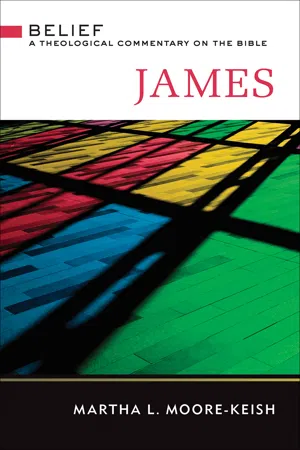
- 205 pages
- English
- ePUB (mobile friendly)
- Available on iOS & Android
eBook - ePub
About this book
Information
Topic
Theology & ReligionSubtopic
Christian Theology1:1–15
Greetings to a Community Being Tested
1:1
“James” Greets the “Twelve Tribes”
“James, a servant of God and of the Lord Jesus Christ, To the twelve tribes in the Dispersion: Greetings.”
This single opening verse both reveals and conceals, offers hints and at the same time refuses to answer some of the questions that the contemporary reader is most curious to learn: Who is this “James”? To whom is he writing? What is the relationship between the author and the original recipients of this . . . letter? (Is it even a letter?) What is the reason for the writing? And where do we, the contemporary readers, fit in?
To puzzle over these questions is to reveal our own peculiarly modern preoccupations with historical context and original authorial intent in Scripture. It is a good and worthy thing to ask such questions, to recognize the historical distance between ourselves and the original audience, to try and ferret out the assumptions of those hearers that might not be our own, and thereby to challenge our own interpretive authority. James, however, is not particularly interested in these questions. At least not directly. Instead, the author of the book of James is eager to deflect attention from himself in order to teach, challenge, and counsel those who will listen—whether in the first or the twenty-first century.
The opening verse does not tell us much, but it does reveal a few things worth noting. First, the author identifies himself simply as “James.” As discussed in the introduction, biblical scholars disagree about the identity of this James: Was the book written by James the brother of Jesus or some other James? Was it a pseudonymous work from a later period, attributed to the early leader of the church in Jerusalem? The very fact that there is no further explanation of identity but simply the bare moniker “James” is suggestive in two ways. First, the identity and authority of the author are simply assumed. The writer does not spend time introducing himself or justifying his right to speak. He and his authority are simply known and do not need further attention. Second, the name “James” itself bears historical significance beyond the immediate author. In Greek, the name is Jakōbos: Jacob, the father of the original twelve tribes of Israel. The author does not develop this connection explicitly, but when we recognize the name, we cannot miss the web of associations that this would have carried for those who heard it in the first century.
Jacob, servant of God, addressing the twelve tribes. This opening image might have taken the original hearers all the way back to the patriarch Jacob’s last words to his twelve sons in Genesis 49. But even more, in addressing the twelve tribes “in the Dispersion,” this verse echoes Isaiah 49:1–6, a passage that also presents Jacob/Israel as the servant of the Lord, appointed to speak and to gather the scattered tribes—as well as proclaiming salvation “to the end of the earth.”1 In any case, this verse signals to us that the author is speaking in a distinctively Jewish context, to an audience for whom such scriptural allusions would have been woven into their worldview, subtly framing this particular address.
Though the biblical resonance of the name itself is profound, the only explicit self-identification that “James” provides in the entire book is here in the first verse: he is “a servant of God and of the Lord Jesus Christ.” That is apparently all we need to know about the one who is addressing us. No fancy title, no lineage by blood or teaching. Just “servant”—or “slave.” The word doulos can be translated either way in English.
Such terminology is complicated. On the one hand, a servant, or slave, is clearly in a submissive position in relation to the one called “Lord.” Especially in the United States, it is impossible to hear the term “slave” without recalling the history of chattel slavery—the horrors of the Middle Passage, the plantation system that thrived in the nineteenth century American South because of the traffic in black bodies, and the lasting political, social, and economic damage that this history has caused for African American communities until today. And other forms of slavery continue to infest our world. In the sex trade, in factories, in mines, on farms, millions of people are forced to work without pay under threat of violence. Contemporary readers should pause at this language of servant/slave and ask whether such a metaphor of slaveholding and bondage is necessary to our understanding of God today.
At the same time, “servant of God” was a common title in the Old Testament for those in special (though certainly subordinate) relationship with God. Jacob/Israel, Moses, David, and Daniel, among others, were all called “servant of the Lord.” To be a servant/slave of God was to be an instrument, a mouthpiece, a trusted helper, a worshiper devoted only to the Most High. To serve the Lord was to recognize all other powers as relative and passing. Thus, though “slave” suggests oppression, the phrase “slave of the Lord/God” raised the status of the speaker in paradoxical ways.2
Conjunctions do not usually merit great attention in biblical texts, but this verse contains a conjunction that is tantalizing in its ambiguity. James calls himself “a servant of God and of the Lord Jesus Christ.” It is striking, first, for a letter that purports to be written by the brother of Jesus that the author never calls himself “brother” but “servant” of Jesus. He does not presume on any family relationship for his authority but places himself in a subordinate position.
Beyond that observation, this little word “and” raises a question about the relationship between the two terms “God” and “Lord Jesus Christ.” Is this a relationship of loose connection or close identification? James does not elaborate on how we are to understand the relation between the two (indeed, he says little about Jesus explicitly at all, only mentioning him by name in 1:1 and 2:1). Not for several centuries do church leaders find it necessary to clearly specify the implications of this “and,” at the Council of Nicaea in 325. Clearly, however, the “and” signals that there is agreement, not tension, between the two terms. All we need to know, for now, is that there is continuity between serving God and serving Jesus. The way of God and the way of Jesus are one and the same. Such simple and undefined Christology might offer us a gift today, inviting us to suspend any attachment or allergy to the theologically freighted term “one substance.” Instead, consider the wisdom of James, for whom the point is not whether Jesus is of the same ontological “substance” as God but that his way of life aligns with the wise and merciful way of God.
So far, we have reflected on this “James” and his relationship as servant of God and of Jesus. But to whom is he writing, and why? The opening verse offers a clue, addressing “the twelve tribes in the Dispersion.” Only James 1:1 and 1 Peter 1:1 in the New Testament use this term “Dispersion” to refer to Christians.3 Such an unusual designation invites us to look both back and forward: to the scattered peoples of Israel whom Jesus came to restore, to the scattered Christian communities of the first century who quickly spread across the Mediterranean basin, and to all those today who live in exile from their original homeland. Into all of these situations of displacement, James speaks a word of hope.
The reference to “the twelve tribes in the Dispersion” (or Diaspora) first of all refers to the Jewish communities that had been scattered from the land of Israel because of conquest by foreign powers. “From 323 to 63 BCE—that is, from the conquest of the land by Alexander the Great to that of Pompey—fully two hundred military campaigns are fought on the territory once ruled by King David. Great numbers of people emigrate or are carried away into slavery.”4 Because of this scattering, Jewish communities by the time of Jesus had already flourished around the Mediterranean for centuries, at some distance from the center in Jerusalem. Indeed, by the first century CE, there are more Jews living outside Palestine than living inside it. Perhaps James was addressing the Christ followers in these previously dispersed Jewish communities. Or perhaps he was speaking primarily to the (also Jewish) Christ followers who scattered from Jerusalem after the stoning of Stephen.5 There was a new wave of migration of early Christians who fled after the martyrdom of this leader, as described in Acts 6–7. Whether James was targeting one or both of these scattered peoples, he identifies his audience as displaced, not at home. They are in exile in another empire.6
In speaking to “the twelve tribes” without further specification, James also signals that he is writing at a time when the borders between “Christian” and “Jewish” communities had not yet become fixed. The establishment of the twelve tribes of Israel constituted the beginning of Israel’s history as a nation, and in the first century CE, expectation of the restoration of the twelve tribes permeated Jewish as well as emerging Christian hopes for redemption. Jesus’ calling of twelve disciples clearly signaled this hope for the restoration of the tribes as a part of the messianic age (as we see, for instance, in Matt. 10). To what extent does James bear hope for the restoration of the twelve tribes as a sign of redemption? We cannot tell, but this allusion in the opening verse does tell us that he does not feel the need to distinguish between Jewish and Christian self-understanding.
How might such an address to people in diaspora speak today, in an age of unprecedented migrations of people across borders because of war or economic hardship?...
Table of contents
- Cover
- Half Title
- Series Page
- Title Page
- Copyright
- Contents
- Publisher’s Note
- Series Introduction by William C. Placher and Amy Plantinga Pauw
- Acknowledgments
- Introduction: Why James? Why Now?
- 1:1–15 Greetings to a Community Being Tested
- 1:16–27 The Living Word of Truth
- 2:1–13 Playing Favorites
- 2:14–26 Faith without Works Is Dead
- 3:1–12 The Dangers of the Tongue
- 3:13–18 True and False Wisdom
- 4:1–10 Conflict between God and “the World”
- 4:11–17 Warnings against Judging or Presuming to Know the Future
- 5:1–6 Critique of Rich Oppressors
- 5:7–20 Final Exhortations to the Community Being Tested
- Postscript : An Enduring Word in an Age of Fear
- For Further Reading
- Index of Ancient Sources
- Index of Subjects
Trusted by 375,005 students
Access to over 1.5 million titles for a fair monthly price.
Study more efficiently using our study tools.
Frequently asked questions
Yes, you can cancel anytime from the Subscription tab in your account settings on the Perlego website. Your subscription will stay active until the end of your current billing period. Learn how to cancel your subscription
No, books cannot be downloaded as external files, such as PDFs, for use outside of Perlego. However, you can download books within the Perlego app for offline reading on mobile or tablet. Learn how to download books offline
Perlego offers two plans: Essential and Complete
- Essential is ideal for learners and professionals who enjoy exploring a wide range of subjects. Access the Essential Library with 800,000+ trusted titles and best-sellers across business, personal growth, and the humanities. Includes unlimited reading time and Standard Read Aloud voice.
- Complete: Perfect for advanced learners and researchers needing full, unrestricted access. Unlock 1.5M+ books across hundreds of subjects, including academic and specialized titles. The Complete Plan also includes advanced features like Premium Read Aloud and Research Assistant.
We are an online textbook subscription service, where you can get access to an entire online library for less than the price of a single book per month. With over 1.5 million books across 990+ topics, we’ve got you covered! Learn about our mission
Look out for the read-aloud symbol on your next book to see if you can listen to it. The read-aloud tool reads text aloud for you, highlighting the text as it is being read. You can pause it, speed it up and slow it down. Learn more about Read Aloud
Yes! You can use the Perlego app on both iOS and Android devices to read anytime, anywhere — even offline. Perfect for commutes or when you’re on the go.
Please note we cannot support devices running on iOS 13 and Android 7 or earlier. Learn more about using the app
Please note we cannot support devices running on iOS 13 and Android 7 or earlier. Learn more about using the app
Yes, you can access James by Martha L. Moore-Keish in PDF and/or ePUB format, as well as other popular books in Theology & Religion & Christian Theology. We have over 1.5 million books available in our catalogue for you to explore.