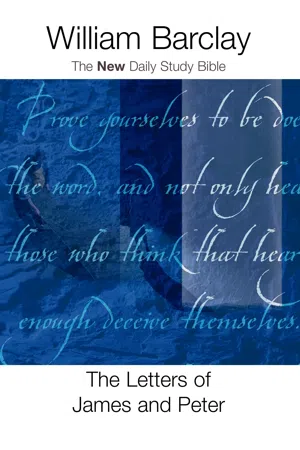
Though located in the back part of the New Testament canon, these letters are nonetheless vitally important. As with all of his writings, William Barclay combines both his charm of style and his thoroughgoing scholarship in this volume.For almost fifty years and for millions of readers, the Daily Study Bible commentaries have been the ideal help for both devotional and serious Bible study. Now, with the release of the New Daily Study Bible, a new generation will appreciate the wisdom of William Barclay. With clarification of less familiar illustrations and inclusion of more contemporary language, the New Daily Study Bible will continue to help individuals and groups discover what the message of the New Testament really means for their lives.
- 240 pages
- English
- ePUB (mobile friendly)
- Available on iOS & Android
eBook - ePub
The Letters of James and Peter
About this book
Information
Topic
Theology & ReligionSubtopic
Biblical Commentary1 PETER
THE GREAT INHERITANCE
1 Peter 1:1–2
Peter, an apostle of Jesus Christ, to God’s chosen people, who are scattered as exiles throughout Pontus, Galatia, Cappadocia, Asia and Bithynia. I am an apostle, and you are chosen, according to the foreknowledge of God, through the consecration of the Spirit, for obedience and to be sprinkled by the blood of Jesus Christ. May grace and peace be multiplied to you.
IT happens again and again in the New Testament that the true greatness of a passage lies not only on the surface and in what is actually said, but in the ideas and the convictions which lie behind it. That is particularly so here.
It is clear that this letter was written to people who were Gentiles. They have been released from the futile way of life which they had learned from their ancestors (1:18). Those who were at one time not a people had become nothing less than the people of God (2:10). In previous times, they had followed the ways, the will and the lusts of the Gentiles (4:3). But the outstanding thing about this passage is that it takes words and conceptions which had originally applied only to the Jews, the chosen nation, and applies them to the Gentiles, who had once been believed to be outside the mercy of God. Once, it had been said that ‘God created the Gentiles to be fuel for the fires of hell.’ Once, it had been said that, just as the best of the snakes must be crushed, so even the best of the Gentiles must be destroyed. Once, it had been said that God loved only Israel of all nations upon the earth. But now the mercy, the privileges and the grace of God have gone out to all the earth and to all people, even to those who could never have expected them.
(1) Peter calls the people to whom he writes the elect, God’s chosen people. Once, that had been a title which belonged to Israel alone: ‘For you are a people holy to the Lord your God; the Lord your God has chosen you out of all the peoples on earth to be his people, his treasured possession’ (Deuteronomy 7:6; cf. 14:2). The prophet speaks of ‘Israel my chosen’ (Isaiah 45:4). The psalmist speaks of ‘children of Jacob, his chosen ones’ (Psalm 105:6, 43).
But the nation of Israel failed in the purposes of God, for, when he sent his Son into the world, they rejected and crucified him. When Jesus told the parable of the wicked tenants, he said that the inheritance of Israel was to be taken from them and given to others (Matthew 21:41; Mark 12:9; Luke 20:16). That is the basis of the great New Testament idea of the Christian Church as the true Israel, the new Israel, the Israel of God (cf. Galatians 6:16). All the privileges which had once belonged to Israel now belonged to the Christian Church. The mercy of God has gone out to the ends of the earth, and all nations have seen the glory and experienced the grace of God.
(2) There is another word here which once belonged exclusively to Israel. The address literally reads: ‘To the elect strangers of the Diaspora throughout Pontus, Galatia, Cappadocia, Asia and Bithynia.’ Diaspora, literally the dispersion, was the technical name for the Jews scattered in exile in all the countries outside the bounds of Palestine. Sometimes in their troubled history, the Jews had been forcibly deported from their native land; sometimes they had gone of their own free will to work, and often to prosper, in other lands. Those exiled Jews were called the Diaspora. But now the real Diaspora is not the Jewish nation; it is the Christian Church scattered abroad throughout the provinces of the Roman Empire and the nations of the world. Once, the people who had been different from others were the Jews; now the people who are different are the Christians. They are the people whose King is God, whose home is eternity, and who are exiles in the world.
THE CHOSEN OF GOD AND THE EXILES OF ETERNITY
1 Peter 1:1–2 (contd)
WHAT we have just been saying means that the two great titles of which we have been thinking belong to us who are Christians.
(1) We are the chosen people of God. There is something uplifting here. Surely there can be no greater compliment and privilege in all the world than to be chosen by God. The word eklektos can describe anything that is specially chosen; it can describe specially chosen fruit, articles specially chosen because they are so outstandingly well made, hand-picked troops specially chosen for some great mission. We have the honour of being specially chosen by God. But there is also challenge and responsibility here. God always chooses for service. The honour which he gives to us is that of being used for his purposes.
(2) We are the exiles of eternity. This is never to say that we must withdraw from the world, but that in a very real sense we must be at the same time both in the world and not of it. It has been wisely said that Christians must be apart from the world but never aloof from it. Wherever the exiled Jews settled, their eyes were always towards Jerusalem. In foreign countries, the synagogues were so built that, when the worshippers entered, they were facing towards Jerusalem. However useful as citizens of their adopted country the Jews were, their greatest loyalty was to Jerusalem.
The Greek word for such a resident in a strange land is paroikos. A paroikos was someone who was in a strange land and whose thoughts always turned to home. This kind of temporary residence was called a paroikia, and paroikia is the direct derivation of the English word parish. The Christians in any place are a group of people whose eyes are turned to God and whose loyalty is beyond. ‘Here’, said the writer to the Hebrews, ‘we have no lasting city, but we are looking for the city that is to come’ (Hebrews 13:14).
We must repeat that this does not mean withdrawal from the world, but it does mean that Christians see all things in the light of eternity and life as a journey towards God. It is this which decides the importance which they attach to anything; it is this which dictates their conduct. It is the measure and the driving force of their lives.
There is a famous unwritten saying of Jesus: ‘The world is a bridge. The wise man will pass over it, but he will not build his house upon it.’ This is the thought which is behind the famous passage in The Epistle to Diognetus, one of the best-known works of the post-apostolic age: ‘Christians are not marked out from the rest of mankind by their country or their speech or their customs … They dwell in cities both Greek and barbarian, each as his lot is cast, following the customs of the region in clothing and in food and in the outward things of life generally; yet they manifest the wonderful and openly paradoxical character of their own state. They inhabit the lands of their birth, but as temporary residents thereof; they take their share of all responsibilities as citizens, and endure all disabilities as aliens. Every foreign land is their native land, and every native land a foreign land … They pass their days upon earth, but their citizenship is in heaven.’
It would be wrong to think that this makes Christians bad citizens of the land in which they live. It is because they see all things in the light of eternity that they are the best of all citizens, for it is only in the light of eternity that the true values of things can be seen.
We, as Christians, are the chosen people of God; we are the exiles of eternity. Therein lie both our priceless privilege and our inescapable responsibility.
THE THREE GREAT FACTS OF THE CHRISTIAN LIFE
1 Peter 1:1–2 (contd)
IN verse 2, we are confronted with the three great facts of the Christian life.
(1) The Christian is chosen according to the foreknowledge of God. The New Testament scholar C. E. B. Cranfield has a fine comment on this phrase: ‘If all our attention is concentrated on the hostility or indifference of the world or the exiguousness of our own progress in the Christian life, we may well be discouraged. At such times we need to be reminded that our election is according to the foreknowledge of God the Father. The Church is not just a human organization – though, of course, it is that. Its origin lies, not in the will of the flesh, in the idealism of men, in human aspirations and plans, but in the eternal purpose of God.’ When we are discouraged, we may well remind ourselves that the Christian Church came into being according to the purpose and plan of God – and, if it is true to him, it can never ultimately fail.
(2) The Christian is chosen to be consecrated by the Spirit. The reformer Martin Luther said: ‘I believe that I cannot by my own reason or strength believe in Jesus Christ my Lord, or come to him.’ For Christians, the Holy Spirit is essential to every part of the Christian life and every step in it. It is the Holy Spirit who awakens within us the first faint longings for God and goodness. It is the Holy Spirit who convicts us of our sin and leads us to the cross where that sin is forgiven. It is the Holy Spirit who enables us to be freed from the sins which have us in their grip and to gain the virtues which are the fruit of the Spirit. It is the Holy Spirit who gives us the assurance that our sins are forgiven and that Jesus Christ is Lord. The beginning, the middle and the end of the Christian life are the work of the Holy Spirit.
(3) The Christian is chosen for obedience and for sprinkling by the blood of Jesus Christ. In the Old Testament, there are three occasions when sprinkling with blood is mentioned. It may well be that all three were in Peter’s mind and that all three have something to contribute to the thinking behind these words.
(a) When a leper had been healed, he was sprinkled with the blood of a bird (Leviticus 14:1–7). Sprinkling with blood is, therefore, the symbol of cleansing. By the sacrifice of Christ, Christians are cleansed from sin.
(b) Sprinkling with blood was part of the ritual of the setting apart of Aaron and the priests (Exodus 29:20–1; Leviticus 8:30). It was the sign of setting apart for the service of God. Christians are specially set apart for the service of God, not only within the Temple, but also within the world.
(c) The great picture of the sprinkling comes from the covenant relationship between Israel and God. In the covenant, God, of his own gracious will, approached Israel that they might be his people and that he might be their God. But that relationship depended on the Israelites accepting the conditions of the covenant and obeying the law. Obedience was a necessary condition of the covenant, and failure in obedience meant failure of the covenant relationship between God and Israel. So the book of the covenant was read to Israel, and the people pledged themselves: ‘All the words which the Lord has spoken we will do.’ As a token of this relationship of obedience between the people and God, Moses took half the blood of the sacrifice and sprinkled it on the altar, and half the blood of the sacrifice and sprinkled it on the people (Exodus 24:1–8). Sprinkling was for obedience.
Through the sacrifice of Jesus Christ, Christians are called into a new relationship with God, in which the sins of the past are forgiven and they are pledged to obedience in the time to come.
It is in the purpose of God that Christians are called. It is by the work of the Holy Spirit that their lives are consecrated to God. It is by the sprinkling of the blood of Christ that they are cleansed from past sin and dedicated to future obedience to God.
THE REBIRTH OF CHRISTIANS
1 Peter 1:3–5
Blessed be the God and Father of our Lord Jesus Christ, who, according to his great mercy, has brought about in us that rebirth which leads to a living hope through the resurrection of Jesus Christ from the dead, an inheritance imperishable, undefilable and unfading, kept safe in heaven for us, who are protected by the power of God through faith, until there comes that deliverance which is ready to be revealed at the last time.
IT will take us a long time fully to take in and understand the riches of this passage, for there are few passages in the New Testament where more of the great fundamental Christian ideas come together.
It begins with a doxology, a hymn of praise, to God – but a doxology with a difference. For a Jew, the most common of all beginnings to prayer was: ‘Blessed are you, O God.’ Christians take over that prayer – but with a difference. Their prayer begins: ‘Blessed be the God and Father of our Lord Jesus Christ.’ They are not praying to a distant, unknown God; they are praying to the God who is like Jesus and to whom, through Jesus Christ, they may come with childlike confidence.
This passage begins with the idea of rebirth; Christians are men and women who have been reborn; they have been given new birth by God to a new kind of life. Whatever else this means, it means that, when people become Christians, there comes into their lives a change so radical that the only thing that can be said is that life has begun all over again for them. This idea of rebirth runs all through the New Testament. Let us try to collect what it says about it.
(1) Christian rebirth happens by the will and by the act of God (John 1:13; James 1:18). It is not something which we achieve any more than we achieve our physical birth.
(2) Another way to put that is to say that this rebirth is the work of the Spirit (John 3:1–15). It happens to people, not by their own effort, but when they give themselves up to be possessed and re-created by the Spirit within them.
(3) It happens by the word of truth (James 1:18; 1 Peter 1:23). In the beginning, it was the word of God which created heaven and earth and all that is in them. God spoke and the chaos became a world, and the world was equipped with and for life. It is the creative word of God in Jesus Christ which brings about this rebirth in our lives.
(4) The result of this rebirth is that those who are reborn become the first fruits of a new creation (James 1:18). It lifts them out of this world of space and time, of change and decay, of sin and defeat, and brings them here and now into touch with eternity and eternal life.
(5) When we are reborn, it is to a living hope (1 Peter 1:3). Paul describes the world without Christ as being without hope (Ephesians 2:12). Sophocles wrote: ‘Not to be born at all – that is by far the best fortune; the second best is as soon as one is born with all speed to return thither whence one has come.’ To the Gentiles, the world was a place where all things faded and decayed; it might be pleasant enough in itself, but it was leading out into nothing but an endless dark. To the ancient world, the Christian characteristic was hope. That hope came from two things. (a) Christians felt that they had been born not of perishable but of imperishable seed (1 Peter 1:23). They had something of the very seed of God in them and, therefore, had in them a life which neither time nor eternity could destroy. (b) It came from the resurrection of Jesus Christ (1 Peter 1:3). Christians had al...
Table of contents
- Cover
- Title Page
- Copyright
- Dedication
- Contents
- Series Foreword
- General Introduction
- General Foreword
- Editor’s Preface
- Introduction to the Letter of James
- James
- Introduction to the First Letter of Peter
- 1 Peter
- Introduction to the Second Letter of Peter
- 2 Peter
Trusted by 375,005 students
Access to over 1.5 million titles for a fair monthly price.
Study more efficiently using our study tools.
Frequently asked questions
Yes, you can cancel anytime from the Subscription tab in your account settings on the Perlego website. Your subscription will stay active until the end of your current billing period. Learn how to cancel your subscription
No, books cannot be downloaded as external files, such as PDFs, for use outside of Perlego. However, you can download books within the Perlego app for offline reading on mobile or tablet. Learn how to download books offline
Perlego offers two plans: Essential and Complete
- Essential is ideal for learners and professionals who enjoy exploring a wide range of subjects. Access the Essential Library with 800,000+ trusted titles and best-sellers across business, personal growth, and the humanities. Includes unlimited reading time and Standard Read Aloud voice.
- Complete: Perfect for advanced learners and researchers needing full, unrestricted access. Unlock 1.5M+ books across hundreds of subjects, including academic and specialized titles. The Complete Plan also includes advanced features like Premium Read Aloud and Research Assistant.
We are an online textbook subscription service, where you can get access to an entire online library for less than the price of a single book per month. With over 1.5 million books across 990+ topics, we’ve got you covered! Learn about our mission
Look out for the read-aloud symbol on your next book to see if you can listen to it. The read-aloud tool reads text aloud for you, highlighting the text as it is being read. You can pause it, speed it up and slow it down. Learn more about Read Aloud
Yes! You can use the Perlego app on both iOS and Android devices to read anytime, anywhere — even offline. Perfect for commutes or when you’re on the go.
Please note we cannot support devices running on iOS 13 and Android 7 or earlier. Learn more about using the app
Please note we cannot support devices running on iOS 13 and Android 7 or earlier. Learn more about using the app
Yes, you can access The Letters of James and Peter by William Barclay in PDF and/or ePUB format, as well as other popular books in Theology & Religion & Biblical Commentary. We have over 1.5 million books available in our catalogue for you to explore.