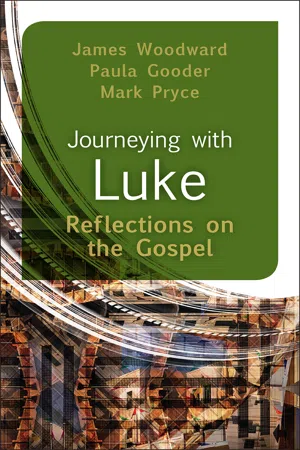
Journeying with Luke is the first of four volumes that offer brief and accessible guides to the Gospels for learning and reflection. Following the Revised Common Lectionary, each chapter corresponds to a season of the liturgical year and the Gospel passages read during that season. The reader will find an introduction to the biblical text that looks at historical and literary themes; imaginative new ways to encounter the text in preaching and study, including poetry; and reflections on the text's meaning for contemporary Christian life. Each chapter ends with an action item, questions for reflection, and a prayer. Perfect for sermon preparation, devotion, or group study, this resource will serve as an indispensable guide to the journey of encountering Jesus in the Gospel of Luke.
- 128 pages
- English
- ePUB (mobile friendly)
- Available on iOS & Android
eBook - ePub
About this book
Information
Print ISBN
9780664260231
Topic
Theology & Religion1
Advent

Exploring the text
Waiting for salvation
Advent encourages us to turn our attention to waiting for the birth (and second coming) of Christ. Unlike Mark's Gospel, the Gospel of Luke introduces us, his readers, to the theme of waiting through the various characters who themselves are waiting before Christ's birth. Mary and Joseph, Elizabeth and Zechariah and then, later in the story, Anna and Simeon are all waiting in different ways. Mary and Joseph (though Joseph only appears fleetingly in Luke) are of course waiting for the fulfilment of the angel Gabriel's prophecy that Mary will bear a child. The waiting of Elizabeth and Zechariah, Anna and Simeon has taken place over a much longer period of time.
We are not told how old Elizabeth is, but Zechariah describes himself as an ‘old man’ (Luke 1.18) and the phrase ‘advanced in years’, translated by the NRSV as ‘getting on in years’, comes twice (1.7, 18), impressing upon us that Elizabeth may be too old for childbirth already. With Simeon and Anna, again the impression given is that they have been waiting for a long time. This is certainly true of Anna. The text of Luke (2.37) is not clear about whether Anna is 84, or whether she was married for seven years and has been a widow for 84 years (which would make her something over 100). She, Luke tells us, spent all her time fasting and praying and never leaving the temple. We assume that Simeon was also old, though the text doesn't actually say that he was. All it says is that once he greeted Jesus he felt able to say that God could now let his servant go in peace. This is normally understood as a reference to death, and to imply that Simeon has been waiting to die.
Whether this is correct or not, by introducing Simeon and Anna Luke reminds us that waiting for Christ is not just waiting for a person but also for an event. Simeon and Anna have been waiting for ‘the consolation of Israel’ (2.25) or for the ‘redemption of Jerusalem’. This third story brings the person of Jesus firmly together with that event of salvation, reminding us that in the person of Christ salvation has, at last, arrived.
Luke draws us, then, into waiting by introducing three sets of two (Joseph and Mary, Zechariah and Elizabeth, Simeon and Anna) alongside whom we can wait as we wait for the birth of Christ.
The Canticles: Singing an old new song
One of the striking features of these three couples is that one of each pair sings a song or canticle in response to the events before them. For Zechariah and Simeon, this song arises at the end of the time of waiting, whereas for Mary the song comes much earlier in the process, after she has gone to visit Elizabeth.
It is commonly recognized that these songs feel very familiar, and not just because we know them so well from the Gospels. They have a ring of the Psalms about them. In fact, even more than that, they bear a remarkable resemblance to psalms of praise, like Psalm 145, which declare God's glorious acts of salvation and goodness in the world. This resemblance is made even clearer in Mary's song which has substantial overlaps with Hannah's Song of Praise in 1 Samuel 2.1–10. Phrases such as ‘My heart exults in the LORD’ (1 Samuel 2.1) and ‘the LORD makes poor and makes rich’ (2.7) suggest that there is some distinct connection between the two songs.
The question is, what kind of overlap? Some scholars argue that these songs were not sung by Zechariah, Mary or Simeon and were written instead by Luke. They argue that he also crafted some of the key speeches in Acts, in order to place important pieces of theology in the mouths of his key characters. This was a very common technique in the ancient world, particularly among Greek historians like Thucydides, who used speeches as a way of reflecting on the events he was describing. If this is what Luke did, he placed these songs in the mouths of Mary, Zechariah and Simeon, borrowing from the riches of the Old Testament in order to make some profound theological statements about God and salvation.
Another option is that these really are the words of Mary, Zechariah and Simeon – even if they've been polished up by subsequent memory – and that the framing of them indicates an important relationship with the Psalms of the Old Testament (actually Luke's inclusion of them indicates this, whoever first sang them). We so often treat the Psalms as though they are entirely static, finished products but evidence from the Psalter itself (which contains versions of the Psalms in slightly different forms) and from the Judaism of the Second Temple Period (where we find non-canonical collections such as the Psalms of Solomon) indicate that the Psalms were seen more as dynamic texts. They were not so much like our hymns, which we turn to and sing as they are, but were explored, reflected upon and then adapted to people's own lives. So that using the phrases, theology and ideas of this treasure trove of worship, new songs could be created out of old ones.
These songs use the language and theology of the Old Testament to sing out in praise of the events of the New Testament. They are old, new songs of praise to God.
Before anything has happened?
One of the other features that seems to join all three canticles together is that their content seems out of proportion with what has actually happened at that stage in the story. Mary declares, while Jesus is still in her womb, that the mighty have been put down and the rich sent empty away. While we know that this is to be one of the major characteristics of Jesus' life and ministry, Jesus has not yet been born and none of these events has actually happened. Again Zechariah blesses God because ‘he has looked favourably on his people and redeemed them’ (Luke 1.68), when all that has happened is that John the Baptist has been born. Simeon, perhaps most surprisingly of all, declares that his eyes ‘have seen … salvation’ (2.30) when all he has seen is Jesus as a tiny baby, who has had no chance of doing anything yet.
What each of the canticles points us to is that Mary, Zechariah and Simeon were, in their waiting, able to see beyond the events immediately before them and to understand their significance. They were able to see that the events surrounding Jesus' birth heralded a new future in which the poor and lowly would find hope and God's people their redemption. They began to comprehend that God's future had already begun to break into the world. It is this kind of vision that Advent encourages us to recapture, so that in our waiting we might begin to see the world through the eyes of God.
Imagining the text
The opening two chapters of Luke's Gospel are full of divine disturbance and of praise. This next poem explores the different responses which God's salvation evokes in Luke's characters. God's redeeming action is faithfully awaited by expectant Israel, but it becomes apparent in ways which are disruptive, extraordinary, ‘outside the box’. The traumatic character of divine grace as Luke portrays it overwhelms some, and inspires in others an outpouring of joyful praise.
Zechariah's sacred duties as priest in the temple are interrupted by the angel Gabriel with the unsettling message from God that he and Elizabeth will be parents to a long-awaited child. Zechariah is stunned into a dumb silence, but Elizabeth and her neighbours are full of praise (Luke 1.1–25). Then in the sixth month of Elizabeth's pregnancy her cousin Mary also receives Gabriel's extraordinary call: to be the mother of the Saviour Jesus! She hurries up to the hill-country to visit Elizabeth; Elizabeth's child in the womb leaps for joy and Mary breaks out into her song of praise, Magnificat, for all that God is doing in and through her for his people Israel (1.39–56, Advent 4). In these exclamations of fearful wonder and praise, Luke allows the praise of women earlier on in the story of salvation – the songs of Hannah the mother of Samuel (1 Samuel 2.1–10), Sarah the mother of Isaac (Genesis 18.9–15; 21.1–7), the women friends of Ruth and Naomi (Ruth 4.13–17) – to resonate around the birth of John the Baptist and of Jesus. At the birth of John, Zechariah breaks out into praise (Luke 1.67–79); at the birth of Jesus the shepherds hear the angels sing God's praise (2.8–20). When Simeon and Anna encounter the infant Jesus with his parents in the temple at Jerusalem they recognize him as the Christ, and pour out their praise to God who is fulfilling through this child his ancient promises to Israel (2.22–38).
The songs from these chapters of Luke's Gospel are set through the Sundays of Advent, Christmas and Epiphany in Year C: Zechariah's song (1.68–79) for Advent 2 and Christmas Eve; Mary's song (1.46–55) for Advent 4. At Christmas the angels' song is the Gospel for Christmas Day (Set I and Set II readings); Simeon's song and Anna's praise (2.22–40) come later in Year C, at Epiphany 4 and at Candlemas.
The disturbance of praise
What begins in the temple,
interrupting sacred custom with a strange rhythm of promise and purpose,
sealing the lips of an uncertain priest
until his heart learns the beat,
blows like warm breath through chill Judaean hills
to a tidy, silent home,
sets curtains and shutters flapping and rattling,
the wretched lingering lodger Shame evicted
with a shout from the guts:
‘Elizabeth is pregnant!’
What follows on
is disgrace ripening into song:
Elizabeth is singing, her neighbours are singing, and panting up from the plains
cousin Mary is singing too
the songs of Hannah, Sa...
Table of contents
- Cover
- Half Title
- Series Page
- Title Page
- Copyright
- Contents
- Preface: What is this book about?
- Introduction: Getting to know the Gospel of Luke
- 1 Advent
- 2 Christmas and Epiphany
- 3 The Sundays before Lent
- 4 Lent
- 5 Passion – Holy Week
- 6 The Easter narratives
- 7 Ordinary Time 1
- 8 Ordinary Time 2
- Further reading
- Some other useful books
Trusted by 375,005 students
Access to over 1.5 million titles for a fair monthly price.
Study more efficiently using our study tools.
Frequently asked questions
Yes, you can cancel anytime from the Subscription tab in your account settings on the Perlego website. Your subscription will stay active until the end of your current billing period. Learn how to cancel your subscription
No, books cannot be downloaded as external files, such as PDFs, for use outside of Perlego. However, you can download books within the Perlego app for offline reading on mobile or tablet. Learn how to download books offline
Perlego offers two plans: Essential and Complete
- Essential is ideal for learners and professionals who enjoy exploring a wide range of subjects. Access the Essential Library with 800,000+ trusted titles and best-sellers across business, personal growth, and the humanities. Includes unlimited reading time and Standard Read Aloud voice.
- Complete: Perfect for advanced learners and researchers needing full, unrestricted access. Unlock 1.5M+ books across hundreds of subjects, including academic and specialized titles. The Complete Plan also includes advanced features like Premium Read Aloud and Research Assistant.
We are an online textbook subscription service, where you can get access to an entire online library for less than the price of a single book per month. With over 1.5 million books across 990+ topics, we’ve got you covered! Learn about our mission
Look out for the read-aloud symbol on your next book to see if you can listen to it. The read-aloud tool reads text aloud for you, highlighting the text as it is being read. You can pause it, speed it up and slow it down. Learn more about Read Aloud
Yes! You can use the Perlego app on both iOS and Android devices to read anytime, anywhere — even offline. Perfect for commutes or when you’re on the go.
Please note we cannot support devices running on iOS 13 and Android 7 or earlier. Learn more about using the app
Please note we cannot support devices running on iOS 13 and Android 7 or earlier. Learn more about using the app
Yes, you can access Journeying with Luke by James Woodward,Paula Gooder,Mark Pryce in PDF and/or ePUB format. We have over 1.5 million books available in our catalogue for you to explore.