![]()
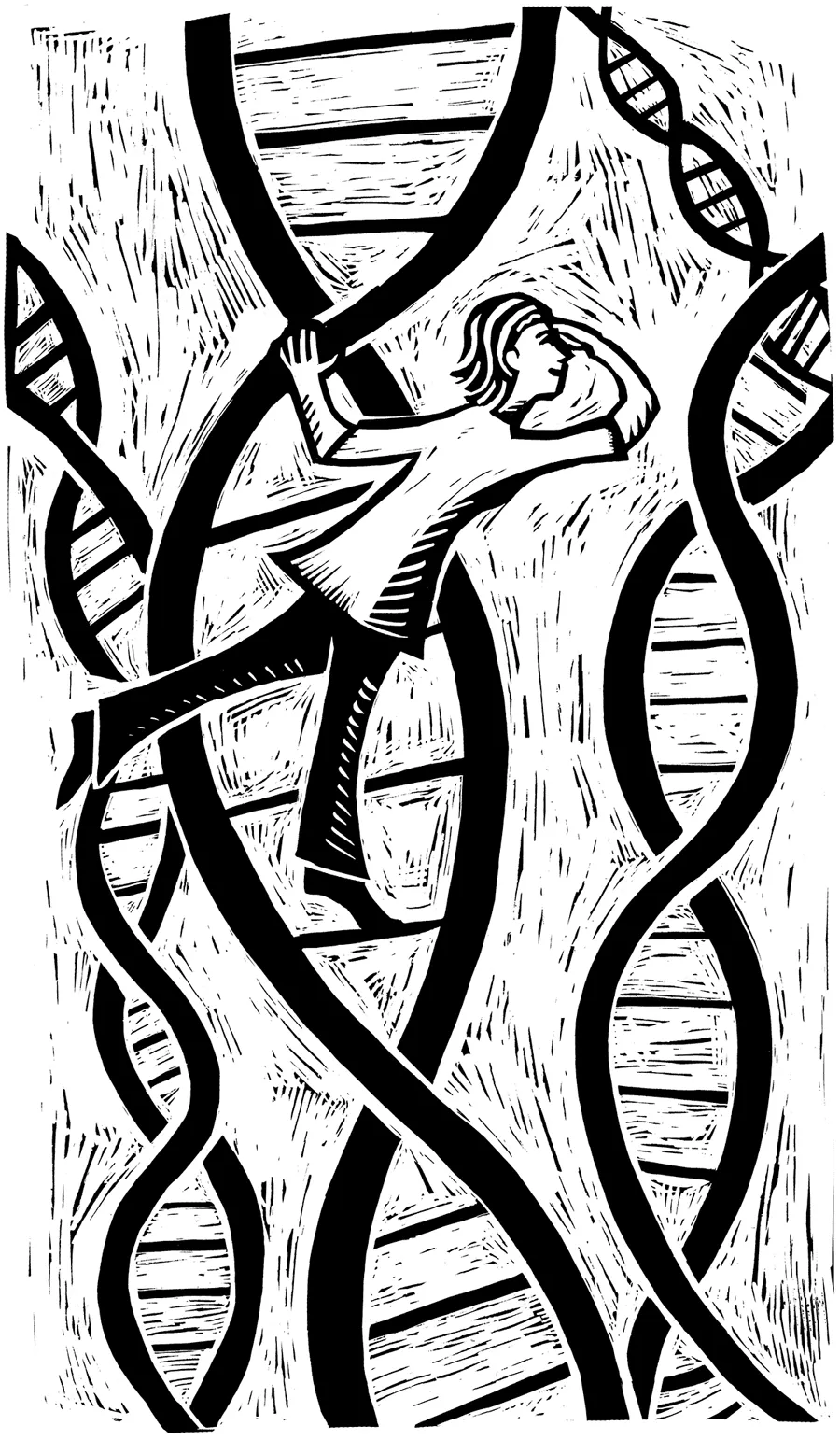
ILLUSTRATION BY CLAUDIA MCGEHEE
1
DNA: The Lazy Person’s
Entry into Genealogy
Early one morning, before I’d had even a sip of my morning coffee, I started collecting my spit. I’d never thought much about salivating before—it was something my mouth did without being told—and making it a voluntary process was surprisingly difficult. I thought about cows chewing their cud, then tried to imagine eating ice cream. Ever so slowly, the liquid accumulated around my teeth and under my tongue, finally giving me enough to spit into a small tube. I repeated the process, this time imagining snacking on a cupcake.
My goal was to fill a small, plastic vial sent to me from a company based in Lehi, Utah. If I gave some strangers there enough saliva, they promised to unlock the secrets of my DNA. As I held the filled-at-last container up to the light, I saw a layer of bubbles topping the viscous fluid like a foamy head on a glass of Guinness. I marveled at what this fluid contained: information about my genetic blueprint and also help in digesting whatever I put into my mouth, from Thai peppers to bean soup. It was an amazingly versatile liquid.
I sealed the tube and packed it into a prepaid box. As I dropped it into a mailbox on my morning walk, I thought about the technicians who spend their days unpacking saliva sent to them from around North America. AncestryDNA, the company that was about to receive my package, has processed the tests of more than fifteen million people. I resisted the urge to calculate just how many barrels of spit that entailed.
Several weeks later, I got the results. Through a mysterious scientific process that I didn’t even attempt to understand, my saliva, bubbles and all, had revealed the following recipe for Lori Erickson:
— 81 percent Norwegian
— 16 percent Swedish
— 3 percent from Ireland and Scotland
It showed that family lore was correct: I am among the least ethnically diverse citizens in America. I tried to take comfort in the smidgeon of Celtic DNA in my mix. It explains my passion for Irish music, men in kilts, and the poetry of William Butler Yeats, I thought, plus the way my ears perk up whenever I hear a Scottish brogue. The Swedish part was a bit disappointing, however, given the fact that I’d been raised to believe that Norwegians are the best type of Scandinavians, the most industrious and friendly, while the Swedes are—well, Swedes. No one had ever revealed to me that our family line was tainted by them.
In some ways, doing genealogy in this way felt like cheating. Instead of straining to read grainy microfilm records in a small-town library or traipsing across rural graveyards, all I needed to do was click through the links provided in an e-mail. As if by magic, page after page of information was revealed. First came a map showing the areas where my ancestors likely lived, with two circles centered in different regions in Norway and another encompassing Ireland and Scotland. Another link gave information on Norwegian immigration, telling how millions of people came to the United States during the nineteenth century because of poverty and a lack of economic opportunities in their native country. The promise of cheap land lured many to the upper Midwest (I mentally added “including to my hometown of Decorah, Iowa, perhaps the most Norwegian-American community in existence”). There they broke the prairie with plows, endured the winters, and no doubt sorely missed the magnificent mountains and fjords of their homeland as they looked out across the gently rolling landscape of the Great Plains.
Another click led to a list of 620 potential relatives, who were grouped into possible second, third, and fourth cousins. I recognized some of the names in the second-cousin category, but none in the third- and fourth- ones. Choosing a distant cousin at random, with a few more clicks I revealed our common ancestors, my great-great-grandparents. I savored the formidable Norwegianness of their names: Hans Ørbech Henrikssøn Bjørager and Sila Bårdsdatter Halverson. Both were born in Lærdal, Sogn og Fjordane, Norway; Hans, in 1815, and Sila, in 1827. Hans had traveled on a ship from Bergen to the United States in the summer of 1850, arriving in New York on July 15, 1850. On October 27 of that same year he married Sila (no record of when she crossed the ocean, and I wondered if they’d known each other in Norway or just had a speedy courtship). Hans died in Decorah in 1890; Sila in 1904.
It was as if I’d received a letter from a stranger who mysteriously knew a myriad of details about my personal life. All from a little tube of saliva.
DNA DETECTIVE WORK
The fact that millions of people have traced their ancestry through DNA analysis is something entirely new in human history, the combination of scientific know-how and a dramatic lowering of the price. For less than $100 and a DNA sample (typically collected from either saliva or a cheek swab), we can get a peek into our ancestral past and the inner workings of our genes.
Genetic genealogy, as it’s often called, usually involves three types of tests, each named after which part of the genetic material is analyzed:
— Y-chromosomal testing is done only on men, because they’re the ones who carry the Y chromosome. While the results are typically done to trace male lineage, women can ask a close male relative to take the test to gain information about their ancestry.
— Mitochondrial DNA testing can be done on anyone, though it traces genetic material inherited only through the maternal lineage (mitochondrial DNA is passed from a mother to her children).
— Autosomal testing looks at the twenty-two pairs of chromosomes shared by both males and females. In addition to giving information on ethnicity, it can be used to determine paternity or trace genetically linked medical conditions.
Now, if you’re worried that this book is going to wander too far into the scientific weeds, be assured that the genetics lesson isn’t going to last long, and waiting in the wings are characters who include Leif the Lucky, Olaf the Stout, and Ivar the Boneless, plus an ax-murdering Viking woman. Fossilized Viking poop will make a cameo appearance, and I’ll explain why the Web of Wyrd might help explain the weirdness in your family. So bear with me on the science lesson, which is a necessary foundation for anyone doing genealogy in the modern age.
As I read about genetic genealogy, even with my limited scientific background I could appreciate the complexities and controversy that surround the tests, especially the inexpensive kits that come in the mail. It turns out that the percentages in my Lori Erickson recipe are not as precise as I’d thought (and they can’t actually explain my love for Irish music or fondness for a Scottish brogue). I took an autosomal test, but if I’d sent my spit to other companies, I’d likely not get the exact same set of results, though hopefully there’d be considerable overlap. In other words, such tests deal in approximations and probabilities, though the companies say that their accuracy will improve as more people get tested and their databases grow.
If you’re contemplating spitting into a vial, you should also think hard about what you want to have revealed. Some tests can reveal medical information—again, in probabilities rather than certainties, but enough to keep you awake at night if you’re a worrier. I knew I didn’t want to receive a heads-up that I might be susceptible to conditions like Parkinson’s or Alzheimer’s. If there’s a sword hanging over my head, I don’t want to know about it until it actually falls.
Privacy advocates raise other concerns about DNA testing, pointing out the potential problems of handing your genetic data to a third party. If you’ve seen enough sci-fi movies, you know what can happen if this information falls into the wrong hands (and even today, this information has been used to crack criminal cases, raising questions about just how private the data is). Corporations have safeguards to shield the identities of those being tested, but reading the fine print in their privacy policies is a good idea.
The testing company I used gave me the additional option of downloading my raw DNA data, an option that amazed me. For millennia, no one, not even the wealthiest and most powerful, had access to this information—in fact, they didn’t even know such information existed. But today, thanks to the labors of thousands of scientists (as well as engineers who figured out a way to process the tests cheaply), the information is made available to anyone with one hundred dollars to spare.
After I downloaded the data, I started reading:
rs1902147231693625TT
rs31319721752721AG
rs125620341768448AG
rs1150939051787173GG
rs66810491800007CC
rs284446991830181AA
rs49703831838555CC
rs49703821840753TT
rs115161851843405AA
rs44756911846808CC
Trust me—it doesn’t get any more interesting than this. The results go on and on and on, revealing thousands of numbers and letters that provide the basis for my biological existence. They explain my hair color and my height, how my ears are shaped, and the fact that I write with my right hand. What would’ve been the result if the A and G had gotten switched on the third row? I’d never know, but once again I had the sense of mysterious forces coming together to make me who I am.
The long chain of numbers and letters made it possible for AncestryDNA to make an estimate of my ethnic mix. I initially thought they’d compare my results to the DNA of Norwegians from the mid-nineteenth century, during the period when Hans and Sila immigrated (I imagined white-coated scientists sampling corpses in rural Norway, a picturesque fjord in the background). Instead, technicians compared my information to a database of results from living people in more than a thousand regions around the world. Because much of my DNA is similar to that of Norwegians alive today, it’s probable that we share common ancestors. No tissue from dead Scandinavians was needed after all.
Researchers have used DNA technology to peer much farther back in time. They’ve even identified a woman known as Mitochondrial Eve, who lived about 150,000 years ago, and Y-Chromosomal Adam, who walked the earth at approximately the same time (give or take thousands of years). Geneticists have traced the Y-chromosomes and mitochondrial DNA of contemporary humans to these two people, both of whom lived in Africa. The fact that they never met, let alone mated, doesn’t make any difference. They’re our genetic mother and father.
While creationists aren’t convinced by this research, still believing in a literal Adam and Eve who lived together in the garden of Eden, the science nicely supports a fundamental premise of many faiths: we’re all related. Because all humans trace their ancestry to Mitochondrial Eve and Y-Chromosomal Adam, everyone who’s ever lived, as well as everyone alive today, could be invited to your family reunion. In fact, we share 99.9 percent of our DNA with other Homo sapiens and a surprisingly large percentage with the nonhuman world. With chimpanzees, it’s 98 percent; with mice, it’s 97 percent. And what about the fruit flies flitting around the compost bin in your garden? They’re kin, too, because about 44 percent of our DNA is similar. Especially in an age with so many divisions, it’s refreshing to be reminded that what we share is so much greater than what separates us.
DNA testing can solve family mysteries, stir up controversy, and contradict cherished family stories. People who proudly claim to be Irish have found only a wee drop in their genes. White supremacists have discovered they have African ancestry. Adoptees have connected with long-lost relatives while others have learned they’re not genetically related to any of their siblings.
Canine DNA testing is also a booming business, though it never leads to any angst on the part of the dog. No poodle has ever been devastated when it was revealed that it carries basset hound genes. And even when the analysis is used to determine which dog owners are neglecting to pick up poop in upscale communities, the pup remains unfazed.
Within my circle of friends, DNA testing is all the rage. Dick, a German-Irish-English native of Des Moines, discovered that he has some Nigerian DNA. Milwaukee-born Brian learned that he has Polynesian DNA in his mix. Ellen, who’d hoped for a link to Asia, was disappointed to have to settle for a potpourri of northern European ethnicity. Helen thought that she was Italian but has to be content with being mostly German.
I’m struck by the conversations about family lore that unfold, revealing aspects of my friends’ lives that I didn’t know. It turns out that Scott, who grew up in small-town Iowa, had great-grandparents who were born in Lebanon. Mary is related to both Che Guevara and Ulysses S. Grant (“I’m from warrior stock way back,” she says). Tom is descended from someone who saved Henry VIII from drowning, a good deed that netted him a knighthood. And Jennifer grew up with stories about being descended from samurai nobility in Japan. I can’t help but look at them a little differently after learning about the ancestors standing behind them.
I was struck by a comment made by my friend Rebecca. “I’d always thought I was English,” she said. “But then I had my DNA tested and realized I have just as much Irish in my background. It changed how I thought about myself. I’m the same person as I was before, and yet I’m not.”
I’m surprised, too, by how often Scandinavia appears in people’s DNA results. The region, after all, is in an isolated and remote part of Europe, the equivalent to North Dakota in the United States. People who live in California can go for years, even entire lifetimes, without meeting a North Dakotan. But Scandinavia pops up in people’s DNA results again and again. A friend-of-a-friend from Ghana, for example, was surprised to discover Scandinavian DNA in her mix, although as far as she knows, her family line is rooted solely in Africa....