eBook - ePub
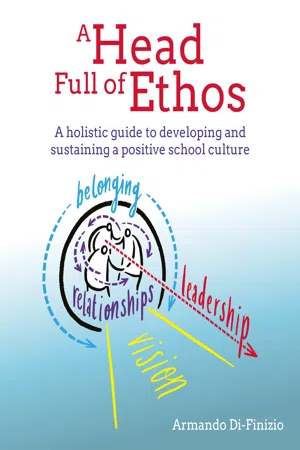
A Head Full of Ethos
A holistic guide to developing and sustaining a positive school culture
- 200 pages
- English
- ePUB (mobile friendly)
- Available on iOS & Android
eBook - ePub
A Head Full of Ethos
A holistic guide to developing and sustaining a positive school culture
About this book
Written by Armando Di-Finizio, A Head Full of Ethos: A holistic guide to developing and sustaining a positive school culture is a head teacher's insightful account of how to go about developing a shared vision and blending it into a school's culture and day-to-day running.When one or more aspects of a school's running or curriculum breaks down, all too often the leadership team will jump from one idea to another in a bid to remedy the problem. This, however, can lead to blurred vision and possible confusion. Leaders may then wonder why the remedies aren't working and are likely to scramble for more, hopefully better, ideas.Armando Di-Finizio, however, believes that the key to success lies in the school's ethos and in the daily manifestation of its underpinning principles.In A Head Full of Ethos, Armando weaves his experiences and the lessons he's learned from three decades of successful school leadership into an engaging illustration of the principles which have supported him in his varied settings. In so doing, he explores the key elements that contribute to nurturing a positive school ethos and cultivating a healthy teaching and learning environment.The book examines the many interconnected cogs of a sustainable ethos - an ethos which will become the driving force in inspiring the school's students to flourish and its staff to grow professionally. In turn, it empowers school leaders at all levels with the means to take more ownership of what they do, and imbues them with more courage in relation to their convictions and decision-making.Suitable for middle and senior leaders in all school settings.
Information
Topic
EducationSubtopic
Education GeneralChapter 1
An Ethos of Insightful Leadership at All Levels
The leadership of a school sets the bar for ethos and keeps us on track when we stray off course. Conversely, leadership can also bring about a systematic breakdown and cause a school to lose all sense of direction, leading to a loss of confidence and respect from the community it serves.
It is the head who primarily sets the scene for a school, and although they require a team behind them to create a great school, nevertheless, they can single-handedly cause it to fail. This also applies to leaders at any level: a head of department can inflict similar damage on their department and a teacher can quickly lose a productive working ethos in their classroom. In short, whether you are a school leader or a teacher just starting out, it is vital that you understand the nuances of leadership.
This chapter covers three areas which experience has led me to believe are at the core of all good leadership:
1 How you perceive yourself and how others perceive you.
2 Self-organisation, clarity and focus.
3 Understanding leadership and how this influences the way you work and relate to your colleagues.
To explore leadership fully and what it entails, we will unpick these three areas in the following ways:
- We begin in Cogs 1.1–1.3 by investigating the self: who you are, how people perceive you and how you model the behaviours you hope to see reflected across your school or department. Exploring these cogs will better equip you to answer the following questions:
› How do I perceive myself as a leader?
› How do others perceive me as a leader?8
› How well do I model the behaviours I want to see?
- In Cogs 1.4 and 1.5, we look at how to organise yourself as a leader, focusing on how you ensure clarity in your intentions, building a team around you and getting the most from them, and how to remain focused and systematic when it comes to school improvement and caring for your staff and students. These cogs will enable you to answer the following questions:
› How can I pace myself and others to ensure we do things well?
› How do I manage the expectations of others, especially those who hold us to account?
› How do I prioritise effectively and avoid the ‘noise’?
- Finally, in Cogs 1.6–1.8, we explore the essence of leadership and working with people: how leadership differs to management, different models of leadership, building and leading a team and getting the most from those you lead. It is as much about understanding others – knowing their strengths and being sensitive to their needs – as it is about simply managing them. These cogs will help you to answer the following questions:
› To what extent am I a leader compared to being a manager?
› What attributes should I look for in my team? Do they complement my own?
› How do I enable others to grow through effective delegation?

Cog 1.1: Sort out your ego!
I had four pressing worries as I walked tentatively towards the entrance of the school on my first day as a head teacher:
1 I wanted to make a lasting impression, describe my hopes and aims clearly and, hopefully, inspire the majority. I thought of all the heads I had worked 9under and their first presentations to staff, either as a new head or at the beginning of the year; so many of them were inspirational. Would I create that same lasting impression?
2 I thought about the head in my own children’s school whom I knew quite well. Although she loved the job, she told me that the big difference between being a deputy and a head was that all eyes and ears are on you and the burden of responsibility never goes away. Even when you are lying on a beach on holiday, the responsibility is there, always creeping up on you just as you begin to relax. Every word you say will be picked up on and dissected.
3 The head in my previous school had left me in charge of the school for three weeks while he took part in an educational study trip. It was frightening how much you can change the ethos of a school in a few short weeks. I didn’t wreck the place but there were certainly some subtle differences around the school which he noticed on his return. It brought home to me the influence – and, dare I say it, power – a head can hold.
4 I was a short, bald Italian man with a strong Scottish accent. I had struggled with dyslexia at school and university (until computers came along and transformed my life – but that is another story). Even though I had been successful as a deputy head, I couldn’t shake off the memory of an assistant head who, when showing me around the school for the first time, led me into the staffroom and announced in a loud but cheery voice: ‘If you’re wondering who this funny little man is, whom I have been showing around, this is your new deputy head.’ With a smile, she then led me off to meet some students, oblivious to my bruised ego. In short, I had a very bad case of imposter syndrome (something I have never really been able to shake off but have learned to live with, as we will see in Cog 1.2).
That first training day in September was top of the charts when it comes to scary. I had met most of the staff during the previous term, but not formally. This would be my first moment as a proper head teacher. The fact that the school had been put into special measures following a damning inspection report didn’t worry me. Nor did that year’s exam results – placing it as the seventh lowest performing school in the country – make me want to run. Nor the fact that it had the highest exclusion figures in the country. Not even that it had been closed and was due to reopen with the same staff and students as an academy. We were to move into a 10new building for the first time, with all the unknowns that would bring, but I knew I would cope with that. Just for good measure, there was also a police order in the local area that banned groups of more than three young people from gathering at any one time due to running battles with rival gangs on the streets outside the school. All of this was fine; I would handle it.
Nope, the things that worried me were all about me, me, me.
Perhaps you have decided that you want to be the head of a school or maybe a head of department. You feel ready for the role and the responsibility that goes with it. What you may not be so ready for is how best to handle the focus that will be on you constantly. How will you cope with almost everyone agreeing with you on a daily basis (to your face at least)? How will you manage being the centre of attention? How aware will you be of any changes in your own behaviour following your first successes or failures? And if the adulation is all going your way, how will you respond when someone disagrees with you? Will you recognise when your behaviour begins to change at home or with friends? These are all the little things that could tip the ethos in your school or department in one direction or another.
What I am describing here concerns the ego. The Latin word for ‘I’, it is often misinterpreted and misused. The standard definition for the term ego is ‘Someone’s … sense of their own worth. For example, if someone has a large ego, they think they are very important and valuable.’1 However, the term was first brought into common usage in the translations of Sigmund Freud.2 Freud described the ego as ‘that part of the id which has been modified by the direct influence of the external world’.3 The id can described as ‘the impulsive (and unconscious) part of our psyche which responds directly and immediately to basic urges, needs, and desires’.4 For example, when babies are born they are all id; as the baby matures, so does the ego in order to modify behaviours according to reality.
In the standard sense, I used to think that I didn’t have much of an ego because I had a million insecurities and rarely pushed myself to go for promotions. What I 11actually had, if we use Freud’s definition, was a healthy ego. As a head of department, I remember once telling a colleague that I would never go for a senior leadership role. My colleague’s reply was, ‘You should only think about going for the next stage when you feel ready.’ This was my ego working as it should. An unhealthy ego that is not in check can lead to poorly judged actions – for example, we may refuse to be proven wrong in an argument with someone to whom we feel superior. Even though we know we are mistaken, we may argue to the bitter end. Conversely, if we feel overly inferior, we may give up too easily, even though we know we are right.
It would be fair to say that all prospective heads have a degree of egotism which enables them to feel confident, strong and, quite possibly, superior enough to apply for headships. This self-belief may stem from a healthy ego which draws on past experience or from an unshakeable and/or irrational self-assurance which may arise from an unhealthy ego. This elevated ego may have its advantages but they are limited.
The problem arises when we want to do it our way and close our ears to advice from others. After all, we have come into the job wanting to lead a school or department with a degree of autonomy. Many of you may have spent most of your professional life thinking that you could do it better and criticised every little thing that every head has ever asked you to do. However, during your time as a teacher and as a middle or senior leader, if you have learned anything, it should be that we are only human – everyone makes mistakes. We need to listen to advice and weigh up all sides of a debate before deciding on a course of action. Easy to say, but the unhealthy part of our ego can grasp the upper hand, resulting in us pushing ahead with our own beliefs and ignoring other voices.
This is where the tension comes in. A certain degree of ego is necessary when it comes to leadership. Someone has to have enough belief in themselves to make the final decision. ...
Table of contents
- Praise
- Title Page
- Dedication
- Preface
- Acknowledgements
- Contents
- Introduction
- Chapter 1: An Ethos of Insightful Leadership at All Levels
- Chapter 2: An Ethos of Vision, Purpose and Direction
- Chapter 3: An Ethos of Care and Positive Relationships
- Chapter 4: An Ethos of Belonging and Inclusiveness
- Final Thoughts
- Bibliography
- Copyright
Trusted by 375,005 students
Access to over 1.5 million titles for a fair monthly price.
Study more efficiently using our study tools.
Frequently asked questions
Yes, you can cancel anytime from the Subscription tab in your account settings on the Perlego website. Your subscription will stay active until the end of your current billing period. Learn how to cancel your subscription
No, books cannot be downloaded as external files, such as PDFs, for use outside of Perlego. However, you can download books within the Perlego app for offline reading on mobile or tablet. Learn how to download books offline
Perlego offers two plans: Essential and Complete
- Essential is ideal for learners and professionals who enjoy exploring a wide range of subjects. Access the Essential Library with 800,000+ trusted titles and best-sellers across business, personal growth, and the humanities. Includes unlimited reading time and Standard Read Aloud voice.
- Complete: Perfect for advanced learners and researchers needing full, unrestricted access. Unlock 1.5M+ books across hundreds of subjects, including academic and specialized titles. The Complete Plan also includes advanced features like Premium Read Aloud and Research Assistant.
We are an online textbook subscription service, where you can get access to an entire online library for less than the price of a single book per month. With over 1.5 million books across 990+ topics, we’ve got you covered! Learn about our mission
Look out for the read-aloud symbol on your next book to see if you can listen to it. The read-aloud tool reads text aloud for you, highlighting the text as it is being read. You can pause it, speed it up and slow it down. Learn more about Read Aloud
Yes! You can use the Perlego app on both iOS and Android devices to read anytime, anywhere — even offline. Perfect for commutes or when you’re on the go.
Please note we cannot support devices running on iOS 13 and Android 7 or earlier. Learn more about using the app
Please note we cannot support devices running on iOS 13 and Android 7 or earlier. Learn more about using the app
Yes, you can access A Head Full of Ethos by Armando Di-Finizio in PDF and/or ePUB format, as well as other popular books in Education & Education General. We have over 1.5 million books available in our catalogue for you to explore.