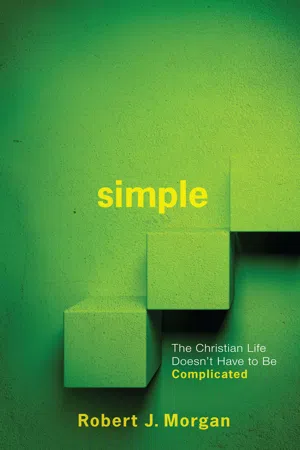
Through the pages of this book, well-known author and pastor, Robert J. Morgan reminds readers that success in the Christian life comes from sticking with the basics of the Bible-- the ABC's of the Christian faith: Assurance - How can I know for sure? Baptism - Why should I get wet? Church - What's it got to offer? Devotions - How can I stay close to God? Evangelism How can I share my faith with others? This book also provides excellent notes from the author for further discussion and Scripture suggested for memorization with each chapter. Robert J. Morgan also answers frequently asked questions on these topics as well. This quick read is packed with powerful information which makes it ideal for individual or small group study by using the Study Guide which is also available from Randall House. This is an ideal book for churches to give to visitors and new believers.
Can we know for sure? Absolutely? With perfect certitude? How can we really know without a shadow of a doubt that we are going to heaven when we die?
Some years ago, a lady in our church said, “Well, I hope I’m saved and going to heaven, but I don’t think I can really know for sure.”
Another man with a troubled past had similar concerns. During a period of discouragement, he relapsed and started drinking again. “I’m not going to heaven now,” he said. “I don’t think I’m still a Christian.”
Another family with a loved one at death’s door wanted me to assure them that their dying relative was really going to heaven. “How can we be sure?” they asked. This man was a wonderful Christian, but his family was insecure about his eternal destination.
These are not uncommon experiences. Bill Bright, founder of Campus Crusade for Christ, observed, “My experience in counseling thousands of students and laymen through the years since I met Christ personally has convinced me that there are literally tens of thousands of good, faithful church-goers who have received Christ in prayer, but who are not sure of their salvation.”1
How different the attitude of the apostle Paul! He exclaimed, “I know whom I have believed and am persuaded that He is able to keep what I have committed to Him until that Day” (2 Timothy 1:12, emphasis mine).
Elsewhere he wrote, “I am persuaded that neither death nor life, nor angels nor principalities nor powers, nor things present nor things to come, nor height nor depth, nor any other created thing, shall be able to separate us from the love of God which is in Christ Jesus our Lord” (Romans 8:38, 39, emphasis mine).
The patriarch Job declared: “I know that my Redeemer lives, And He shall stand at last on the earth; And after my skin is destroyed, this I know, That in my flesh I shall see God” (Job 19:25, 26, emphasis mine).
The psalmist David said, “Now I know that the Lord saves His anointed” (Psalm 20:6, emphasis mine).
I have three preliminary thoughts about this:
Assurance of salvation isn’t a matter of whether or not we feel saved. Dr. R. A. Torrey wrote in his book for new Christians: “We may feel forgiven, or we may not feel forgiven, but that does not matter. It is not a question of what we feel but of what God says.”2
It isn’t a matter of knowing the exact time and place of your conversion. Some people are bothered because they don’t know precisely when and where they were born again; but though you may not remember the particulars, God does. It’s not a question of what we remember, but of what God has done and of what God has told us in His Word. Acts 16:31 says: “Believe on the Lord Jesus Christ, and you will be saved” (emphasis mine). There’s no “maybe” or “might be” about it. The Bible uses the vocabulary of certainty. If you are actively trusting Christ right now as your Savior, there had to be a point in your past—perhaps in your childhood—when you began. Thank God for it, and don’t anguish if you can’t remember the exact time or place.
On the other hand, it is possible to have a false assurance of salvation. Some people who think they’re saved and going to heaven are mistaken. Matthew 7:21-23 is a stark passage of Scripture in which Jesus says: “Not everyone who calls me their Lord will get into the kingdom of heaven. Only the ones who obey my Father in heaven will get in. On the day of Judgment many will call me their Lord. They will say, ‘We preached in your name, and in your name we forced out demons and worked many miracles.’ But I will tell them, ‘I will have nothing to do with you!’” (CEV).
There are two vitally important questions to ask and answer. First, do you know Christ? Second, do you know that you know Christ? In other words: Are you saved, and do you have assurance of your salvation?
We can approach this theme from two different passages of Scripture, both written by the apostle John, the man who can reasonably be called our Lord’s best friend on earth. He referred to himself as “the disciple whom Jesus loved.” He was the one who sat next to Jesus at the Last Supper and to whom Jesus entrusted the care of His mother as He was dying on the cross. John became the last surviving member of the original apostolic band, and according to our best knowledge, he was the only apostle to have died a natural death. In the New Testament, he wrote the gospel of John, the letters of 1, 2, and 3 John, and the book of Revelation.
One of the things I like best about John’s writings is his clarity in stating his reason for writing. His gospel and his first epistle are very similar, and both contain purpose statements at the end of their respective books. These two purpose statements answer our two questions: Do I know Christ? Do I know I know Christ?
John’s great statement of purpose for his gospel is found near the end of his book, in John 20:30, 31, “And truly Jesus did many other signs in the presences of His disciples, which are not written in this book; but these are written that you may believe that Jesus is the Christ, the Son of God, and that believing you may have life in His name.”
Our Salvation Is Centered in Christ
The first thing to notice is that our salvation is centered in Christ. It begins: And truly Jesus did many other signs in the presence of His disciples, which are not written in this book. The word sign was John’s code word for our Lord’s miracles. In his gospel, John describes eight different miracles that Jesus performed. Dr. J. Sidlow Baxter called this “the octave of miracles in John’s Gospel.”
The turning of the water into wine (John 2:1-11)
The healing of the nobleman’s son (4:46-54)
The curing of the Bethesda paralytic (5:1-9)
The feeding of the five thousand (6:5-13)
The walking over the sea of Galilee (6:19-21)
The giving of sight to the blind man (9:1-7)
The raising of Lazarus from death (11:1-44)
The miraculous draught of fishes (21:1-11)
“As all musical sound is comprehended in eights or octaves,” wrote Baxter, “so John has comprehended the significance of all our Savior’s miracles in these eight.”3
But now, at the end of his book, John avows that these eight miracles were only a sampling of our Lord’s miraculous works. In fact, the very last sentence of the gospel of John says, “And there are also many other things which Jesus did, which if they were written one by one, I suppose that even the world itself could not contain the books that would be written. Amen” (John 21:25).
Jesus came as a Miracle-Worker with supernatural power. But exactly who was He? What was the secret of His identity? Who did He claim to be? John goes on to say, “And truly Jesus did many other signs in the presence of His disciples, which are not written in this book; but these are written that you may believe that Jesus is the Christ, the Son of God” (John 20:20).
Notice those three names or titles for our Lord Jesus.
First, He is Jesus. From one perspective, there was nothing unusual about the name Jesus. It was a common designation in the biblical world, and many Jewish parents gave their boys this name. It speaks of His humanity, His ordinariness. But it also speaks of His extra ordinariness. Jesus is the New Testament version of the Old Testament name Joshua, and it comes from two shorter Hebrew words—the name Jehovah coupled with the verb to save—literally, “Jehovah Saves.” That explains the angel’s message to Joseph: “You shall call His name Jesus for He shall save His people from their sins” (Matthew 1:21). This name embodies His mission and conveys His purpose.4
The whole teaching of the Bible is this: The God who created us is very powerful and very pure, but all of us have brought shame and disgrace upon ourselves. We are all sinners, and sinners cannot inhabit God’s presence in eternity. So God Himself became a man—Jesus Christ—born through the womb of a virgin; He Himself was pure, sinless, and perfect. When He died on the cross, He bore the penalty and punishment for our sins so that in Him we might have forgiveness and eternal life, not on the basis of our own merits, but on the basis of His righteousness, His death on the cross, and His resurrection from the grave. Romans 4:25 says, “He was delivered over to death for our sins and was raised to life for our justification” (NIV). This truth is all that is bound up in His name Jesus—Jehovah Saves!
Second, He is the Christ. “These things were written that you may believe that Jesus is the Christ.” This is the English translation of the Greek work Christos, which was the Greek term for the Hebrew word Messiah. It literally means Anointed One. Long before Jesus was born in Bethlehem, the Old Testament prophets predicted that a Messiah would be sent into the world, anointed by God, to provide the human race with hope, heaven, forgiveness of sin, and everlasting life. Seven centuries before Christ was born, the prophet Isaiah wrote, “The Spirit of the Sovereign LORD is on me, because the LORD has anointed me to preach good news to the poor” (Isaiah 61:1, NIV, emphasis mine). He predicted the coming of the Anointed One, the Christ.
Third, Jesus is the Son of God. “These things were written that you may believe that Jesus is the Christ, the Son of G...
Table of contents
Cover
Half title
Title
Copyright
Contents
Dedication
It’s Simple
1 a = assurance
2 How Can I Know for Sure?
3 b = baptism
4 Why Should I Get Wet?
5 c = church
6 d = devotions
7 e = evangelism
Notes
About the Author
Trusted by 375,005 students
Access to over 1.5 million titles for a fair monthly price.
Study more efficiently using our study tools.
Frequently asked questions
Yes, you can cancel anytime from the Subscription tab in your account settings on the Perlego website. Your subscription will stay active until the end of your current billing period. Learn how to cancel your subscription
No, books cannot be downloaded as external files, such as PDFs, for use outside of Perlego. However, you can download books within the Perlego app for offline reading on mobile or tablet. Learn how to download books offline
Perlego offers two plans: Essential and Complete
Essential is ideal for learners and professionals who enjoy exploring a wide range of subjects. Access the Essential Library with 800,000+ trusted titles and best-sellers across business, personal growth, and the humanities. Includes unlimited reading time and Standard Read Aloud voice.
Complete: Perfect for advanced learners and researchers needing full, unrestricted access. Unlock 1.5M+ books across hundreds of subjects, including academic and specialized titles. The Complete Plan also includes advanced features like Premium Read Aloud and Research Assistant.
Both plans are available with monthly, semester, or annual billing cycles.
We are an online textbook subscription service, where you can get access to an entire online library for less than the price of a single book per month. With over 1.5 million books across 990+ topics, we’ve got you covered! Learn about our mission
Look out for the read-aloud symbol on your next book to see if you can listen to it. The read-aloud tool reads text aloud for you, highlighting the text as it is being read. You can pause it, speed it up and slow it down. Learn more about Read Aloud
Yes! You can use the Perlego app on both iOS and Android devices to read anytime, anywhere — even offline. Perfect for commutes or when you’re on the go. Please note we cannot support devices running on iOS 13 and Android 7 or earlier. Learn more about using the app
Yes, you can access SIMPLE by Robert J Morgan in PDF and/or ePUB format, as well as other popular books in Theology & Religion & Christian Ministry. We have over 1.5 million books available in our catalogue for you to explore.