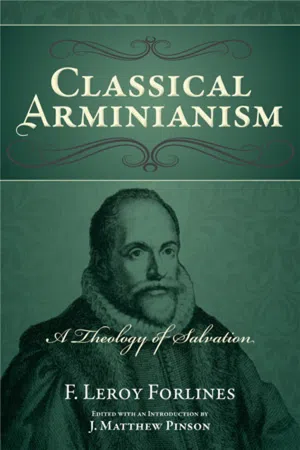
In this current environment of growth among Traditional Calvinism, Arminians of all denominations are looking for a good resource from an Arminiam interpretation. Once again, Forlines and Pinson have worked together to provide such a resource. This book is a valuable contribution to the Arminian-Calvinist debate. Pinson has gleaned and edited the content related to the doctrine of salvation from Forlines' tone, The Quest for Truth, and arranged the material in logical order, in a reader-friendly fashion. The result is a smaller, more topic-specific book that will find an entirely new audience among Arminians who are seeking to defend their theological position against the rise of the New Calvinism. This is an excellent resource tool for further study of the Arminian view.
- 392 pages
- English
- ePUB (mobile friendly)
- Available on iOS & Android
eBook - ePub
About this book
Information
Topic
Theology & ReligionSubtopic
Christian TheologyCHAPTER 1
Human Nature, Total Depravity,
and the Image of God

The psalmist asks one of the most important questions ever to be raised by a human being in Psalm 8:4: “What is man, that You art mindful of him?” The answer to this question is not simply an exercise in mental curiosity by those seated at the intellectual round table. Our whole being cries out for an answer.
Proper identification is important. Even a machine requires proper identification. A motor requires proper identification in order that the right fuel may be used, the proper function may be understood, the right adjustments may be made, the right parts may be ordered for replacement, etc. Improper identification can have serious results. The same can be said of plants. What may be fatal to one plant may not be harmful at all to another. The same can be said of animals. Improper identification can be dangerous and even fatal because it can result in an improper prescription.
It seems absurd, in a way, even to talk about improper identification of human beings since we are all human. We observe others and are observed by them. The problem rests in the danger of an improper description of man. Two conflicting views of human beings demand our attention. One view describes man as a being related to the animal world. He has an animal history. He has the needs of an animal of his type. The other view describes man as created by God in God’s image. He is accountable to God.
It is obvious that the prescriptions written for man’s needs will differ greatly according to which of these views a person embraces. If the wrong prescription can cause malfunction and even disastrous results for a machine, it should be more obvious that the wrong prescription for a human being can have the most serious consequences. We need a proper prescription for our lives. Proper prescriptions can come only after we have proper identification. It is only when we have a prescription based on our design that we can know true happiness.
Special divine revelation takes the guesswork out of identification. Identification comes to us as a “given” from the Creator. The real nature of man’s personality and what it takes to meet human needs will never be discovered by observation and experience. It must come to us as a “given.”
I am not suggesting that the whole picture of man comes so fully amplified that there is no room for study. I am saying, however, that revelation does give us the basics and that all amplification of details must involve reflection upon the data of revelation. Also, we must be constantly subjecting whatever may be known through research and observation to the authority of revelation.
One of the important things to observe about a system is that nothing in a system can be fully identified without reference to its other parts. Every part of a system is tied into the system by relationships to other parts. These relationships must be touched on in identifying a part. The matter of relationship in identification is clearly revealed in the statement: “Man is created in the image of God.” To identify man without identifying God, and then to elaborate the meaning of “the image of God,” is disastrous.
THE MEANING OF BEING CREATED IN THE IMAGE OF GOD
It is a mistake to begin our identification of human beings by saying, “Man is a sinner.” That is true, but there is something more fundamental in explaining what a human being is. Human beings are created in the image of God.
If the man at a body shop is going to work to restore a wrecked automobile, he will need to know what it was like before it was wrecked. So it is with human beings. While it is necessary for us to recognize that “all have sinned,” we need to know what human beings were like before they sinned. Saying that a human being is a sinner tells us about a serious problem he has, but it does not tell us what a human being is. It is important in identifying man to say that God created him, but that still does not tell you what a human being is. God also created plants and animals. We have not told what a human being is until we say that he or she is created in the image of God.
Once we know what it means to be created by God in His image, then we can begin to address the fact that man is a sinner, the problems that presents, and the hope and meaning of redemption. What human personality is and how human personality functions are understood by knowing the meaning of being created in the image of God. The basic needs of human beings are determined by knowing the design of human beings as they came from the hand of the Creator.
That man is created in the image of God is declared in Genesis 1:26–27. The meaning is that man is patterned after God. In what sense is man patterned after God? That it was not a physical likeness is too obvious to require proof.1
A RATIONAL LIKENESS
We get clues from Colossians 3:10 and Ephesians 4:24 regarding what is involved in being created in God’s image. In Colossians 3:10 we read: “And have put on the new man who is renewed in knowledge according to the image of Him who created him.” The image of the Creator in man is linked to rationality. Therefore, we conclude that being created in the image of God involves human rationality. We do not make people rational by educating them. We can educate people because by the design of creation they are rational.
Human beings are created as rational beings, and this makes it possible for us to think, reason, and learn. It is astounding what human minds have been able to accomplish. All of this has been possible because God created human beings with intelligence. As created, rational beings, not only are we able to think and reason, but we also have rational needs. We need knowledge and understanding. People need answers to the inescapable questions of life: Is there a God? If so, what is He like? How can I know Him? How do we account for the origin of the universe and man? What is a human being? How do I know what is right and what is wrong? Is there life after death? If there is, how do I get ready for it? Human beings are in desperate need of answers to these questions. Human beings need a worldview. When a person starts answering these questions, he or she is developing a worldview.
A MORAL LIKENESS
In Ephesians 4:24 Paul wrote: “And that you put on the new man, which was created according to God, in true righteousness and holiness.” We conclude from this text that the image of God in man makes man a moral creature. In thinking of morals at this point, we should think in the broadest sense of the word to include the whole scope of what is involved in holiness, love, wisdom, and ideals. We do not make people moral by teaching them morals. We can teach them morals because by the design of creation they are moral. Paul tells us that every human being has the law of God written on his or her heart (Rom. 2:14-15).
The need to live according to God’s moral standard and to appreciate beauty and excellence is designed in every human being. We cannot decide whether we need to live according to God’s moral standard. God decided that when He created us. We can decide whether we want to live according to God’s moral teachings, but we cannot decide whether we need to. God has already decided that. A human being cannot go contrary to God’s moral law without suffering consequences.
Since we all have to deal with our own sinfulness, it helps us when we can see moral issues addressed in the Bible. Yet general revelation does a good job of informing us on basic morality. At the judgment, no person will honestly be able to say to God, “I didn’t know it was wrong to lie. I didn’t know it was wrong to steal. I didn’t know it was wrong to murder. I didn’t know it was wrong to have sex outside marriage.” The suppression of the Truth will no longer work.2
Until Jesus Christ returns, we will always have to contend with sin. No sin will be exterminated from the human race prior to His return. But there is a decided difference between the presence of sinful behavior and the idealizing of such behavior. It was this problem that Paul addressed in Romans 1:32, “They not only do the same, but also give hearty approval to those who practice them” (NASB). The word that is translated “give hearty approval to” is suneudokeō. The literal meaning is “to think well with.” When wrong behavior is approved and idealized, we have reached a new low.
LIKENESS SUMMED UP IN THE WORD PERSON
The word person sums up the idea of rationality and morality. God is personal. Man is personal. The basic thrust of the idea of being created in the image of God is that man is a personal being. A person is one who thinks, feels, and acts.
THE MEANING OF MIND
We think with our minds. The mind is referred to in Matthew 22:37; Romans 14:5; and Hebrews 8:10. The words think, reason, and understanding are used too often in Scripture to require a list of proof texts. We think with our minds. We grasp ideas. We reason. We make judgments. We draw conclusions. We size up situations.
THE MEANING OF HEART
The heart is referred to in Matthew 22:37; Romans 10:1, 9; Hebrews 8:10; and many other passages. We feel with our hearts. The heart is the seat of the emotions. With the heart we feel the reality of the truth that we know with our mind. The heart registers the value we place on things. It is with the heart that we feel sorrow and sadness. Sorrow and sadness reflect feelings of negative value or disvalue. Feelings of positive value are joy, happiness, satisfaction, peace, and contentment. Heart involvement represents the involvement of our deepest inner self. The human heart cries out for more than a mere objective grasp of knowledge.
THE MEANING OF WILL
The New Testament does not use the noun form of will to refer to the faculty of choice in man. However, the verb form (thelō) is used (Mt. 16:24; 21:29; 23:37; Mk. 8:34; Jn. 7:17; Rev. 22:17; and others). By will, we mean power of choice. Every command, every prohibition, every exhortation, and every entreaty in the Bible made to people presupposes they are capable of making choices.
Whether we want to think of the act of willing as the function of a faculty of the person or simply the person making a choice, the fact remains that the ability to choose is part of being a person. That ability of choice is what we call will. In his totality, man is a thinking, feeling, acting being. He thinks with his mind, feels with his heart, and acts with his will.
THE CONSTITUTIONAL AND FUNCTIONAL LIKENESS OF GOD IN MAN
What has been said about man as a personal, rational, moral creature is frequently referred to as the formal likeness of God in man.3 I prefer to speak of it as th...
Table of contents
- Cover
- Title
- Copyright
- Table of Contents
- Introduction
- Chapter 1 Human Nature, Total Depravity, and the Image of God
- Chapter 2 The Theology of Election
- Chapter 3 Proof Texts for Unconditional Election: Romans 9
- Chapter 4 Proof Texts for Unconditional Election: Other Texts
- Chapter 5 Scriptural Support for Conditional Election
- Chapter 6 The Nature of Atonement and Justification
- Chapter 7 The Condition of Salvation
- Chapter 8 Sanctification
- Chapter 9 The Perseverance of the Saints
- Chapter 10 Apostasy and Assurance: Doctrinal and Practical Considerations
- Author, Subject Index
- Scripture Index
Trusted by 375,005 students
Access to over 1.5 million titles for a fair monthly price.
Study more efficiently using our study tools.
Frequently asked questions
Yes, you can cancel anytime from the Subscription tab in your account settings on the Perlego website. Your subscription will stay active until the end of your current billing period. Learn how to cancel your subscription
No, books cannot be downloaded as external files, such as PDFs, for use outside of Perlego. However, you can download books within the Perlego app for offline reading on mobile or tablet. Learn how to download books offline
Perlego offers two plans: Essential and Complete
- Essential is ideal for learners and professionals who enjoy exploring a wide range of subjects. Access the Essential Library with 800,000+ trusted titles and best-sellers across business, personal growth, and the humanities. Includes unlimited reading time and Standard Read Aloud voice.
- Complete: Perfect for advanced learners and researchers needing full, unrestricted access. Unlock 1.5M+ books across hundreds of subjects, including academic and specialized titles. The Complete Plan also includes advanced features like Premium Read Aloud and Research Assistant.
We are an online textbook subscription service, where you can get access to an entire online library for less than the price of a single book per month. With over 1.5 million books across 990+ topics, we’ve got you covered! Learn about our mission
Look out for the read-aloud symbol on your next book to see if you can listen to it. The read-aloud tool reads text aloud for you, highlighting the text as it is being read. You can pause it, speed it up and slow it down. Learn more about Read Aloud
Yes! You can use the Perlego app on both iOS and Android devices to read anytime, anywhere — even offline. Perfect for commutes or when you’re on the go.
Please note we cannot support devices running on iOS 13 and Android 7 or earlier. Learn more about using the app
Please note we cannot support devices running on iOS 13 and Android 7 or earlier. Learn more about using the app
Yes, you can access Classical Arminianism by F. Leroy Forlines, J. Matthew Pinson in PDF and/or ePUB format, as well as other popular books in Theology & Religion & Christian Theology. We have over 1.5 million books available in our catalogue for you to explore.