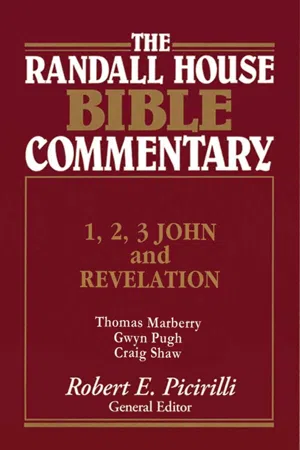
Dr. Thomas Marberry, Dr. Gwyn Pugh, and Dr. Craig Shaw served as writers of this ninth edition of the commentary series published by Randall House. This work offers a thorough study of the entire books of 1, 2, 3 John and Revelation using a verse-by-verse method. With Robert Picirilli as the General Editor, Dr. Marberry and Dr. Craig Shaw served as the writers for 1, 2, 3 John and Gywn Pugh served as the writer for Revelation. Besides the verse-by-verse study method, the writers also provide excellent summaries of passages and application notes for teaching the passages. This work is a great addition to any study library for pastors and students. Eight other works are available in the Commentary series on other books of the New Testament.
- 512 pages
- English
- ePUB (mobile friendly)
- Available on iOS & Android
eBook - ePub
The Randall House Bible Commentary: 1,2,3 John and Revelation
About this book
Information
Topic
Theology & ReligionSubtopic
Biblical CommentaryCOMMENTARY ON THE
EPISTLES OF JOHN
INTRODUCTION
The letters of John are important. They give modern believers a snapshot of what life was like within the Christian community of Asia Minor in the first century. They point out that life was not always easy for Christians of the first and second generations. They had to battle enemies from without and within; their daily lives were filled with struggles and difficulties. Modern Christians readily admit that first-century churches struggled against persecution and opposition from an unbelieving world. It is more difficult to admit that they also struggled with internal problems of heresy, jealousy, envy, and conflict (Burge 17). These three brief letters bring modern readers face to face with the external opposition as well as with the doctrinal errors and internal conflicts that the early churches confronted on a regular basis.
These letters also give modern believers a picture of the vibrant life and faith of the early Christians. They remind us how seriously these believers took their faith commitment and how willing they were to contend for “the faith which was once delivered unto the saints” (Jude 3). The author of these letters challenged them to respond with faith and love to a situation that had shaken the very foundations of their newfound faith. They never lost hope, but they were realistic in their appraisal of the current situation. They demonstrated great courage, faith, and commitment. These brief and often neglected letters contain a message that the church of the twenty-first century needs to hear and heed (Burge 18).
The Johannine Epistles are normally numbered among the Catholic or General Epistles. The word “catholic” in this context means “universal.” They are called “Catholic Epistles” or “General Epistles” because they were not written to one specific church but to a group of churches.
Even so, 1 John does not reflect several of the characteristics that were commonly found in first-century letters. It identifies neither its author nor its recipients. It also lacks the farewell that is customarily found at the end, and the organization is different. First John is difficult to outline because themes are repeated and often overlap. (For more analysis of the organization and structure of 1 John see Burge 42; Jackman 17, 18; Kruse 1-15; and McDowell 188, 189.) McDowell (188) suggests that the book is a tract or a homily. Many scholars believe that 1 John is a circular letter designed to meet the needs of a community of churches in Asia Minor. Burge (42) suggests that it may be a pamphlet, a brochure, or an encyclical.
Second and Third John also differ from the other General Epistles. While they follow the customary way of writing letters in the first century, they are very brief and more personal than the other General Epistles. They are addressed to individuals and respond to very specific situations in a local church. The other General Epistles are longer, more well-developed, and written to groups of churches.
Second and Third John have never enjoyed widespread popularity. They are the shortest books in the New Testament. They seem to have circulated only in certain areas and are not widely quoted by early Christian writers (Akin 21-27). Since they deal with very specific situations in a local church, many writers find it difficult to isolate teachings that can be applied in a variety of different contexts. They have always lived in the shadow of 1 John (Marshall 2), and the fact that they are so closely related to it has led many in the history of the church to see little value in studying them (Burge 13). Even so, these brief letters make a significant contribution to the thought of the New Testament. As Akin (22) writes concerning them, “Here we discover nuggets of gold that, when carefully mined, yield a small but valuable treasure that will better adorn the Lord’s church with truth.”
First John is more widely known and used. Many new believers find assurance of eternal life in John’s faithful words. They also find encouragement to continue in the face of earthly challenges and spiritual unfaithfulness. Marshall (1) suggests that 1 John is an excellent starting point for one who wishes to study the theology of the New Testament. He notes that 1 John is concerned with “the very fundamentals of Christian belief and life.”
Authorship
These epistles, like the Gospels, do not name their authors. First John launches directly into the subject matter of the letter. Second and Third John identify their author only by the title “Elder.” Apparently, the identity of the author of these letters was so well known to his spiritual children that he knew they would recognize him by what he wrote (Barker 299).
Three views of the authorship of these letters are found in the field of New Testament studies. The first is the traditional view, that the author of all three was John, the son of Zebedee and brother of James. Early church tradition is virtually unanimous in attributing the first epistle to the Apostle John. Kruse (11-14), after analyzing early statements about the authorship of 1 John, concludes: “What is clear from these citations is that early Christian tradition is unanimous in ascribing 1 John to John, the disciple and apostle of the Lord.” Lenski (363) reflects this traditional viewpoint when he writes, “The fact that the First Epistle of John was written by the apostle John and by no one else is beyond serious question.”
The authorship of 2 and 3 John was apparently more difficult for the early church, but a clear majority considered John the Apostle to be their author as well (Plummer, Introduction ii-iii). A minority of the early Christian writers distinguished between John the Apostle and John the Elder and attributed these letters to John the Elder. The majority, however, viewed the term “elder” as a title describing John the Apostle, the author of all three letters (Kruse 42; Marshall 46). The traditional view that John the Apostle is the author of all three epistles is still widely held today (McDowell 189-191).
A second view which finds considerable support in contemporary scholarship is that the author was not the Apostle John himself, but one of his disciples commonly known as John the Elder. Hunter (174, 175) and Brooke (lxvii) defend this position. Brooke (lxxvii) extensively analyzes both the similarities and the differences between the Gospel of John and the Johannine Epistles and devotes considerable attention to statements made by early Christian writers. He concludes that the most likely interpretation is that the Epistles were written by John the Elder, not John the Apostle: “His relation to John the son of Zebedee is a mystery which, at present at least, we have not enough evidence to enable us to solve.” He asserts that the view that John the Elder was a pupil of John the Apostle, and in some sense a disciple of Christ, is “perhaps the hypothesis which leaves the fewest difficulties unsolved.”
The third view that is found in N.T. scholarship today is that these epistles were written by early leaders in or near the city of Ephesus who were not directly connected with the Apostle John. The best known defender of this position is C. H. Dodd (lxix) who argues that these epistles were written by one of the “Presbyters” who lived in Asia Minor between A.D. 96 and 110. He suggests that we do not have sufficient evidence to identify the author. He writes that it is “highly unlikely” that the author should be identified with the Apostle John.
Dodd analyzes the possibility that the author was “John the Presbyter,” a rather shadowy figure mentioned by the early Christian writer Papias. John the Presbyter was, supposedly, a follower of Jesus, not the Apostle John, an early Christian leader who lived and died in Ephesus. Dodd concludes that John the Presbyter, if he ever lived, is not a good candidate to be the author of these Epistles. He would have been a very old man at the time they were written. Dodd’s (lxxi) final conclusion is that we simply do not know who the author was, but “we know what manner of man he was, what he taught about faith and duty, and what part he played at a critical moment in the history of the Church.”
Similarly, Grayston argues that 2 and 3 John share a common author who was an anonymous Christian leader, but who did not write 1 John (153). In his view, 1 John had more than one author. He argues that 1 John includes an “initial agreed statement” which was drafted by some anonymous Christians. Then the main author of the book, also anonymous, made use of this material to produce the final document (9).
Moffatt (594, 595) also argues that 1 John was written by an anonymous author. He suggests that the author of 1 John may have been one of those who brought the Gospel of John into its final form, but there is insufficient evidence to come to any firm conclusions.
Some scholars prefer to leave the authorship of these Epistles an open question. Marshall (46), for example, writes that the author may be John the Apostle who came to be known as the “elder.” The author also may be a follower of the Apostle who came to be known as “the elder.” Burge (39) suggests that we do not have “unambiguous objective evidence of apostolic authorship” either for the Gospel of John or for the Epistles. He goes on to argue, however, that the absence of such evidence does not make apostolic authorship “implausible.” His position, then, is that the Apostle John is the most likely candidate for the authorship of these letters, but there is not sufficient evidence to arrive at complete certainty.
Law (43) arrives at similar conclusions, thinking it clear that the author of these three Epistles serves as a “spiritual guide and guardian” for the churches of Asia Minor. He writes that this agrees with the traditional interpretation of the relationship that existed between the Apostle John and these churches during the closing decades of the first century, but he adds this qualification: “Nothing has been, so far, adduced that points conclusively to an apostolic authorship.”
Since the Johannine Epistles do not name any author, we should investigate both the internal evidence and the external evidence before arriving at any conclusion. We should not simply accept the opinions of other writers who have dealt with this important issue.
As for the internal evidence, 1 John seems to have been written by one who was an eyewitness to the life and ministry of Jesus Christ, most probably an apostle (Stott 30-39). The opening verses give an account of one who saw Christ with his own eyes, both before and after His resurrection. “That which was from the beginning, which we have heard, which we have seen with our eyes, which we have looked upon, and our hands have handled, of the Word of life” (1 Jn. 1:1). Here the author forcefully makes his case for an intimate relationship with the Lord. He uses the three greatest of the five senses to bolster the case for his eyewitness account: hearing, sight, and touch. He further develops the account by saying in v. 2 that “we bear witness” (Greek marture, testify) and “show” (Greek apangell, declare) what we have known and “what was manifested” (Greek phanero, make apparent) to us. Verse 3 repeats the refrain, “that which we have seen and heard we declare unto you.”
Many scholars have recognized that these letters come from the hand of an eyewitness. Stott (30) writes, “His declaration is a testimony, and his testimony depends on the personal experience granted to his ears, eyes, and hands.” These bold assertions mark the fact that the author is able to speak authoritatively. They also declare to the reader that the author is speaking from a position of leadership because of his close association with the Lord Jesus Christ, a position held only by one recognized as an apostle.
Kruse (9) proposes three facts concerning the author which we can learn from the text of 1 John. They are:
(i) he writes as an individual, something which his repeated self-references in the first person singular indicate (2:1, 7, 8, 12, 13, 14, 26; 5:13); (ii) his language and thought bear very striking resemblance to that of the Fourth Gospel, suggesting that he either wrote the Gospel as well or was deeply influenced by its language and concepts; (iii) he writes as an eyewitness of Jesus Christ, introducing himself, along with others, as one who has heard, seen with his eyes, looked at, and touched with his hands the incarnate Word of life (1:1-5).
At the time of the writing of the Epistles, there was only one living apostle, John, who was known by the church to have had an authentic personal experience with Jesus and who could make such a bold declaration. Without the widely recognized personal witness of the author, it is doubtful that the early church would have recognized these Epistles as authoritative. Kruse (9) explains that all three of these letters came to be accepted into the Canon because the church assumed them to be the work of the apostle.
The use of the term “elder” is important to this discussion because both 2 and 3 John identify their author as “the elder.” The word (Greek presbuteros) originally meant an old man. In the first century, the word came to mean “one who exercises oversight and leadership” (Marshall 42). The term was used in this capacity to describe the leaders of the Jewish Sanhedrin; the early church also began using this designation for groups of leaders (Acts 14:23). Although the term “elder” is only used in 2 and 3 John, 1 John gives hint of the same understanding when he uses the words “little children” (Greek teknia) to emphasize the relationship of an elder to his followers.
With this understanding of the word “elder,” it is possible to associate the elder of 2 and 3 John with the Apostle John. That is exactly what many in the early church did. Writers such as Polycarp, Papias, Irenaeus, Origen, Cyprian, Clement of Alexandria, Tertullian, Eusebius, and others all made this association. Plummer (Second Epistle 1) describes elder as “a not unlikely appellation to have been given to the last surviving apostle.”
Some scholars have argued that John the Elder is not John the Apostle but a disciple of the great apostle. Hunter (62), for example, suggests that both the Gospel of John and the Epistles of John were not written by John the Apostle but by his disciple, John the Elder. He notes that the Gospel of John makes use of material from Matthew and Luke and argues that it would be unlikely for a disciple of Jesus to make use of a Gospel written by another disciple. Such conduct would be expected from the disciple of an apostle. Hunter finds many similarities in vocabulary and writing style between the Gospel of John and 1 John, as well as “the same distinctive idioms and phrases” (174, 175). After examining the evidence, he concludes: “First John is, therefore, in all probability, the work of John the Elder, the disciple of the Apostle John.” The following quotation from Papias (as preserved in the writings of Eusebius) is most often used to support this hypothesis.
If anywhere one came my way who had been a follower of the elders, I would inquire about the words of the elders, what Andrew and Peter had said, or what Thomas or James or John or Matthew or any other of the Lord’s disciples had said; and I would inquire about the things which Aristion and the elder John, the Lord’s disciples, say (Akin 3).
In this quotation Papias mentions the name “John” twice. The first occurs in a very ambiguous context. Andrew, Peter, Thomas, James, John, and Matthew are described as “elders” and later as the “Lord’s disciples.” The second reference is to “Aristion and the elder John.” We know nothing about the individual named Aristion. “The Elder John” is not clearly identified as the Apostle John or as some other person named John. This quotation from Papias is difficult to interpret, and it is not surprising that various interpretations have been suggested (Stott 38-41). Regardless, the quotation is ambiguous, and it is difficult to determine precisely the meaning that Papias intended. It certainly does not provide conclusive evidence that John the Disciple and John the Elder are two separate individuals.
Carson, Moo, and Morris (449) argue that it would have been natural for the Apostle John to refer to himself as “the” elder not just as “an” elder. He was not just an ordinary elder; he occupied a position of special authority. Stott (44) has a similar position. He suggests that the author’s description of himself as an “elder,” the authoritative tone with which he speaks, and his claims to be an eyewitness are “fully consistent with the early tradition of the church that these three letters were in fact written by the apostle John.”
An understanding of the circumstances of the recipients of the letters may also help to identify the author of these letters. The readers of the three epistles may be identified as a group of believers, most probably in a church or churches, who were familiar with and accepting of the leadership and authority of the author. First John addresses its readers “little children” (1 Jn. 2:1, 12, 28; 3:7, 18; 4:4; 5:21) indicating that the relationship between the church and the author is an intimate one, that of a father to his children. (This diminutive term of affection appears only eight times in the New Testament, seven in 1 John and one in the Gospel). “The elect lady and her children” of 2 John is most certainly a designation for a church and her members. Third John is addressed to Gaius and it appears that he is a leader among the members of a local congregation, perhaps the same congregation as that found in 2 John. The author is not a member of the churches addressed; they do, however, share a common fellowship with the Father and the Son (1 Jn. 1:3).
The group of churches for whom these letters and the Gospel were written has come to be known as the “Johannine community.” Kruse (4, 5) summarizes the basic characteristics both of this community, and of those who had withdrawn from it, thus:
1. A number of churches in and around Ephesus in the Roman province of Asia.
2. Churches with a loose fellowship with the elder of 2 and 3 John.
3. A group of secessionists from the Johannine community whose beliefs involved a denial that Jesus was the...
Table of contents
- Cover
- Half title
- Title
- Copyright
- Editor’s Preface
- Contents
- Introduction to Epistles of John
- Outline of 1 John
- Commentary—2 John
- Outline
- Introduction
- Commentary—3 John
- Outline
- Bibliography
- Commentary—Revelation
- Outline
- Bibliography
Trusted by 375,005 students
Access to over 1.5 million titles for a fair monthly price.
Study more efficiently using our study tools.
Frequently asked questions
Yes, you can cancel anytime from the Subscription tab in your account settings on the Perlego website. Your subscription will stay active until the end of your current billing period. Learn how to cancel your subscription
No, books cannot be downloaded as external files, such as PDFs, for use outside of Perlego. However, you can download books within the Perlego app for offline reading on mobile or tablet. Learn how to download books offline
Perlego offers two plans: Essential and Complete
- Essential is ideal for learners and professionals who enjoy exploring a wide range of subjects. Access the Essential Library with 800,000+ trusted titles and best-sellers across business, personal growth, and the humanities. Includes unlimited reading time and Standard Read Aloud voice.
- Complete: Perfect for advanced learners and researchers needing full, unrestricted access. Unlock 1.5M+ books across hundreds of subjects, including academic and specialized titles. The Complete Plan also includes advanced features like Premium Read Aloud and Research Assistant.
We are an online textbook subscription service, where you can get access to an entire online library for less than the price of a single book per month. With over 1.5 million books across 990+ topics, we’ve got you covered! Learn about our mission
Look out for the read-aloud symbol on your next book to see if you can listen to it. The read-aloud tool reads text aloud for you, highlighting the text as it is being read. You can pause it, speed it up and slow it down. Learn more about Read Aloud
Yes! You can use the Perlego app on both iOS and Android devices to read anytime, anywhere — even offline. Perfect for commutes or when you’re on the go.
Please note we cannot support devices running on iOS 13 and Android 7 or earlier. Learn more about using the app
Please note we cannot support devices running on iOS 13 and Android 7 or earlier. Learn more about using the app
Yes, you can access The Randall House Bible Commentary: 1,2,3 John and Revelation by Robert Picirilli in PDF and/or ePUB format, as well as other popular books in Theology & Religion & Biblical Commentary. We have over 1.5 million books available in our catalogue for you to explore.