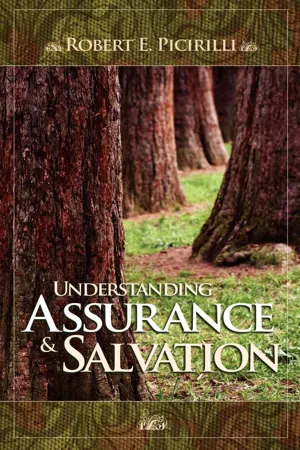
Dr. Picirilli gives a basic overview of the teachings of Joseph Arminius and discusses the biblical explanation of the possibility of apostasy. This booklet presents the Reformed Arminian position of assurance and salvation in easy-to-understand terms that prove beneficial to both scholar and layperson. This is an ideal book for ministers and church leaders to have in the office library. This quick read is ideas for anyone interested in doctrine and theology.
- 60 pages
- English
- ePUB (mobile friendly)
- Available on iOS & Android
eBook - ePub
Understanding Assurance and Salvation
About this book
Information
Topic
Theology & ReligionSubtopic
Christian MinistryCHAPTER ONE
Arminianism and Conditional Perseverance
As I have said in the preface, Arminius himself and his first followers1 avoided a clear conclusion on the subject of perseverance. But they raised the question, and the natural implications of their non-predestinarian view of salvation, even at that early stage, tended to question whether Calvinism’s assumption of necessary perseverance was truly biblical.
Arminius’ opinion on the subject can be captured in this relatively brief statement on the subject:
My sentiments respecting the perseverance of the Saints are, that those persons who have been grafted into Christ by true faith, and have thus been made partakers of his life-giving Spirit, possess sufficient powers [or strength] to … gain the victory over those enemies—yet not without the assistance of the grace of the same Holy Spirit…. So that it is not possible for them, by any of the cunning craftiness or power of Satan, to be either seduced or dragged out of the hands of Christ. But I think it is useful and will be quite necessary in our first convention, to institute a diligent enquiry from the Scriptures, whether it is not possible for some individuals through negligence to desert the commencement of their existence in Christ, to cleave again to the present evil world, to decline from the sound doctrine which was once delivered to them, to lose a good conscience, and to cause Divine grace to be ineffectual.
Though I here openly and ingenuously affirm, I never taught that a true believer can either totally or finally fall away from the faith, and perish; yet I will not conceal, that there are passages of Scripture which seem to me to wear this aspect; and those answers to them which I have been permitted to see, are not of such a kind as to approve themselves on all points to my understanding.2
From a historical perspective, Arminius insisted that the denial of such a possibility “was never, from the very times of the apostles down to the present day, accounted by the church as a catholic doctrine,” and that the view that holds apostasy to be possible “has always had more supporters in the church.”3 And in his long “examination” of the treatise on predestination by William Perkins, he undertook to show that Perkins’ arguments against the possibility of apostasy were not sufficient to make the case certain—even after he entered the discussion by remarking, “That true and saving faith may be, totally and finally, lost, I should not at once dare to say.”4
The very fact that he and his followers raised this question, however, indicates that this view was sure to follow from the basic principle that salvation is conditional. Ever since that early period, then, when the issue was being examined again, Arminians have taught that those who are truly saved need to be warned against apostasy as a real and possible danger.
Key to this belief is the conviction that salvation is conditional. In that case, continuing to possess salvation is continuing to meet the biblical condition of faith. It is true that Arminians of different times and places have presented the details of this view in different ways. Even so, this view most certainly does not require thinking that salvation (whether at first or subsequently) is by works in any sense.
The Arminian believes, with the Calvinist, that the Bible warns the regenerate against turning away from God: in other words, against apostasy. It seems clear to the Arminian, then, that the possibility of apostasy must therefore really exist.
Among matters that are debated by Arminians within their own ranks are such questions as the following.
•Does the word “elect” include only those who persevere to final salvation, or does it include those who are regenerated and fall away? Arminius himself defined election so as to favor the first of these two possibilities. In this way, he apparently agreed with Augustine, that the regenerate who apostatize are non-elect.5 This issue may be as much a matter of terminology as anything else. It will not be pursued in this work.
•Can apostasy be remedied? In other words, can one who is regenerate and becomes unregenerate via apostasy be regenerated again? There have been Arminians on both sides of this question. Again, the details of this difference will not be explored at length in this work. I think it is clear that the answer is no, and some reasons for this will be indicated in chapter two, as the message of the book of Hebrews is expounded.
The Scriptural Argument for Conditional Perseverance
The Arminian is quick to urge that the issue of whether a saved person may be lost should be settled not on systematic but on biblical grounds. That is (as all would agree) the question: Does the Bible teach the possibility of apostasy?
New Testament Passages
New Testament passages teaching the possibility of apostasy include the following.
1. The book of Hebrews as a whole. Warnings and exhortations relative to apostasy and perseverance are thematic throughout the book. Each main section has a hortatory “center” assuming the possibility of apostasy. These are:
•chs. 1, 2, with 2:1-4 at the heart;
•chs. 3, 4, with 3:7—4:2 at the heart;
•chs. 5-7, with 5:11—6:12 at the heart, especially 6:4-6;
• chs. 8-12, with 10:19-39 and 12:1-24 at the heart.
Especially do the sections 6:4-6 and 10:19-39 take this doctrine to its fullest and clearest development. Without expanding on this now, I will simply refer to the following chapter, which will explore the teaching of Hebrews on this subject in detail. As will be noted there, if one wishes to get the best biblical material on any subject, he needs to consult the Bible where it is dealing directly with that subject, if this is possible. The book of Hebrews deals directly with perseverance and apostasy and provides the most important part of any biblical discussion of the subject.6
2. Second Peter 2:18-22 is very similar to the passages that are at the heart of the book of Hebrews. This will also be treated in the following chapter, although somewhat more briefly than Hebrews.
3. Other passages are often included in such a discussion as this, and will be mentioned here just briefly. My own approach to the subject is such that I do not tend to look for intimations of the possibility of apostasy everywhere in the New Testament, but instead to build the case on the passages that treat the matter directly. Following that, I am prepared for other intimations of the possibility when they arise. Among these are the following.
a. First Timothy 1:18-20 and 2 Timothy 2:16-18 refer to some, by name, who evidently apostatized from the faith.
b. Colossians 1:21-23 presents final salvation as conditional upon continuing in faith.
c. First Peter 1:5 indicates that our keeping, like our original justification, while it is by the powerful work of God, is also by faith.
d. Galatians 5:1-4 warns about falling from grace and apparently implies that this had happened to false teachers troubling the Galatians.
e. First Thessalonians 3:5; Philippians 2:16; and Galatians 4:9-11 can be grouped together as places where Paul referred to the frightening possibility that his work (which produced true believers) would come to be vain.
f. First Corinthians 10:1-14 warns those who consider (apparently correctly) that they stand against falling, using Israel as a telling example.
Many will use other passages that vary in strength (and applicability) on this subject. I for one am willing to stake the doctrine on the teaching of Hebrews and 2 Peter and then let the other passages confirm what we learn there. If those two books teach that apostasy really is possible, and I am confident they do, then the Calvinist is mistaken on this doctrine.
Response to Calvinists’ Scriptures
Response to Scriptures prized by Calvinists as teaching the necessary (for sub-Calvinists,7 unconditional) perseverance of the regenerate. These include:
John 10:27-29: “I give [my sheep] eternal life, and they shall never perish; neither shall anyone snatch them out of My hand.”
Romans 11:29: “For the gifts and calling of God are irrevocable.”
Philippians 1:6: “Being confident of this very thing, that He who has begun a good work in you will complete it until the day of Jesus Christ.”
Second Thessalonians 3:3: “The Lord is faithful, who will establish you and guard you from the evil one.”
Second Timothy 1:12; 4:18: “I know whom I have believed and am persuaded that he is able to keep what I have committed to Him until that Day.” “And the Lord will deliver me from every evil work and preserve me for His heavenly kingdom.”
First Peter 1:5: “Who are kept by the power of God through faith for salvation ready to be revealed in the last time.”
Romans 8:29, 30, 35-39: “Whom he foreknew, He also predestined to be conformed to the image of His Son … Moreover whom He predestined, these He also called; whom He called, these He also justified; and whom He justified, these He also glorified.”
1. Those passages, especially in the gospel of John, which contain strong promises of (final) salvation to believers and are therefore thought to imply necessary perseverance cannot be used for that purpose lest they “prove too much.” In other words, to say that those promises require the impossibility of a changed situation places t...
Table of contents
- Cover
- Title Page
- Copyright
- Table of Contents
- Preface
- Chapter 1
- Chapter 2
Trusted by 375,005 students
Access to over 1.5 million titles for a fair monthly price.
Study more efficiently using our study tools.
Frequently asked questions
Yes, you can cancel anytime from the Subscription tab in your account settings on the Perlego website. Your subscription will stay active until the end of your current billing period. Learn how to cancel your subscription
No, books cannot be downloaded as external files, such as PDFs, for use outside of Perlego. However, you can download books within the Perlego app for offline reading on mobile or tablet. Learn how to download books offline
Perlego offers two plans: Essential and Complete
- Essential is ideal for learners and professionals who enjoy exploring a wide range of subjects. Access the Essential Library with 800,000+ trusted titles and best-sellers across business, personal growth, and the humanities. Includes unlimited reading time and Standard Read Aloud voice.
- Complete: Perfect for advanced learners and researchers needing full, unrestricted access. Unlock 1.5M+ books across hundreds of subjects, including academic and specialized titles. The Complete Plan also includes advanced features like Premium Read Aloud and Research Assistant.
We are an online textbook subscription service, where you can get access to an entire online library for less than the price of a single book per month. With over 1.5 million books across 990+ topics, we’ve got you covered! Learn about our mission
Look out for the read-aloud symbol on your next book to see if you can listen to it. The read-aloud tool reads text aloud for you, highlighting the text as it is being read. You can pause it, speed it up and slow it down. Learn more about Read Aloud
Yes! You can use the Perlego app on both iOS and Android devices to read anytime, anywhere — even offline. Perfect for commutes or when you’re on the go.
Please note we cannot support devices running on iOS 13 and Android 7 or earlier. Learn more about using the app
Please note we cannot support devices running on iOS 13 and Android 7 or earlier. Learn more about using the app
Yes, you can access Understanding Assurance and Salvation by R Picirilli in PDF and/or ePUB format, as well as other popular books in Theology & Religion & Christian Ministry. We have over 1.5 million books available in our catalogue for you to explore.