God created the institution of the family and the institution of the local church with distinct purposes. Both exist for the glory of God and the spreading of the Gospel. Limited Church: Unlimited Kingdom seeks to reclaim the simple, transformational, and global mission revealed in Scripture for both the church and the family. Rob Rienow shares from a heart for ministry and gives significant insight based on his ministry experience as well as the experiences of others. His motivation for writing this books is to see churches and families have a lasting impact on future generations. He begin the work by setting a solid foundation on the sufficiency of Scripture followed by another vital section on the lost doctrine of jurisdiction. Rienow continues by sharing God's mission for the local church and the family followed by an excellent section on uniting the church and family in the Great Commission. Each chapter ends with discussion questions, making this an ideal read for a ministry team, small group study, or seminary class. Parents and grandparents will benefit as well from this book gaining a plan to pass faith to the next generation. Rienow brings local churches and families together to advance the gospel.
eBook - ePub
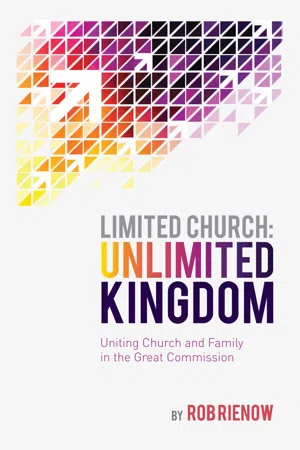
Limited Church: Unlimited Kingdom
Uniting Church and Family in the Great Commission
- 336 pages
- English
- ePUB (mobile friendly)
- Available on iOS & Android
eBook - ePub
About this book
Information
Print ISBN
9780892656769

SECTION 1: THE SUFFICIENCY OF SCRIPTURE

CHAPTER 1: THE BATTLE OF THE CENTURY
“… For you have exalted above all things your name and your word.”
—PSALM 138:2b
The church service finished about fifteen minutes ago. You are talking with a group of Christian friends, when a visitor approaches you and says, “I have some questions. Can you talk to me?”
You and your friends are eager to help. “Sure, what’s on your mind?”
“Well, for starters, I have been thinking a lot about Heaven. What will it be like there?”
What would you say? My guess is you would begin to talk about how God will one day create a brand new earth, and that those who have trusted Christ will live together with Him. In Heaven, there will be no more tears, or crying or pain! It will be a perfect place, free from all sin and evil, and it will last forever.
The visitor responds softly, “Heaven sure sounds like a wonderful place. I don’t have much hope in this life … but I could hope for that. How do you know these things?”
“These aren’t my ideas. In the Bible, God has given us the truth about Heaven, Hell, and His plan to save us from our sins. The things I am telling you are written down at the end of the book of Revelation.”
Now imagine that one of your friends eagerly chimes into the conversation and said, “You are right, Heaven is going to be wonderful! Just last week, I was watching this amazing show on TV, and a man was being interviewed who actually had gone to Heaven. Then this person was brought back to life. He said after he died, the first thing that happened is he was invited to a banquet table where he had a meal with all of his relatives who had died. After that, he was teleported to the pearly gates where Moses and Noah were standing. They told him he had not been good enough in this life to enter Heaven, so he was being sent back to try to be a better person. It was very inspiring and made me want to be a better person too. He wrote a great book about his experience, you should really check it out.”
The conversation has taken a new direction. How are you feeling right now? I hope you are about ready to jump out of your skin and are formulating a plan to interrupt your friend as quickly as possible!
But what’s the problem? Why would you be concerned about this shift in the conversation? The answer is obvious. When someone asks us a question such as, “What is Heaven like?” we only need to refer to one book—the Bible.
The Bible is sufficient to answer this question. Only in the Bible do we have God’s revealed truth about what Heaven will be like. To bring any other source of knowledge to the conversation is at best dangerous, and at worst heresy.
When it comes to questions such as,
• “Why did Jesus have to die?”
• “How can I be saved?”
• “Why should I be baptized?”
• “Who is the Holy Spirit?”
• “Where is God?”
Most Christians I know would use their Bible, and their Bible alone, to find the answers. They might need to make use of a reference book, but only so they might find the appropriate Scriptures. Christians believe that not only is the Bible true, it is enough. It is sufficient.
But what about these questions:
• “What should be our strategy in youth ministry?”
• “What should we teach this year in women’s ministry?”
• “Should we have children in our worship services?”
• “How can we reach more singles?”
• “How can we do a better job caring for the poor?”
For many years in pastoral ministry, I rarely opened my Bible to seek answers to these questions. Think of your own first response to questions like these. If someone asked you, “What should be our strategy in youth ministry?” Would you begin your reply with, “Well, in the Bible, God speaks to this issue and He lays out for us His plan for how children are to be evangelized and discipled. Let me show you …”?
Or what about, “How can we reach more singles?” Would your first response be, “That is a great question! God has a lot to say about singleness in the Bible, and in the New Testament we find some very specific things that the early church did to minister to singles. Let me show you …”?
This next statement may shock you. In some seminaries today, pastors are not trained to use the Bible for ministry decisions. We are trained to use the Bible for “doctrinal” issues like the ones listed above, but when it comes to daily church decisions pragmatism, innovation, creativity, and human wisdom rule the day.
For the first decade of my pastoral ministry, I sought to get all my “doctrine” from the Bible, while I made ministry decisions myself and with my staff team. The Bible was enough for me when it came to my systematic theology, but not enough when it came to how God’s institutions of the family and the local church should function.
THE BATTLE IS ON
The church faced a cataclysmic battle in the 20th century. A war was waged over the Bible. Was it true? Could it be trusted? Was it inspired and authoritative? Many churches and denominations were lost, as they abandoned their belief in the Bible as the inspired Word of God.1
However, God never abandons His church. In the lives of millions of Christians, thousands of churches, and many denominations, the Holy Spirit defeated the demonic attack of liberalism, and there was a renewed commitment to the authority and truth of the Bible. The so-called Search for the Historical Jesus was demonstrated to be fraught with inconsistencies and poor scholarship.2 Significant archaeological finds dramatically increased in the 20th century, and to the shock and amazement of the world, continued to support the true history as recorded in the Bible.3
My guess is that if you were to ask your congregation, “How many of you believe the Bible is completely true and trustworthy?” almost every hand would go up! Praise God!
I can remember reading both the scholarly and popular writings defending God’s Word against any and all comers. In high school, I devoured Josh McDowell’s, Evidence That Demands a Verdict 4, and More Than a Carpenter.5 My son is now starting to read them. In college and graduate school, it was a privilege to be able to learn from the more rigorous and technical apologetic resources dealing with hermeneutics and canonical development.6 You do not need to check your brain at the door to follow Christ and believe the Bible.7
At this point, I need to make a dangerous assumption about you. I am going to assume that you are completely convinced the Bible is the inspired, true, authoritative Word of God. Everything that follows in this book is based on that core conviction.
If you are not convinced and convicted about the inspiration and truth of the Bible, you may want to stop reading and look at some of the books I mentioned above. If you don’t already believe the Bible is true, the rest of this book will make little sense.
THE BIBLE IS TRUE BUT IS IT ENOUGH?
The church faces a new battle in the 21st century. The battle in many Christian churches today is not “Is the Bible true?” but “Is the Bible enough?” The challenge in the 20th century was over inerrancy, the challenge in the 21st century is over sufficiency.
Do we believe the Bible, or do we believe the Bible alone? Do we allow the Bible to shape our thoughts and opinions on every subject? How we answer these questions radically shapes how we live out our faith, and seek to advance the Gospel of our supreme Lord and Savior, Jesus Christ.
In some ways, the issue at the heart of the Protestant Reformation has returned. During the 14th–16th centuries the church powerfully united, and powerfully divided around five “onlys.” In Latin, we call them the five “solas.”
Only is a powerful word. It is extreme. It picks a fight. It draws a line in the sand.
During the Reformation, believers in Jesus Christ staked their families, their fortunes, their reputations, and their very lives on five solas … five onlys. These are words many died for, and many are still8 dying for.
Sola Scriptura—Only Scripture—The Bible and the Bible alone is our authority in all matters of faith and life.9
Sola Gratia—Only Grace—We don’t deserve salvation and forgiveness. We are saved by the unearned loving grace of God.10
Sola Fide—Only Faith—We do not earn points with God through doing good things. We cannot earn His favor or salvation by being virtuous. We cannot lose salvation by being extra bad. We are forgiven and made right when we respond to God’s grace with repentance and faith.11
Solus Christus—Only Christ—God has made one and only one way for sinful men and women to be forgiven and saved, and that is through Jesus’ death, resurrection, and glorious ascension.12
Soli Deo Gloria—Only for the Glory of God—This is the purpose of life—the purpose of working, eating, marrying, coming to church, planting your garden, reading your Bible, and volunteering—it is all for the glory of God.13
It was on these five biblical doctrines that men like John Wycliffe, Jan Hus, William Tyndale, Martin Luther, and John Calvin sought to bring about a re-formation of the church. Sola Scriptura served as the foundation for the other four solas. What would you use to teach someone the doctrine of grace? How would you seek to persuade someone that Jesus was the Christ, the one and only Son of God? What would you use to explain to someone the nature of God, and what it means to worship Him? You would use the Bible, and the Bible alone, to teach and understand the doctrines of grace, faith, Christ, and worship. The protestant reformation was centered on, grounded in, and built upon the doctrine of the sufficiency of the Bible.
The history of Christianity in general, and the history of each Christian person specifically, is a constant journey of reforming and recalibrating. Satan and the world are constantly seeking to pull the church and individual believers away from the true worship of God. This has been so true in my life. I go through times when I give the enemy a foothold, allow a sin to grow in a dark corner, or I find myself thinking just like the world. God then brings the truth of the Bible to that situation, the Holy Spirit convicts my heart, I repent, confess, and by God’s grace get back on track. God continually forms me, and re-forms me into the image of His Son. Most nights during family worship, as my children would tell you, I thank God for His grace, mercy, and patience with me, a sinner.
The same is true in the history of the church. Individual churches and entire denominations at times have fallen into disobedience, false teaching, and heresy. There are numerous instructions in the New Testament that elders/pastors are to make absolutely sure they guard the doctrine taught in the church. Make sure everything comes from the Bible! Don’t have any wiggle room for false teachers who want to bring in legalism, who want to bring in ideas from the godless culture around us, or who want to mix faith in Christ with other world religions.
Tragically, this is exactly what happens in personal lives, in churches, and entire global networks of churches. If you don’t pull the weeds, they take over.
The Christian life is one of continually re-forming, always seeking to re-align our churches, our families, and ourselves with the true worship of God, as He has revealed it to us in the pages of Scripture.
BELIEVING THE BIBLE IS TRUE IS NOT ENOUGH
There are many places in God’s Word where He teaches us that the Bible is not only true, but sufficient. One of these texts is found in 2 Timothy 3:14–17. Paul writes this to Timothy, who was a young pastor:
“But as for you, continue in what you have learned and have firmly believed, knowing from whom you learned it and how from childhood you have been acquainted with the sacred writings, which are able to make you wise for salvation through faith in Christ Jesus. All Scripture is breathed out by God and profitable for teaching, for reproof, for correction, and for training in righteousness, that th...
Table of contents
- Cover
- Title Page
- Copyright
- Dedication
- Acknowledgments
- Table of Contents
- Introduction
- Section 1: The Sufficiency of Scripture
- Section 2: The Lost Doctrine of Jurisdiction
- Section 3: God's Mission for the Local Church
- Section 4: God’s Mission for the Family
- Section 5: Uniting Church and Family in the Great Commission
Trusted by 375,005 students
Access to over 1.5 million titles for a fair monthly price.
Study more efficiently using our study tools.