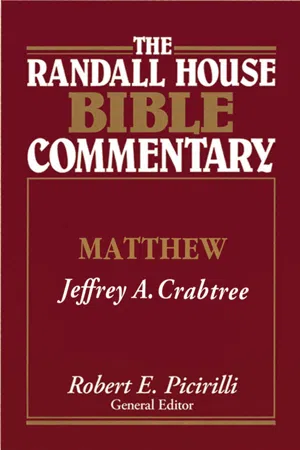
This is the tenth edition to the commentary series from Randall House. This edition offers a thorough study of the entire book of Matthew using a verse-by-verse method. With Robert E. Picirilli as the General Editor, Jeffrey A. Crabtree served as the writer for this edition on Matthew. Besides a verse-by-verse study method, the writer also provides excellent summaries of passages and application notes for teaching the passages of Matthew. This work is a great addition to any study library.
- 504 pages
- English
- ePUB (mobile friendly)
- Available on iOS & Android
eBook - ePub
The Randall House Bible Commentary: Matthew
About this book
Information
Topic
Theology & ReligionSubtopic
Biblical CommentaryI. THE BIRTH NARRATIVE: THE ROYAL MESSIAH’S BIRTH AND EARLY CHILDHOOD (1:1—2:23)
The title “According to Matthew” denotes that this Gospel record is Matthew’s testimony. See “author” in the Introduction. As one of the original twelve apostles, Matthew had a story to tell. This Gospel is his record.
A. The Genealogy of Jesus (1:1-17)
Each of the Gospel writers began his record differently. John began with Jesus’ pre-existence (Jn. 1:1-3). When the beginning began, Jesus was there. Jesus is deity. John wrote to convince unbelievers that Jesus is the Christ, the Son of God (Jn. 20:31).
Luke began his account by stating his reason for writing a record of Jesus’ life (Lk. 1:1-4). His goal was to convince Theophilus of the “certainty” of the events and teachings of Jesus’ life and ministry. He started his story at one year and three months before Jesus was born. For Luke, Jesus is the anointed Son of God.
Mark began his testimony of Jesus’ life with a record of John the Baptist’s wilderness ministry. John the Baptist presumably began his public ministry just a short time before he baptized Jesus. Following His baptism and temptation, Jesus began His own public ministry. After approximately 430 years of silence, Israel now had two prophetic voices. Unlike the apostle John and the historian Luke, Mark does not specifically state his purpose for writing.
Matthew began with a genealogy. Though not specifically stated as such, his purpose for writing is hinted at in verse 1: Jesus is a descendant of Abraham and more particularly a descendant of King David. Jesus is an Israelite by birth and a legal descendant of King David. Such a genealogy was especially important if Matthew’s primary audience was Jewish (Hendriksen 106).
Matthew divided this genealogy into three major sections in keeping with key events in Israel’s history. He moved from Abraham, the father of the nation, to King David, the great king to whom the promise of an eternal successor was made; from King David to the Babylonian exile, Judah’s punishment for breaking the Sinai covenant; and from the Babylonian exile to the birth of Jesus the Christ.
1. Introduction: Jesus as King of the Jews (1:1)
1 The book of the generation of Jesus Christ, the son of David, the son of Abraham.
Matthew began his record of Jesus’ genealogy with words similar to those in Genesis 2:4 and 5:1. In these Genesis verses, the Greek version of the Old Testament (the Septuagint or LXX) has the same two words translated “generations”(Greek biblos geneseō). Literally, Matthew wrote, “[The] book of the genesis of”: in other words, “[This is the] record of the origin of.” This record covers approximately twenty-one hundred years from Abraham to Jesus. The importance of Matthew’s record cannot be overemphasized since only he and Luke include birth and infancy narratives in their accounts.
This record of Jesus’ ancestors supports the doctrine of His humanity. See comments on 1:21 for the meaning of the name “Jesus” and comments on 12:18 and 16:16 for a fuller discussion on the title “Christ.” He is the human “son of” David and of Abraham. The word “son” (Greek huios) can refer to a first generation descendant or to a more distant descendant (BAGD 833; 1 Chr. 4:1). Matthew used the term both ways in these first seventeen verses.
Matthew introduced Jesus first as the “son of” David, which means He fulfills the covenant promise to David recorded in 2 Samuel 7:16: “And thine house and thy kingdom shall be established for ever before thee: Thy throne shall be established for ever.” See also 1 Chronicles 17:11-14. Jesus is the Davidic son upon whose shoulder the government rests, the Wonderful Counselor, Mighty God, Everlasting Father, and Prince of Peace of Isaiah 9:6-7. Jesus as Son of David is a reoccurring theme in Matthew’s Gospel (9:27; 12:23; 15:22; 20:30, 31; 21:9, 15; 22:42-45). Other N.T. writers also referred to Jesus by this title (Acts 2:29-36; Rom. 1:3; 2 Tim. 2:8; Rev. 22:16; Barclay 1:17). Scripture describes this covenant with David as irrevocable (Jer. 33:20-22, 25-26). It was important that Matthew address this. The Jews knew the Scriptures and understood that the Messiah would descend from King David. See 22:41-46 and comments.
In this way Matthew introduced Jesus as the Messianic fulfillment of the Davidic Covenant. His opening words prepare the reader for Gabriel’s promise to Mary: “The Lord God shall give him the throne of his father David: And he shall reign over the house of Jacob for ever; and of his kingdom there shall be no end” (Lk. 1:32b, 33).
Matthew also introduced Jesus as the son of Abraham. As such, Jesus fulfilled the promise to Abraham in Genesis 22:18—“And in thy seed shall all nations of the earth be blessed.” See also Genesis 12:3. Peter later proclaimed that Jesus is the seed of Abraham sent to bless the world with deliverance from sin (Acts 3:26). According to Paul this link between Abraham and Jesus is foundational to Christianity (Gal. 3:16; Carson, Matthew 62).
Verse 1, then, reveals Matthew’s intentions. He sought to demonstrate that Jesus is the Messiah “in the kingly line of David, heir to the messianic promises, the one who brings divine blessings to all nations” (Carson, Matthew 63). As such, the genealogy focuses mainly on the royal line of David while at the same time including names of non-Jews who joined the O.T. community of faith.
2. Jesus’ genealogy from Abraham to King David (1:2-6a)
2 Abraham begat Isaac; and Isaac begat Jacob; and Jacob begat Judas and his brethren;
3 And Judas begat Phares and Zara of Thamar; and Phares begat Esrom; and Esrom begat Aram;
4 And Aram begat Aminadab; and Aminadab begat Naasson; and Naasson begat Salmon;
5 And Salmon begat Booz of Rachab; and Booz begat Obed of Ruth; and Obed begat Jesse;
6a And Jesse begat David the king;
Matthew’s source for names from Abraham to Zerubbabel appears to have been 1 Chronicles 1-3 and Ruth 4:12-22. His source for names from Zerubbabel to Joseph is unknown today. Carson (Matthew 63) says there is “good evidence that records were kept at least till the end of the first century” so there is no reason to think that Matthew’s record is unreliable.
The differences between Matthew’s genealogical record and Luke’s (Lk. 3:23-38) are many. Eusebius reported in the fourth century that explanations (he calls them “guesses”) were offered in his day (Eccl. Hist. VII.I.1) and commentators today continue to suggest possible solutions (see Marshall 157-161). Some suggest Luke gave Mary’s genealogy and Matthew gave Joseph’s. Others think one recorded Joseph’s real genealogy and the other the throne succession from King David (Hill 74). This question is unanswerable given our present state of knowledge.
Regardless, this much is clear: Matthew (vv. 16, 18, 20) presented Jesus as the legal son of Joseph (“there was no other way of reckoning his descent”; Marshall 157) and the biological son of Mary. Luke is just as clear. Joseph is “of the house and lineage of David” (Lk. 2:4; also Lk. 1:27) and Gabriel seems to imply the same about Mary (Lk. 1:32—“his father David”). Zechariah corroborated this when he praised God “who raised up a horn of salvation for us in the house of his servant David” (Lk. 1:69).
Abraham, the father of natural Israel and of all people of faith, heads the genealogical list. The Messianic line went through Abraham’s son Isaac (Gen. 17:19-21; 21:12), not Ishmael or the sons of Keturah (Gen. 25:5-6). Isaac fathered Jacob and Esau, but the Abrahamic promises and the messianic line are traced only through Jacob (Gen. 27:29; Mal. 1:2). Jacob, whose name was changed to Israel, fathered twelve sons. All of these sons were included in the covenant people (“and his brethren”) but Judah (Judas) was designated as the clan through which the Messiah would come (Gen. 49:10).
Judah married a Canaanite woman and had three sons (Gen. 38). The Lord killed the oldest son, Er, for his wickedness. Judah instructed his second oldest son, Onan, to marry his brother’s wife, Tamar (probably a Canaanite, Gundry 14), perform the duty of kinsman redeemer and raise a son to carry on his brother’s name. (For a fuller discussion of levirate marriage, see 22:23-33.) Onan did not want to raise a son for his brother, possibly because he did not want to give up his brother’s inheritance. His sin cost him his life as well.
Judah, not wanting to lose another son, sent Tamar back to her father’s home with a promise that he would have his third son, Shelah, marry her when he was grown. After some time passed, Tamar realized that Judah had no intention of effecting her redemption so she disguised herself as a harlot and went to meet him. Judah did not recognize her. He hired her and she conceived and gave birth to twins, Pharez (Perez) and Zarah (Zerah). In effect, Judah was her redeemer. Judah and Tamar’s firstborn (Judah’s fourth son) became the legal heir of Er and the son through whom the Messiah came. Though born of an incestuous relationship and half Canaanite, Pharez was included in the Messianic line.
Little is known about Hezron (Gen. 46:12; Num. 26:21; 1 Chr. 2:5, 9; 4:1), Ram (Ru. 4:19; 1 Chr. 2:9-10), Amminadab (Ru. 4:19-20), Nahshon and Salmon (Ru. 4:20-21). Amminadab’s daughter married Aaron (Ex. 6:23) and his son Nahshon was the leader of the tribe of Judah while Israel was in the wilderness (Ex. 6:23; Num. 1:7; 2:3; 7:12; 10:14; 1 Chr. 2:10). Ram, son of Hezron and father of Amminadab, had a nephew also named Ram (1 Chr. 2:9, 25). Since Israel spent four hundred and thirty years in Egypt (Ex. 12:40-41) there are probably some gaps in this genealogy (Wilkins 59).
Salmon’s descendant Boaz (Booz) was the kinsman redeemer (Dt. 25:5-10; Lev. 25:25-34, 47-54) of Naomi and Ruth. Boaz redeemed Naomi’s land by purchasing it and Mahlon’s name by marrying Mahlon’s widow, Ruth the Moabitess (Ru. 4:9-10). Boaz and Ruth’s first son was Obed, the grandfather of King David. Because of this levirate marriage, Obed was the legal son of Mahlon and Ruth though he was the natural son of Boaz and Ruth. Obed became the father of Jesse (Ru. 4:22; 1 Chr. 2:12), the father of David.
Matthew is the only biblical writer to mention Salmon and Rahab (Rachab) together. Rahab lived at the time of the conquest, a couple hundred years before Boaz (1 Kg. 6:1). Nevertheless, N.T. writers have some knowledge of her beyond the O.T. records (Heb. 11:31; Jas. 2:25). This is one of those instances where Matthew passed over several years of descendants in order to include only select persons in his genealogy of Jesus (Hendriksen 116).
3. Jesus’ genealogy from David to the Babylonian exile (1:6b-11)
6b And David the king begat Solomon of her that had been the wife of Urias;
7 And Solomon begat Roboam; and Roboam begat Abia; and Abia begat Asa;
8 And Asa begat Josaphat; and Josaphat begat Joram; and Joram begat Ozias;
9 And Ozias begat Joatham; and Joatham begat Achaz; and Achaz begat Ezekias;
10 And Ezekias begat Manasses; and Manasses begat Amon; and Amon begat Josias;
11 And Josias begat Jechonias and his brethren, about the time they were carried away to Babylon:
David was Israel’s finest king. God’s promise to David that he would have an eternal dynasty (see above) became part of prophetic literature and the hope of Israel (Ps. 89:3-4, 35-37; 132:10-12). He was recognized by O.T. prophets as a type of the Messiah to come (Jer. 23:5-6; 30:9; 33:14-26; Ezek. 34:23, 24; 37:24-28; Hos. 3:5). This is one point of Matthew’s genealogy. The other is that Jesus descended from Abraham. Jesus is the promised son of David. And unlike Luke, who traced Jesus’ ancestry through David’s son Nathan (Lk. 3:31), Matthew traced His genealogy through King Solomon and the descendants who actually sat on David’s throne. According to Matthew, Jesus is the divinely designated heir to the throne.
Solomon was David’s eighth son (1 Chr. 3:1-5) and God’s chosen heir to the throne (1 Chr. 22:9). His mother was Bathsheba “of Uriah,” possibly a Gentile (v. 6; Nolland 75). He was Israel’s wisest (1 Kg. 4:29-34) and wealthiest king (1 Kg. 10:14-27). His was the golden age of Israel. God repeated the words of the covenant He had made with David and assured Solomon of his place in the covenant promise if he too obeyed the Lord (2 Chr. 7:17-18).
Rehoboam (Roboam) was Solomon’s son and successor. Just a few days into his reign, as a judgment against Solomon’s idolatry, God divided the kingdom and it has never reunited (1 Kg. 11:9-13, 31, 33; 12:1-19). Because of His promise to David (1 Kg. 11:13, 32), God did not totally destroy Israel. The rejoining of Israel and Judah into one kingdom has been prophesied to happen during the Messianic Age (Ezek. 37:15-22).
Abijah (Abia), Rehoboam’s son and successor, was a wicked king. Like his father, Abijah was permitted to reign only because of the Davidic Covenant (1 Kg. 15:4). He believed that this covenant gave him, as David’s descendant, a guaranteed right to rule over all Israel (2 Chr. 13:5).
Asa was Abijah’s son and successor. He was a good king at first but in his later years he sinned by not relying totally on the Lord (2 Chr. 16:7). Scripture makes no reference to the Davidic Covenant in its record of Asa’s reign or of his son’s, Jehoshaphat’s (Josaphat).
The Lord blessed Jehoshaphat with a secure kingdom because he followed the example of King David (2 Chr. 17:3). His son and successor, Jehoram (Joram), did not follow the Lord. He did great evil, following the example of his father-in-law, King Ahab, king of the Northern Kingdom. Scripture states that God would not destroy the house of David because of the covenant (2 Kg. 8:19; 2 Chr. 21:7).
Without explanation, Matthew passed over the next four rulers of Judah—Ahaziah, Athaliah, Joash, and Amaziah (2 Chr. 22—25)—reigns that covered a period of about forty-five years (Wood 294-295). All were evil rulers though Joash and Amaziah started out serving the Lord. Athaliah, the daughter of Israel’s King Ahab, was the only woman to rule over Judah and the only ruler in Judah not in the Davidic royal line. She tried to eradicate the “whole royal family” (2 Kg. 11:1) but the priest Jehoiada used the Davidic Covenant as legal basis to unseat Athaliah and restore the throne to a descendant of David (2 Chr. 23:3b). This is the last specific mention of the Davidic Covenant by the writers of First and Second Kings and First and Second Chronicles.
Uzziah (Ozias or Azariah), descendent of Jehoram and son of Amaziah, was one of Judah’s greatest kings. Scripture states that he did what was right in the eyes of the Lord as did his son and successor, Jotham. Jotham’s son Ahaz (Achaz) was a wicked king. Scripture makes no mention of the Davidic Covenant in the accounts of these men. However, it was to Ahaz as the official representative of the “house of David” that Isaiah delivered the prophecy of Immanuel’s birth (Is. 7:13-14), which shows that God’s faithfulness to the Davidic Covenant was behind this sign of a son born to a virgin.
Hezekiah (Ezekias), son of Ahaz, was a righteous king. When Sennacherib, king of Assyria, came to attack Jerusalem, God promised to defend the city for His “sake and for the sake of David [his] . . . servant” (2 Kg. 19:34; 20:6; Is. 37:35). Hezekiah was succeeded by his son Manasseh.
Manasseh was Judah’s longest ruling (fifty-five years) and worst king (2 Kg. 21:9-11). His sins were so offensive to God that even though he repented (2 Chr. 33:12-17) and God heard his prayer, God would not spare the city of Jerusalem (2 Kg. 23:26-27; 24:3; Jer. 15:4). Jerusalem’s fall to Nebuchadnezzar was in large part a...
Table of contents
- Cover
- Half title
- Title
- Copyright
- Dedication
- General Editor’s Preface
- Contents
- Introduction
- Outline
- Commentary
- Bibliography
Trusted by 375,005 students
Access to over 1.5 million titles for a fair monthly price.
Study more efficiently using our study tools.
Frequently asked questions
Yes, you can cancel anytime from the Subscription tab in your account settings on the Perlego website. Your subscription will stay active until the end of your current billing period. Learn how to cancel your subscription
No, books cannot be downloaded as external files, such as PDFs, for use outside of Perlego. However, you can download books within the Perlego app for offline reading on mobile or tablet. Learn how to download books offline
Perlego offers two plans: Essential and Complete
- Essential is ideal for learners and professionals who enjoy exploring a wide range of subjects. Access the Essential Library with 800,000+ trusted titles and best-sellers across business, personal growth, and the humanities. Includes unlimited reading time and Standard Read Aloud voice.
- Complete: Perfect for advanced learners and researchers needing full, unrestricted access. Unlock 1.5M+ books across hundreds of subjects, including academic and specialized titles. The Complete Plan also includes advanced features like Premium Read Aloud and Research Assistant.
We are an online textbook subscription service, where you can get access to an entire online library for less than the price of a single book per month. With over 1.5 million books across 990+ topics, we’ve got you covered! Learn about our mission
Look out for the read-aloud symbol on your next book to see if you can listen to it. The read-aloud tool reads text aloud for you, highlighting the text as it is being read. You can pause it, speed it up and slow it down. Learn more about Read Aloud
Yes! You can use the Perlego app on both iOS and Android devices to read anytime, anywhere — even offline. Perfect for commutes or when you’re on the go.
Please note we cannot support devices running on iOS 13 and Android 7 or earlier. Learn more about using the app
Please note we cannot support devices running on iOS 13 and Android 7 or earlier. Learn more about using the app
Yes, you can access The Randall House Bible Commentary: Matthew by Jeffrey A. Crabtree in PDF and/or ePUB format, as well as other popular books in Theology & Religion & Biblical Commentary. We have over 1.5 million books available in our catalogue for you to explore.