Dr. Pinson bring from his thorough research this collection of essays to the reader as a blend of church history and theology. This work is an important resource to understand an evangelical Arminianism while revealing the context of its Reformation roots
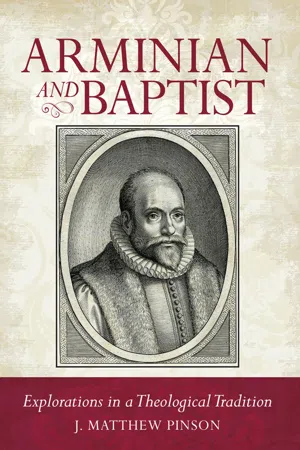
- 282 pages
- English
- ePUB (mobile friendly)
- Available on iOS & Android
eBook - ePub
About this book
Information
Topic
Theology & ReligionSubtopic
Christian Theology

JACOBUS ARMINIUS: REFORMED AND ALWAYS REFORMING

ARMINIUS AND HIS INTERPRETERS
Jacobus Arminius has been the object of much criticism and much praise during the past four centuries. Arminians have usually poured praise on him as the progenitor of their theological tradition, while non-Arminians, specifically those within the Reformed-Calvinistic tradition, have heaped criticism on him for departing from the Reformed faith. Both praise and criticism, however, have mostly proceeded from partisan biases and rest on misinterpretations of Arminius’s theology. Most Reformed critics have portrayed him as a semi-Pelagian and a defector from Reformed theology, while most Arminians—Wesleyans and Remonstrants—have cast him in Wesleyan or Remonstrant terms, failing to take seriously his theology itself and the context in which it was spawned.1
Both Reformed and Arminian scholars have traditionally portrayed Arminius’s thought as a departure from Reformed theology, or, as Richard A. Muller described it, “a full-scale alternative to Reformed theology.”2 Many Reformed thinkers have portrayed Arminius as “a clever dissembler who secretly taught doctrines different from his published writings.”3 Most writers commit the post hoc ergo propter hoc fallacy by attributing to Arminius theological movements that came after him. Roger Nicole, for example, described Arminius as the originator of a slippery slope that started with Episcopius and Limborch (who were “infiltrated by Socinianism”) and ended with Unitarianism, Universalism, and the philosophy of E. S. Brightman.4 Reformed writers traditionally described Arminius as a semi-Pelagian, an appellation that persists to this day. Several Reformed authors have recently characterized Arminius’s thought as “semi-Pelagian”5 or even “similar to Pelagianism.”6 These comments are remarkable given Arminius’s often stated aim to maintain “the greatest possible distance from Pelagianism.”7
Most Arminians, while praising Arminius, have viewed him in the light of either Remonstrant or Wesleyan theology, thus describing him in more synergistic or semi-Pelagian terms. The tendency of most Arminians is to give a brief biographical sketch of Arminius, with the customary discussion of “Arminius as the Father of Arminianism,” and then to offer an exposition of the five points of the Remonstrance. Or, as Carl Bangs says, the biographical sketch is many times followed by “copious references to Arminius’s successor, Simon Episcopius, who, although in many ways a faithful disciple of Arminius, is not Arminius.”8
None of these things, however, is true of Arminius, and only when one brings certain assumptions to his writings will one interpret him in these ways. Bangs summarizes this problem well:
It is evident that such accounts of Arminius assume a definition of Arminianism which cannot be derived from Arminius himself. It means that the writers begin with a preconception of what Arminius should be expected to say, then look in his published works, and do not find exactly what they are looking for. They show impatience and disappointment with his Calvinism, and shift the inquiry into some later period when Arminianism turns out to be what they are looking for—a non-Calvinistic, synergistic, and perhaps semi-Pelagian system.9
Those who bring presumptions into the study of Arminius by reading later Arminian themes into his thought fail to realize perhaps the most important thing about his theology: that it is distinctively Reformed, and that it is a development of Reformed theology rather than a departure from it. By focusing on Arminius’s doctrine of predestination and its differences with both Calvin and post-Dort Calvinism, people have tended to emphasize Arminius’s differences with Calvin and the Reformed tradition rather than his similarities with them. Both Arminians and Calvinists have thought of Arminius’s theology as essentially a reaction against Reformed theology rather than the selfconsciously Reformed theology that it is.10 William den Boer is correct when, discussing Arminius in his Reformed context, he favorably cites Willem J. Van Asselt’s comment that there were “different trajectories” in sixteenth-century Reformed theology, and that it was “not monolithic.” Thus, den Boer places Arminius’s thought in the “spectrum” of sixteenth-century Reformed theology—a movement that was “multi-faceted, dynamic, and ever-developing.” He thus rightly criticizes the view that there was “the Reformed theology.”11
Those who see predestination as the essential core of Reformed theology find it easy to say that, since Arminius did not articulate predestination in the same way Calvin did, he is a semi-Pelagian. Then they transfer this alleged semi-Pelagianism to all of his theology. Generations of theological students have received this picture of Arminius. But this approach fails to take his theology seriously. The best way to understand Arminius, and thus to benefit from his unique and substantial contribution to Protestant theology, is to understand his theological context, his stated view of Reformed theology (specifically that of Calvin), his confessional beliefs, and his published writings. If one believes Arminius to be an honest man, rather than a treacherous one, one will see a picture of him emerge that is radically different from the one(s) above.12
ARMINIUS’S LIFE
Before discussing the theological milieu in which Arminius taught and wrote, it will be helpful to give a brief sketch of his life.13 Arminius, born in 1559 and named Jacob Harmenszoon, grew up in Oudewater, Holland, and later studied at the newly established University of Leiden. After graduation from Leiden in 1581, he was brought to Geneva to study under Theodore Beza, Calvin’s successor and son-in-law. He left there to study at Basel for a year but returned and studied at Geneva until 1586. Arminius’s second stint at Geneva went smoothly. Beza gave a glowing report to the Amsterdam burgomasters, who were inquiring if Arminius was fitting in well.
In 1587, Arminius was assigned a pastorate in Amsterdam and was ordained in 1588. Before assuming his pastorate, Arminius traveled with his friend Adrian Junius to Italy and studied philosophy for seven months with James Zabarella at the University of Padua. Arminius took this journey without the permission of the Amsterdam burgomasters. Though he said that the experience made the Roman Church appear to him “more foul, ugly, and detestable” than he could have imagined,14 some of his later enemies used the trip to suggest that he had sympathies with Rome, “that he had kissed the pope’s shoe, become acquainted with the Jesuits, and cherished a familiar intimacy with Cardinal Bellarmine.”15
In 1590, Arminius married Lijset Reael, a daughter of a member of the city council. About this time, he became involved in theological controversy. Arminius was asked to refute the teachings of Dirk Coornhert, a humanist who had criticized Calvinism, and two ministers at Delft who had written an anti-Calvinist pamphlet. The traditional view was that Arminius, in his attempt to refute these anti-Calvinist teachings, converted from Calvinism to anti-Calvinism. Yet Bangs has shown there is no evidence that he ever held strict Calvinist views. At any rate, he became involved in controversy over the doctrines of the strong Calvinists. In 1591, he preached on Romans 7, arguing against the Calvinists’ view that the person described in vv. 14-24 was regenerate. A minister named Petrus Plancius led the charge against Arminius. Plancius labeled Arminius a Pelagian, alleging that Arminius had moved away from the Belgic Confession of Faith and the Heidelberg Catechism, advocating non-Reformed views on predestination and perfectionism. Arminius insisted his theology was in line with that of the Reformed Church and its Confession and Catechism, and the Amsterdam burgomasters sided with him. About a year later, after a sermon on Romans 9, Plancius again led the charge against Arminius. The latter insisted his teachings were in line with Article 16 of the Belgic Confession, and the consistory accepted Arminius’s explanation, urging peace until the matter could be decided by a general synod.
For the next ten years, Arminius enjoyed a relatively peaceful pastorate and avoided theological controversy. During this decade, he wrote a great deal on theology (things that were never published in his lifetime), including extensive works on Romans 7 and 9 as well as a long correspondence with the Leiden Calvinist Francis Junius. In 1602, after Leiden professor Lucas Trelcatius the elder died from the plague, there was a move to get Arminius appointed to his position, but there was also opposition to Arminius’s appointment, led by Leiden professor Franciscus Gomarus. Despite this opposition, the Leiden burgomasters appointed Arminius as professor of theology in May 1603. Soon he was awarded a doctorate in theology.
Arminius would spend the last six years of his life at Leiden, struggling with tuberculosis but always in a firestorm of theological controversy. The primary source of the controversy was predestination, and this is what Arminius and the movement that was named after him became known for. Another issue of dispute was the convening of a national synod. Arminius’s side wanted a national synod convened with power to revise the Confession and Catechism, while the strict Calvinists relied more on local synods. In 1607, the States General brought together a conference to prepare for a national synod. Arminius recommended the revision of the confessional documents but was voted down. He continued to be accused of heresy and false teaching, which resulted in his petitioning the States General to inquire into his case. Eventually, Arminius and Gomarus appeared before the High Court in 1608 to make their respective cases. This was the occasion for Arminius’s famous Declaration of Sentiments.16
In his Declaration of Sentiments, Arminius forthrightly argued against the Calvinist view of unconditional election.17 He concluded his declaration by asking again for a national synod with hopes for a revision of the Confession. Gomarus appeared before the States General and accused Arminius of errors on not only original sin, divine foreknowledge, predestination, regeneration, good works, and the possibility of apostasy, but also the Trinity and biblical authority. While the States General did not support Gomarus, the controversy became more heated.
In August of 1609, the States General invited Arminius and Gomarus back for a conference. They were each to bring four other colleagues. Arminius’s illness, which had been worsening, made it impossible for him to continue the conference, which was dismissed. The States General asked the two men to submit their views in writ...
Table of contents
- Cover
- Title Page
- Copyright
- Dedication
- Table of Contents
- Preface
- Chapter One: Jacobus Arminius: Reformed and Always Reforming
- Chapter Two: The Nature of Atonement in the Theology of Jacobus Arminius
- Chapter Three: Sin and Redemption in the Theology of John Smyth and Thomas Helwys
- Chapter Four: The First Baptist Treatise on Predestination: Thomas Helwys’s Short and Plaine Proofe
- Chapter Five: Thomas Grantham and the Diversity of Arminian Soteriology
- Chapter Six: Atonement, Justification, and Apostasy in the Theology of John Wesley
- Chapter Seven: Confessional, Baptist, and Arminian: The General-Free Will Baptist Tradition and the Nicene Faith
- Appendix One. Introduction to Classical Arminianism
- Appendix Two. Whosoever Will: A Review Essay
- Appendix Three. A Review of Arminian Theology: Myths and Realities
- Indices
Trusted by 375,005 students
Access to over 1.5 million titles for a fair monthly price.
Study more efficiently using our study tools.
Frequently asked questions
Yes, you can cancel anytime from the Subscription tab in your account settings on the Perlego website. Your subscription will stay active until the end of your current billing period. Learn how to cancel your subscription
No, books cannot be downloaded as external files, such as PDFs, for use outside of Perlego. However, you can download books within the Perlego app for offline reading on mobile or tablet. Learn how to download books offline
Perlego offers two plans: Essential and Complete
- Essential is ideal for learners and professionals who enjoy exploring a wide range of subjects. Access the Essential Library with 800,000+ trusted titles and best-sellers across business, personal growth, and the humanities. Includes unlimited reading time and Standard Read Aloud voice.
- Complete: Perfect for advanced learners and researchers needing full, unrestricted access. Unlock 1.5M+ books across hundreds of subjects, including academic and specialized titles. The Complete Plan also includes advanced features like Premium Read Aloud and Research Assistant.
We are an online textbook subscription service, where you can get access to an entire online library for less than the price of a single book per month. With over 1.5 million books across 990+ topics, we’ve got you covered! Learn about our mission
Look out for the read-aloud symbol on your next book to see if you can listen to it. The read-aloud tool reads text aloud for you, highlighting the text as it is being read. You can pause it, speed it up and slow it down. Learn more about Read Aloud
Yes! You can use the Perlego app on both iOS and Android devices to read anytime, anywhere — even offline. Perfect for commutes or when you’re on the go.
Please note we cannot support devices running on iOS 13 and Android 7 or earlier. Learn more about using the app
Please note we cannot support devices running on iOS 13 and Android 7 or earlier. Learn more about using the app
Yes, you can access Arminian and Baptist by J. Matthew Pinson in PDF and/or ePUB format, as well as other popular books in Theology & Religion & Christian Theology. We have over 1.5 million books available in our catalogue for you to explore.