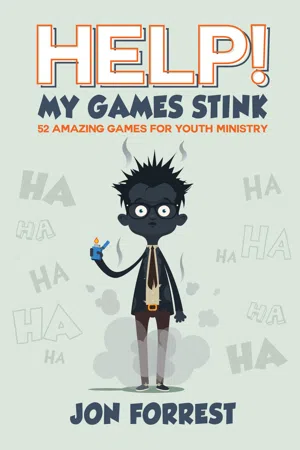
Ever tried an icebreaker with a tiny bit of pyrotechnics? Get students attention without burning down anything. Jon Forrest has developed an essential resource for youth ministry leaders, volunteers, youth camp workers, and anyone called on to lead events with students. Filled with 52 creative, fun games for small and large audiences, this resource will draw your group together and create an environment where relationship building and learning can take place. Jon Forrest also shares relatable personal narrative based on his many years of youth ministry experience. This book provides instruction needed to gain the right skills in leading games along with the tools of ideas for success. The games are divided into categories for planning convenience. Added words of wisdom and encouragement for student ministry staff is provided in the final chapter of the book.
- 150 pages
- English
- ePUB (mobile friendly)
- Available on iOS & Android
eBook - ePub
About this book
Information
Topic
Theology & ReligionSubtopic
Christian MinistrySection 1


Engagement Is Key
I heard about the pastor of a small group who scheduled a family style lock-in. He chose to have his devotion time around midnight in a stuffy room with terrible air conditioning.
One of the young boys who, more than likely, had not been engaged by the group, slipped to the back of the room and sat in a window they had opened to get a little airflow. It’s hard to say whether he sat there for the fresh air or to see the more interesting activities going on outside the window.
The cool air paired with the long-winded speaker and the fact that the boy had not become involved with the service, eventually got the best of him. This was way more than nodding off. This was slobber-inducing hibernation sleep.
Regrettably, in his sleep, the boy fell out of the window. It would have been comical if it hadn’t been a third-floor window. The boy died from a lack of engagement. And you thought that hole in the wall from your last lock-in was bad.
Fortunately, the pastor was the apostle Paul. He went down and raised Eutychus from the dead (Acts 20:7-12). If you can raise the dead, engaging students is not that important.
Maybe I’m being a little tough on Paul. Can you imagine how engaging he was? With that Road to Damascus story, he probably didn’t need Mental Ping Pong to get kids’ attention. But as I read this account from Acts, it’s apparent that even Paul had students who were difficult to incorporate into group time conversation.
Finding those points of engagement is what this book is for. I hope you can use the ideas in this book to involve students who are more comfortable spectating than participating.
Teaching Students Is Like Feeding Bears in Captivity
If people were data recorders we would not need this book. Imagine being able to hit a red record button in student’s brains and then just fill them with information. I’m about to make up a stat here. Students only absorb every nineteenth word you say. You can help this a little by mixing in the words “hanky-panky,” “fleek,” and “IMAX®.”
Students are suffering from information over-saturation. It reminds me of a time when I was a kid and went to Pigeon Forge on vacation with my family. The Smoky Mountains were our vacation spot. We would always drive through the countryside hoping to see a bear. Other than the occasional hay bale my imagination turned into a bear, we never had any luck spotting one. So, you can imagine my excitement when I saw the souvenir shop that advertised “Come Feed the Live Black Bears.”
I begged dad until he took me. Near the bear’s huge concrete pit, we bought a third of a loaf of bread to feed this awesome creature. I was so excited until I looked down into the quarry and saw a bear that looked like he might explode if he ate one more slice of bread! The floor of this sad structure was littered with stale bread that countless kids before had tried tempting the bear’s appetite without success. The disappointed kid next to me threw a slice of bread that landed on the poor creature’s back; he didn’t even acknowledge it.
That reminds me of our students. Can you begin to fathom the amount of information they are bombarded with? Even content they love is swiped upwards or sideways in less than a second. How in the world can we be sure they hear the only message that counts? That is not an exaggeration either. Compared to the gospel, everything else is rubbish.
Priming Students to Learn
Students must be primed for this message of life. My lesson in priming was incredibly frustrating. I wanted to make a duck race game. So, I bought two cast iron water pumps like Laura Ingalls might use. They were so cool! I mounted the pumps on fifty-five gallon drums and ran gutters away from the pumps for eight feet, and then curved them to bring the water back toward the pump where it emptied into the drum. So, when a rubber duck was put in the gutter in front of the spout and I started pumping, it would race through the gutter and end up back in front of me. At least that was the plan.
I built the whole set. I put a duck in place and started pumping the handle like a wild man. Nothing happened. I pumped harder and still nothing. I took the pump back off of the barrel and as I stuffed it back in the box I noticed the instructions. The little paper said “cebar la bomba antes de su uso.” When I turned it over to the English side of the instructions it said, “Pump must be primed before use.” I poured a little water down into the pump and began pumping the handle and out flowed a rolling river that merrily floated my little duck on his way.
Students are a lot like that. The priming process of playing a game does a few things. Students are much more likely to become engaged in the conversation if they are enjoying themselves. It relaxes them. You will have an easier time connecting with them if they like you as well as the person sitting next to them in a group.
My Checkered Past With Games
For years, I was on a quest to find the perfect student ministry game. I knew it was out there! I visualized myself introducing it to a room of students who would look at me as if I were this generation’s Bob Barker. You know, I’d kind of have the personality of Ryan Seacrest with the prizes of Oprah on one of her give-away shows, along with the demeanor of Santa Claus.
But the truth is—there is no magic, foolproof icebreaker that will make your students have a blast, prepare them to learn, and love you. It’s like a “fun exercise” or a “delicious healthy snack.” They exist only in our wildest dreams.
You can, however, become a consistently good game leader when you realize a few simple tips, quit relying on the game, and focus on the experience.
All of us have heard about an incredible game from a friend, which we quickly plop out in front of our students saying, “This is fun!” only to have them pelt us with rotten vegetables.
Relying on the quality of a game to engage students is like buying a beautiful cut of steak only to bring it home and sling it in the microwave. (You may notice many of my illustrations involve eating.) You’re only halfway there when you leave the butcher, or when you have an incredible game in mind.
The Subtle Shift That Can Change Everything
I wish I knew exactly how many game books I’ve purchased in my life. It would also be embarrassing to know how many youth ministry game videos I have watched online. I’m haunted in thinking there is a great idea out there that I haven’t heard about. But there is a big problem with these resources, which is what led me to write this book. We completely explain the fun out of our games.
Here’s the solution! It’s the subtle shift that could change everything about your icebreaking fun time. Game instructions are for you as the leader, not for the participants.
You can explain what you want to do for five minutes and still have people in the dark, or you can strategically show them what you want in a simple moment and have immediate fun.
Think about it, when you go to an arcade and swipe your card to play a game, how many directions are you given? Of course, you die a time or two getting the hang of it, but in no time, you’re a pro.
I fully believe most of the fun our icebreakers and games produce dies in the introduction and explanation phase. We can fix that.
In this book, you will find instructions for each game, but those instructions are just so you will understand the game. You will also find an example of exactly what you could say in introducing each game. There’s nothing magical about the words I’ll give you to say. It’s more about keeping you from saying too much.
By the way, the titles that are provided are only there to help give you a reference point. Don’t even bring them up to the students. They should be having fun before they even know you are playing a game.
Primum Non Nocere
This may be the least fun and most important section in this book.
Doctors have a promise in the Hippocratic oath that youth workers need to pay special attention to. They say, “primum non nocere.” It means “first, do no harm.” Youth pastors should totally take this same oath.
Student and worker protection is so incredibly vital. I’m not sure it’s our most important job, but it is our first job. I can prove it to you. Imagine that you go on this incredible mission trip every year where ten thousand people are won to Christ and every kid becomes a missionary. It’s a pretty successful trip. But now imagine you lose a student in that country every 10 years when you visit. If that were the case, this otherwise ridiculously successful trip would cease to exist. You can’t sidestep safety. That’s why I say it is our first concern.
Keeping kids safe is important. You must repeat this phrase to yourself from time to time. “Don’t do anything dumb. Don’t do anything dumb.” The reason you should remind yourself of this is because dumb things seem fun and look really cool in pictures and your students are drawn to them like Vanilla Ice to a reality TV show.
For instance, fifteen years ago we all played “Sardines” at a lock-in. If you are not familiar with this game, it’s basically reverse hide and go seek. One person hides in the darkened church and everyone tries to find the person and hide with them. So, in about 15 minutes everyone is stuffed in the mop closet that smells like a dead mouse. Only now it also smells like fourteen pairs of teen boy’s shoes with a touch of Axe Body Spray and a dead mouse. It’s more fun than it sounds. Students go crazy for it.
What could possibly go wrong at the beginning of this game when there are two people locked in a dark closet? I can hear somebody say, “Well, we would send one of our workers to hide so it wouldn’t be two students.” That may be even worse. I hope you have instilled in your workers the wild importance of having two-deep leadership. Never be alone with a student. Even in a counseling situation be in a highly visible area with people nearby. Gender doesn’t matter. You must be above reproach.
Back to our game, let’s say you figured out a way not to have two people alone in the hiding place, you still have to deal with the three couples you have who could not care less about the game, but instead would find their own dark corner of the church to…how shall I say this gently, “discuss the seventh commandment.”
Sardines is so much fun. And we will never play it again. Yes, I’m old. Yes, I’m really careful. But decisions like this are the reason I have been able to work with students in one place for over twenty years.
Don’t misunderstand, I love dumb stuff. It’s a constant struggle for me. I want to play Chubby Bunny just like you do. This is the game where students stuff marshmallows in their mouth and see how many they can get shoved in there and still be able to say, “Chubby Bunny” before they either choke to death or vomit all over the youth room. Doesn’t that description make you want to play this old favorite?
People die playing this. I’ve seen people choke playing it. It’s not a good idea. If you have a bunch of marshmallows laying around and you need a game, see who can catch one in their mouth from the farthest distance, but don’t take a chance when it comes to safety.
Remember, primum non nocere, or in other words “don’t do anything dumb!”
Section 2
1
This game is piece of cake. Give a student a subject to talk about. He has to talk about it for thirty seconds without pausing or saying “uh,” “um,” or hesitating for 3 seconds. I’ll give you a few subjects as examples, but you will probably want your kid to talk about whatever topic you’re going to cover that night.
It’s amazing how many kids start with, “Ummm.” Remember they cannot pause or say “uh,” “um,” or hesitate for more than three seconds.”
Buzz them with an annoying “AAAHHHH” if they mess up or delay.
Possible topics:
• Vacuum cleaners
• Pesky nose hair
• Mosquitos
• The chur...
Table of contents
- Cover
- Title Page
- Copyright
- Dedication
- Table of Contents
- Introduction
- Section 1 Why Do We Need Games in the First Place
- Section 2 No Prep/No Props
- Section 3 Team Building
- Section 4 Games in a Circle
- Section 5 Group Games Ending With a Winner
- Section 6 Up Front Games Ending With a Winner
- Section 7 Big Starters (aka Leftover Stuff)
- Section 8 Help Beyond the Games
Trusted by 375,005 students
Access to over 1.5 million titles for a fair monthly price.
Study more efficiently using our study tools.
Frequently asked questions
Yes, you can cancel anytime from the Subscription tab in your account settings on the Perlego website. Your subscription will stay active until the end of your current billing period. Learn how to cancel your subscription
No, books cannot be downloaded as external files, such as PDFs, for use outside of Perlego. However, you can download books within the Perlego app for offline reading on mobile or tablet. Learn how to download books offline
Perlego offers two plans: Essential and Complete
- Essential is ideal for learners and professionals who enjoy exploring a wide range of subjects. Access the Essential Library with 800,000+ trusted titles and best-sellers across business, personal growth, and the humanities. Includes unlimited reading time and Standard Read Aloud voice.
- Complete: Perfect for advanced learners and researchers needing full, unrestricted access. Unlock 1.5M+ books across hundreds of subjects, including academic and specialized titles. The Complete Plan also includes advanced features like Premium Read Aloud and Research Assistant.
We are an online textbook subscription service, where you can get access to an entire online library for less than the price of a single book per month. With over 1.5 million books across 990+ topics, we’ve got you covered! Learn about our mission
Look out for the read-aloud symbol on your next book to see if you can listen to it. The read-aloud tool reads text aloud for you, highlighting the text as it is being read. You can pause it, speed it up and slow it down. Learn more about Read Aloud
Yes! You can use the Perlego app on both iOS and Android devices to read anytime, anywhere — even offline. Perfect for commutes or when you’re on the go.
Please note we cannot support devices running on iOS 13 and Android 7 or earlier. Learn more about using the app
Please note we cannot support devices running on iOS 13 and Android 7 or earlier. Learn more about using the app
Yes, you can access Help! My Games Stink by Jon Forrest in PDF and/or ePUB format, as well as other popular books in Theology & Religion & Christian Ministry. We have over 1.5 million books available in our catalogue for you to explore.