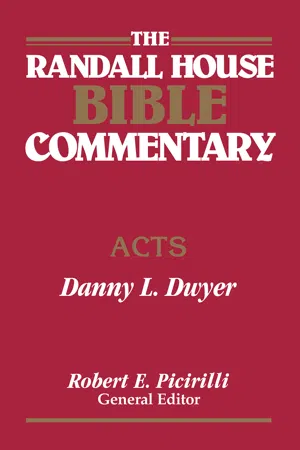
This is the eleventh edition to the commentary series from Randall House. This edition offers a thorough study of the entire book of Acts using a verse-by-verse method. With Robert E. Picirilli as the General Editor, Danny Dwyer served as the writer for this edition on Acts. Besides a verse-by-verse study method, the writer also provides excellent summaries of passages and application notes for teaching the passages of Acts. Maps of Paul's missionary journeys are included along with a chart displaying the authorities and events of the time of Acts.
- 390 pages
- English
- ePUB (mobile friendly)
- Available on iOS & Android
eBook - ePub
About this book
Information
Topic
Theology & ReligionSubtopic
Biblical CommentaryOUTLINE OF THE ACTS OF THE APOSTLES
I. Prologue, 1:1-5
A. Link to the “former treatise,” 1:1-3
B. The Command to Wait, 1:4-5
II. The Empowering of the Holy Spirit for Witness, 1:6—2:47
A. The Purpose for Waiting: Empowered Witness, 1:6-8
B. The Ascension of Christ, 1:9-11
C. Obedient Waiting in an Upper Room, 1:12-14
D. Selection of a Replacement for Judas Iscariot, 1:15-26
1. The defection of Judas Iscariot, 1:15-20
2. The election of Matthias, 1:21-26
E. The Filling of the Holy Spirit, 2:1-13
1. The miraculous event, 2:1-4
2. The wider audience responds, 2:5-13
F. Peter’s First Sermon, 2:14-36
1. Appeal to the prophesy of Joel: “this is that,” 2:14-21
2. Jesus of Nazareth, the resurrected Christ, 2:22-36
a. His approval by God, 2:22-24
b. Confirmation from Psalm 16:8-11, 2:25-31
c. Proclamation of Jesus of Nazareth as Lord and Christ, 2:32-36
G. Response to Peter’s Message, 2:37-41
H. Early Community Life of the Church, 2:42-47
III. The Church’s Witness in Jerusalem, 3:1—8:1a
A. Healing of the Lame Beggar, 3:1-11
B. Peter’s Second Sermon, 3:12-26
C. Peter and John on Trial Before the Sanhedrin, 4:1-22
1. The arrest of Peter and John, 4:1-4
2. The arraignment before the Sanhedrin, 4:5-7
3. The answers to the charges, 4:8-22
a. Response from Peter and John, 4:8-12
b. Response from the Sanhedrin, 4:13-22
D. The Report to the Church, 4:23-31
E. The Church Continues Community Life, 4:32-37
F. The Deceit of Ananias and Sapphira, 5:1-11
G. Further Signs and Wonders by the Apostles, 5:12-16
H. All the Apostles Arrested and Arraigned Before the Sanhedrin, 5:17-42
1. Arrested by the Sanhedrin, released by the angel of the Lord, 5:17-26
2. Arraigned before the Sanhedrin, 5:27-40
a. The testimony of the apostles, 5:27-32
b. The reasoning of Gamaliel, 5:33-40
3. The continuing witness of the Apostles, 5:41-42
I. Further Organization of the Community Life of the Church, 6:1-7
J. The Witness of Stephen, 6:8—8:1a
1. Stephen’s ministry, 6:8-10
2. Stephen’s arrest, 6:11-15
3. The Message of Stephen to the Sanhedrin, 7:1-53
a. The time of Abraham and the Patriarchs, 7:1-8
b. The time of Joseph, 7:9-16
c. The time of Moses, 7:17-43
(1) The first forty years, 7:17-22
(2) The second forty years, 7:23-29
(3) The third forty years, 7:30-43
d. The time of David and Solomon, 7:44-50
e. Stephen’s pointed application, 7:51-53
4. The martyrdom of Stephen, 7:54—8:1a
a. Stephen’s vision of Jesus, 7:54-56
b. Stephen is stoned to death, 7:57—8:1a
IV. The Church’s Witness in Judaea and Samaria, 8:1b-40
A. Persecution and Dispersion Throughout Judaea and Samaria, 8:1b-4
B. The Witness of Philip, 8:5-40
1. Initial ministry in Samaria, 8:5-8
2. The conversion of Simon the sorcerer, 8:9-25
3. The conversion of the Ethiopian eunuch, 8:26-40
V. The Church’s Witness “to the Uttermost Part of the Earth,” 9:1—21:17
A. The Conversion of Saul of Tarsus, 9:1-31
1. Saul encounters the living Christ, 9:1-9
2. Ananias sent to help Saul, 9:10-19a
3. Saul preaches in Damascus, 9:19b-25
4. Saul comes to Jerusalem as a Christ-follower, 9:26-31
B. Peter’s Ministry in Western Judaea, 9:32-43
1. The healing of Aeneas, 9:32-35
2. The raising of Tabitha (Dorcas) from the dead, 9:36-43
C. The Conversion of Cornelius the Roman Centurion, 10:1—11:18
1. The vision of Cornelius, 10:1-8
2. The vision of Peter, 10:9-16
3. Peter’s witness to the household of Cornelius, 10:17-48
a. Peter meets with the representatives of Cornelius, 10:17-23a
b. Exchange between Peter and Cornelius in Caesarea, 10:23b-33
c. Peter’s message to the household of Cornelius, 10:34-43
d. The Holy Spirit falls on the household of Cornelius, 10:44-48
4. Peter’s testimony of the conversion of the household of Cornelius, 11:1-18
a. Contention with Peter at Jerusalem, 11:1-3
b. Peter’s testimony and the glorious agreement, 11:4-18
D. The Establishing of the Church at Antioch, 11:19-30
1. Many at Antioch converted upon hearing the gospel, 11:19-21
2. The Jerusalem church sends Barnabas to confirm, 11:22-26
3. The beginning of the famine relief offering, 11:27-30
E. Herod Targets the Church for Persecution, 12:1-25
1. James is killed, and Peter is imprisoned, 12:1-19
a. The killing of James by Herod, 12:1-2
b. Peter is imprisoned by Herod but released by the angel of the Lord, 12:3-19
2. The death of Herod, 12:20-23
3. The church continues in ministry, 12:24-25
F. The First Missionary Journey, 13:1—14:28
1. The call and commissioning of Barnabas and Saul, 13:1-3
2. Witness on the island of Cyprus, 13:4-12
a. First witness, in the synagogues, 13:4-5
b. The conversion of Sergius Paulus, 13:6-12
3. John Mark abandons the work, 13:13
4. Witness in Antioch of Pisidia, 13:14-52
a. Paul’s first recorded sermon to Jews, 13:14-41
(1) The setting, 13:14-15
(2) The sermon, 13:16-41
(a) God’s favor in choosing Israel, 13:16-25
(b) God’s promise of the Messiah fulfilled in Jesus, 13:26-37
(c) Paul’s appeal and warning, 13:38-41
b. Gentile opportunity, Jewish opposition, 13:42-52
5. Witness in Iconium, 14:1-7
6. Witness at Lystra and Derbe, 14:8-21a
a. Healing o the lame man, 14:8-10
b. Barnabas and Paul proclaimed as gods, 14:11-18
c. Jews from Antioch and Iconium stir opposition, 14:19-21a
7. Paul and Barnabas return to Antioch, 14:21b-28
G. The Council at Jerusalem, 15:1-35
1. The controversy, 15:1-5
2. The consideration of the controversy, 15:6-12
3. The counsel of James, 15:13-21
4. The conclusion that was reached, 15:22-29
5. Conferring with the church at Antioch, 15:30-35
H. The Second Missionary Journey, 15:36—18:22
1. Division and separation of Paul and Barnabas, 15:36-41
2. Return to Lystra and Derbe: Timothy joins the team, 16:1-5
3. The call to Macedonia, 16:6-10
4. Witness in Philippi, 16:11-40
a. The conversion of Lydia, 16:11-15
b. Deliverance of the spirit-possessed damsel, 16:16-18
c. Imprisonment of Paul and Silas, 16:19-40
(1) Arrested on false charges, 16:19-24
(2) The conversion of the jailer and his household, 16:25-34
(3) Humiliation of the city leaders, 16:35-40
5. Witness in Thessalonica, 17:1-9
6. Witness in Berea, 17:10-15
7. Witness in Athens, 17:16-34
a. In the synagogue and market, 17:16-17
b. Challenged by the Epicureans and Stoics, 17:18-21
c. Paul’s message to the Areopagus, 17:22-31
d. Response to Paul’s message, 17:32-34
8. Witness in Corinth, 18:1-17
a. Joining with Aquila and Priscilla, 18:1-3
b. Witness to the Jews, 18:4-11
c. Trial before Gallio, 18:12-17
9. Paul returns to Antioch in Syria, 18:18-22
I. The Third Missionary Journey, 18:23—21:16
1. Strengthening the churches, 18:23
2. Witness in Ephesus, 18:24—19:41
a. Apollos, 18:24-28
b. The Ephesian disciples and the baptism of John, 19:1-7
c. In the synagogue and school of Tyrannus, 19:8-12
d. Encounter with Jewish exorcists, 19:13-20
e. Paul’s intention to go to Jerusalem, then Rome, 19:21-22
f. The riot of the cult worshipers against the believers, 19:23-41
(1) The charge of Demetrius and the silversmiths, 19:23-28
(2) The frenzied mob in the theater, 19:29-34
(3) The town-clerk dismisses the assembly, 19:35-41
3. Journey to Jerusalem, 20:1—21:16
a. Paul returns to Macedonia and Achaia, 20:1-5
b. Paul at Troas and the restoration of Eutychus, 20:6-12
c. From Troas to Miletus, 20:13-16
d. Paul addresses the Ephesian elders at Miletus, 20:17-38
(1) Paul’s personal ministry, 20:17-27
(2) Charge to the elders, 20:28-35
(3) Tearful farewell, 20:36-38
e. From Miletus to Tyre, 21:1-6
f. From Tyre to Caesarea, 21:7-14
g. From Caesarea to Jerusalem, 21:15-16
VI. Paul’s Witness Before Kings and Rulers, 21:17—28:31
A. Meeting With James and the Elders at Jerusalem, 21:17-26
B. The Riot Over Paul in the Temple, 21:27-40a
1. Paul accosted and beaten by the temple mob, 21:27-30
2. Paul rescued by the Roman guard, 21:31-40a
C. Paul’s Defense Before the Temple Mob, 21:40b—22:21
1. His appeal to be heard, 21:40b—22:2
2. His life before conversion to Christ, 22:3-5
3. His conversion to Christ, 22:6-16
4. His vision in Jerusalem and commission from the Lord, 22:17-21
D. Paul’s Exchange With the Roman Tribune, 22:22-29
E. Paul’s Testimony Before the Sanhedrin, 22:30—23:11
1. Confrontation with the high priest, 22:30—23:5
2. Paul’s bold announcement leads to internal division on the Council, 23:6-11
F. The Murder Plot Against Paul, 23:12-35
1. The perpetrators and their plan, 23:12-15
2. The plot revealed, 23:16-22
3. Hasty transfer of Paul to Caesarea, 23:23-35
a. The guard assembled and the Tribune’s letter, 23:23-30
b. Paul transported to Caesarea under heavy security, 23:31-35
G. Paul’s Defense Before Felix, the Governor, 24:1-27
1. The formal accusation, 24:1-9
2. Pauls’ answer to the charges by Tertullus, 24:10-21
3. The response of Felix, 24:22-23
4. Further audience with Felix and Drusilla, 24:24-27
H. Paul’s Defense Before Festus the Governor and Agrippa the King, 25:1—26:32
1. Paul’s first defense before Festus, the governor, 25:1-12
2. Paul’s second defense before Festus, Agrippa II, and Bernice, 25:13—26:32
a. The inquiry of Festus to Agrippa about Paul, 25:13-22
b. The political assembly to hear Paul, 25:23-27
c. Paul’s defense testimonial, 26:1-23
(1) Paul’s expression of appreciation, 26:1-3
(2) Paul’s past life in Judaism, 26:4-11
(3) Paul’s encounter with the risen Jesus of Nazareth, 26:12-18
(4) Paul’s obedience to “the heavenly vision,” 26:19-23
d. The reaction to Paul’s defense, 26:24-32
(1) Reaction from Festus, 26:24-26
(2) Exchange with Agrippa, 26:27-29
(3) The decision to send Paul to Rome, 26:30-32
I. The Voyage to Rome, 27:1—28:15
1. From Caesarea to Fair Havens, 27:1-8
2. The storm and shipwreck, 27:9-44
a. The decision to sail, 27:9-12
b. The storm “Euroclydon,” 27:13-20
c. Encouraging words from Paul, 27:21-26
d. The shipwreck and escape to land, 27:27-44
3. On the island of Melita (Malta), 28:1-10
4. From Melita (Malta) to Rome, 28:11-15
J. Imprisoned in Rome, 28:16-31
1. Arrangements for the Apostle Paul, 28:16
2. Meeting with Jewish leaders, 28:17-29
3. Imprisoned but not silenced, 28:30-31
The life of Jesus of Nazareth that culminated in His resurrection and ascension, as recorded in Luke and Acts respectively, raises the question, “What happened to the followers of Jesus Christ?” His was a life unlike any other. It culminated in an event unlike any other. It was the testimony of His followers that Jesus was literally, physically raised from the dead. They claimed to be eyewitnesses who saw Him, spoke with Him, interacted with Him, even ate with Him—for many days following their discovery that His body was not in the tomb where they laid Him. His appearances to them on that day when He had them physically touch His body (Jn. 20:24-29) were convincing proofs of His reality. That not only changed their lives, it changed everything.
How did it change everything? How did it change them? What did they do with that information? Did they follow His directions to tell the world about Him? Luke provides his answer to those questions in the Acts of the Apostles. His is an apologetic of the validity of Christianity on every level of faith and lifestyle, as demonstrated in the lives and messages recorded in the narrative. Although Theophilus is named as the recipient of the records Luke is presenting, it seems clear that a wider audience is also expected. This is intended by Jesus’ command to witness this message “unto the uttermost part of the earth” (1:8).
I. PROLOGUE (1:1-5)
In beginning his writings, Luke, the author of the Gospel and the Book of Acts, uses a formal literary prologue unlike any other N. T. writer. Its usage is not without purpose and is, at least, two-fold. First, in using a literary structure, Luke distinguishes himself as more than just a keeper of diaries and a collector of interesting stories. Fitzmyer (80) remarks that Luke is a remarkable Hellenistic writer.
Second, the intentional use of a second literary prologue also serves as a clear connection with the previous volume, the Gospel of Luke, as well as an introduction to the present volume. Indeed, the two volumes by the same author have been acknowledged since the second century as a “History of Christian Origins” (Bruce, Acts 15).
A brief survey of commentators shows differing opinions on the length of the prologue to the Acts narrative (Stott 21; Bruce, Acts 30; Harrison 35; Fitzmyer 191). Beginning with a reference to the Gospel of Luke, then using a command from Jesus to transition to the Acts narrative, the most natural break in this opening statement seems to come at the end of verse 5. These first five verses establish a literary bridge that connects Luke’s record in his Gospel—which concludes with the most miraculous event in history, the resurrection of Jesus Christ—to his record of what happened to the followers of Jesus Christ. These two volumes present the written apologetic of real people, places, events, and testimonials with which Luke wants to establish the faith of Theophilus and all who read his accounts.
A. Link to the “former treatise” (1:1-3)
1 The former treatise have I made, O Theophilus, of all that Jesus began both to do and teach,
2 Until the day in which he was taken up, after that he through the Holy Ghost had given commandments unto the apostles whom he had chosen:
3 To whom also he shewed himself alive after his passion by many infallible proofs, being seen of them forty days, and speaking of the things pertaining to the kingdom of God:
Luke begins his second volume with a reference to the first, the Gospel of Luke. In doing so, he clearly takes ownership of the writing and links the two together. Bock (51-53) lists five distinct links between the two volumes showing that the Acts of the Apostles is an essential outgrowth and continuation of the Gospel of Luke:
“First, Luke calls the first book a ‘former account’… Second, the address to Theophilus recalls the figure introduced to us in Luke 1:3. The overlapping address shows that Luke composed Acts as a single story line extending from His Gospel…Third, this link to Luke’s Gospel is further confirmed in Acts 1:4-5, which marks the connection with John the Baptist, the figure with whom Luke’s Gospel begins…Fourth, the overlapping accounts of the ascension…Fifth, the direct allusion back to the instruction given…to await the Spirit and be witnesses.”
The same person, Theophilus (meaning “lover of God” or “loved by God”), is addressed as the recipient of the book, only this time with no qualifying title (“most excellent” in Lk. 1:3). Geldenhuys (53) sees the title as indicating high political rank (compare 24:3) and suggests that Theophilus was but one of many high ranking officials of Luke’s acquaintance. As the Acts record will show, Luke would have interaction with many such high ranking officials, especially at Antioch of Syria (13:1). Lenski (21) proposes that the difference in the uses of the name shows that Theophilus was not a believer when Luke wrote the prologue to the Gospel but now he is. This second volume would serve him as evidence of faith displayed in the lives of many others, including many of high civil and social rank such as he.
Some inf...
Table of contents
- Cover
- Title Page
- Copyright
- Dedication
- Contents
- General Editor’s Preface
- Introduction
- Authorities and Events of Acts Table
- Outline
- Bibliography
Trusted by 375,005 students
Access to over 1.5 million titles for a fair monthly price.
Study more efficiently using our study tools.
Frequently asked questions
Yes, you can cancel anytime from the Subscription tab in your account settings on the Perlego website. Your subscription will stay active until the end of your current billing period. Learn how to cancel your subscription
No, books cannot be downloaded as external files, such as PDFs, for use outside of Perlego. However, you can download books within the Perlego app for offline reading on mobile or tablet. Learn how to download books offline
We are an online textbook subscription service, where you can get access to an entire online library for less than the price of a single book per month. With over 1.5 million books across 990+ topics, we’ve got you covered! Learn about our mission
Look out for the read-aloud symbol on your next book to see if you can listen to it. The read-aloud tool reads text aloud for you, highlighting the text as it is being read. You can pause it, speed it up and slow it down. Learn more about Read Aloud
Yes! You can use the Perlego app on both iOS and Android devices to read anytime, anywhere — even offline. Perfect for commutes or when you’re on the go.
Please note we cannot support devices running on iOS 13 and Android 7 or earlier. Learn more about using the app
Please note we cannot support devices running on iOS 13 and Android 7 or earlier. Learn more about using the app
Yes, you can access The Randall House Bible Commentary: Acts by Danny Dwyer, Robert E. Picirilli in PDF and/or ePUB format, as well as other popular books in Theology & Religion & Biblical Commentary. We have over 1.5 million books available in our catalogue for you to explore.