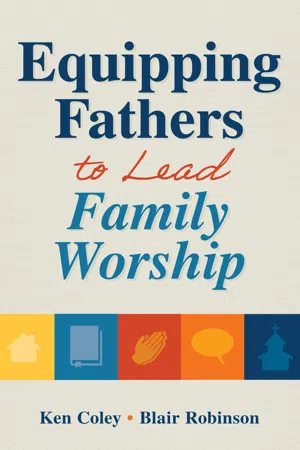
Equipping Fathers to Lead Family Worship offers a historical, theological, biblical, and pedagogical text that focuses on the responsibility that Christian fathers have to lead their families in the worship of God. The book is for use in local churches and Christian households and is meant to serve as a resource to assist pastors and leaders to equip fathers and family household leaders with personal and family worship practices.
Offers a biblical overview of the responsibilities given to fathers to practice as they lead their families in the worship of God.
Provides a review of historical practices of family worship, a description of worship elements for the family, and training for teaching children in the home.
Recommends training propositions for pastors as they equip fathers and household leaders in the church.
This chapter will attempt to provide an explanation from God’s Word of how God designed the home to function. God has provided the heads of households to lead their families in instruction and in the praise of His name. To build the argument, this chapter will look more closely at Deuteronomy 6:4-9 and Ephesians 6:1-4. Beginning the work by examining God’s Word lays a convictional foundation for the rest of the book.
In God’s care for His people, He has intentionally and strategically designed the home as a place of worship. Specifically, a place for His people to worship Him—the one and only God of the universe. His design comes with great provision. Most generously, God provides Himself as the primary caretaker and overseer of His households, providing His Word with covenants and promises attached. God provides a way of fellowship through His Son, Jesus, who is the Creator, atoning sacrifice, Redeemer, Resurrection, and King for His people. He provides His Spirit who convicts, guides, and produces fruit in His people for His glory. He is our great provision. He is our great gift. He is the good news.
God has also designed the home to be led by men who love Him with full hearts and who fear Him. He has instructed these men to faithfully fulfill the responsibilities to lead, serve, and shepherd those in their homes (Ephesians 6:4). These are men who yield to Christ as the head of their families, and who lead their families toward Him no matter the cost; men who trust His Word, teach His Word, rejoice in His Word, and pray according to His Word. Yes, this is God’s good design for the home.
This examination and request for men to lead their home is certainly not to suggest that women do not play an essential role in the home as well because they absolutely do. They too are a significant piece of God’s provision for the household. They teach children and serve as a model of faithfulness for them to observe (Proverbs 1:8; 31:28). They too are called to love God with their heart, soul, and might (Deuteronomy 6:5), and they are called to promote their husband’s leadership and keep him accountable to leading his household (Genesis 2:18; Ephesians 5:22). Women are to be cherished in the home the same way that Christ cherishes His bride, the Church. There are times when women must take the lead role in leading the family to worship God, such as when the father is unavailable or unconverted. In God’s provision, we see that Timothy’s mother and grandmother were responsible for training him in the faith early in his life, with no mention of his father in the Scriptures (2 Timothy 1:5; 3:14-15). However, this particular book will focus on the father’s role and responsibility in caring for and leading the home, as is described in Scripture.
If you are a pastor, this is what God has laid out for His people, and we have a specific responsibility to shepherd and equip His people for such a task as those who will give an account of their souls (Hebrews 13:17). A faithful brother once asked me, “What has God required of you as a pastor?” I responded with examples such as, “Shepherd His people, faithfully teach the Scriptures, provide Gospel-centered counseling, lead by example, etc.” His response I will not forget, “God expects the same for a father in his home.” To build the argument for God’s design, we must first be convinced (and convicted) by what God’s Word says on the matter of family worship and the role of father. The Scripture speaks directly to the matters of the home and the blessing of passing along the Word of God and works of God to the next generation. Though there is simply not enough time to exegete all biblical passages that relate to this topic, looking intently at two texts should be enough to begin a conviction.
A framework before we dive in:
Fathers, we do not have the capabilities or power to move our children spiritually. It is the grace and kindness of God that grows your children spiritually through the work of the Holy Spirit. The work and glory belong to Him. Yet, we do not stand idly by, for God has given us responsibilities to cultivate, encourage, pray, and instruct them. Our children are to know they are loved … even if they do not love the Lord you love. Guard yourself with this truth as we begin, as it will help you depend upon the God of all wisdom and power.
Deuteronomy 6:4-9
After roaming the wilderness for forty years, Israel stood at the precipice of their Promised Land and received from God through Moses the Book of Deuteronomy. Deuteronomy is instruction centered on ensuring Israel’s faithful devotion to God as His covenant people when entering Canaan. Deuteronomy provides an extensive educational plan for God’s people in which it was intended that every person in the nation, and future generations, would be trained from (cf. Deuteronomy 4:9, 10; 6:7, 20;11:19; 31:13; 32:7, 46). Deuteronomy 4, 5, and 6, emphasize the charge of God’s words to the coming generations specifically, most notably emphasized in Deuteronomy 6:6-9. Moses calls the Israelites to focus on their children and their children’s children. Due to God’s exclusive preservation and covenant for His people, He expected Israel to be faithful in following Him, worshiping Him, and training up generation after generation who hold to the same faith and obedience to God as the generation of Israel who received this instruction first.
Preserving the nation through the training of the next generation is a critical subject in the book of Deuteronomy, and the responsibility lands with Israel to do so. With this responsibility, God’s people are concurrently urged not to forget who God is, what He has done for them, or that they are accountable to pass along the truths and history of God to their children. Forgetting to do this opens the whole nation up to the great risk that their children will not know or worship the God of salvation. Israel was commanded to remember, and guard against forgetting, what God had asked of them when entering the land.
The Shema
Though this command is apparent throughout Deuteronomy, chapter 6:4-9 highlights this command and warning. Jewish tradition terms this passage as the Shema, which means “to hear,” named after the first word of verse 4. The Shema delivers the Lord’s instruction to Israel to teach the future generations, setting up what would become the core of daily Jewish worship. “Hear, O Israel,” in verse 4, or “listen up” Israel, as we would understand today, is a directive to pay attention and consider the attributes of God and to heed the following teaching. And God can command this, because He is the one, unique, undivided God in all of creation. When He speaks, His people are called to listen, worship, and obey.
The Shema then moves from who God is to what the people of Israel are called to do. Verse 5 says “You shall love,” as Israel receives an invitation to respond in love to God “with all your heart and with all your soul and with all your might.” Summarizing this phrase in a helpful way, J. W. Turner and Ken Coley use their expertise to suggest that after Moses reviewed the Ten Commandments in Deuteronomy 5, he declared in the Shema, “Obey the Lord your God exclusively with all your innermost personal reflections; with all your outermost public expressions; and with all your efforts and exertions.”1 The idea stressed giving one’s entire self to God and His commands. In essence, this type of devotion to God creates a deep culture of committed worship.
Despite Deuteronomy’s attention to obedience from the immediate audience of Israel, the secondary element of the passage focuses on educating the coming generations of Israel, as already discussed. When individuals love God, they are to teach the next generation to do the same thing. This instruction was to be purposeful, regular, and routine (Deuteronomy 4:9 and 6:2). Fundamentally, verses 6-9 convey to Israel how they can remain mindful of God, as family worship becomes an essential theme for the people of God to carry out their own worship and also the worship of their lineage.
For this little book, the focus is on God’s instruction in verse 7. Verse 7 says, “You shall teach them diligently to your children,” which represents the transmitting of “these words” from parents to their children. Parents must first internalize and then pass these commands from God to the next generation. The word teach in this passage refers to more than mere speaking. Turner and Coley emphasize that the word “teach” in Hebrew pedagogy, “cannot be separated from the qualifier before it in verse 6: ‘These words that I command you today shall be on your heart,’” and thus families should practice them so consistently in effort to pierce the conscience and mindfulness of the children in the home.2 Our teaching becomes the “impressing” of these words. It’s how we fix the truth deeply in one’s mind. The Hebrew word for teach in verse 7 is the word sh-n-n (shinan), which means repeat.3 In some places of Scripture, this root word (shinan) simply means “repeat” (cf. Proverbs 17:9). However, in verse 7, the word suggests a particular kind of repetition—that of a constant sharpening.4 One scholar provides the imagery of this word in action as that of a stone worker who is methodically hammering and chiseling a slab of granite in effort to create a lasting message.5 The work is tiring. At times it feels like progress isn’t happening. Yet the constant hammering in and inscribing of these words helps to create a lasting message on the children’s hearts. Therefore, parents repeat, blow by blow, the truth, grace, and glory of God to their children.
The concluding half of verse 7 identifies the specific times parents must discuss these words with their children: “and shall talk of them when you sit in your house, and when you walk by the way, and when you lie down, and when you rise.” The connotation in the passage suggests that the demands of Yahweh’s covenant and the reminders of His faithfulness ought to be the topic of conversation for parents with their children in all settings. Redeeming conversations and specific instruction about God should drive the motives of personal worship and family worship. The responsibility is for these conversations to be the culture of the home—a lifestyle. This passage leaves no room for dichotomies in conversation or in worship. Said another way, God’s glory and our need for a Savior should be the language of our homes. ...
Table of contents
Cover Page
Title Page
Copyright
Dedication
Table of Contents
Introduction: Equipping Fathers to Lead Family Worship
Part One: Know the Ancient Paths
Part Two: Walk the Ancient Paths
Part Three: Point to the Ancient Paths
Appendix A: Resources for Family Worship Models and a Sample Family Worship Structure
Appendix B: Great Resources for Learning More About Family Worship
Appendix C: Basic Educational Learning Concepts
Trusted by 375,005 students
Access to over 1.5 million titles for a fair monthly price.
Study more efficiently using our study tools.
Frequently asked questions
Yes, you can cancel anytime from the Subscription tab in your account settings on the Perlego website. Your subscription will stay active until the end of your current billing period. Learn how to cancel your subscription
No, books cannot be downloaded as external files, such as PDFs, for use outside of Perlego. However, you can download books within the Perlego app for offline reading on mobile or tablet. Learn how to download books offline
Perlego offers two plans: Essential and Complete
Essential is ideal for learners and professionals who enjoy exploring a wide range of subjects. Access the Essential Library with 800,000+ trusted titles and best-sellers across business, personal growth, and the humanities. Includes unlimited reading time and Standard Read Aloud voice.
Complete: Perfect for advanced learners and researchers needing full, unrestricted access. Unlock 1.5M+ books across hundreds of subjects, including academic and specialized titles. The Complete Plan also includes advanced features like Premium Read Aloud and Research Assistant.
Both plans are available with monthly, semester, or annual billing cycles.
We are an online textbook subscription service, where you can get access to an entire online library for less than the price of a single book per month. With over 1.5 million books across 990+ topics, we’ve got you covered! Learn about our mission
Look out for the read-aloud symbol on your next book to see if you can listen to it. The read-aloud tool reads text aloud for you, highlighting the text as it is being read. You can pause it, speed it up and slow it down. Learn more about Read Aloud
Yes! You can use the Perlego app on both iOS and Android devices to read anytime, anywhere — even offline. Perfect for commutes or when you’re on the go. Please note we cannot support devices running on iOS 13 and Android 7 or earlier. Learn more about using the app
Yes, you can access Equipping Fathers to Lead Family Worship by Kenneth S. Coley, Ed.D.,Blair Robinson in PDF and/or ePUB format, as well as other popular books in Theology & Religion & Christian Ministry. We have over 1.5 million books available in our catalogue for you to explore.