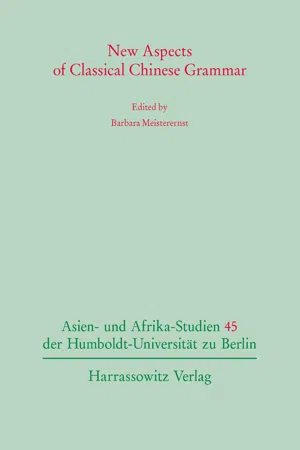
The objective of the collection of articles presented in this volume is to provide a representative and meaningful selection of present research work on Classical Chinese Grammar. Since the articles cover a temporal range from the Pre-Classical to the Medieval period, the term 'Classical Chinese' is used in a more generous sense.Two different but representative lines of research are predominant in this collection: the first focuses on the lexicon of Chinese, and the second focuses on its syntax or on the interface of its syntax and its semantics. Regarding the history of grammatical studies of Chinese, the first approach can be considered as a continuation and refinement of the traditional Chinese linguistic studies with new linguistic tools; the second approach follows and enhances the syntactic approach first proposed for the analysis of Chinese in the grammar of von der Gabelentz. In addition to these two general fields, a third and innovative field of research is included, focusing on the stratification of different linguistic registers in the Ancient Chinese language. With its selection of articles, this volume represents the multifaceted approaches presently employed to study the lexicon and the grammar of Classical Chinese, and it demonstrates the great progress the employment of different theoretical frameworks has induced in the analysis of the grammar Classical Chinese in recent times. This volume intends to convey the relevance of a meticulous and detailed study of the structural properties of Classical Chinese and to demonstrate that this study has to go beyond the mere analysis of apparent similarities.
- 181 pages
- English
- PDF
- Available on iOS & Android
eBook - PDF
New Aspects of Classical Chinese Grammar
About this book
Information
Table of contents
- Cover
- Title Page
- Copyright
- Table of Contents
- Body
- Introduction
- EDITH ALDRIDGE: ECM and Control in Archaic Chinese
- FRANÇOISE BOTTÉRO: Glossing Strategies in the Shìmíng
- SHENGLI FENG AND JAN VIHAN: The Tripartite Division of Formal, Informal and Elevated Registers
- HU CHIRUI: From Implicity to Explicity: Grammar Changes Induced by Lexical Changes
- BARBARA MEISTERERNST: The Expression of Epistemic Modality in Classical and Han Period Chinese
- WANG CHENG AND YUAN YIMIN: Aspectual Function of the Particle yú in Old Chinese
- LUKÁŠ ZÁDRAPA: Lǚshì Chūnqiū: Object Words Denoting Processes
Trusted by 375,005 students
Access to over 1.5 million titles for a fair monthly price.
Study more efficiently using our study tools.
Frequently asked questions
Yes, you can cancel anytime from the Subscription tab in your account settings on the Perlego website. Your subscription will stay active until the end of your current billing period. Learn how to cancel your subscription
No, books cannot be downloaded as external files, such as PDFs, for use outside of Perlego. However, you can download books within the Perlego app for offline reading on mobile or tablet. Learn how to download books offline
Perlego offers two plans: Essential and Complete
- Essential is ideal for learners and professionals who enjoy exploring a wide range of subjects. Access the Essential Library with 800,000+ trusted titles and best-sellers across business, personal growth, and the humanities. Includes unlimited reading time and Standard Read Aloud voice.
- Complete: Perfect for advanced learners and researchers needing full, unrestricted access. Unlock 1.5M+ books across hundreds of subjects, including academic and specialized titles. The Complete Plan also includes advanced features like Premium Read Aloud and Research Assistant.
We are an online textbook subscription service, where you can get access to an entire online library for less than the price of a single book per month. With over 1.5 million books across 990+ topics, we’ve got you covered! Learn about our mission
Look out for the read-aloud symbol on your next book to see if you can listen to it. The read-aloud tool reads text aloud for you, highlighting the text as it is being read. You can pause it, speed it up and slow it down. Learn more about Read Aloud
Yes! You can use the Perlego app on both iOS and Android devices to read anytime, anywhere — even offline. Perfect for commutes or when you’re on the go.
Please note we cannot support devices running on iOS 13 and Android 7 or earlier. Learn more about using the app
Please note we cannot support devices running on iOS 13 and Android 7 or earlier. Learn more about using the app
Yes, you can access New Aspects of Classical Chinese Grammar by Barbara Meisterernst in PDF and/or ePUB format, as well as other popular books in Languages & Linguistics & Languages. We have over 1.5 million books available in our catalogue for you to explore.