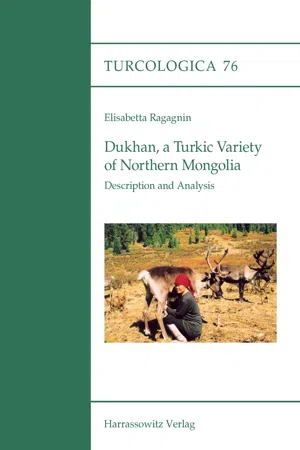
This volume offers the first grammatical description of Dukhan, a highly endangered non-written Turkic language spoken in northern Mongolia by approximately 500 people. Most of the Dukhans are engaged in reindeer breeding and follow a nomadic lifestyle in the forested taiga areas of the Tsagaan Nuur county in the Khövsgöl province of Mongolia. The present description is exclusively based on the material collected by the author during intensive fieldwork sojourns. After a presentation of the Dukhan people with respect to lifestyle, material culture and ethnohistorical background and some introductory linguistic considerations including a sociolinguistic scrutiny, the descriptive chapters focus on the sound system, derivational and inflectional morphology and the verbal categories aspect, mood and tense. The description of the phonological system is of particular interest, since it helps to better understand the fortis vs. lenis opposition of Turkic consonants. The volume also includes a large text corpus organized according to the topics "How to do things", "Life stories", "Tales" and "Legends". Each text is interlinearized: the first line represents the phonetic IPA-based transcription, the second line represents the broad transcription in use in Turcological studies, whereas the third and last line contains morpheme-by-morpheme glosses. Translations are given separately at the end of each text.
eBook - PDF
Dukhan, a Turkic variety of Northern Mongolia
Description and Analysis
- 305 pages
- English
- PDF
- Available on iOS & Android
eBook - PDF
About this book
Information
Table of contents
- Cover
- Titel Page
- Copyright
- Table of Contents
- Body
- Acknowledgments
- 1 Introduction
- 2 The speakers of Dukhan
- 3 The Dukhan language
- 4 The sound system: phonemes and allophones
- 5 Phonotactics and morphophonology
- 6 Diachronic phonology
- 7 Word classes and derivation
- 8 Inflectional morphology
- 9 Aspect, mood and tense
- 10 Other word classes
- Appendix A: Texts
- Appendix B: Map
- References
- Index
- List of Tables
Trusted by 375,005 students
Access to over 1.5 million titles for a fair monthly price.
Study more efficiently using our study tools.
Frequently asked questions
Yes, you can cancel anytime from the Subscription tab in your account settings on the Perlego website. Your subscription will stay active until the end of your current billing period. Learn how to cancel your subscription
No, books cannot be downloaded as external files, such as PDFs, for use outside of Perlego. However, you can download books within the Perlego app for offline reading on mobile or tablet. Learn how to download books offline
Perlego offers two plans: Essential and Complete
- Essential is ideal for learners and professionals who enjoy exploring a wide range of subjects. Access the Essential Library with 800,000+ trusted titles and best-sellers across business, personal growth, and the humanities. Includes unlimited reading time and Standard Read Aloud voice.
- Complete: Perfect for advanced learners and researchers needing full, unrestricted access. Unlock 1.5M+ books across hundreds of subjects, including academic and specialized titles. The Complete Plan also includes advanced features like Premium Read Aloud and Research Assistant.
We are an online textbook subscription service, where you can get access to an entire online library for less than the price of a single book per month. With over 1.5 million books across 990+ topics, we’ve got you covered! Learn about our mission
Look out for the read-aloud symbol on your next book to see if you can listen to it. The read-aloud tool reads text aloud for you, highlighting the text as it is being read. You can pause it, speed it up and slow it down. Learn more about Read Aloud
Yes! You can use the Perlego app on both iOS and Android devices to read anytime, anywhere — even offline. Perfect for commutes or when you’re on the go.
Please note we cannot support devices running on iOS 13 and Android 7 or earlier. Learn more about using the app
Please note we cannot support devices running on iOS 13 and Android 7 or earlier. Learn more about using the app
Yes, you can access Dukhan, a Turkic variety of Northern Mongolia by Elisabetta Ragagnin in PDF and/or ePUB format, as well as other popular books in Languages & Linguistics & Languages. We have over 1.5 million books available in our catalogue for you to explore.