eBook - ePub
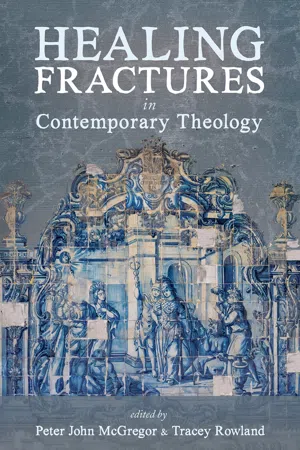
Healing Fractures in Contemporary Theology
- 302 pages
- English
- ePUB (mobile friendly)
- Available on iOS & Android
eBook - ePub
Healing Fractures in Contemporary Theology
About this book
Since Vatican II, the key question that has developed in Catholic theology, often unstated or unrecognized, is, what is theology? The thesis presented here is that contemporary theologizing is "fractured" in many places and to varying degrees. These fractures can vary in seriousness between theologians, and a particular theologian may suffer from some fractures but not others. The fractures addressed here are between
-theology and spirituality
-theology and philosophy
-theology and liturgy
-the literal and spiritual senses of sacred scripture
-theology, preaching, and apologetics
-theology and ethics
-theology and social theory
-dogmatic and pastoral theology
-theology and the "koinonial" Christian life
-theologians and non-theologians
- the generation gap between Gen X and Millennial/Post-Millennial Catholics, and
-theology and the Magisterium.
For each of these, an attempt is made to examine the symptoms, give a diagnosis, and write a prescription.
Information
Topic
Theology & ReligionSubtopic
Christian Denominations1
Theology and Spirituality
If someone were a member of an Introduction to Theology class at a seminary or university, the most simple definition of theology that he or she would be likely to hear would almost certainly be St. Anselm’s dictum fides quaerens intellectum, faith seeking understanding. Or a person might be told that, based on the etymology of the term, theology is the “word about” or the “study of” God. Or one might be directed to read the first question in St. Thomas Aquinas’s Summa Theologiae, there discovering that sacra doctrina is a science that is based on principles revealed by God.1 Or a more contemporary definition proposed might be something like that of Karl Rahner’s, that theology “is essentially the conscious effort of the Christian to hearken to the actual verbal revelation, which God has promulgated in history, to acquire a knowledge of it by the methods of scholarship and to reflect upon its implications.”2 Or another might be that of St. John Paul II, that theology “is a cognitive process through which the human mind, illuminated by faith and stimulated by love, advances in the immense territories that divine Revelation has thrown open before it,” and is “a science through which the Christian’s reason, which receives certitude from the light of faith, by reasoning strives to understand what it believes, that is, the revealed mysteries and their consequences.”3 Having said this, one thing that all of these definitions of theology have in common is that they can give the impression that theology, while it involves revelation and faith, is at its most fundamental level an exercise in discursive reasoning.
In contrast, Joseph Ratzinger has drawn attention to the ancient Greek use of the word θεολογία (theologia) to designate, not a human science, but the divine discourse itself. For this reason, the Greeks designated as “theologians” only those who could be regarded as instruments of the divine discourse. So, Aristotle drew a distinction between θεολογία and θεολογιχή (theologiche)—between theology and the study of theology, between the divine discourse and human effort to understand it. Pseudo-Dionysius used the word “theology” to designate Sacred Scripture—the discourse of God rendered into human words.4 According to him, Scripture alone is theology in the fullest sense of the word. The writers of Sacred Scripture are theologoi, “through whom God as subject, as the word that speaks itself, enters into history.”5 Thus the Bible becomes the model of all theology, and the biblical writers the norm for the theologian. Because theology is ultimately the word which God speaks to us, it can never be a merely “positive” science, but rather a “spiritual” one. Even when studied in the academe, theology must be studied “in the context of a corresponding spiritual praxis and of a readiness to understand it, [and] at the same time, as a requirement that must be lived[;] . . . just as we cannot learn to swim without water, so we cannot learn theology without the spiritual praxis in which it lives.”6 It must include “the necessary self-transcendence of contemplation into the practice of the faith.”7
Here Ratzinger is saying something more than that theologians need to be prayerful people. The spiritual praxis to which he refers is something more than being faithful to prayer, or even that it must be a theology “on one’s knees.”8 It is a praxis within which theology “lives,” and “a requirement that must be lived.” One must understand this spiritual praxis, this “spirituality,” as something more than one’s prayer life, or a particular “spirituality” identified as “Benedictine,” “Franciscan,” “Dominican,” or “Carmelite.” It is contemplation that is put into practice, that is, it is theoria that is put into praxis.
It will be the contention of this chapter that a “fracture” is to be found in much contemporary theology between what Ratzinger calls the “positive” and the “spiritual” aspects of this theology. This could also be expressed by the statement that much contemporary theology is “despiritua...
Table of contents
- Title Page
- Contributors
- Introduction
- Chapter 1: Theology and Spirituality
- Chapter 2: What Is Philosophy?
- Chapter 3: Theology and Philosophy
- Chapter 4: Theology and Liturgy
- Chapter 5: The Literal and Spiritual Senses of Sacred Scripture
- Chapter 6: Theology, Preaching, and Apologetics
- Chapter 7: Theology and Ethics
- Chapter 8: Theology and Social Theory
- Chapter 9: Dogmatic and Pastoral Theology
- Chapter 10: Theology and the “Koinonial” Christian Life
- Chapter 11: Theologians and Non-Theologians
- Chapter 12: The Generation Gap between Gen X and Millennial/Post-Millennial Catholics
- Chapter 13: Theologians and the Magisterium
Trusted by 375,005 students
Access to over 1.5 million titles for a fair monthly price.
Study more efficiently using our study tools.
Frequently asked questions
Yes, you can cancel anytime from the Subscription tab in your account settings on the Perlego website. Your subscription will stay active until the end of your current billing period. Learn how to cancel your subscription
No, books cannot be downloaded as external files, such as PDFs, for use outside of Perlego. However, you can download books within the Perlego app for offline reading on mobile or tablet. Learn how to download books offline
Perlego offers two plans: Essential and Complete
- Essential is ideal for learners and professionals who enjoy exploring a wide range of subjects. Access the Essential Library with 800,000+ trusted titles and best-sellers across business, personal growth, and the humanities. Includes unlimited reading time and Standard Read Aloud voice.
- Complete: Perfect for advanced learners and researchers needing full, unrestricted access. Unlock 1.5M+ books across hundreds of subjects, including academic and specialized titles. The Complete Plan also includes advanced features like Premium Read Aloud and Research Assistant.
We are an online textbook subscription service, where you can get access to an entire online library for less than the price of a single book per month. With over 1.5 million books across 990+ topics, we’ve got you covered! Learn about our mission
Look out for the read-aloud symbol on your next book to see if you can listen to it. The read-aloud tool reads text aloud for you, highlighting the text as it is being read. You can pause it, speed it up and slow it down. Learn more about Read Aloud
Yes! You can use the Perlego app on both iOS and Android devices to read anytime, anywhere — even offline. Perfect for commutes or when you’re on the go.
Please note we cannot support devices running on iOS 13 and Android 7 or earlier. Learn more about using the app
Please note we cannot support devices running on iOS 13 and Android 7 or earlier. Learn more about using the app
Yes, you can access Healing Fractures in Contemporary Theology by Peter John McGregor,Tracey Rowland, Peter John McGregor, Tracey Rowland in PDF and/or ePUB format, as well as other popular books in Theology & Religion & Christian Denominations. We have over 1.5 million books available in our catalogue for you to explore.