The Instructional Design Trainer's Guide provides foundational concepts and actionable strategies for training and mentoring instructional design and educational technology students to be effective across contexts. ID faculty are charged with bridging the gap between research and practice preparing graduate students for the real-world workforce. This book provides trainers and university programs with authentic learning experiences that better articulate the practices of and demands on design and technology professionals in the field. Through this enhanced perspective, learners will be better positioned to confidently embrace constraints, work among changing project expectations, interact with multiple stakeholders, and convey to employers the skills and competencies gleaned from their formal preparation.
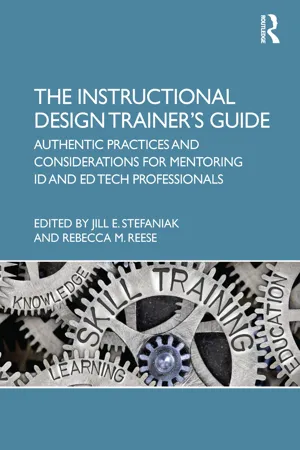
eBook - ePub
The Instructional Design Trainer’s Guide
Authentic Practices and Considerations for Mentoring ID and Ed Tech Professionals
- 250 pages
- English
- ePUB (mobile friendly)
- Available on iOS & Android
eBook - ePub
The Instructional Design Trainer’s Guide
Authentic Practices and Considerations for Mentoring ID and Ed Tech Professionals
About this book
Information
1 A Holistic Approach to Teaching Instructional Design
Jill E. Stefaniak and Rebecca M. Reese
DOI: 10.4324/9781003109938-1
Chapter Overview
The practice of instructional design consists of applying strategies to analyze, design, and development solutions that best address the needs of a situation. Experienced instructional designers apply an iterative approach to design where they take a systemic view of the situation and use that information to inform their design. While several books have been written that outline the fundamental practices of instructional design, many of these imply that instructional design is simply a systematic and linear process. The purpose of this chapter is to provide our view of instructional design and explain the impetus for this book, which is focused on how to teach instructional design.
Guiding Questions
- What is instructional design?
- What challenges do I observe my students encountering while learning instructional design?
- What holistic skills do my students need to be taught to be successful?
- How can I promote a designer mindset in my classes?
- How can I prepare my students to consider the systemic implications of their design decisions?
What is Instructional Design?
Instructional design is commonly recognized by practitioners and academics as “the systematic and reflective process of translating principles of learning and instruction into plans for instructional materials, activities, information resources, and evaluation” (Smith & Ragan, 2005, p. 4). Richey et al. (2011) expanded on this definition to recognize the role and responsibility instructional designers have for facilitating and maintaining a variety of activities that support learning and improve performance.
Over the decades, a number of books have been written to provide an overview of the instructional design process (Brown & Green, 2016; Cennamo & Kalk, 2019; Dick et al., 2009; Larson & Lockee, 2020; Morrison et al., 2013; Seels & Richey, 1994). Many of these have been used as textbooks in several learning, design, and technology programs. While there may be slight differences to approaching instructional design, they all present prescriptive strategies for applying a systematic approach to instructional design.
Applying a systematic approach to instructional design does not necessarily equate to linearity. While most designers will adopt some systematic steps to designing instruction, expert designers recognize that design is recursive (Ertmer & Stepich, 2005; Rowland, 1992; Hardré et al., 2005; Perez & Emery, 1995). Experienced designers will approach every project with two things:
- Sustainable instructional design solutions require consideration of the systemic factors contributing to the project needs;
- Design requires an iterative approach to interpreting and meeting the needs of a project.
Recognizing that instructional design does not occur in a vacuum, it is important that instructional designers are trained to recognize the systemic nature that is instructional design (Kowch, 2019; Nelson, 2020; Stefaniak, 2020). In a systemic review conducted by Stefaniak and Xu (2020) to examine the extent that instructional design models address systemic considerations, they found three models addressed strategies to promote systemic design (Cennamo, 2003; Gibbons, 2014; Tessmer & Wedman, 1990).
Applications of Instructional Design
Instructional design extends to a variety of sectors such as business and industry, healthcare, higher education, government, K-12 education, military, and not-for-profit. Each sector has its own nuanced expectations, organizational culture, and factors that must be attended to by instructional designers. Several organizations such as the International Board of Standards for Training Performance and Instruction (ibstpi), the Association for Educational Communications and Technology, the E-Learning Guild, the Online Learning Consortium, and the International Society for Performance Improvement have established competencies and guidelines expected of instructional design professionals.
Several studies have been conducted exploring competencies expected of instructional designers. Table 1.1 provides an overview of these studies. These studies have explored which competencies, knowledge, skills, and attitudes are most prevalent in the field. A common theme among a number of the studies outlined in Table 1.1 is that they stress the need for instructional designers to extend their skillset beyond “ADDIE” to include attitudes and soft skills needed to facilitate instructional design activities. These soft skills include the ability to communicate with clients and team members, engage in project management, work independently and within a team, and demonstrate leadership (Koszalka et al., 2013; Visscher-Voerman, 2017; Williams van Rooij, 2010).
| Author(s) and Year | Audience | Purpose of Study |
|---|---|---|
| Kline et al. (2020) | Educational technologists in higher education (project management) | Exploration of project management competencies of educational technologists in higher education. |
| Martin et al. (2021) | Instructional designers in higher education | Overview of learning and development roles in higher education. |
| Martin and Ritzhaupt (2021) | Instructional designers | Overview of standards and competencies expected of instructional design and technology professionals. |
| Ritzhaupt and Kumar (2015) | Instructional designers in higher education | Study explored the knowledge, skills, and attitudes required of instructional designers in higher education. |
| Ritzhaupt and Martin (2014) | Educational technologists | Development of a multimedia competency survey to evaluate competencies required of educational technologists. |
| Rozitis (2017) | High school teachers | Examination of instructional design competencies required of high school teachers responsible for teaching online courses. |
| Sugar et al. (2007) | Instructional designers (multimedia production) | Identification of multimedia production competencies in instructional design practices. |
| Sugar et al. (2012) | Instructional designers (multimedia production) | Analysis of job postings to identify multimedia production competencies and skills expected of instructional designers. |
| Williams van Rooij (2011) | Instructional design (project management) | Study explored the convergence and divergence between instructional design and project management competencies. |
| Yalçın et al. (2021) | Instructional designers | Study explored the construct validity of the ibstpi standards. |
| York and Ertmer (2011) | Instructional designers | An exploratory study to establish instructional design heuristics to support the professional development of instructional designers. |
| Wang et al. (2021) | Instructional designers | Exploratory study comparing job announcement analyses with instructional design competencies. |
Upon our review of the scholarship on instructional design and the professional development of instructional designers in addition to our own personal experience as designers in the field, we suggest that the training and preparation of instructional designers expand beyond the prescriptive approaches focused on applying ADDIE and address constituent skills identified by experts in the field. Examples of these additional topics include, but are not limited to, the following:
- Adopting a designer mindset;
- Promoting equity and inclusive in design;
- Employing inclusive design;
- Recognizing systemic factors influencing work and learning environments;
- Espousing creativity in design;
- Project management and leadership.
This is not intended to be an exhaustive list, but it does emphasize the need for instructional designers to be training other key aspects of design and educational pedagogy.
Promoting Equity and Inclusive Through Design
Instructors often approach course design, the question of who they’re designing for comes last. Instructional design approaches designing with equity at the center of the process, to anticipate the unique needs of the target learners for each course. Putting learners at the heart of course design gives more of them the opportunity to successfully complete the course. When design does not interrogate assumptions about learner differences/needs it can end up reinforcing inequalities. Putting equity at the heart of instructional design confronts and removes barriers to learning.
Equity-centered design is typically described as the practice of intentional inclusivity throughout the design process thereby addressing inequity and barriers to success (Indar, 2018; Oliveri et al., 2020; Poe et al., 2018). Equity-centered design expands on the concept of human-centered design and relevant methodologies through intentional identification and addressing barriers for learners that are or could be minoritized within the learning environment. Equitable learning environments must be intentionally designed to create spaces in which all students have equitable access, and feel valued and supported. Without such ...
Table of contents
- Cover Page
- Half Title Page
- Title Page
- Copyright Page
- Dedication
- Contents
- About the Editors
- List of Contributors
- 1 A Holistic Approach to Teaching Instructional Design
- 2 An Overview of the Competencies and Career Outcomes in Educational Technology
- 3 Inscribing a Designer Mindset to Instructional Design Students
- 4 Preparing Instructional Design Students for Reflective Practice
- 5 Creativity and Design Thinking: Crucial Mindsets in Instructional Design Education
- 6 Learning Experience Design in Practice: “Theoretically, We Did Everything Right”
- 7 Empathy for Action in Instructional Design
- 8 Designed Failure in Instructional Design and Technology
- 9 Instructional Design from the Lens of Self-Regulated Ill-Structured Problem Solving: Research and Practical Applications
- 10 Designing for Service-Learning Experiences
- 11 Inclusive Online Courses: Universal Design for Learning Strategies that Impact Faculty Buy-In
- 12 Systems Thinking in Instructional Design
- 13 Integrating Ethics into the Curriculum: A Design-Based Approach for Preparing Professionals to Address Complex Problem Spaces
- 14 Instructional Design Embedded in Culture
- 15 Preparing Instructional Designers to Scale Needs Assessment
- 16 The Value of Human Performance Improvement in Instructional Design and Technology
- 17 Preparing Instructional Designers to Apply Human Performance Technology in Global Context
- 18 Integrating Evaluation in Instructional Design Practice
- 19 Project Management for Instructional Designers: Navigating People, Processes, and Politics
- 20 Supporting Instructional Design Graduate Education through Networked Learning and Institutional Social Media
- 21 Creating and Cultivating a Regional Community of Practice for Instructional Design and Faculty Development Practitioners
- 22 Developing Consulting Skills in Novice Instructional Designers
- Index
Trusted by 375,005 students
Access to over 1.5 million titles for a fair monthly price.
Study more efficiently using our study tools.
Frequently asked questions
Yes, you can cancel anytime from the Subscription tab in your account settings on the Perlego website. Your subscription will stay active until the end of your current billing period. Learn how to cancel your subscription
No, books cannot be downloaded as external files, such as PDFs, for use outside of Perlego. However, you can download books within the Perlego app for offline reading on mobile or tablet. Learn how to download books offline
We are an online textbook subscription service, where you can get access to an entire online library for less than the price of a single book per month. With over 1.5 million books across 990+ topics, we’ve got you covered! Learn about our mission
Look out for the read-aloud symbol on your next book to see if you can listen to it. The read-aloud tool reads text aloud for you, highlighting the text as it is being read. You can pause it, speed it up and slow it down. Learn more about Read Aloud
Yes! You can use the Perlego app on both iOS and Android devices to read anytime, anywhere — even offline. Perfect for commutes or when you’re on the go.
Please note we cannot support devices running on iOS 13 and Android 7 or earlier. Learn more about using the app
Please note we cannot support devices running on iOS 13 and Android 7 or earlier. Learn more about using the app
Yes, you can access The Instructional Design Trainer’s Guide by Jill Stefaniak, Rebecca Reese, Jill Stefaniak,Rebecca Reese,Jill E. Stefaniak,Rebecca M. Reese, Jill E. Stefaniak, Rebecca M. Reese in PDF and/or ePUB format, as well as other popular books in Didattica & Didattica generale. We have over 1.5 million books available in our catalogue for you to explore.