- 305 pages
- English
- PDF
- Available on iOS & Android
eBook - PDF
About this book
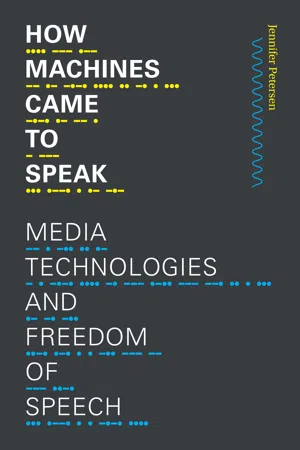
In How Machines Came to Speak Jennifer Petersen constructs a genealogy of how legal conceptions of "speech" have transformed over the last century in response to new media technologies. Drawing on media and legal history, Petersen shows that the legal category of speech has varied considerably, evolving from a narrow category of oratory and print publication to a broad, abstract conception encompassing expressive nonverbal actions, algorithms, and data. She examines a series of pivotal US court cases in which new media technologies—such as phonographs, radio, film, and computer code—were integral to this shift. In judicial decisions ranging from the determination that silent films were not a form of speech to the expansion of speech rights to include algorithmic outputs, courts understood speech as mediated through technology. Speech thus became disarticulated from individual speakers. By outlining how legal definitions of speech are indelibly dependent on technology, Petersen demonstrates that future innovations such as artificial intelligence will continue to restructure speech law in ways that threaten to protect corporate and institutional forms of speech over the rights and interests of citizens.
Information
Publisher
Duke University Press BooksYear
2022Print ISBN
9781478014522
9781478013600
eBook ISBN
9781478021827
Table of contents
- Cover
- Contents
- Acknowledgments
- Introduction. The “Speech” in Freedom of Speech
- 1. Moving Images and Early Twentieth-Century Public Opinion
- 2. “ A Primitive but Effective Means of Conveying Ideas”: Gesture and Image as Speech
- 3. Transmitters, Relays, and Messages: Decentering the Speaker in Midcentury Speech Law
- 4. Speech without Speakers: How Speech Became Information
- 5. Speaking Machines: The Uncertain Subjects of Computer Communication
- Conclusion. The Past and Future of Speech
- Appendix on Methods
- Notes
- Bibliography
- Index
Trusted by 375,005 students
Access to over 1.5 million titles for a fair monthly price.
Study more efficiently using our study tools.
Frequently asked questions
Yes, you can cancel anytime from the Subscription tab in your account settings on the Perlego website. Your subscription will stay active until the end of your current billing period. Learn how to cancel your subscription
No, books cannot be downloaded as external files, such as PDFs, for use outside of Perlego. However, you can download books within the Perlego app for offline reading on mobile or tablet. Learn how to download books offline
Perlego offers two plans: Essential and Complete
- Essential is ideal for learners and professionals who enjoy exploring a wide range of subjects. Access the Essential Library with 800,000+ trusted titles and best-sellers across business, personal growth, and the humanities. Includes unlimited reading time and Standard Read Aloud voice.
- Complete: Perfect for advanced learners and researchers needing full, unrestricted access. Unlock 1.5M+ books across hundreds of subjects, including academic and specialized titles. The Complete Plan also includes advanced features like Premium Read Aloud and Research Assistant.
We are an online textbook subscription service, where you can get access to an entire online library for less than the price of a single book per month. With over 1.5 million books across 990+ topics, we’ve got you covered! Learn about our mission
Look out for the read-aloud symbol on your next book to see if you can listen to it. The read-aloud tool reads text aloud for you, highlighting the text as it is being read. You can pause it, speed it up and slow it down. Learn more about Read Aloud
Yes! You can use the Perlego app on both iOS and Android devices to read anytime, anywhere — even offline. Perfect for commutes or when you’re on the go.
Please note we cannot support devices running on iOS 13 and Android 7 or earlier. Learn more about using the app
Please note we cannot support devices running on iOS 13 and Android 7 or earlier. Learn more about using the app
Yes, you can access How Machines Came to Speak by Jennifer Petersen in PDF and/or ePUB format, as well as other popular books in Social Sciences & Media & Entertainment Law. We have over 1.5 million books available in our catalogue for you to explore.