Introduction
This is a book about fish.
Not literally but metaphorically.
David Foster Wallace, American author and novelist, once wrote: “There are these two young fish swimming along and they happen to meet an older fish swimming the other way, who nods at them and says, ‘Morning, boys. How’s the water?’ And the two young fish swim on for a bit, and then eventually one of them looks over at the other and goes, “‘What’s water?’”1
The “moral” of this parable, if you will, is that most people are not aware of certain features of the world around them, despite how intertwined those features are in their lives. This is my attempt to be the older fish, except I am not asking you how the water is. I’m here to tell you that the water is poisoned.
My fear is that most people who use social media are like the two young fish in David Foster Wallace’s parable. Social media has become so woven into all of our lives that, like a fish in water, we don’t even notice it anymore. We just consume content on social media constantly without ever stopping to consider the puppet strings that are being pulled behind all the content on our screens. We consume content and content consumes us. This is my plea for you to stop scrolling for a moment and consider the state of the pixelated water in which you swim.
We easily swim through our lives today without considering the effects of social media on ourselves and the world around us. We spend our Friday nights scrolling Instagram while watching Netflix, and we don’t even think twice about it. We fight with strangers about politics on Twitter because it’s just what you do. We post pictures of our loved ones and life updates to Facebook without even considering the privacy implications of posting that information.
I grew up on social media, using AOL Instant Messenger as early as the first grade. I have spent about ten years deep-sea diving in this ocean by merit of my daily work and personal study. This is my attempt to steal your attention away from the Silicon Valley geniuses who have spent their lives trying to harness it so I can alert you to just how harmful it may be for your heart and your mind.
The social internet is brilliant and obscene. It sharpens the mind and dulls it. It brings nations together and tears them apart. It perpetuates, reveals, and attempts to repair injustice. It is an untamed beast upon which we can only hope to ride but never quite tame. It is hard to see it now, but the social internet is not just the latest iteration of the printing press or the television. The pervasiveness and invasiveness of the social internet can be likened to an alien invasion. You can’t stop it; you must learn to live alongside it, whether you like it or not. You may delete your Facebook account, but a friend will ask you if you have one. You can stay off Twitter, but you will hear about what happened there on the evening news.
We may be able to log off the social internet, delete our accounts, and never participate, but we can never escape its influence. What is it doing to us?
What’s the Point?
You can easily become discouraged when you are exploring the depth of negativity wrought by social media and our relationship with it. Whether it’s the rampant privacy concerns that average users ignore or the mental health effects that go untreated or the blurring of the line between “truth” and “fiction,” when you start to notice the toxins in the water and no one else seems to care, it can be disorienting to the point of despair. This is why I have kept the “What’s the point?” question at the fore of my mind all along.
My goal is not to tell you to delete your social media accounts. Though that is a fine application of what you will read. Nor is the point of this to call out the unethical practices of social media companies in their perpetual harvesting of user data for profit. Though that does happen in here.
So then, what is the point of this book?
The point is simply to help you see that the water is toxic. The goal is to help you recognize that social media is changing the way you think, feel, and live. Like water to a fish, social media has come to pervade the lives of everyone. As a fish cannot live apart from water, we cannot live apart from social media, even if we delete our accounts! My grandma has never used social media in her life. She might read this book because she loves me, but this book will be utter nonsense to her because she has never logged onto any social media platform. Guess what, though: in our weekly phone calls, she often mentions something her friends saw on Facebook. Social media is inescapable.
Because we cannot escape social media, my goal is not to call you to delete your accounts and log off. I simply want you to recognize that social media is changing how you think and feel about life and largely in negative ways. Whether this book leads you to delete your accounts or use them with greater discernment and care doesn’t matter to me. My hope is that your perspective is reoriented enough to at least examine your relationship with social media and not simply scroll on mental autopilot anymore. I provide some action steps in part 3, but those are optional applications of a bigger purpose: to know that the water is toxic.
In order to accomplish that purpose, though, I need something from you.
What This Book Requires of You
In his book Amusing Ourselves to Death, Neil Postman writes about Lewis Mumford, a twentieth-century American writer and thinker:
Lewis Mumford . . . has been one of our great noticers. He is not the sort of a man who looks at a clock merely to see what time it is. Not that he lacks interest in the content of clocks, which is of concern to everyone from moment to moment, but he is far more interested in how a clock creates the idea of “moment to moment.”
“The clock,” Mumford has concluded, “is a piece of power machinery whose ‘product’ is seconds and minutes.” In manufacturing such a product, the clock has the effect of disassociating time from human events and thus nourishes the belief in an independent world of measurable sequences.
Moment to moment, it turns out, is not God’s conception, or nature’s. It is man conversing with himself about and through a piece of machinery he created.
In Mumford’s great book Technics and Civilization, he shows how, beginning in the fourteenth century, the clock made us into time-keepers, and then time-savers, and now time-servers.2
If my book is to accomplish its purpose, to get you to recognize the noxious nature of the social media waters in which we swim, I need you to help me by being a “great noticer” like Lewis Mumford.
The product of a clock is its seconds and minutes; the product of social media is the content we consume. Like Mumford looked beyond the seconds and minutes produced by the clock, so we must look beyond the funny cat videos and family photos produced by our Facebook feeds. Man made the clock to serve man, but man ended up serving the clock. Man made social media to serve man, but man has come to serve social media.
I will serve you better if you read this book with the mind of Lewis Mumford, attempting to be a “great noticer” who looks beyond the surface of our most consuming pastime to the depths of how it is affecting every facet of our lives.
Man made social media to serve man, but man has come to serve social media.
Also, before we go any further, we have to do a bit of housekeeping in regard to terminology. I will use the term social internet more frequently than social media. I do this because I want us to think of the entire internet as social, not just the social media apps that litter our phone screens. The principles here apply to all the ways we interact with people online, not just through Facebook, Instagram, or other such platforms. Generally, I will use the term social media when I am referring to the apps and platforms we all use, and I will use the term social internet if I am speaking more broadly of all the ways the internet is social. If the term social internet trips you up, just mentally substitute social media for it; it’s not a big deal. But, given that this book is meant to broaden our understanding of the social aspects of the internet and how we are changed by them, I think it is important that we think in terms of the social internet, not just social media.
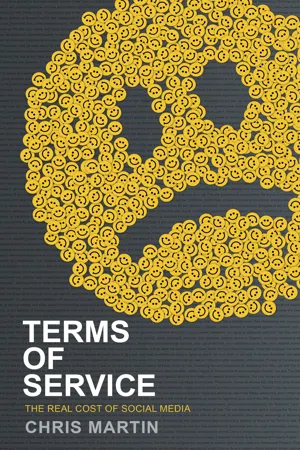
The Terms of Service
Nobody reads the terms of service for new websites or software they sign up to use. For instance, if you’re a Spotify user, when you checked the box in agreement with their terms, you provided them access to your photos and videos. Most Spotify users don’t know that. Apple iTunes users, your terms indicate that you cannot use iTunes to construct a nuclear missile, so don’t get any ideas! The terms of service (or terms and conditions, which is the same concept) to which we all agree when we sign up for a social media platform are often concerning in and of themselves.
We agree to a lot of conditions when we use social media that are not included in the terms of service we dishonestly say we have read when we sign up for these platforms. The terms of service we lie about reading do not mention the risk of mental illness or the insidious nature of cancel culture. There is no warning in terms of service agreements about rampant polarization or disfigured ideas of beauty.
When we chain ourselves to our preferred social media platforms, we give up more than we realize. Social media may not cost anything, but it isn’t free.
I am concerned about the terms of our service to an invention that was originally designed to serve us but which we have come to serve. We are servants of the social internet. It governs our days and poisons our lives more than we recognize.
To what have we agreed? These social media apps may be free, but what do they actually cost us?
Let’s find out.