Justice and Equity in Climate Change Education
eBook - ePub

Justice and Equity in Climate Change Education

Exploring Social and Ethical Dimensions of Environmental Education

  1. 296 pages
  2. English
  3. ePUB (mobile friendly)
  4. Available on iOS & Android
eBook - ePub

Justice and Equity in Climate Change Education

Exploring Social and Ethical Dimensions of Environmental Education

About this book

This volume looks at the ways in which climate change education relates to broader ideas of justice, equity, and social transformation, and ultimately calls for a rapid response to the need for climate education reform.

Highlighting the role of climate change in exacerbating existing societal injustices, this text explores the ethical and social dimensions of climate change education, including identity, agency, and societal structure, and in doing so problematizes climate change education as an equity concern. Chapters present empirical analysis, underpinned by a theoretical framework, and case studies which provide critical insights for the design of learning environments, curricula, and everyday climate change-related learning in schools.

This text will benefit researchers, academics, educators, and policymakers with an interest in science education, social justice studies, and environmental sociology more broadly. Those specifically interested in climate education, curriculum studies, and climate adaption will also benefit from this book.

Information

Publisher
Routledge
Year
2022
Print ISBN
9781032162560
9780367344702
eBook ISBN
9781000517163
Edition
1

Part I Theoretical Perspectives of Equity and Justice in Climate Change Education

1 Bringing Climate Injustices to the Forefront Learning from the Youth Climate Justice Movement

Rupinder Kaur Grewal, Ellen Field, and Paul Berger
DOI: 10.4324/9780429326011-3
April 22, 2021 was marked by an Earth Summit, organized by the Biden–Harris Administration, that brought 40 leaders from around the world together to pledge new greenhouse gas reduction targets. Xiye Bastida, a Mexican-born 19-year-old, was one of two youth activists invited to speak. Her speech to global leaders demanded holistic and inclusive solutions to climate change:
You need to accept that the era of fossil fuels is over. We need a just transition to renewables worldwide so that we can stop emitting carbon and focus on drawing down carbon. But most importantly, all of these solutions must be implemented with the voices of frontline black, brown, and Indigenous communities as leaders and decision-makers. We demand comprehensive, non-Eurocentric climate education including literacy on climate justice, environmental, ancestral and Indigenous wisdom on historical movements … You are the naive ones, if you think we can survive this crisis in the current way of living. You are the pessimists if you don’t believe we have what it takes to change the world. If you want to know why youth activists are rising up, it’s because we’re striving for joy. Joy for our communities and future generations. The climate crisis is so violent, and it has exacerbated so much injustice, it is time that you stop thanking us for being activists.
Bastida is advocating for system change that addresses multiple injustices, reaching far beyond generational injustices to include considerations of race, colonial histories, geopolitics, and Western economic power and privilege. Since Greta Thunberg’s lone climate strike in 2018, the climate strike movement has continued to grow and evolve into a global network of youth climate activist groups focused on campaigns advocating for systemic change that center justice. Bastida’s speech points to the disconnect between the dominant cultural perspective on climate change as a technical problem and the current, often youth-driven, demand for climate justice-oriented discourses to generate responsive and inclusive actions to tackle climate change and its underlying causes.
There is finally now recognition by North American leaders of the urgent need to sharply reduce greenhouse gas emissions by 2030 to mitigate dangerous climate disruption (Davenport et al., 2021). With current climate change education responses inadequate (Field et al., 2019; Plutzer et al., 2016), and a window of opportunity for change opened by awareness of the need to act at every level, this chapter explores key ideas from the youth climate justice movement that formal education systems should embrace. We begin with the development of the movement, discuss some of its defining aspects, describe gaps in current climate change education, and conclude by proposing a framework for climate justice education for formal education systems. We believe that formal education structures, curricula, and practice must learn from the youth climate justice movement. Schooling should move beyond the current focus of knowledge and understanding of climate change science and climate impacts (Bhattacharya et al., 2020; Hargis & McKenzie, 2020; Wynes & Nicholas, 2019) and go through a pivotal reorientation of what schooling “is” and “does” in this current moment where, globally, we face an existential crisis (Kwauk & Casey, 2021). In this chapter, we argue that the youth climate justice movement provides a blueprint for transformative and transgressive pedagogies that formal education systems should learn from and integrate into their policies and practices.

Key Aspects of the Youth Climate Justice Movement

In this section, we provide context and outline defining aspects of the youth climate justice movement.

Emergence of the Youth Climate Justice Movement

The environmental justice movement preceded the climate justice movement in drawing attention to the disproportionate environmental degradation experienced by communities of color (McKenzie et al., 2017; Mitchell & D’Onofrio, 2016). Resistance to activities that harm the environment has, of course, been led by Black, Indigenous, and racialized communities (BIPoC) since long before the term environmental justice began to be used by Black people in the Civil Rights Movement in the USA in the 1960s (Stephens, 1996).
The climate justice movement is said to have begun by critiquing the carbon-driven economy as an indicator of larger inequities exploited by global capitalism (Schlosberg & Collins, 2014). The movement originated with a focus on eradicating the causes of climate change and addressing the inequitable impacts of the oil industry (Bruno et al., 1999). CorpWatch, an NGO that helped organize the first-ever known Climate Justice Summit during COP 6 in 2000, became one of the major movement organizations, along with Climate Justice Now! at the Bali COP13 meetings in 2007 (Schlosberg & Collins, 2014). The climate justice movement focuses on how climate change disproportionately impacts marginalized groups and the world’s poorest countries.
The movement recently gained tremendous traction, revitalized and invigorated by youth activists. In 2015, a group of students invited youth worldwide to miss school on the first day of the United Nations Climate Change Conference in Paris (Climate Strike, 2016). On November 30, 2015, supported by several organizations including 350.org, a climate strike took place in over 100 countries from Melbourne to Mexico City, with more than 50,000 people participating (Phipps et al., 2015). In addition to demanding 100% clean energy and to keep fossil fuels in the ground, protesters and activists were pushing for a bolder international agreement at the climate summit (Adam & Siddiqui, 2015). The international agreement was negotiated over the period of two weeks during the Paris United Nations Framework Convention on Climate Change’s (UNFCCC) 21st Conference of the Parties (COP 21). The Paris Agreement was finally adopted on December 12, 2015, which was a “historic turning point for global climate action” as it was a point when “world leaders came to a consensus on an accord comprised of commitments by 195 nations to combat climate change and adapt to its impacts” (Denchak, 2021, para. 2).
The climate strike of November 2015 and the establishment of the Paris Agreement gave rise to a proliferation of new movements and organizations oriented towards climate justice, including: Zero Hour (2017), the Sunrise Movement (2017), and Fridays for Future (2018). However, this is not to say that there were none prior to 2015; other organizations include: Greenpeace (1971), the IPCC (1988), 350.org (2007), Guardians of the Forest, also known as Guardians of the Amazon (2013), and Project Drawdown (2014). Some have deep roots. For instance, Guardians of the Forest are a group of 120 Indigenous peoples in the Brazilian state of Maranhão who have been defending their land and the remaining Amazon rainforest for more than five centuries. When asked when they were founded, one of the leaders of the group, Olimpio Santos Guajajara, answered: “in 1500, the year the Portuguese landed in Brazil with an armada under the command of Pedro Álvares Cabral” (Libardi, 2020, para. 1).
Youth activism itself is also not new; youth aged 18–30 have participated in both local and international social movements across the world for decades. They have been instrumental in fighting for social justice, including in feminist, environmentalist, anti-war, immigrant rights, and the US Civil Rights movements. In relation to climate change activism, youth in Australia, for example, formed the Australian Youth Climate Coalition in November 2006 to organize and involve youth in demanding climate change actions from government leaders (Munro, 2009). What is relatively new and specific to the current youth climate justice movement is that youth activists are positioned as leaders, where they are asked to speak at international governmental meetings, have rallied millions, and are leading robust social movements aimed at stopping the existential crisis of our time (Bowman, 2020a; Han & Ahn, 2020). Canadian water warrior Autumn Peltier, Land Protector Quannah Chasinghorse, Little Miss Flint (Amariyanna “Mary” Copeny), the Guardians of the Forest, and Zeena Abdulkarim (from Zero Hour) are among many inspiring youths who are leading the climate justice movement today (Janfaza, 2020). The work achieved by such resilient Black, Indigenous, and racialized youth activists will be discussed in further sections.

Justice as Central for Youth Climate Activists

Marginalized communities are at the forefront of experiencing the negative impacts of climate change, with Indigenous peoples worldwide often the first to suffer, given their intimate relationship with the environment. This includes Indigenous peoples from sub-Saharan Africa, the Maldives, the Himalayas, Bangladesh, the Amazon, and the Arctic regions (Etchart, 2017; Haluza-Delay, 2013). Greta Thunberg (2019), the Swedish teen whose 2018 school climate strike sparked a huge wave of youth protest, consistently highlights “equity” in her speeches, including: “the people who have contributed the least to this crisis are the ones who are going to be affected the most” (pp. 39–40). Whereas the focus of mainstream climate change movements is often on reducing greenhouse gas emissions, the youth climate justice movement emphasizes disproportionate climate change impacts and insists that these inequities must be addressed at a governmental level.
Climate justice is a contested concept, developing out of policy discourses (e.g., Robinson, 2018), liberal philosophy, and the youth climate justice movement (McGregor et al., 2018). It differs from environmental racism, environmental justice, or ecojustice, though they often get grouped together or are used interchangeably in some contexts (see Haluza-Delay, 2013). Like environmental justice, many scholars have advocated the use of climate justice to describe the effects of climate change through a human rights lens and social justice framework (Haluza-Delay et al., 2009; Klein, 2014; Stapleton, 2019; Tuck & Yang, 2018). Movements focused on climate justice aim to disrupt oppressive systems of colonialism, capitalism, patriarchy, and racism, and try to reimagine the current inequitable system so those who are already underprivileged are not further disadvantaged by climate change (Kanbur, 2018; Stapleton, 2019).
As many youth activists have continuously asserted, climate injustices are not merely environmental issues but also racial injustices and gender injustices (McKibben, 2017). However, the claims of youth climate activists are not homogeneous nor are their experiences; and they may be better understood as a “polyphonic movement” (Bowman, 2020b). Nevertheless, youth climate activist messaging has a common characteristic that focuses on intergenerational injustices of climate disruption; that is, climate change will affect their futures and that adults have not acted with moral responsibility and obligation (Robinson, 2018). Given that youth are in marginalized positions (Bowman, 2020b), and that intergenerational injustice is the starting point of their climate concerns (Thew et al., 2020), the youth climate activist movement is embedded with an intersectional view, advocating for lenses of equity, anti-oppression, and anti-racism to be permanently integrated into decision-making with a focus on addressing the underlying roots of climate injustices (Damico et al., 2020; Klein, 20...
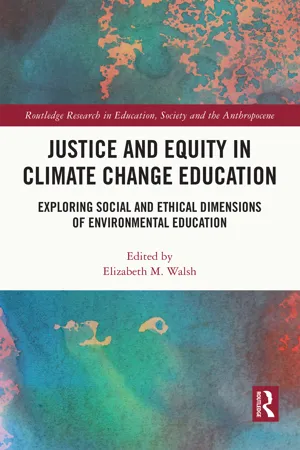
Table of contents

  1. Cover Page
  2. Half Title Page
  3. Series Page
  4. Title Page
  5. Copyright Page
  6. Contents
  7. List of Illustrations
  8. Preface
  9. List of Contributors
  10. Introduction: Climate Change Education Must Be Education for Justice: Historical and Conceptual Foundations for Centering Equity in Climate Change Education
  11. Part I Theoretical Perspectives of Equity and Justice in Climate Change Education
  12. Part II Case Studies and Enactments of Climate Change Education for Equity and Justice

Trusted by 375,005 students

Access to over 1.5 million titles for a fair monthly price.

Study more efficiently using our study tools.

Frequently asked questions

Yes, you can cancel anytime from the Subscription tab in your account settings on the Perlego website. Your subscription will stay active until the end of your current billing period. Learn how to cancel your subscription
No, books cannot be downloaded as external files, such as PDFs, for use outside of Perlego. However, you can download books within the Perlego app for offline reading on mobile or tablet. Learn how to download books offline
Perlego offers two plans: Essential and Complete
  • Essential is ideal for learners and professionals who enjoy exploring a wide range of subjects. Access the Essential Library with 800,000+ trusted titles and best-sellers across business, personal growth, and the humanities. Includes unlimited reading time and Standard Read Aloud voice.
  • Complete: Perfect for advanced learners and researchers needing full, unrestricted access. Unlock 1.5M+ books across hundreds of subjects, including academic and specialized titles. The Complete Plan also includes advanced features like Premium Read Aloud and Research Assistant.
Both plans are available with monthly, semester, or annual billing cycles.
We are an online textbook subscription service, where you can get access to an entire online library for less than the price of a single book per month. With over 1.5 million books across 990+ topics, we’ve got you covered! Learn about our mission
Look out for the read-aloud symbol on your next book to see if you can listen to it. The read-aloud tool reads text aloud for you, highlighting the text as it is being read. You can pause it, speed it up and slow it down. Learn more about Read Aloud
Yes! You can use the Perlego app on both iOS and Android devices to read anytime, anywhere — even offline. Perfect for commutes or when you’re on the go.
Please note we cannot support devices running on iOS 13 and Android 7 or earlier. Learn more about using the app
Yes, you can access Justice and Equity in Climate Change Education by Elizabeth M. Walsh in PDF and/or ePUB format, as well as other popular books in Didattica & Didattica generale. We have over 1.5 million books available in our catalogue for you to explore.