- 164 pages
- English
- ePUB (mobile friendly)
- Available on iOS & Android
eBook - ePub
Analog and Pulse Circuits
About this book
This book is intended for anyone who has an interest to learn the analysis and design of analog and digital systems. The book covers the foundation of analysis and design of all analog and pulse circuits. The book is organized into seven chapters. In each chapter, practical derivations are explained step by step.
Note: T& F does not sell or distribute the Hardback in India, Pakistan, Nepal, Bhutan, Bangladesh and Sri Lanka.
Frequently asked questions
Yes, you can cancel anytime from the Subscription tab in your account settings on the Perlego website. Your subscription will stay active until the end of your current billing period. Learn how to cancel your subscription.
No, books cannot be downloaded as external files, such as PDFs, for use outside of Perlego. However, you can download books within the Perlego app for offline reading on mobile or tablet. Learn more here.
Perlego offers two plans: Essential and Complete
- Essential is ideal for learners and professionals who enjoy exploring a wide range of subjects. Access the Essential Library with 800,000+ trusted titles and best-sellers across business, personal growth, and the humanities. Includes unlimited reading time and Standard Read Aloud voice.
- Complete: Perfect for advanced learners and researchers needing full, unrestricted access. Unlock 1.4M+ books across hundreds of subjects, including academic and specialized titles. The Complete Plan also includes advanced features like Premium Read Aloud and Research Assistant.
We are an online textbook subscription service, where you can get access to an entire online library for less than the price of a single book per month. With over 1 million books across 1000+ topics, we’ve got you covered! Learn more here.
Look out for the read-aloud symbol on your next book to see if you can listen to it. The read-aloud tool reads text aloud for you, highlighting the text as it is being read. You can pause it, speed it up and slow it down. Learn more here.
Yes! You can use the Perlego app on both iOS or Android devices to read anytime, anywhere — even offline. Perfect for commutes or when you’re on the go.
Please note we cannot support devices running on iOS 13 and Android 7 or earlier. Learn more about using the app.
Yes, you can access Analog and Pulse Circuits by Dayaydi Lakshmaiah,C.B. Ramarao,K. Kishan Rao in PDF and/or ePUB format, as well as other popular books in Technology & Engineering & Electrical Engineering & Telecommunications. We have over one million books available in our catalogue for you to explore.
Information
Edition
1Chapter 1 Linear Wave Shaping
1.1 INTRODUCTION
Let us consider a transmission network consisting of linear elements. Sinusoidal signal is applied to a network, the output signal is sinusoidal in the steady state conditions. The influence of the network circuit on the signal may be completely specified by the ratio of output to input amplitude and phase angle between output and input waveform. No other periodic waveform preserves its shape. Generally when transmitted through a linear network the output signal may have a little resemblance to the input signal.
“The process whereby the shapes of non sinusoidal signals are shaped by passing the signal through the linear network is called linear wave shaping”.
1.2 HIGH PASS RC CIRCUIT

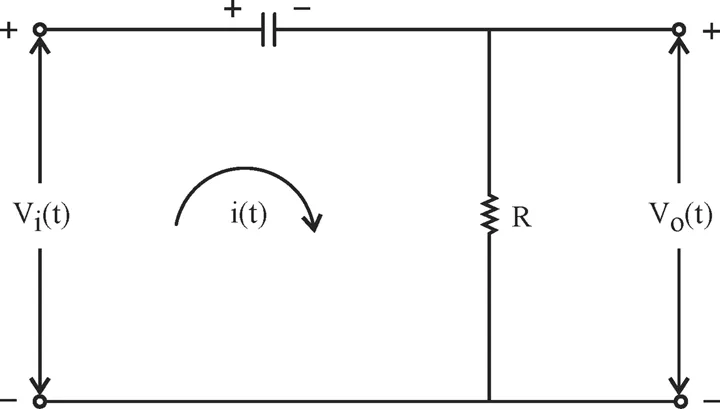
The high pass RC circuit is shown in Fig.1.1. The input is denoted by Vi(t), and the output as Vo(t), ‘a’ is the charge of the capacitor.
At zero frequency the capacitor has infinite reactance and hence open circuited. Therefore, the capac...
Table of contents
- Cover Page
- Half-Title Page
- Title Page
- Copyright Page
- Dedication
- Preface
- Table of Contents
- Chapter 1 Linear Wave Shaping
- Chapter 2 Non Linear Wave Shaping
- Chapter 3 Switching Characteristics of Devices
- Chapter 4 Multi-vibrator
- Chapter 5 Time Base Generator
- Chapter 6 Logic Gates
- Chapter 7 Sampling Gates