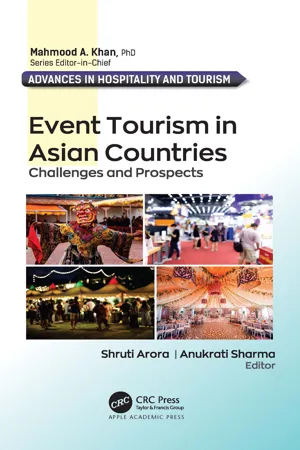
Events, including repeat annual events, have the unique ability to drive sustainable tourism to certain areas and regions and to generate economic benefits for local communities. The events industry has grown dramatically over the last several decades, and there has been increased participation from governments, local communities, and the private sector. This new volume offers a wide variety of research, experience, and examples of events in Asia, including business meetings and conferences, destination weddings, carnivals, food and art festivals, music festivals and concerts, cultural and traditional events, religious and spiritual gatherings, sports events, and others.
The authors, from various parts of Asia, give illustrative examples of events tourism from their home countries, including India, Sri Lanka, Turkey, Malaysia, Uzbekistan, and Kyrgyzstan. The diverse perspectives are from stakeholders, travelers, researchers, academicians, professionals in the event and tourism industry, and the community. The chapters in the volume cover the changing trends in the event tourism industry, the influence and role of social media and other technology, the contribution of women in events and festivals, and the impact of event tourism in economic development on local communities.
Addressing the issues, challenges, and future of event tourism and management, this new volume will be a valuable addition to the library of event professionals, hospitality and tourism researchers, community development managers, and others in Asia and elsewhere.
Frequently asked questions
Yes, you can cancel anytime from the Subscription tab in your account settings on the Perlego website. Your subscription will stay active until the end of your current billing period. Learn how to cancel your subscription.
At the moment all of our mobile-responsive ePub books are available to download via the app. Most of our PDFs are also available to download and we're working on making the final remaining ones downloadable now. Learn more here.
Perlego offers two plans: Essential and Complete
Essential is ideal for learners and professionals who enjoy exploring a wide range of subjects. Access the Essential Library with 800,000+ trusted titles and best-sellers across business, personal growth, and the humanities. Includes unlimited reading time and Standard Read Aloud voice.
Complete: Perfect for advanced learners and researchers needing full, unrestricted access. Unlock 1.4M+ books across hundreds of subjects, including academic and specialized titles. The Complete Plan also includes advanced features like Premium Read Aloud and Research Assistant.
Both plans are available with monthly, semester, or annual billing cycles.
We are an online textbook subscription service, where you can get access to an entire online library for less than the price of a single book per month. With over 1 million books across 1000+ topics, weâve got you covered! Learn more here.
Look out for the read-aloud symbol on your next book to see if you can listen to it. The read-aloud tool reads text aloud for you, highlighting the text as it is being read. You can pause it, speed it up and slow it down. Learn more here.
Yes! You can use the Perlego app on both iOS or Android devices to read anytime, anywhere â even offline. Perfect for commutes or when youâre on the go. Please note we cannot support devices running on iOS 13 and Android 7 or earlier. Learn more about using the app.
Yes, you can access Event Tourism in Asian Countries by Shruti Arora,Anukrati Sharma in PDF and/or ePUB format, as well as other popular books in Business & Hospitality, Travel & Tourism Industry. We have over one million books available in our catalogue for you to explore.
The tourism and travel industry is such an industry that has developed as the biggest worldwide industry in the 20th century and is anticipated to grow quicker day by day and events have become a big way to gather large amount of media interest, and attracting venture and moreover political interest, and this also lays the role of events combining with tourism. Events are the significant spark in tourism industry. The Asian nations have a wonderful history of showing their societies and cultures through different events and having tourism prospects. Although it is of common knowledge that event tourism as an industry has equally optimistic and pessimistic impacts on destinations and their communities, the impact of properly planned events on tourism has been a reason of escalating significance for destination competitiveness because they add a mixture of attractions to the tourist. Due to this reason only event tourism became established as an independent discipline a few decades ago. The reason behind this study is to assess principally the idea of events and the tourism industry and the connection linking events and tourism through theoretical study. In this chapter, the nature, evolution, growth and expansion of event tourism, and future challenges are discussed.
1.1 INTRODUCTION
Tourism, by and large, is known for its accommodation, hospitality, leisure, and guest attractions. But today event organizers and managers have realized the value of events and this awareness gave birth to the event tourism industry. Going into event tourism it is first and foremost imperative to identify what tourism and event are since they both go connected with each other. The term âeventâ does not have a universally accepted single definition. The events are extremely flexible or multitalented in nature; as a result the explanation of the events can vary in different situations. Bowdin (2006) observes the word âeventâ is to reveal particular functions, presentations, performances, or festivities that are deliberately structured and molded to smear special occasions and/or to accomplish particular social, cultural, or corporate objectives and destinations. Events are increasing in recent decades and interest in understanding their importance in the tourism industry has risen accordingly. An occasion or event is happening at a particular point in time and place, or celebrating, or identifying a unique event. An event plays a momentous role in the enlargement of culture, arts, education, and tourism. There are different types of events which are as follows (Figure 1.1):
FIGURE1.1 Types/classification of event, Source: Sharma and Arora (2018).
Mega events that are by and large targeted at international markets. They have an explicit acquiesce in terms of enlarged tourism, media exposure, and financially viable impact like the Olympic Games, Commonwealth Games, Maha Kumbh Mela.
Minor events include historical, cultural, and musical and dance performance.
Major events magnetize considerable local interest and a huge number of participants as well as generating significant tourism income like the Jaipur Literature Festival.
Regional events that are designed to increase the appeal of a specific tourism destination or region like Pushkar Mela.
Corporate events, such as business dinners, conferences, product launches, and meetings, are used to endorse their companyâs brand name and products.
Private events, such as wedding, birthday parties, and festival gatherings, are used for persons who can book venues.
Charity/fundraising events are organized to raise money for a charitable trust such as charitable auctions.
Tourism has a great potential to accelerate progress across sustainable development goals. It can generate quality jobs for durable growth, reduce poverty, and promote fair and inclusive economic growth. Tourism can be explained as an individual traveling to and staying in places outside their normal environment for the purpose of relaxation, business, and different purposes. Events are supportive in destination appearances and attractiveness and on a very basic level, it is useful in advertising and promotion of places that are productive in worldwide competitiveness to pull visitor spending. Combination of event and tourism is explained by Getz (2008) that explains event tourism as an interrelation between tourism management and event management. Tourismmanagement deals with tourism development depending on examining the behavior and motivation of a wide range of sightseers. On the other side, event management transacts with event marketing, blueprint, and supervision of an event. Subsequently, event tourism is in the focal point of these management segments. In other words, event tourism focuses on full use of the abilities of events to accomplish tourism expansion of host communities. Event tourism can be described as planning and advertising of any events, fairs, and festivals to attract more tourist that can act as a technique for financial boom. Present tourism is an increasingly rigorous, commercially structured, and business-related set of activities and as a result, events have gained fame and used efficiently by profit and nonprofit institutions.
1.2 RELATIONSHIP BETWEEN EVENTS AND TOURISM
The rise in per capita income and the necessitate for leisure and pastime activity put up an emergent interest in tourism (Komurcu et al., 2014). In the same way, the demands and needs of the tourists become enlarged and differed. At this point, alternative tourism took place. Event tourism is one of the alternative tourism types that ought to be esteemed by the business endeavors of tourism sector, event managers, and regional authorities as it adds to the advancement of the destination and gives various advantages like economic, sociocultural and environmental development. The rivalry between tourist destinations strengthens and develops day by day. So it is essential to constantly discover the new conduct of diversification of the accessible tourism product and develop new concepts to participate in the market. Event tourism can help destinations to attract more tourists and offers a competitive marketing advantage. Event tourism has been assumed as a strategic approach during the destination management industry and is recognized as a key tourism product (Benur and Bramwell, 2015; McKercher, 2016). Events can act as a final product to destination marketing that will bring opportunities and can create a hugely positive impact on the development of countries as it contributes to the GDP of the country and creates millions of jobs. This development will persist as Asian tourists are increasing in number. For increasing the number of tourists there is a necessity of organizing a planned event that often boosts the development of infrastructure. There are various types of events that are organized in Asian countries and only some of the regions are particularly famed for the meticulous type of event such as:
Singapore, Hong Kong, Malaysia especially for MICE tourism
Macau for convention and exhibition
India for art, religious, and cultural events
Thailand for Lantern FestivalsâLoy Krathong and Yi Peng
Singapore for Neon Lights festival
Bali for Gandrung Sewu festival (one of Asiaâs newer cultural festivals)
The event industry is a vibrant and best ever-growing sector by means of development in tourism. When appropriately facilitated, events have the probability to fabricate the visitor economy, offer media exposure, advance development and improvement, and motivate infrastructure upgrades that incorporate the rise of new associations. According to Lee et al. (2004) on a worldwide scale celebrations, events and occasions with a solid social part are essentially expanding in numbers. According to Milic (2010), the more extensive the range and importance of the events, the higher the level of the global affection and contribution of the worldwide and local celebrities, the larger the awareness of the global media for such an occasion, and simultaneously, the better the promotion of the destination, its culture and traditions, but also its economy, so there is a need to arrange big events and attract the tourist and promote the destinations.
1.3 GROWTH OF EVENT TOURISM IN ASIAN COUNTRIES
The entire area is seeing a sort of blast with certain nations being unquestionably more developed in the curve. Events are an enormous part of the tourism industry and are enduring to grow. Event can be centered on music, sport, learning, or extravagance, they are producing billions of profits and changing the way association, hospitality associations, and resorts work far and wide. At present, there is a vast agreement of rising economies in the area and most of them are currently prepared to understand the capability of event tourism. The Asian countries covered are as follows:
Eastern Asia-Pacific covers Mongolia, China, Japan, Korea, and Hong Kong.
Southeast Asia covers Singapore, Philippines, Thailand, Cambodia, Malaysia, Indonesia, Vietnam, Lao PDR, and Brunei Darussalam.
South Asia covers Sri Lanka, Bangladesh, Pakistan, India, and Nepal.
As per MasterCard Global Destination Cities Index (GDCI) (2017), Asia Pacific destinations finished up half of the worldâs best 10 most visited urban areas. Besides, the area likewise had the most elevated guest spending among its main 10 cities. The worldwide guest spends in this area shows the areaâs sturdy developing status (Ho, 2018). Asia and in this way the Pacific (+6%) recorded 343 million worldwide visitor appearances in 2018. The influx in Southeast Asia developed 7%, trailed by Northeast Asia (+6%) and South Asia (+5%). Oceania indicated progressively moderate development at +3% (UNWTO, 2019). Asiaâs developing economy is positively affecting the business travel showcase. Commencing from January to August 2019, 17% of Asians voyaging overseas were on business/MICE trips, which contrasted with the preceding year and was a better than expected raise of 8% (Rokou, 2019). This development is due to the strategies that are planned to utilize the events in the tourism industry, setting goals and objectives, and discover the possibility to accomplish these objectives in a long run. An event tourism strategy helps to expand the conceivable positive advantages that events can bring to destinations and would prompt progression in the advancement of the event business.
Likewise, Southeast Asia draws in an enormous number of vacationers every year. Its social and cultural history is apparent by means of an abundance of old monuments, legacy sites, brilliant and colorful celebrations, and particular cooking styles and taste that have risen for tourist who look for an inimitable cultural familiarity. Southeast Asiaâs fairs and social celebrations have come to be the Association of Southeast Asian Nations (ASEANs) best resource for the tourism industry (Shamasundari, 2017). Progressively, nations and territories worldwide assemble together in quest of hosting international sporting events as these bring monetary advantages to the host country; however, these countries are also concerned in gaining elusive outcomes such as stronger networks, sportâs culture, expressive dedication, improved identity, and destination promotion. South-East Asia/ASEAN proved it is not simply a dynamic and vibrant location in terms of monetary development however also as a international magnificence venue for many massive worldwide wearing occasions (ASEAN Tourism, 2014). With ASEAN having arranged and being host to such assorted international events, beginning from the Asian games to Commonwealth games; and from worldwide Tennis Tournaments to Asianâs biggest Regatta, ASEANâs place a few of the worldwide biggest and most alluring location for overall games is legitimately merited.
1.4 FUTURE CHALLENGE IN THE EVENT TOURISM INDUSTRY
To date, there is hardly a single industry that has not suffered from the fallout of COVID-19. According to the report, as of April 6, 2020, 96% of all international destinations have acquainted travel limitations accordingly with the infection. Around 90 destinations have absolutely or to some degree shut their boundaries to vacationers, whereas a further 44 are shut to specific si...
Table of contents
Cover Page
Half-Title Page
Title Page
Copyright Page
About the Editors
Table of Contents
Contributors
Abbreviations
Preface
1. Event Tourism: Prospects and Trends
2. Main Tendencies of Historical and Cultural Tourism Development in Uzbekistan
3. Event Tourism in Turkey
4. Tribal Fair and Festival: Context, Examples, and the Interpretation of Technology
5. The Impact of Modernization on Malay Weddings
6. Events Tourism in the Eye of the COVID-19 Storm: Impacts and Implications
7. Business Tourism and Economic Impacts: Evidence from the Malaysian Business Events Industry
8. The Effect of Traditional and Modern Events on Studentsâ Psychology and Well-Being: A Case Study on ALLEN
9. Travel and Tourism Competitiveness and Cultural Tourism Events in Sri Lanka
10. Future of Food Tourism in India: A Psychographic Overview
11. Social Media Transforming Tourist Behavior
12. Mega-Events Tourism and Sustainability: A Critique
13. Local Economic Incentives of Art Events: A Case Study of KochiâMuziris Biennale
14. Role of Event Tourism in Economic Development
15. Role of Host Communities in Indigenous Cultural Events and Tourism Interactions: Challenges Toward Imaging the Event Located at Little-Known Destinations
16. World Nomad Games as an Emerging Large-Scale Event and Its Role for Tourism Development in Kyrgyzstan
17. Participation and Role of Women in Events and Festivals: A Study on the Contributions of Women in Revitalizing and Sustaining the Folk Potential of Fairs and Festivals in India
18. Prospects and Challenges of Event Tourism in BangladeshâPost-COVID-19
19. Challenges for Community Engagement in Event Tourism: A Case Study of Bundi Utsav of Rajasthan, India
20. Digital Platforms and Future Challenges of Tourism in Asian Countries
21. The Future of Event Tourism: Path for Sustainable Growth Toward 2030