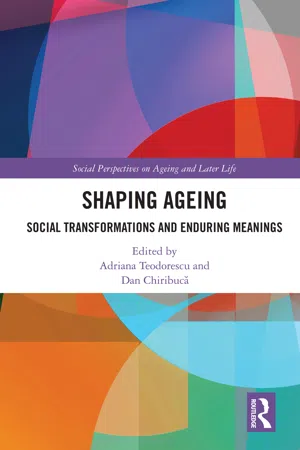
This volume examines the manifold, often contradictory, aspects of ageing, considering the ways in which contemporary social transformations affect the experience, conception, interpretation, and representation of ageing. Thematically arranged, it brings together the latest scholarly work from around the world to consider theories and narratives of ageing and the effects of space and place on identity and the experience of old age. Combining micro and macro perspectives, as well as theoretical and applied research, this interdisciplinary volume offers cross-cultural and comparative studies that resist overgeneralization and reductivism in an effort to shed fresh light on our experience, understanding, and response to ageing in the modern world. As such, it will appeal to scholars across the social sciences, particularly sociology, gerontology, demography, social policy, and cultural studies, with interests in ageing and later life.
eBook - ePub
Shaping Ageing
Social Transformations and Enduring Meanings
- 188 pages
- English
- ePUB (mobile friendly)
- Available on iOS & Android
eBook - ePub
Shaping Ageing
Social Transformations and Enduring Meanings
About this book
Information
Part 1 Theories and narratives of ageing and old age
1 The philosophic homework of later life On narrative, wisdom, and the positive potential of growing old
DOI: 10.4324/9781003046790-3
Introduction
For most of my academic life, certainly the portion of it that I’ve devoted to teaching and writing on ageing, I’ve been haunted by a cluster of questions – more hunches, really – that hover around that intriguing frontier where the social sciences bump up against the humanities. Capturing such hunches are a few phrases in particular that I’ve stumbled across in my years of reading in both of these broad areas.
One is from Eugene Bianchi’s (1991:60) book Aging as a Spiritual Journey, where he writes of the need for ‘aging in depth’. Another is from psychologist, Mark Freeman (1993:184), who views ‘our lives [as] richly ambiguous texts … whose readings cannot ever yield a final closure’. Still another is from a slim volume titled The Measure of My Days by Florida Scott-Maxwell (1968), writing in her 80s about the need to ‘possess all you have been and done’ and, in the process, becoming ‘fierce with reality’ (1968:42). Then there is this one from a popular book by Zalman Schacter-Shalomi called From Age-ing to Sage-ing. It is the phrase ‘philosophic homework’, the purpose of which, he argues, is ‘to synthesize wisdom from long life experience’ (Schacter-Shalomi and Miller 1995:124).
The first time I read it, that phrase set my mind spinning. But what does it mean? And is ‘homework’ even something we want to deal with in later life? Homework is for children, surely, no t for those of us in our so-called golden years! I disagree. I fear we have been unwittingly bought into the ‘narrative of decline’ (Gullette 2004:28) by which, too often, ageing is construed as ‘a problem to be solved’ (Cole 1992:241): a perception that, alas, prevails within gerontology itself, not to mention in our own heads and hearts as ageing individuals.
Looking at ageing and an ageing population as, at bottom, a problem – physical, financial, political, or existential – is itself problematic. For it over-focuses on the negatives of ageing and, in doing so, eclipses the positive potential that is inherent in the experience of ageing. It blinds us to the view of ageing as a journey of continuing maturation; as a unique sort of adventure in which, as Scott-Maxwell (1968:139) puts it, ‘all is uncharted and uncertain’; and as just possibly, the fulfilment of the life cycle instead of its tragic denouement. For such reasons, it leads us to expect too little of later life and too little of ourselves as ageing persons. For later life, despite its obvious limitations, perhaps even because of them, brings a unique set of developmental tasks that beg to be tackled – tasks that are primarily narrative in nature, for they have to do with how we ‘story’ our lives (Kenyon et al. 2011). And tackling them – which, make no mistake, requires work, ‘storywork’, I call it (Randall 2010) – can open us to new levels of learning, of autobiographical learning, and even to Wisdom. That said, wisdom is a topic that gerontologists in general are reluctant to address, however much later life has traditionally been viewed as its province and however much our present society needs its share of wise elders to guide it into the future. It is certainly not a topic on the agenda of mainstream gerontological research, leastwise to the extent that pragmatic matters like fall prevention, diabetes management, and dementia care so frequently are.
My plan in what follows is, first, to introduce certain core concepts from that branch of gerontology with which I’m most familiar: narrative gerontology. Second, it is to contextualize the idea of philosophic homework in relation to the concept of wisdom, where that concept, in turn, is viewed as having a narrative dimension. Third, it is to sketch the developmental tasks that I’ve just alluded to, and fourth, to suggest various ways in which we can help one another tackle this homework by fostering ‘wisdom environments’ (Randall and Kenyon 2002) whenever we can.
Narrative gerontology
A narrative approach to ageing, and thus to wisdom, represents a rather different starting point for thinking about later life, and for experiencing it, too, namely that the distinguishing feature of our uniquely human being is that we are hermeneutical beings. In other words, we are interpreting beings. We are makers of meaning. And our main means of making it is by making (i.e. imagining, articulating, sharing) stories: stories about what is, what has been, and what might be happening in our lives and our world; stories that can be long or short, fuzzy or focused, big or small, and so on. Moreover, we inevitably compose these stories within the larger stories of particular families, relationships, communities, and cultures. Each such context constitutes, in turn, a unique narrative environment that is characterized by a particular set of values and assumptions, of ‘narrative templates’ (Abbott 2002:7) and ‘narrative resources’ (Freeman 2000:81) for storying our lives as a whole. At heart, we are ‘the story species’ (Gold 2002). Indeed, our brains themselves seem hard-wired for narrative reasoning, all the more so as we age, when, according to gerontologist Gene Cohen (2005), better cooperation between our left and right hemispheres enhances our capacity for post-formal thinking and intensifies our ‘autobiographical drive’ (2005:23), thus rendering the latter years of life ‘the narrative phase par excellence’ (Freeman 1997:394).
Taking its cue from narrative psychology, which sees ‘narrative knowing’ (Polkinghorne 1988) as a core mode of cognition, narrative gerontology – which shares an affinity with ‘literary gerontology’ (see Wyatt-Brown 2000) – views our ‘self’ itself as having a narrative dimension. And it views our life, as we subjectively experience it, as a complex, quasi-literary composition – as a flesh-and-blood novel, if you will (Randall and Khurshid 2017) – that we are forever in the middle of as author, narrator, editor, protagonist (ideally?), and reader more or less at once. Borrowing from psychologist Dan McAdams’s (2001) interpretation of Erik Erikson’s iconic concept of identity, ‘identity is a lifestory’ (p. 643; emphasis McAdams’s), namely an internalized and evolving narrative construction – or ‘myth’ as he calls it – that equips us with the sense of unity and coherence, meaning and purpose, which we need to go about living our lives; bearing in mind, of course, that we are never just one story but many. As autobiography scholar, Paul John Eakin, astutely notes, ‘there are many stories of Self to tell, and many selves to tell them’ (1999:xi).
Rather than viewing lives, then, from a predominantly biomedical angle, as bodies that change over time in an ultimately deteriorating manner – change that can be identified and measured from the outside, as it were – a narrative gerontology envisions lives as textual entities far more than physiological ones, and this dimension is what sets us most apart from those around us. In the words of well-known writer Oliver Sacks (1987:111), ‘biologically, physiologically, we are not so different from one another’; however, ‘historically, as narratives, we are each of us unique’. From such a perspective, we can begin to acknowledge the complexities of our experience of ageing on the inside, where topics such as meaning and identity, memory and wisdom, intersect with one another in countless subtle ways. From this inside perspective, where the focus is on biographical ageing rather than biological ageing, there is, in effect, no limit to how much we can (consciously and creatively) grow old and not just (physically and passively) get old. And key to doing so is a mode of meditation on the internal material of our lives – on our ‘texistence’, if you will (Randall and McKim 2008:5) – that I like to speak of as ‘reading our lives’.
Reading in general – for instance, reading a novel – is an intricate intellectual activity of making and re-making meaning, and it is intricate, too, in terms of our experience of time. As we go our way through ‘the story’, page by page, scene by scene, we are forever shuffling between our remembrance of what we’ve already read (the past) and our anticipation of what lies ahead (the future). In a parallel manner, reading our lives is a combination of reviewing, re-interpreting, and reflecting on the memory texts in terms of which we understand who we are (Randall 2014) while, at the same time, imagining what lies ahead, and these two temporal orientations are tightly entwined. We view the past through the lens of the present in the light of whatever future, or futures, we may favour or fear. And vice versa as well, for our sense of the future is inevitably coloured by what we make of our past. When I say memories here, however, I really mean stories, insofar as our memories of events are much less un-edited accountings of the facts than they are narrative texts, with memory in general – which is to say autobiographical memory – being narratively constructed (see Neisser and Fivush 1994). As I’m fond of saying, autobiographical memory is a matter of faction.
In any case, this whole process of making and re-making meaning, as we shift from hindsight to foresight and back, is pivotal to our development, specifically our narrative development. It is pivotal to the development of our narrative identity – a mode of development that therefore knows no end. Particular periods or chapters in our life, as well as particular memories within them, will get reflected on from different angles at different times. And on each such occasion of remembering and reflecting, different meanings can be discerned within them and different insights can be pulled out of them, not unlike how each time we re-read a favourite work of literature, we discover new things in it (Lesser 2002). In this sense, the future brings fresh vantage points for evaluating the past. Accordingly, ‘the past’, as the writer May Sarton (1981:95) sees it, ‘is always changing’. More to the point, ‘the meaning of the past develops throughout life’ (Charmé 1984:40), not unlike how the meaning we experience in reading a novel intensifies as The End draws near. Despite the fact that lifespans in general continue to lengthen, our physical development seems capped at a maximum of around 120 years, whereas our narrative development ‘is a potentially infinite process’ (Freeman 1991:90).
Given this brief picture of how ageing can be viewed from a narrative perspective, I’ll shift shortly to the developmental tasks of later life, tasks that are integral to the philosophic homework of later life and...
Table of contents
- Cover
- Half Title Page
- Series Page
- Title Page
- Copyright Page
- Contents
- Notes on contributors
- Introduction: ageing matters: a constructivist perspective
- Part 1 Theories and narratives of ageing and old age
- Part 2 Ageing and old age in different spaces
- Index
Trusted by 375,005 students
Access to over 1.5 million titles for a fair monthly price.
Study more efficiently using our study tools.
Frequently asked questions
Yes, you can cancel anytime from the Subscription tab in your account settings on the Perlego website. Your subscription will stay active until the end of your current billing period. Learn how to cancel your subscription
No, books cannot be downloaded as external files, such as PDFs, for use outside of Perlego. However, you can download books within the Perlego app for offline reading on mobile or tablet. Learn how to download books offline
Perlego offers two plans: Essential and Complete
- Essential is ideal for learners and professionals who enjoy exploring a wide range of subjects. Access the Essential Library with 800,000+ trusted titles and best-sellers across business, personal growth, and the humanities. Includes unlimited reading time and Standard Read Aloud voice.
- Complete: Perfect for advanced learners and researchers needing full, unrestricted access. Unlock 1.5M+ books across hundreds of subjects, including academic and specialized titles. The Complete Plan also includes advanced features like Premium Read Aloud and Research Assistant.
We are an online textbook subscription service, where you can get access to an entire online library for less than the price of a single book per month. With over 1.5 million books across 990+ topics, we’ve got you covered! Learn about our mission
Look out for the read-aloud symbol on your next book to see if you can listen to it. The read-aloud tool reads text aloud for you, highlighting the text as it is being read. You can pause it, speed it up and slow it down. Learn more about Read Aloud
Yes! You can use the Perlego app on both iOS and Android devices to read anytime, anywhere — even offline. Perfect for commutes or when you’re on the go.
Please note we cannot support devices running on iOS 13 and Android 7 or earlier. Learn more about using the app
Please note we cannot support devices running on iOS 13 and Android 7 or earlier. Learn more about using the app
Yes, you can access Shaping Ageing by Adriana Teodorescu, Dan Chiribucă, Adriana Teodorescu,Dan Chiribucă in PDF and/or ePUB format, as well as other popular books in Scienze sociali & Sociologia. We have over 1.5 million books available in our catalogue for you to explore.