A completely revised and updated reference for farm animal anesthesia, sedation, and pain management
The newly revised Second Edition of Farm Animal Anesthesia: Cattle, Small Ruminants, Camelids, and Pigs is a practical and easy-to-use manual for techniques associated with anesthesia and pain management in farm animal species. The new edition incorporates advances in surgical and diagnostic techniques, with the latest drugs and equipment, updated images, and new technique descriptions added throughout the book.
Farm Animal Anesthesia offers additional and updated information on drug combinations and anesthetic techniques relevant to small ruminants and potbellied pigs, reflecting their growing popularity. New chapters and topics on paralytic drugs for complete muscle relaxation, use of ventilators for advanced and complex surgeries, updated local and regional anesthetic techniques, and comprehensive standing surgery and diagnostic procedures have been added.
Readers will also benefit from access to a companion website with video clips demonstrating local and regional anesthetic techniques described within. The book also includes:
A thorough introduction to general preanesthetic considerations for ruminants, camelids, including alpacas and llamas, and potbellied pigs
A comprehensive exploration of commonly used preanesthetics and injectable anesthetics, including anticholinergics, sedatives, tranquilizers, analgesics, and injectable anesthetics
Practical discussions of standing sedation and chemical restraint, including new drug combinations for reliable restraint and remote drug delivery
In-depth description of the use of neuromuscular blocking drugs and monitoring in farm animals
Complete review of regulatory and legal considerations of anesthetics and analgesics used in farm animals
Farm Animal Anesthesia is an indispensable resource for farm animal practitioners, veterinary surgeons, veterinary anesthetists, and researchers, as well as for veterinary students and residents in surgery and anesthesia.
Trusted by 375,005 students
Access to over 1.5 million titles for a fair monthly price.
Department of Clinical Sciences, College of Veterinary Medicine, Auburn University, Auburn, AL, USA
General anesthesia in farm animals, like cattle, sheep, goats, llamas, alpacas, and pigs, requires special attention due to the uniqueness of the anatomical and physiological characteristics as compared to dogs, cats, and horses. Camelids (llamas and alpacas) only have two forestomachs but are otherwise similar in many ways to cattle and small ruminants. Although some farm animals may cost as much as purebred companion animals, farm animal veterinarians are often faced with economic constraints and a limited number of approved drugs for use in surgical procedures requiring anesthesia. Physical restraint and local anesthetic techniques are most commonly employed to produce immobility and analgesia for these species. Ruminants generally tolerate physical restraint and recumbency well. This, along with local and/or regional anesthetic techniques, allows many minor surgical procedures to be performed in the standing position and under field conditions. General anesthesia is more frequently performed in camelids and swine for even minor surgical procedures due to their intolerance of physical restraint. It is important to remember that farm animals perceive pain no differently than other species, therefore analgesia for prevention and easing of pain is just as important as it is for companion animals. With surgical procedures requiring general anesthesia, balanced anesthetic technique should be employed to provide narcosis, analgesia, and muscle relaxation, thereby minimizing the stress response induced by surgery and anesthesia. Most of the anesthetics and anesthetic adjuncts commonly used in farm animal practice do not have Food and Drug Administration (FDA) approval for use in ruminants, camelids, and swine [1, 2]. However, per the Animal Medicinal Drug Use Clarification Act (AMDUCA) of 1994, extralabel use of drugs is permitted when animal health is threatened or death may result if not treated [3]. While prevention of violative residues should always be considered, anesthetics are usually used for a short duration, and anesthetized animals are unlikely to be marketed immediately after surgery. Furthermore, anesthetics used today tend to have very short half‐lives (t½), and they are potent enough that only low doses are required to produce general anesthesia. The possibility of an animal carrying anesthetic residues within its edible tissues after the surgical incision has healed, which normally occurs within an average of 14 days, is extremely low. Thus, problems with anesthetic drug residues appear to be rare [4]. Nevertheless, veterinarians should consult the Food Animal Residue Avoidance Databank (FARAD) for meat and milk withdrawal intervals for extralabel use of analgesics, sedatives, and injectable anesthetics as well as for updates of drugs prohibited from extralabel use [1, 2].
Prior to anesthesia, an appropriate patient history, including breed, age, sex, condition, and temperament of the patient, and a complete physical examination are indicated. Due to economic reasons, blood work including complete blood count and chemistry profile is performed only in farm animals with significant systemic diseases and those considered to have a higher anesthetic risk. For example, animals with severe gastrointestinal (GI) abnormalities often suffer extreme dehydration with or without electrolyte alteration, which may require intervention to optimize the patient's condition with fluid therapy prior to the induction of anesthesia [5]. In healthy animals, total plasma protein and packed cell volume are sufficient indicators of a patient's hydration status.
Most sedatives and general anesthetics cause some degree of cardiovascular depression, which may not be a great concern for healthy patients. However, normal cardiovascular protective mechanisms or reflexes in response to the depressing effects of anesthetics may be obtunded in animals with compromised cardiac function or severe electrolyte imbalances as a consequence of disease conditions. Maintaining a balance of concentrations of electrolytes like calcium, sodium, and potassium across the cell membranes is essential in establishing normal cell membrane potential and contractility. Disturbance of these electrolyte balances across cell membranes changes cellular resting membrane potentials and subsequent initiation and propagation of cellular depolarization and repolarization. Acidosis has been shown to cause electrolyte imbalances resulting in decreased myocardial contractility and increased response of the myocardial cells to circulating catecholamines. Therefore, anesthetic‐induced cardiovascular depression combined with severe preexisting acidosis and electrolyte imbalances can lead to detrimental side effects like severe cardiac arrhythmias, bradycardia, decreased myocardial and vascular cellular contractility, reduced cardiac output, and hypotension. As a result, anesthetized animals may not be able to maintain adequate cardiac output or arterial blood pressure leading to significantly decreased peripheral tissue and muscle perfusion with subsequent development of severe adverse effects such as irreversible postanesthetic neuromyopathy [6].
1.1 Positioning
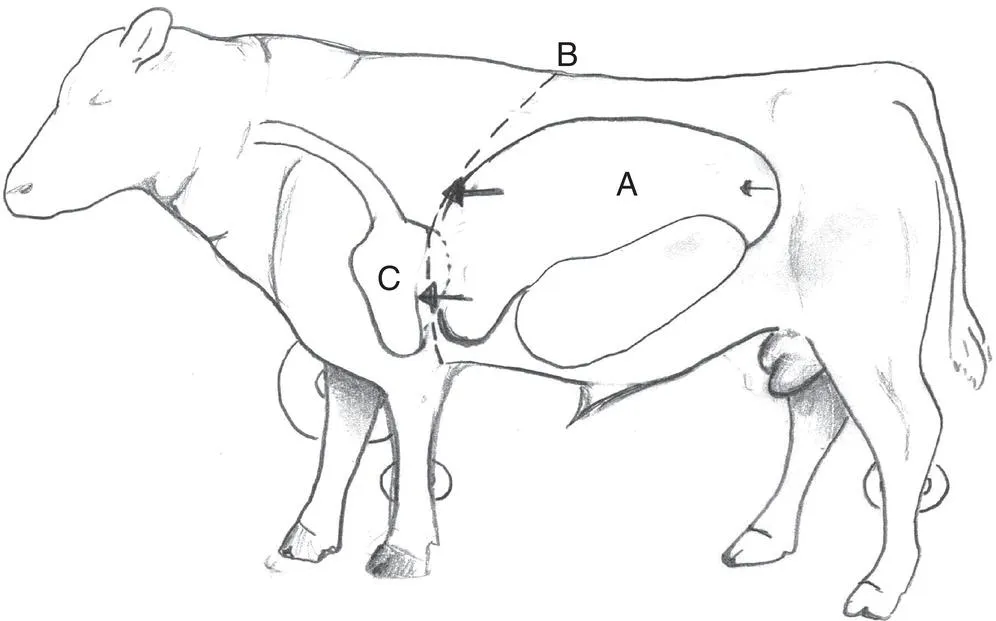
Ruminants, camelids, and swine are susceptible to complications associated with anesthesia and recumbency. Positioning of these animals, particularly adult cattle, in dorsal or lateral recumbency for surgery allows for the weight of abdominal viscera to shift ventrally and cranially, causing the diaphragm to be pushed further into the thoracic cavity, thereby reducing the functional residual capacity of the lungs (Figure 1.1). As a result, an increased ventilation/perfusion mismatch may lead to significant hypoventilation and hypoxemia during anesthesia. Furthermore, the weight of the abdominal viscera may compress great vessels such as the vena cava leading to decreased venous return, cardiac output, and arterial blood pressures [7]. Therefore, close monitoring of cardiovascular and pulmonary functions and institution of appropriate treatments to ensure normal arterial blood pressure and adequate ventilation are important parts of perioperative anesthetic management.
...
Table of contents
Cover
Table of Contents
Title Page
Copyright Page
Dedication Page
Contributing Authors
Preface
About the Companion Website
1 Preanesthetic Considerations
2 Commonly Used Preanesthetics
3 Standing Sedation and Chemical Restraint
4 Injectable Anesthetics and Field Anesthesia
5 Neuromuscular Blocking Agents
6 Inhalation Anesthesia and Use of Ventilators
7 Perioperative Monitoring and Management of Complications
8 Local and Regional Anesthesia in Food Animals
9 Anesthetic Management of Specific Procedures
10 Pain Management for Farm Animals
11 Fluid Therapy
12 Regulatory and Legal Considerations of Anesthetics and Analgesics Used in Food‐producing Animals
13 Euthanasia of Farm Animals
Index
End User License Agreement
Frequently asked questions
Yes, you can cancel anytime from the Subscription tab in your account settings on the Perlego website. Your subscription will stay active until the end of your current billing period. Learn how to cancel your subscription
No, books cannot be downloaded as external files, such as PDFs, for use outside of Perlego. However, you can download books within the Perlego app for offline reading on mobile or tablet. Learn how to download books offline
Perlego offers two plans: Essential and Complete
Essential is ideal for learners and professionals who enjoy exploring a wide range of subjects. Access the Essential Library with 800,000+ trusted titles and best-sellers across business, personal growth, and the humanities. Includes unlimited reading time and Standard Read Aloud voice.
Complete: Perfect for advanced learners and researchers needing full, unrestricted access. Unlock 1.5M+ books across hundreds of subjects, including academic and specialized titles. The Complete Plan also includes advanced features like Premium Read Aloud and Research Assistant.
Both plans are available with monthly, semester, or annual billing cycles.
We are an online textbook subscription service, where you can get access to an entire online library for less than the price of a single book per month. With over 1.5 million books across 990+ topics, we’ve got you covered! Learn about our mission
Look out for the read-aloud symbol on your next book to see if you can listen to it. The read-aloud tool reads text aloud for you, highlighting the text as it is being read. You can pause it, speed it up and slow it down. Learn more about Read Aloud
Yes! You can use the Perlego app on both iOS and Android devices to read anytime, anywhere — even offline. Perfect for commutes or when you’re on the go. Please note we cannot support devices running on iOS 13 and Android 7 or earlier. Learn more about using the app
Yes, you can access Farm Animal Anesthesia by HuiChu Lin, Thomas Passler, Stuart Clark-Price, HuiChu Lin,Thomas Passler,Stuart Clark-Price in PDF and/or ePUB format, as well as other popular books in Medicine & Veterinary Medicine. We have over 1.5 million books available in our catalogue for you to explore.