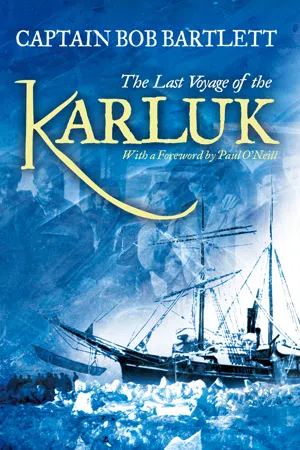
On January 4, 1914, the Karluk was stuck in ice when the ominous sound of the ship's stern being ripped open by pack ice was heard by all on board. It sounded like the firing of a cannon. Bartlett immediately ordered supplies be unloaded on the ice. The Karluk began to break up on January 10, and all on board were ordered to abandon ship. When everyone was safely on the ice, the captain himself went back to his cabin and, all alone, put Chopin's Funeral March on his Victrola. As the water rose in the cabin, he whispered "Goodbye, " left the sinking vessel to the mournful sound of Chopin's music and hurried out on the ice. It was to be the beginning of one of the greatest feats of valour in world history. From the foreword by Paul O'Neill
eBook - ePub
The Last Voyage of the Karluk
Shipwreck and Rescue in the Arctic
- English
- ePUB (mobile friendly)
- Available on iOS & Android
eBook - ePub
About this book
Trusted by 375,005 students
Access to over 1.5 million titles for a fair monthly price.
Study more efficiently using our study tools.
Information
CHAPTER I
THE EXPEDITION AND ITS OBJECTS
We did not all come back.
Fifteen months after the Karluk, flagship of Vilhjalmar Stefansson’s Canadian Arctic Expedition, steamed out of the navy yard at Esquimault, British Columbia, the United States revenue cutter, Bear, that perennial Good Samaritan of the Arctic, which thirty years before had been one of the ships to rescue the survivors of the Greely Expedition from Cape Sabine, brought nine of us back again to Esquimault—nine white men out of the twenty, who, with two Eskimo men, an Eskimo woman and her two little girls—and a black cat—comprised the ship’s company when she began her westward drift along the northern coast of Alaska on September 23, 1913. Years of sealing in the waters about Newfoundland and of Arctic voyaging and ice travel with Peary had given me a variety of experience to fall back upon by way of comparison; the events of those fifteen months, I must say, justified the prophecy that I made in a letter to a Boston friend, just before we left Esquimault: “This will have the North Pole trip ‘beaten to a frazzle.’”
It did; and there were two main reasons why.
One was that the Karluk, though an old-time whaler, was not built, as the Roosevelt was, especially for withstanding ice pressure; very few ships are. Dr. Nansen’s ship, the Fram, was built for the purpose and has had a glorious record in both the Arctic and the Antarctic. The Karluk, a brigantine of 247 tons, 126 feet long, twenty-three feet in beam, drawing 16 ½ feet when loaded, was built in Oregon originally to be a tender for the salmon fisheries of the Aleutian Islands. Her duty had been to go around among the stations and pick up fish for the larger ships. The word karluk, in fact, is Aleut for fish. When later in her career she was put into the whaling service her bow and sides were sheathed with two-inch Australian ironwood, but she had neither the strength to sustain ice pressure nor the engine power to force her way through loose ice. She had, however, an honourable career in the now virtually departed industry of Arctic whaling, and was personally and pleasantly known to Stefansson, who had travelled on her from place to place along the Alaskan coast on several occasions during his expeditions of 1906–7 and 1908–12.
The other reason was that the winter of 1913–14 was unprecedented in the annals of northern Alaska. It came on unusually early, as we were presently to learn, and for severity of storm and cold had not its equal on record.
The National Geographic Society had originally planned to finance our expedition, and it was only at the urgent request of the Canadian premier, the Right Hon. R. L. Borden, that the Society relinquished its direction to the enterprise. The Canadian Government felt that since the country to be explored was Canadian territory it was only fitting that the expedition fly its flag and be financed from its treasury.
When I returned from the seal fisheries to Brigus, my old home in Newfoundland, in the spring of 1913, I found awaiting me a telegram from Stefansson, asking me to join his expedition and take charge of the Karluk. I went at once to New York, then to Ottawa for a day with the government authorities and direct from there to Victoria, BC. It was the middle of May and there was work to be done to get the ship ready to sail in June.
It was an elaborate expedition, one of the largest and most completely equipped, I believe, that have ever gone into the Arctic. It differed, too, in one other respect, than that of size, from previous Arctic expeditions, in that its main objects were essentially practical—in fact, one might say, commercial. It was in two divisions. The northern party, under Stefansson himself, was primarily to investigate the theory so ably advanced by Dr. R. A. Harris of the United States Coast and Geodetic Survey that new land—perhaps a new continent—was to be found north of Beaufort Sea, which is that part of the Arctic Ocean immediately to the north of Alaska. “The main work of the party aboard the Karluk”—to quote Stefansson—“was to be the exploration of the region lying west of the Parry Islands and especially that portion lying west and northwest from Prince Patrick Island. The Karluk was to sail north approximately along the 141st meridian until her progress was interfered with either by ice or by the discovery of land. If land were discovered a base was to be established upon it, but if the obstruction turned out to be ice an effort was to be made to follow the edge eastward with the view of making a base for the first year’s work near the southwest corner of Prince Patrick Island, or, failing that, on the west coast of Banks Island.” The Karluk was to go first to Herschel Island, the old rendezvous of the Arctic whaling fleet and the northernmost station of the Canadian Mounted Police. If she should be beset in the ice and forced to drift, it was expected that certain theories about the direction of Arctic currents would be tested, and there would also be opportunity for dredging and sounding.
Both of these main objects were accomplished; Stefansson ultimately found new land and the Karluk engaged in an Arctic drift, but neither result was attained in quite the way which was planned when we were getting the ship ready in May and June 1913. We returned—some of us—rather earlier than we expected, for we were prepared to be away until September 1916, and contrary to one of the theories of Arctic currents we did not drift across the Pole to the Greenland shore. Before we started some of the newspaper accounts of the expedition said that the ship might be crushed in the ice; the newspapers are more often correct than they are supposed to be.

THE KARLUK IN HER WHALING DAYS
Travelling to Herschel Island on the Mary Sachs and the Alaska, small schooners equipped with gasoline engines, the southern party, under Dr. R. M. Anderson, who had been Stefansson’s only white companion on his previous expeditions, was to map the islands already discovered east of the mouth of the Mackenzie River; to make a collection of the Arctic flora and fauna; to survey the channels among the islands, in the hope of establishing trade-routes; to make a geographical survey of the coast from Cape Parry to Kent Peninsula and of Victoria Island north and east of Prince Albert Sound, with the primary object of investigating copper-bearing formations; and to study still further the blond Eskimo who had been discovered by Stefansson in 1910.

VILHJALMAR STEFANSSON
Photograph copyrighted, 1914, by Lomen Bros., Alaska.
Peary’s attainment of the North Pole in 1909, the goal of three centuries of struggle, enabled the world to give attention to problems unrelated to polar discovery and afforded men an opportunity to realize not only that a million square miles in the Arctic still remained marked on the maps as “unexplored territory,” but also...
Table of contents
- Dedication
- Copyright
- Contents
- Illustrations
- Foreword
- CHAPTER I
- CHAPTER II
- CHAPTER III
- CHAPTER IV
- CHAPTER V
- CHAPTER VI
- CHAPTER VII
- CHAPTER VIII
- CHAPTER IX
- CHAPTER X
- CHAPTER XI
- CHAPTER XII
- CHAPTER XIII
- CHAPTER XIV
- CHAPTER XV
- CHAPTER XVI
- CHAPTER XVII
- CHAPTER XVIII
- CHAPTER XIX
- CHAPTER XX
- CHAPTER XXI
- CHAPTER XXII
- CHAPTER XXIII
- CHAPTER XXIV
- CHAPTER XXV
- CHAPTER XXVI
- CHAPTER XXVII
- CHAPTER XXVIII
- CHAPTER XXIX
- CHAPTER XXX
- CHAPTER XXXI
- About the Author
- Index
Frequently asked questions
Yes, you can cancel anytime from the Subscription tab in your account settings on the Perlego website. Your subscription will stay active until the end of your current billing period. Learn how to cancel your subscription
No, books cannot be downloaded as external files, such as PDFs, for use outside of Perlego. However, you can download books within the Perlego app for offline reading on mobile or tablet. Learn how to download books offline
Perlego offers two plans: Essential and Complete
- Essential is ideal for learners and professionals who enjoy exploring a wide range of subjects. Access the Essential Library with 800,000+ trusted titles and best-sellers across business, personal growth, and the humanities. Includes unlimited reading time and Standard Read Aloud voice.
- Complete: Perfect for advanced learners and researchers needing full, unrestricted access. Unlock 1.5M+ books across hundreds of subjects, including academic and specialized titles. The Complete Plan also includes advanced features like Premium Read Aloud and Research Assistant.
We are an online textbook subscription service, where you can get access to an entire online library for less than the price of a single book per month. With over 1.5 million books across 990+ topics, we’ve got you covered! Learn about our mission
Look out for the read-aloud symbol on your next book to see if you can listen to it. The read-aloud tool reads text aloud for you, highlighting the text as it is being read. You can pause it, speed it up and slow it down. Learn more about Read Aloud
Yes! You can use the Perlego app on both iOS and Android devices to read anytime, anywhere — even offline. Perfect for commutes or when you’re on the go.
Please note we cannot support devices running on iOS 13 and Android 7 or earlier. Learn more about using the app
Please note we cannot support devices running on iOS 13 and Android 7 or earlier. Learn more about using the app
Yes, you can access The Last Voyage of the Karluk by Captain Robert A. Bartlett in PDF and/or ePUB format, as well as other popular books in History & Historical Biographies. We have over 1.5 million books available in our catalogue for you to explore.