- 94 pages
- English
- ePUB (mobile friendly)
- Available on iOS & Android
eBook - ePub
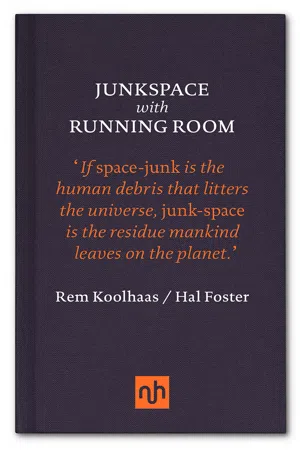
Junkspace with Running Room
About this book
In Junkspace (2011), architect Rem Koolhaas itemised in delirious detail how our cities are being overwhelmed. His celebrated jeremiad is here updated and twinned with Running Room, a fresh response from architectural critic Hal Foster.
Information
Topic
ArchitectureSubtopic
Architecture General– Running Room –
Autonomy
Autonomy, or the notion that each art stands apart, in its own area of competence, is the first principle of modern aesthetics, in place at least since the time of Kant, and it is a bad word for most of us informed by the hybrid style of postmodern practice, not to mention the interdisciplinary moves of postmodern theory. We tend to forget that autonomy is always provisional, situated historically and politically, and that the arts are always defined in relation to one another, never absolutely; in short, we tend to forget that autonomy is always semi. This is all the more true for architecture, of course, bound up as it is with constraints of purpose and program.
Enlightenment thinkers advocated political autonomy in order to resist the absolute power of the ancien régime, while modernist artists advocated aesthetic autonomy in order to counter the persistent demand for illustrational meanings (illustrational as in ideological or commercial). Like essentialism in debates about identity, then, autonomy might be a bad word, but it is not always a bad strategy, especially at a time when the hybrid and the interdisciplinary have become almost the routine: call it ‘strategic autonomy’. In Junkspace, Rem Koolhaas uses the term only once, and he qualifies it as ‘quasiautonomy’; nevertheless, at least implicitly, it is a value he wants to reassert, even a position he wants to reclaim. Is this possible in a world of Junkspace?
Bigness
One approach to Junkspace is to see it in relation to another Koolhaas notion, that of Bigness. In a 1993 text on the subject he proposed five theorems:
1. Beyond a certain critical mass, a building becomes a BIG Building. Such a mass can no longer be controlled by a singular architectural gesture, or even by any combination of architectural gestures. The impossibility triggers the autonomy of its parts, which is different from fragmentation: the parts remain committed to the whole.
2. The elevator—with its potential to establish mechanical rather than architectural connections—and its family of related inventions render null and void the classical repertoire of architecture. Issues of composition, scale, proportion, detail are now moot. The ‘art’ of architecture is useless in BIGNESS.
3. In BIGNESS, the distance between core and envelope increases to the point where the façade can no longer reveal what happens inside. The humanist expectation of ‘honesty’ is doomed; interior and exterior architectures become separate projects, one dealing with the instability of programmatic and iconographic needs, the other—agent of dis-information—offering the city the apparent stability of an object. Where architecture reveals, BIGNESS perplexes; BIGNESS transforms the city from a summation of certainties into an accumulation of mysteries. What you see is no longer what you get.
4. Through size alone, such buildings enter an amoral domain, beyond good and bad. Their impact is independent of their quality.
5. Together, all these breaks—with scale, with architectural composition, with tradition, with transparency, with ethics—imply the final, most radical break: BIGNESS is no longer part of any issue. It exists; at most, it coexists. Its subtext is fuck context.
In 1993 Koolhaas was optimistic about Bigness. It was a ‘model of programmatic alchemy’ that allowed for internal diversity; better still, it suggested a way to design at an urban scale again, ‘to reconstruct the Whole’; in fact, through Bigness architecture might ‘regain its instrumentality as a vehicle of modernization’. But that was then. In 1993, just a few years after the fall of the Wall, the New Europe was still a fresh idea, its leaders were in an expansionist mood, and Koolhaas was a beneficiary of this big thinking (for example, his Office of Metropolitan Architecture, or OMA, did the master plan for ‘Euralille’ (1990-94), a complex of buildings for a provincial city in northern France that suddenly became a hub for the revised continent). Moreover, China had unleashed its Market-Leninism, and countless commissions would soon appear on the eastern horizon. In short, a new wave of modernization had built up, and Koolhaas called on architects to ride it.
Eight years later Junkspace reads as a repudiation of Bigness. Here Koolhaas laments the passing of both architectural art and modernist honesty. If Junkspace is also ‘beyond good and bad’, beyond the usual terms of critical judgment, there is no more promise in this surpassing. And if the ‘fuck context’ of Bigness once offered a thrill, there is no such bravado with Junkspace: for Koolhaas it is the only context we have, and it sucks. Junkspace is the ‘fallout’ of the modernization that Bigness hoped to manage; it is the bad hangover after the big debauch. And today, another decade on, after the crash of 2008 and with Europe in trouble, the entropy has sped up. It is as though the latest wave of modernization had crashed, and left us strewn on the beach with all the other junk.
Bonaventure
In his influential analysis of postmodern space, ‘Postmodernism, or the Cultural Logic of Late Capitalism’ (1984), Fredric Jameson used the vast atrium of the Bonaventure Hotel in Los Angeles, realized by John Portman in 1974, as the primary symptom of a new architectural sublime, one that seems almost intended to derange the human sensorium. Jameson saw this spatial delirium as a particular instance of our general incapacity to comprehend the late-capitalist world, to map it cognitively. Strangely, what Jameson offered as a critique of postmodern culture such architects as Frank Gehry and Zaha Hadid took as a model: the creation of extravagant spaces that tend to overwhelm the subject, of a neo-Baroque architecture dedicated to the glory of the powers of the day. (In the original Baroque the primary patrons were prince and church; in the new version they include giant corporations, ambitious governments, sports empires, and cultural institutions like art museums.) It is as though these architects designed not in contestation of ‘the cultural logic of late capitalism’ but according to its specifications, and for this feat they were touted as the most original artists of the age.
In 1987 Koolhaas penned his own appreciation of Portman that pointed to the architectural potential of buildings like the Bonaventure; now he calls such architecture ‘JunkSignature™’, and argues that its mission is ‘to intimidate’. ‘You thought that you could ignore Junkspace,’ Koolhaas writes in a challenge to his peers, ‘but now your own architecture is infected, has become equally smooth, all-inclusive, continuous, warped, busy, atrium-ridden’. Clearly, the thrill of delirious space, as elaborated by the Guggenheim in Bilboa and other master buildings, is gone. Belying its name, the Bonaventure is aging badly, sagging like an old movie star whose facelifts have failed.
Conditional
Without the elevator and the automobile, the old arrangement of dense downtown and sprawling suburb could not have emerged, as the elevator allowed the skyscraper to rise, and the automobile assisted in the commute from distant home and back. Similarly, the escalator and the air-conditioner permitted the big structures that soon spread from city to suburb and beyond—from the department store to the shopping mall, casino, theme park, airport terminal, and so on. According to the authors of The Harvard Guide to Shopping (2001), where Junkspace first appeared, the escalator allowed for ‘smoothness’ of flow through these structures, while the air-conditioner supplied ‘life support’ for the consumers who pass through them. Like Bigness, Junkspace also depends on these mechanisms—it too is ‘the product of an encounter between escalator and air-conditioning’—but it is one ‘conceived in an incubator of sheetrock’. This image plays on the old line from Lautréamont about ‘the chance encounter of a sewing machine and an umbrella on an operating table’, which the Surrealists took up as a readymade definition of the irrational effects of collage; in Junkspace, however, such absurd juxtapositions are the planned norm. The tables are turned in another way too, for Junkspace is ‘subsystem only, without superstructure’, which is to suggest that the elevator and the air-conditioner have taken on a monster life of their own, and together have ‘launched the endless building’, one which, because it is endless, ‘is never closed’. Indeed, ‘Junkspace can easily engulf a whole city,’ Koolhaas warns in his apocalyptic mode, and under its domain everything becomes provisional: ‘conditioned space inevitably becomes conditional space, and sooner or later all conditional space turns into Junkspace’.
Consumerist
Provisional architecture seems a contradiction in terms, but if ‘the only certainty is mutation’ it is a contradiction that architects must confront. Planned obsolescence is so natural to us we no longer see how crazy a construction it is, and its cycle becomes only more frantic: in an economic world based on computing, the commodity is no longer an object to be produced so much as a datum to be manipulated—designed and redesigned, consumed and reconsumed. Junkspace thus concerns time as much as space: it is an effect of the continual transformation of space according to the accelerated temporality of consumption, not to mention the projected temporality of speculation. In Junkspace upgrades are so fast that they are difficult to distinguish from breakdowns; ‘instead of development, it offers entropy’, and ‘Under Construction’ becomes a permanent state of affairs. It is this ceaseless consumption that drives Junkspace, and transforms structures once thought to be separate from shopping, such as airports and museums, accordingly. Junkspace is not merely junk in space, then, nor is it simply all the junky buildings out there (most of which are not designed by architects at all); it is junk as space. In his account of consumer capitalism, Jean Baudrillard argued that the commodity had refashioned the sign in its own image; so too, in his vision of Junkspace, Koolhaas suggests that the commodity is now suffused into space.
Design
Today everything from jeans to genes is treated as so much design, which is a prime reason for the increased mixing of the old categories of object and subject. (Is a ‘personal device’ a person or a device?) One need not be rich to be designer and designed in one, whether the product in question is a home or a business, a drooping face (designer surgery) or a lagging personality (designer drugs). Is this designed subject of consumerism an unintended offspring of the ‘constructed subject’ of postmodernism? One thing is clear: design supports a dizzying circuit of production and consumption. And in this political economy the old heroes of industrial culture—the author as producer, the artist as constructor, the architect as engineer—are displaced. ‘In this war,’ Koolhaas states in Junkspace, ‘graphic designers are the great turncoats’. Architects must become designers, it seems, or lose.
Environment
The world of total design is an old dream of modernism, but it only comes true, in perverse form, in our pan-capitalist present. In post-Fordist production commodities are tweaked and markets niched in such a way that a product can be mass in quantity yet appear personal in address. Desire is not only registered in countless products; it is specified there, and so too is identity. ‘That’s me!’ we say, in unison with millions of other semi-unique selves who receive the same catalogue or click on the same we...
Table of contents
- Cover
- Praise
- Title Page
- Contents
- Preface
- Junkspace
- Running Room
- Bibliography
- About the Publisher
- Other titles from Notting Hill Editions
- Copyright
Trusted by 375,005 students
Access to over 1.5 million titles for a fair monthly price.
Study more efficiently using our study tools.
Frequently asked questions
Yes, you can cancel anytime from the Subscription tab in your account settings on the Perlego website. Your subscription will stay active until the end of your current billing period. Learn how to cancel your subscription
No, books cannot be downloaded as external files, such as PDFs, for use outside of Perlego. However, you can download books within the Perlego app for offline reading on mobile or tablet. Learn how to download books offline
Perlego offers two plans: Essential and Complete
- Essential is ideal for learners and professionals who enjoy exploring a wide range of subjects. Access the Essential Library with 800,000+ trusted titles and best-sellers across business, personal growth, and the humanities. Includes unlimited reading time and Standard Read Aloud voice.
- Complete: Perfect for advanced learners and researchers needing full, unrestricted access. Unlock 1.5M+ books across hundreds of subjects, including academic and specialized titles. The Complete Plan also includes advanced features like Premium Read Aloud and Research Assistant.
We are an online textbook subscription service, where you can get access to an entire online library for less than the price of a single book per month. With over 1.5 million books across 990+ topics, we’ve got you covered! Learn about our mission
Look out for the read-aloud symbol on your next book to see if you can listen to it. The read-aloud tool reads text aloud for you, highlighting the text as it is being read. You can pause it, speed it up and slow it down. Learn more about Read Aloud
Yes! You can use the Perlego app on both iOS and Android devices to read anytime, anywhere — even offline. Perfect for commutes or when you’re on the go.
Please note we cannot support devices running on iOS 13 and Android 7 or earlier. Learn more about using the app
Please note we cannot support devices running on iOS 13 and Android 7 or earlier. Learn more about using the app
Yes, you can access Junkspace with Running Room by Rem Koolhaas in PDF and/or ePUB format, as well as other popular books in Architecture & Architecture General. We have over 1.5 million books available in our catalogue for you to explore.