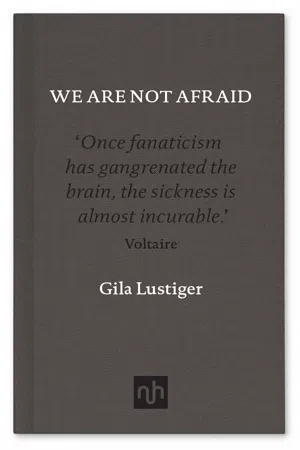
In 2015 a terrifying new era began for Paris and the rest of Europe: the attack on the staff of Charlie Hebdo and the terrorist attacks on Paris on November 13 that left 130 people dead. The terrorists were born on French soil. In this award-winning essay, Lustiger explores the historical, social, and political conditions that give rise to terrorism and suggests how we might 'set the world back on course'.
- 144 pages
- English
- ePUB (mobile friendly)
- Available on iOS & Android
eBook - ePub
We Are Not Afraid
About this book
Information
PART ONE
– France is at War –
I n the first days following the Paris attacks of 13 November, 2015, I became obsessed with accumulating information. I read newspapers, listened to the radio, watched countless television reports, trawled the internet looking for announcements and pictures posted under various hashtags, and discussed with friends the updated results of the investigations broadcast to the world by the newsagencies’ live feeds; every minute brought new information, it became my life, 24/7.
I did it because I was devastated. Because I wanted to understand what had actually happened, what was about to engulf us, what we had to get to grips with. ‘Because “Knowledge is power”,’ I would reply, quoting the English philosopher Francis Bacon, whenever my family begged to be allowed just once not to wake up to the voices of the France Culture or France Inter radio journalists. I knew as well as anybody that there was no point in getting bogged down in all this information. I had lived in Israel after all, a country where attacks were daily fare. Over there, psychologists would assert that this sort of information did not actually aid communication, deepen understanding or lead to any conclusion, indeed too much information did nothing to diminish fear – on the contrary it stoked it and rendered people passive. You shouldn’t seek out the news for more than an hour a day, unless your life actually depended on it. Instead you should focus on the everyday.
If I had heeded this advice I would doubtless have fed my family and friends better and, to be honest, it would have been more constructive to tidy my office than to obsess about the next alert on my smartphone. Following the attacks my mobile was constantly in my trouser pocket or by me on the table or on my bedside table at night. And always on ‘loud’. I even took it with me when I went jogging in the Jardin du Luxembourg, because you could never be too sure. I had become an information junkie and my drug of choice, in this digital age, was instantly available. Unlike José, our local tramp, I didn’t even have to go to the supermarket to get my bottle of cheap rotgut. I just had to sit down at my desk and open the browser. I could get my fix with a few clicks of my mouse.
Most announcements came at one remove. ‘Our television colleagues tell us,’ they would say. Or ‘As reported in the newspaper Libération, it is possible that’ or ‘According to eyewitnesses’ or ‘The Washington Post reports that’. By the second day the news had already spread around the world. If any of the journalists in the city had come across a single piece of information, a picture or an anecdote, or had even discovered a new eyewitness, or scooped a leaked announcement, then he was immediately quoted by his colleagues. CNN reported what AFP had published, who in turn were quoting Mediapart – it was a neverending cycle. Police investigations by their very nature take time, and yet the whole world was desperate for action and results. And above all everybody was needing to be told that something was being done, that measures were being taken that would protect them from what President Hollande on the Elysée Palace Twitter account had called an act of ‘absolute barbarism’ and an ‘act of war’.
‘Yesterday’s events constitute an act of war,’ he wrote, ‘in the face of which the country must take appropriate decisions.’
But what were the appropriate decisions? The question was debated immediately around the world. From then on I would read analyses by terror experts, psychologists, sociologists, philosophers, social workers, mothers of jihadists, fathers of victims, experts on Islam, Middle East specialists and politicians who were called in to explain to us what had happened and what might yet happen.
Civil society has regretfully become accustomed to the fact that jihadists hate journalists, cartoonists and Jews. But with the 13 November attacks we all became a target. Paris was ‘the capital of abomination and perversion’ said the so-called Islamic State, when they claimed responsibility for the attacks, and ‘this attack was merely the beginning of the storm and a warning for all those who wanted to learn from it.’
The left-wing government learned quickly. The very next day President François Hollande announced a state of emergency. Border controls were introduced, they called up reservists, mobilised soldiers and carried out house searches. On the third day after the attacks, in a speech to the gathered deputies and senators at the palace of Versailles, Hollande announced a whole raft of further measures, including the extension of the state of emergency, a meeting with Presidents Obama and Putin to forge a coalition against IS, the racking up of air strikes on terrorist positions in Iraq and Syria, a reversal of the planned reductions in army personnel numbers, the transfer of the Charles de Gaulle aircraft carrier to Syria and legislative reform which would allow for anyone of dual nationality convicted of terrorism to lose their French passport.
I can clearly remember a brief exchange I had with a friend. We were standing at the bar in one of those bistros where you can pick up your lottery winnings, drinking lemonade and listening to the television above the barkeeper’s head.
‘France is at war,’ started Hollande. ‘Friday’s attacks are acts of war. We will prolong the state of emergency for another three months . . . but this war, unlike any other we have known, against a new enemy requires a constitutional amendment which will enable us to manage the crisis.’
‘What on earth will that mean?’ I whispered, horrified, to my friend.
‘Give it a rest Gila,’ he said. ‘I don’t want to hear any more!’
I didn’t say another word. And when the whole bistro, including the regulars, joined in the Marseillaise with the French MPs and senators, I looked down at my trainers in embarrassment.
Expressions of nationalist feeling scare me. Yet two days later I found myself crying as I watched 70,000 people of both nations singing the French national anthem live from the football international at London’s Wembley stadium.
‘A shark and an elephant cannot meet and make war. But anything which lives in the same water has, whether it likes it or not, an identity which makes either war or mutual understanding possible,’ writes Ernst Bloch in Farewell to Utopia. Were we living in the same waters as IS? And who had decided, IS or France? Did President Hollande really have to use the same vocabulary as the very terrorists who wanted nothing other than to foment civil war in Europe? So . . . we were at war. Brilliant, I thought. Had anyone bothered to ask us, the people?
—
I read in an article that the terrorists had opened fire during the sixth song of the Eagles of Death Metal. I knew where the journalist had got his source. In my media obsession I had come across the interview which the drummer’s brother had given to WSB-TV in which he reassured the reporter. His brother was fine, he had said, he was at the police station. How weird was that, I thought, that a French journalist based his report on a telephone interview which the brother of an American drummer had given to a small TV station in Atlanta, and then I got to work finding out the title of the song in question. The novelist in me feels that this sort of incidental information should perhaps be looked into a bit more closely to try and establish some sort of meaning.
I spent a morning trawling every conceivable source. In vain. I started ringing around.
‘Do you happen to know what song the band in Bataclan played just before the attack? No big deal, it’s just I’ve read the terrorists had opened fire at the start of the sixth song.’
‘You and your crazy questions,’ was all he said.
My second phone call was equally unsuccessful. ‘No idea,’ I was told. And ‘What does it matter?’
Not until my fourth call did I get the answer I hadn’t asked for: ‘I know you,’ said a friend who really knew me, ‘you just want a distraction.’
She was right, of course. And I assume that the journalist too was trying to master his own sense of devastation with concrete facts. The sixth song, that was real – quantifiable. It had clear limits, something happened at the sixth song, not the fourth or the fifth, something which none of us understood and which we had to keep returning to ever since 13 November.What was going on in the heads of those men? What does somebody think about who types, as he did, ‘It’s starting, we’re off’ into his mobile, gets out of his car, throws the phone into the nearest bin and goes into a concert venue to shoot into the crowd? What is behind this brutal singularity of purpose? And how can you bring someone to hate so much that he is prepared to turn himself into an instrument of death?
I tried to think myself into his state of quasi-intoxication, into that heady feeling of superiority. He must have felt so powerful as he set off, in the knowledge he was carrying certain death in his bag. And how he must have despised all those who had come, not to die, but to enjoy themselves. According to one of the survivors, he had killed continuously for ten minutes, remaining very calm and composed, only to turn his own body into the ultimate killing machine by blowing himself up once he had fired all his ammunition.
Yet it wasn’t just his blind zeal which devastated us, not just the radicality of his actions, not only the realisation that it was possible to kill off all human feeling in oneself. What left us speechless, what we couldn’t accept, was that this ‘cold fire of the fanatic’ – this description is from Erich Fromm, and nothing says it better – this passion without heat had left all of us, victims, bereaved, witnesses, with a sickening feeling of helplessness, of being at the mercy of forces we could not control.
In the days following the attacks we all tried to find words for our devastation and that father who, two days after the bloodbath, still didn’t know whether his daughter had survived, spoke the words for all of us. His daughter had moved to Paris from Marcqen-Baroeul, a medium-sized town with a population of 40,000 to the north of Lille, to work as a lighting technician at Bataclan. Her name was Nathalie, she was thirty-one, and on the picture of her put out on the internet under the hashtag #rechercheparis , which people were using to search for their loved ones, she was smiling and making the Heavy Metal sign, fist raised, index and little finger up, called variously devil’s horns or chip fork, depending on where you were coming from.
We had all watched as Nathalie’s father spoke to the Prime Minister. Earlier he had been to the military academy in Paris where they had set up a first response station for the families of victims. He had gone through the lists of names, gone to all the hospitals and A&E departments. He had been searching the city for two days and still had found neither his daughter nor any clue as to what had become of her that evening; and now he had decided to play his last trump and buttonhole the Prime Minister Manuel Valls, live on camera. He caught up with him at the Gare du Nord.
‘I have no news of my daughter who was in the Bataclan,’ he began, and Valls signalled to the security guards to let the man through. ‘Nobody can tell me where she is. Why won’t anyone tell me anything?’ he asked. ‘It’s unacceptable, unacceptable in this country.’
We had all watched this exchange which lasted all of thirty seconds because it was broadcast on all channels. And we had all seen the shock in the eyes of that father and had realised what he couldn’t yet take on board, and each and every one of us could have cried out with him: This is unacceptable, unacceptable in this country.
—
The coverage over the last weeks had not lacked for meticulously researched details, which I assume were meant to give us back a sense of reality. Because what exactly do we learn from knowing that the attacker who killed nineteen people and injured nineteen others in the bar La Belle Equipe fired a hundred rounds? That he was too wound up to aim properly? That he was a bad shot? Or just really keen? What value is there in knowing that the RAID, the special armed police unit, shot 5,000 rounds in the course of a seven-hour shoot-out in a flat in Seine-Saint-Denis where the terrorists had taken refuge? And what deep insights do we gain from reading that the first attacker in the Stade de France set off his suicide vest at Gate D in the 16th minute of the match?
Undisputed first prize for summing up reality in pithy sentences goes to public prosecutor François Molins. A journalist writing in the left-leaning newspaper Libération even sung his praises in an article called ‘I love you Mr Molins’ and went on to admit that ‘I am not the only one waiting for your press conference. When you appear on the screen, everyone stops talking. Be quiet, Molins is about to speak. We turn up the volume, and, to a man, listen to what you have to say. Imagine, François, a bunch of left-wing journalists hanging on the words of a public prosecutor.’ The journalist goes on to say that in a world that has fallen out of kilter, Molins replaced rumour with fact, put a stop to rampant speculation and brought chronological order to chaos.
Since press rooms the world over were hanging on the words of the public prosecutor we now all know that the first attacker triggered his suicide vest at Gate D of the Stade de France at 21.20, the second suicide bomber ten minutes later at 21.30 at Gate H, and the third blew himself up outside a McDonalds at 21.53. That at the same time in the tenth arrondissement at 21.25 an armed attacker shot and killed 15 customers in the bar Le Carillon and the restaurant Le Petit Cambodge and severely injured ten others. And in the rue du Faubourg and the rue de la Fontaine au Roi at 21.32, eleven people died and a further eight were injured. That the attackers killed a further nineteen people in the restaurant La Belle Equipe at 21.36. That at 21.40 a suicide bomber blew himself up and injured several people at the Café Voltaire. And that at 21.40 three terrorists shot into the crowd at the Bataclan concert hall and thereafter two of the attackers, having fired all their ammunition, blew themselves up.
—
‘What’s this all about?’ my son asked me recently in the kitchen as we were standing in front of the fridge eating the day before’s leftovers, and waved his fork at a new list on the fridge door.
I love lists, they make me feel secure. They help me to maintain perspective, to divide up my days, to get things done. I often pin lists on my fridge door: shopping lists, notes to self, birthday reminders, appointments, timetables – and this list also had an air of the inventory about it.
‘I’ve decided to write down those pieces of information from the reports on the attacks which I think are beside the point,’ I replied and tried to explain to him what had moved me to do it. I talked about the hyperrealism of the reporting, about how we were being bombarded with so much detail that the real issues were invisible. ‘It distracts us,’ I said. ‘It focusses us on details when the big picture, now of all times . . .’
‘You don’t mean you’re going to write a story about the attacks?’ he interrupted. He looked at me, horrified.
‘No of course not,’ I hastened to say. ‘Definitely not a story. I’m just collecting again.’
I cut out articles from newspapers, read news reports and books. That afternoon I had taken Jean Baudrillard down from the bookshelf, along with Erich Fromm, George L Mosse, Voltaire, Richard Sennett and Avishai Margalit. And more books would follow.
‘The entrance gates don’t belong on here,’ said my son once he had perused the whole list and asked me about every single item.
‘You mean because they didn’t get through?’ We called the attackers they. We hadn’t learned their names. We didn’t dignify them with more than a neutral, anonymous they when we talked about 13 November because our focus was on the victims.
‘And because they’re two concrete geographical references.’
He was right of course, writing ‘Gate D and Gate H’ is not the same as expressing an opinion, or explaining a world view. It’s just a statement of fact. Gate D and Gate H did not constitute superfluous information. Above all it did not stand for, What would have happened if . . .
Like his two fellows, the attacker who blew himself up outside a McDonald’s had tried to get ...
Table of contents
- Cover
- Title
- Contents
- – Preface –
- Part One: – France is at War –
- Part Two: – Riots in the Banlieues –
- Part Three: – Us and Them –
- Part Four: – Left and Right –
- Part Five: – 13 November 2015 –
- – Afterword –
- Copyright
Trusted by 375,005 students
Access to over 1.5 million titles for a fair monthly price.
Study more efficiently using our study tools.
Frequently asked questions
Yes, you can cancel anytime from the Subscription tab in your account settings on the Perlego website. Your subscription will stay active until the end of your current billing period. Learn how to cancel your subscription
No, books cannot be downloaded as external files, such as PDFs, for use outside of Perlego. However, you can download books within the Perlego app for offline reading on mobile or tablet. Learn how to download books offline
Perlego offers two plans: Essential and Complete
- Essential is ideal for learners and professionals who enjoy exploring a wide range of subjects. Access the Essential Library with 800,000+ trusted titles and best-sellers across business, personal growth, and the humanities. Includes unlimited reading time and Standard Read Aloud voice.
- Complete: Perfect for advanced learners and researchers needing full, unrestricted access. Unlock 1.5M+ books across hundreds of subjects, including academic and specialized titles. The Complete Plan also includes advanced features like Premium Read Aloud and Research Assistant.
We are an online textbook subscription service, where you can get access to an entire online library for less than the price of a single book per month. With over 1.5 million books across 990+ topics, we’ve got you covered! Learn about our mission
Look out for the read-aloud symbol on your next book to see if you can listen to it. The read-aloud tool reads text aloud for you, highlighting the text as it is being read. You can pause it, speed it up and slow it down. Learn more about Read Aloud
Yes! You can use the Perlego app on both iOS and Android devices to read anytime, anywhere — even offline. Perfect for commutes or when you’re on the go.
Please note we cannot support devices running on iOS 13 and Android 7 or earlier. Learn more about using the app
Please note we cannot support devices running on iOS 13 and Android 7 or earlier. Learn more about using the app
Yes, you can access We Are Not Afraid by Gila Lustiger in PDF and/or ePUB format, as well as other popular books in Politics & International Relations & Terrorism. We have over 1.5 million books available in our catalogue for you to explore.