Haniá
Haniá, Crete’s westernmost province, is still its least visited, which is a significant part of its attraction. Although tourist development is spreading fast and has already covered much of the coast around the city of Haniá, the west is likely to remain one of the emptier parts of the island, partly because there are few beaches suited to large resort hotels, and partly because the great archeological sites are a long way from here. In their place are some of the island’s most classic elements: scattered coves, unexploited rural villages, and a spectacular vista of mountains.
The harbour and mosque in Haniá
Georgios Tsichlis/Shutterstock
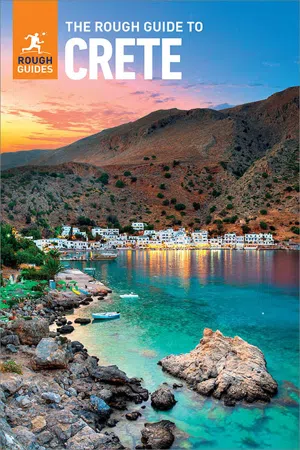
The harbour in the tiny village of Loutró at night
Georgios Tsichlis/Shutterstock
The city of Haniá, island capital until 1971, is unequivocally the most enjoyable of Crete’s larger towns, littered with oddments from its Venetian and Turkish past, and bustling with harbourside life. To either side, along virtually the whole north coast of the province, spreads a line of sandy beach – at times exposed, and increasingly developed, but still with numerous stretches where you can escape the crowds. Three peninsulas punctuate this northern coastline: Akrotíri, enclosing the magnificent natural harbour of Soúdha Bay; Rodhopoú, a bare and roadless tract of mountain; and, at the western tip of the island, Gramvoúsa, uninhabited and entirely barren. Akrotíri, ringed with air bases and naval installations, is well worth a day-trip, with a couple of excellent beaches and two beautiful monasteries. Most tourists stay to the west, on the coast between Haniá and Rodhopoú, in one of a number of former villages now linked by an ever-expanding strip of low-rise development centred on Ayía Marína and Plataniás, with the villas and apartments thinning out as you head further from the city.
The south is overshadowed by the peaks of the Lefká Óri – the White Mountains – whose grey bulk, snow-capped from January through to June, dominates every view in western Crete. Although marginally less high than the Psilorítis range, they’re far more rewarding for walking or climbing. Along the south coast the mountains drop straight to the Libyan Sea, and the few towns here lie in their shadow, clinging to what flat land can be found around the bays. Through the heart of the massif there’s no road at all, nor is there any driveable route along the south coast: unless you want to travel back and forth across the island you’ll have to rely on boats, or on walking. The hike through the National Park in the Samariá Gorge, Europe’s longest, is stunning, despite the summer hordes. With a little spirit of adventure and preparation you can take scores of other, deserted hiking routes.
The south-coast communities beneath the mountains see plenty of visitors, mostly gorge-trippers passing through, but none could really be described as a resort. Ayía Rouméli, the sometimes frenetic end-point of the Samariá Gorge walk, and serene Loutró can be reached only on foot or by boat. Hóra Sfakíon, the capital of the wild region known as Sfakiá, is a pleasant place to stay if you can handle the influx of day-trippers; more peace is to be found down the coast a little, at the superb beaches by the Venetian castle of Frangokástello.
The west end of the island, beyond Rodhopoú, is very sparsely populated. The port of Kastélli is the only town of any size, and there’s a small resort at Paleóhora in the south. Soúyia may be the next in line for development, but for the moment it seems in a rather charming state of limbo. The whole of the mountainous southwestern corner, an area known as Sélinos, is worth exploring, with rough roads leading to untouched mountain villages and little-known ruins and churches. On the west-facing coast – hard to get to but well worth the effort – are two of Crete’s finest beaches, Falásarna and Elafonísi. Finally there’s Gávdhos, an island some 30km off the south coast that is Europe’s southernmost point, caught somewhere between the eighteenth and the twenty-first centuries.
Haniá town
HANIÁ (Χανιά), as any of its residents will tell you, is spiritually the capital of Crete, even if the formal political title was long ago passed back to Iráklio. With its shimmering waterfront, crumbling masonry and web of alleys, it is an extraordinarily attractive city, especially if you can catch it in spring when the Lefká Óri’s snow-capped peaks seem to hover above the roofs. Although it is for the most part a modern place, whose permanent population – fast expanding into hill and coastal suburbs – always outnumbers the visitors, you might never know this as a tourist. Surrounding the harbour is a wonderful jumble of Venetian streets, a maze-like old town contained by ancient city walls and littered with Ottoman, Byzantine and Minoan ruins. Highlights include the Venetian harbour itself and a quartet of museums, but the greatest pleasure of all, perhaps, is to be had simply wandering the narrow streets and stepped alleyways. Add plentiful accommodation and tavernas, excellent markets, shopping and nightlife, and you’ll almost certainly want to stay longer than you intended.
Brief history
Haniá is one of the longest continuously inhabited city sites in the world, though its convoluted and often violent history has left it with relatively little to show for it. Only recently has the arrival of tourism, amid a rare period of peace and prosperity, inspired the will – if not the resources – to save the city’s crumbling architectural heritage.
Ancient Kydonia and La Canea
Ancient Kydonia was an apparently substantial Minoan community about which little is known: only scattered remnants have so far been brought to light, but many believe that there was a major palace here, probably beneath the modern buildings in Kastélli, overlooking the harbour. After the collapse of the Minoan palace culture, Kydonia grew into one of the island’s most important cities – well enough known for its citizens to warrant a mention in Homer’s Odyssey – and remained so through the Classical Greek era. When Rome came in search of conquest, the city mounted a stiff resistance prior to its eventual capitulation in 69 BC, after which it flourished once more. The Kastélli hill served as the Roman city’s acropolis, but dwellings spread at least as far as the extent of the walled city that can be seen today: Roman mosaics have been discovered beneath Cathedral Square and up near the present-day market.
In early Christian times Kydonia was the seat of a bishop, and under the protection of Byzantium the city flourished along with the island. As the Byzantine Empire became increasingly embattled however, so its further outposts, Kydonia included, suffered neglect. Not much is heard of the place again until the thirteenth century, when the Genoese seized the city from the Venetians and held it from 1263 to 1285.
Haniá orientation
Haniá’s old city clusters around the harbour, and most tourists confine themselves to this area or the fringes of the new town up towards the bus station. You may get lost wandering among the alleys, but it’s never f...