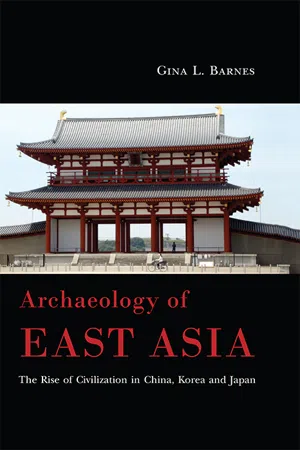
Archaeology of East Asia constitutes an introduction to social and political development from the Palaeolithic to 8th-century early historic times. It takes a regional view across China, Korea, Japan and their peripheries that is unbounded by modern state lines. This viewpoint emphasizes how the region drew on indigenous developments and exterior stimuli to produce agricultural technologies, craft production, political systems, religious outlooks and philosophies that characterize the civilization of historic and even modern East Asia.
This book is a complete rewrite and update of The Rise of Civilization in East Asia, first published in 1993. It incorporates the many theoretical, technical and factual advances of the last two decades, including DNA, gender, and isotope studies, AMS radiocarbon dating and extensive excavation results. Readers of that first edition will find the same structure and topic progression. While many line drawings have been retained, new colour illustrations abound. Boxes and Appendices clarify and add to the understanding of unfamiliar technologies. For those seeking more detail, the Appendices also provide case studies that take intimate looks at particular data and current research.
The book is suitable for general readers, East Asian historians and students, archaeology students and professionals.
Praise for The Rise of Civilization in East Asia:
“…the best English introduction to the archaeology of East Asia … brilliantly integrates the three areas into a broad regional context.” Prof. Mark Hudson
eBook - ePub
Archaeology of East Asia
The Rise of Civilization in China, Korea and Japan
- 432 pages
- English
- ePUB (mobile friendly)
- Available on iOS & Android
eBook - ePub
About this book
Information
Subtopic
Asian HistoryIndex
Social SciencesChapter 1
Orientation
Prior to nation-states, geography was broad and unbounded, with peoples traveling and intermixing at will. Despite the development of multitudinous regional ‘cultures’ and even states across East Asia, interaction was the name of the game. Thus geography is the basic referent for discussing human occupation of the landscape (Figure 1.1). Since most archaeological reports, however, discuss finds in terms of modern provinces and prefectures, these are given in Figures 2.1–2.3.
Now, let’s take a tour of East Asia to get oriented.
Grounding
Starting from the Yellow Sea
The central geographical point of reference for this text is the ‘Yellow Sea Basin’. The Yellow Sea grades into the East China Sea to the south, but for our purposes, the Yellow Sea Basin is defined as beginning at the Shanghai Delta in the southwest and extending to southern Kyushu in the southeast. The Ryukyu Islands are sandwiched by the East China Sea on the west and the Pacific Ocean on the east. The Yellow Sea is made yellow by the deposits of loess coming off the China Mainland and deposited into Bohai Bay in the northwest, the Bay being formed by the pinching in of the Shandongi and Liaodong peninsulae.ii The Yellow River has changed course many times over the millennia, sometimes draining into the Yellow Sea below the Shandong peninsula. The northeastern Bohai Bay receives the Liao River runoff, draining the Manchurian Basin. East of the Korean Peninsula lies the Eastern Sea, more commonly known as the Japan Sea. The Korean Peninsula and Japanese Islands are divided by two straits on either side of Tsushima Island:iii the Korea Strait and the Tsushima Strait, respectively ca. 120km and 65km wide at their narrowest points. These will simply be referred to here as the Korea Strait.

Figure 1.1 The geography of East Asia
formally defined as the modern nations of China, the two Koreas, Taiwan and Japan. Mongolia and the Russian maritime region are indicated here. Deserts are marked with dashes. Although the Tibetan Plateau and Tarim Basin form a large part of modern China, their archaeologies are not specifically dealt with here. East Asia, as covered in this book, can be thought of as centered on the Yellow Sea.
CP = Central Plain, surrounded by NCP = North China Plain
CP = Central Plain, surrounded by NCP = North China Plain
Several terms have been devised here to refer to parts of East Asia without using modern nation-state designations. The ‘China Mainland’ (or just ‘Mainland’) refers to most of the modern state of China, though the far west (Xinjiang province), the southeastern coast, and Tibet are not dealt with here. I devised the terms ‘Pen/Insular’ and ‘Pen/Insulae’ to refer to the combined areas of the Korean Peninsula and the Japanese Islands, whereas the term ‘Peninsula(r)’ (capitalized) is used specifically to refer to the Korean Peninsula; other peninsulae are not capitalized to make that difference clear. On that Peninsula, names of the five major rivers (the Yalu, Taedong, Han, Kum and Nakdong) are used as geographical locators. The term ‘continent(al)’ embraces both the China Mainland and the Korean Peninsula, and possibly other regions, in contrast to the Japanese Islands.
Within the Japanese archipelago, areas on the main island (Honshu) are often referred to by sub-regions: Tohoku, Kanto, Chubu, Tokai, Hokuriku, Kinai, and San’in. In addition, the Inland Sea area can be referred to as the Seto region and divided into western and eastern portions. Honshu itself is effectively divided into east and west by the ‘waist of Honshu’ at Nagoya City. Finally, I’ve coined three new terms to refer to the land areas underlying the Yellow Sea and Inland Sea when they were exposed as broad Plains during the glacial phases of the Pleistocene (Ice Age) period: first, the Yellow Plain and Seto Plain; then, I refer to the entire northeastern landmass that was exposed during the maximum period of lowered sea level in the Pleistocene as East Asialand, comparable to the Southeast Asian Sundaland.
Mainland geography
The ‘China Mainland’ is divided into the Manchurian Basin in the northeast, the Inner Mongolian steppes in the north, the North China Plain (NCP in Figure 1.1), the Yangzi Basin in central China, and the Sichuan Basin in the southwest. The Yellow River is best used to find oneself in Mainland geography. Rising in the northern Tibetan Plateau, it bends north around the arid Ordos region and then south to meet the Wei River flowing in from the west; it then flows through a narrow passage, which I have named the Huanghe Corridor, onto the North China Plain. Huanghe is the Chinese name meaning ‘yellow river’. Where it emerges from the Huanghe Corridor, the area is traditionally called the Central Plainiv (Zhongyuan, CP in Figure 1.1), considered the heartland of Chinese civilization. Since the Bronze Age, the Yellow River has laid down about 10 meters of alluvium on the North China Plain, burying the ancient landscape and making archaeological recovery extremely difficult. Perhaps because of the multiple changes of course, Neolithic and Bronze Age settlement on the China Mainland concentrated in the Wei River valley, the Central Plain, and the Huai River valley between the Yellow and Yangzi Rivers.
The Qinling Mountains and the Huai River served at different times to mark the division between the north and south Mainland. My term ‘East Coast’ breaches this divide, signifying the coastal region inclusive of the Shandong peninsula to below the Shanghai Delta. The Yangzi Basin and Shanghai Delta developed rice-based cultures different from the Yellow–Wei River drainage millet-based cultures. Influences from this southern region stimulated the development of rice-growing cultures in the southern Pen/Insulae, but how this technology was diffused is still debated.
The loesslands
Aeolian sediments blown in from Central Asian deserts accumulated in areas of the central and northeastern Mainland. These deposits could be up to hundreds of meters thick and form an important locus of Palaeolithic research as well as a major resource for Neolithic millet farmers. It is a landscape unfamiliar to most Westerners, heavily dissected by erosion since the Neolithic.
The Northern Zone
In the northern Mainland lie the Manchurian Basin in the northeast, the Mongolian Plateau to the north, and the Tarim Basin in the northwest. The Bohai Corridor (now often called the Liaoxi Corridor) connects the North China Plain to the lower Manchurian Basin, drained by the Liao River; historically, the regions to the west and east of the lower Liao River were respectively designated Liaoxi and Liaodong. The upper Manchurian Basin is drained to the north into the Amur by the Sungari River.
This entire northern region is characterized by increasing aridity from the coast toward Inner Asia, with Manchurian forests grading into Mongolian steppe, steppe desert, and of course the Gobi Desert. The Tarim Basin has as its core the Taklamakan Desert, with steppe to the north and oases lining the southern edge. In the past, the central and western arid areas were once colonized by greater tracts of forest and grasslands, leading to patterns of human settlement rather different from those seen today.
Westward ho!
East-west travel on the China Mainland would seem naturally to follow the Yellow River and the Yangzi River (called in Chinese the Changjiang ‘long river’), but this is not necessarily so. The major route to the west starts from the Huanghe Corridor and follows the Wei River into the Gansu Corridor (now often referred to as the Hexi Corridor). This is the route of the old Silk Road leading from the Central Plain into the Tarim Basin. From the Wei River valley, there is also a route south, across the Qinling Mountains into the Sichuan Basin; this allowed steppe-culture influence to reach this southwestern area, unlike other areas of the southern Mainland.
Eastward bound
Travel across the seas could be accomplished by island-hopping from Taiwan through the Ryukyu archipelago to Kyushu, though this was a little used route. Leapfrogging from the Shandong to Liaodong peninsulae provided another crossing point. The most treacherous crossing was directly across the Yellow Sea from the Shanghai Delta region to North Kyushu or the southern coast of the Korean Peninsula; boats therefore often hugged the shore of the Yellow Sea instead, but some evidence hints at direct crossings. The Korea Strait was always open, even as a large river in periods of lowest sea level, and required a boat crossing; but the northern Japanese Islands were connected to the Russian maritime region in glacial times, providing a northern entrance into the Japanese archipelago.
North-south divisions
All three areas of East Asia are subject to clear north/south divides extending from the prehistoric to the present. These divisions are partially determined naturally, by climate and resources, but cultural factors are also at work – responding not only to local climates but to proximate peoples.
On the China Mainland, the Qinling Mountains nominally divide North and Sout...
Table of contents
- Cover
- Title Page
- Copyright
- Contents
- List of Boxes
- List of Figures
- List of Tables
- Preface
- Dedication
- Chapter 1: Orientation
- Chapter 2: Archaeological Organization
- Chapter 3: The Earliest Inhabitants (2,000,000–40,000 years ago)
- Chapter 4: Innovations of Modern Humans (40,000–10,000 years ago)
- Chapter 5: Earlier Holocene Subsistence Patterns (10,000–5000 years ago = 8000–3000 BC)
- Chapter 6: The Mid-Holocene Social Mosaic (5000–2000 BC)
- Chapter 7: Emergence and Decline of Late Neolithic Societies (3300–1900 BC)
- Chapter 8: Bronze Age Beginnings (2000–850 BC)
- Chapter 9: Early State Florescence (1500–770 BC)
- Chapter 10: Eastern Zhou and Its Frontiers (1st millennium BC)
- Chapter 11: Pen/Insular Rice, Bronze and Iron (1300–200 BC)
- Chapter 12: The Making and Breaking of Empire (350 BC–500 AD)
- Chapter 13: The Yellow Sea Interaction Sphere (400 BC – 300 AD)
- Chapter 14: Mounded Tomb Cultures (2–5c AD)
- Chapter 15: East Asian Civilization (3–7c AD)
- Chapter 16: Epilogue: Ancient East Asia in the Modern World
- Appendices
- Endnotes
- Sources for Illustrations and Box and Table data
- Bibliography
Trusted by 375,005 students
Access to over 1.5 million titles for a fair monthly price.
Study more efficiently using our study tools.
Frequently asked questions
Yes, you can cancel anytime from the Subscription tab in your account settings on the Perlego website. Your subscription will stay active until the end of your current billing period. Learn how to cancel your subscription
No, books cannot be downloaded as external files, such as PDFs, for use outside of Perlego. However, you can download books within the Perlego app for offline reading on mobile or tablet. Learn how to download books offline
Perlego offers two plans: Essential and Complete
- Essential is ideal for learners and professionals who enjoy exploring a wide range of subjects. Access the Essential Library with 800,000+ trusted titles and best-sellers across business, personal growth, and the humanities. Includes unlimited reading time and Standard Read Aloud voice.
- Complete: Perfect for advanced learners and researchers needing full, unrestricted access. Unlock 1.5M+ books across hundreds of subjects, including academic and specialized titles. The Complete Plan also includes advanced features like Premium Read Aloud and Research Assistant.
We are an online textbook subscription service, where you can get access to an entire online library for less than the price of a single book per month. With over 1.5 million books across 990+ topics, we’ve got you covered! Learn about our mission
Look out for the read-aloud symbol on your next book to see if you can listen to it. The read-aloud tool reads text aloud for you, highlighting the text as it is being read. You can pause it, speed it up and slow it down. Learn more about Read Aloud
Yes! You can use the Perlego app on both iOS and Android devices to read anytime, anywhere — even offline. Perfect for commutes or when you’re on the go.
Please note we cannot support devices running on iOS 13 and Android 7 or earlier. Learn more about using the app
Please note we cannot support devices running on iOS 13 and Android 7 or earlier. Learn more about using the app
Yes, you can access Archaeology of East Asia by Gina L. Barnes in PDF and/or ePUB format, as well as other popular books in Social Sciences & Asian History. We have over 1.5 million books available in our catalogue for you to explore.