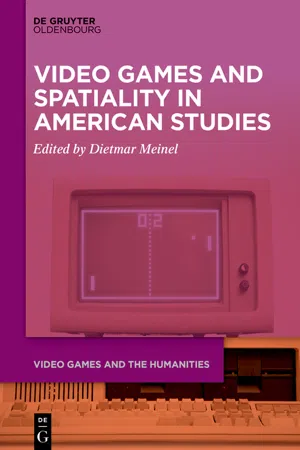
While video games have blossomed into the foremost expression of contemporary popular culture over the past decades, their critical study occupies a fringe position in American Studies. In its engagement with video games, this book contributes to their study but with a thematic focus on a particularly important subject matter in American Studies: spatiality. The volume explores the production, representation, and experience of places in video games from the perspective of American Studies. Contributions critically interrogate the use of spatial myths ("wilderness," "frontier," or "city upon a hill"), explore games as digital borderlands and contact zones, and offer novel approaches to geographical literacy. Eventually, Playing the Field II brings the rich theoretical repertoire of the study of space in American Studies into conversation with questions about the production, representation, and experience of space in video games.
- 301 pages
- English
- ePUB (mobile friendly)
- Available on iOS & Android
eBook - ePub
Video Games and Spatiality in American Studies
About this book
Information
Topic
EducationSubtopic
North American HistoryPart I
Notes on the State of Montana: The U.S. American Spatial Imagination and the Retrotopia of Far Cry 5
Sören Schoppmeier
“Montana. Big Sky Country. The Treasure State. People got a lot of names for it. I just call it home” (Far Cry 5). These are the first words heard by the player in Ubisoft’s first-person, open-world shooter Far Cry 5 (2018). Uttered by Mary May Fairgrave, a bar owner and resident of the game’s fictional Hope County, they do not just introduce the game’s setting. They also establish an affective contrast to the violent events surrounding the militant, Christian-fundamentalist cult called Project at Eden’s Gate, which constitute the basis for the game’s central conflict. A particular sense of place, then, permeates the gameworld and combines with a larger notion of space that emerges from a long history and tradition of a decidedly U.S. American spatial imagination. This conception of space, in turn, is imbued with a temporal dimension unequivocally oriented toward the past, which is exemplary for a line of reactionary political thinking that has grown in prominence over the past decade.
In his 2017 book Retrotopia, Zygmunt Bauman theorizes the recent surge in populist, reactionary, and nationalist political movements in many Western democracies. Bauman locates the visions of society and community guiding these rising political forces in a disfigured appropriation of the utopian tradition, which has been inverted and reoriented from a progressive, ideal future-in-the making to a return to a past experienced as lost but worthy of resuscitation (see 8 – 9). In Bauman’s words: “From that double negation of More-style utopia – its rejection succeeded by resurrection – ‘retrotopias’ are currently emerging: visions located in the lost/stolen/abandoned but undead past, instead of being tied to the not-yet-unborn and so inexistent future, as was their twice-removed forebear” (4 – 5). One could say, then, as I argue in a comparable context, that “retrotopia constitutes a longing for a better future in the image of an idealized, if not outright imagined, past” (Schoppmeier 18). This longing, one may add, evidently hampers efforts to envision alternative futures not based on a presumed state of a better past, which may be better equipped to solve empirically real, global, and unprecedented challenges – such as human-caused climate change – which are rooted precisely in the past romanticized here.
Drawing on Bauman’s concept of “retrotopia” (8), this chapter argues that Far Cry 5’s spatial imaginary betrays a distinctly reactionary view of the United States. Even though the game seemingly attempts to stay clear of (explicit) political statements, its rendering of contemporary Montana as a place suffused with a nostalgic longing for an imagined, bygone state that never was exemplifies the “retrotopian romance with the past” (9) delineated by Bauman.
I begin with a brief summary of Far Cry 5 in order to contextualize its setting, plot, and gameplay. My argument then unfolds across three sections. First, I examine Far Cry 5’s organization of gamespace against the background of U.S. American traditions of imagining space on the North American continent, focusing particularly on the ways in which gameplay is structured around and informs the gamespace in this context. This consideration of gameplay continues in the second section, which zooms in on specific notions of place in relation to the shared cultural history of the venues depicted in the game. Finally, the third section weaves together the threads from the preceding parts and explicates the reactionary temporal imagination underlying Far Cry 5’s depiction of Montana qua its fictional proxy Hope County, illuminating the game’s cultural work with regard to questions of space, time, and American culture.
Out of Montana: An Overview of Far Cry 5
Released in March 2018 for PC, PlayStation 4, and Xbox One, Ubisoft’s Far Cry 5 both follows established routines and breaks new ground for the Far Cry series. Staying true to the franchise’s blueprint, gameplay revolves around exploring a vast, freely traversable gamespace of varying terrain and conquering its sections by force. Whereas the familiar Far Cry formula continues to structure the ludic experience of Far Cry 5, however, its setting marks a turning point in the history of the series. Previous titles were set in remote and decidedly exoticized regions such as Micronesia, central Africa, an archipelago somewhere between the Indian Ocean and the Pacific Ocean, and the Himalayas. In contrast, Far Cry 5 is the first entry to take place in the United States, specifically rural Montana. Populated, as were its predecessors, not only by hostile factions but also an assortment of habitat-appropriate wildlife, Far Cry 5’s gameworld evokes the recurring function of nature in the U.S. American cultural imagination – not without consequence for its cultural work vis-à-vis ideas about time and space in the United States, as I elaborate in the following pages.1 Before returning to the question of the American wilderness, however, a few words on Far Cry 5’s central plot are in order.
Set in Hope County, a fictional blend of recognizable Western landscape, rural industry, and small-town clichés, players take on the role of an unnamed deputy of the United States Marshals Service on an assignment with the goal of ending the activities of an apocalyptic, Christian cult called ‘Project at Eden’s Gate’ and arresting its charismatic leader Joseph Seed. The mission ends in a disaster, with Seed escaping and the cult, which operates like a paramilitary militia, capturing all members of the squad except for the protagonist and the local Sheriff. The remainder of the game revolves around taking Hope County back from the cult by expunging its members and rallying the scattered resistance around the county. Throughout the game, players help the locals, rescue hostages, destroy cult property, and, most importantly, liberate cult outposts, which are essentially various businesses hijacked by the cult. The fact that Hope County is finally devastated anyways in Far Cry 5’s final scene does not take away from the dominance of acts of retaking throughout the duration of the game.
First announced in 2017, Far Cry 5 entered a political moment in the United States that had just seen former real estate mogul and reality TV star Donald Trump win the American presidential election for the Republican Party. Against this background, the populist right-wing resurgence in the United States immediately became a lens through which some interpreted Far Cry 5’s plot and setting when the game was revealed. Once the game was released, however, nearly all allusions to the political reality in the United States had been subdued either by not engaging with issues evoked by the game or by keeping them contained in smaller, often inconsequential parts of the game. Nonetheless, as I will argue in the following sections, Far Cry 5’s conceptions of space and place and their relation to longer traditions of thought in American culture betray a reactionary vision of the United States intimately related to that underlying Trump’s election and presidency.
Big Sky Country: Gamespace and the American Spatial Imagination
The first thing players see in Far Cry 5 after the failed mission to arrest Joseph Seed is the inside of a high-tech bunker, where the protagonist wakes up after having been rescued by a local prepper. Upon leaving the bunker for the first time, players are momentarily blinded by sunlight before witnessing what appears like a placid forest. Players now find themselves surrounded by lush and seemingly unspoiled nature, which exudes a sense of tranquility and regeneration. From this point onward, open spaces and idyllic landscapes dominate the visual and spatial experience of playing Far Cry 5, while also providing a recurring contrast between the enclosed and the open, between the technological and the natural – in other words: between the ‘civilized’ and the ‘wild.’ As the third-least populated state of the United States, Montana epitomizes a region prone to evoke sensations of a vast, untamed continent even today. The game’s audiovisual representation, I argue, combines this geographical focus to imbue the structural organization of the gamespace and the rhythms of open-world gameplay with cultural connotations linked to a particular history of thought concerned with ‘uncivilized’ space on the North American continent.
From a purely formal perspective, the game not only follows its predecessors in the Far Cry franchise, it also epitomizes a spatial distinction regularly found in video games. Particularly in the genres of role-playing games and open-world shooters, the most fundamental segmentation of gamespace is the differentiation between safe zones, where the player character cannot be attacked or at least is not attacked without provocation, and conflict zones, where the player character is continuously exposed to potential harm by other entities in the gameworld.2 The former often serve as opportunities for the player to save the game state, regenerate the player character’s health, purchase in-game goods, and learn about and accept quests. The latter, in turn, provide the space for the game’s ludic challenges as well as the ensuing rewards. While safe zones generally come in the guise of towns or even houses, conflict zones are often decidedly marked as a kind of wilderness regulated by little other than the ‘law of the jungle.’ In other words: it is commonly a representation of ‘civilization’ that grants players safety, while it is the ‘wilderness’ that puts them in peril at the same time as it also promises material rewards and character growth.
In the history of the U.S. American spatial imagination, few ideas have proven as powerful as that of the wilderness on the North American continent. A central figuration of this idea has been the myth of the frontier, whose core argument is that the Western frontier, the line which separates the civilization embodied by settlements east of the frontier from a perceived wilderness beyond, has decisively shaped the American people and nation. Throughout the various forms of the myth, exceptional individuals of originally European origin leave civilization, venture into the wilderness, endure hardships, and eventually return to civilization as new, stronger, and wiser men, now distinctly U.S. American.3 The most famous formulation of the myth has been historian Frederick Jackson Turner’s 1893 paper “The Significance of the Frontier in American History.” Turner viewed the frontier experience as the single most important influence in the emergence of an original U.S. American nation. In his view, the pioneers’ contact with wilderness forced them into a struggle with a hostile environment for which they were not prepared. Yet they endured and eventually overcame this ordeal, during the course of which they were remade as U.S. Americans at the same time as the wilderness was transformed into a place of civilization (see Turner 1 – 4).4
A more pertinent conceptualization of the frontier thesis as a myth can be found in Richard Slotkin’s study Regeneration through Violence: The Mythology of the American Frontier 1600 – 1860 (1973). What Turner considered a historical development, Slotkin identifies as a myth originating in Puritan writing and perpetuated through numerous works of U.S. American literature. What is absent in Turner’s hypothesis, however, becomes the central force defining the American experience of westward expansion in Slotkin’s study: violence. The regeneration allegedly afforded by the mythic space of the frontier appeared to necessitate violence, generally directed at Nati...
Table of contents
- Title Page
- Copyright
- Contents
- Video Games and Spatiality in American Studies: An Introduction
- Part I
- Part II
- Part III
- Contributors
- Index
Trusted by 375,005 students
Access to over 1.5 million titles for a fair monthly price.
Study more efficiently using our study tools.
Frequently asked questions
Yes, you can cancel anytime from the Subscription tab in your account settings on the Perlego website. Your subscription will stay active until the end of your current billing period. Learn how to cancel your subscription
No, books cannot be downloaded as external files, such as PDFs, for use outside of Perlego. However, you can download books within the Perlego app for offline reading on mobile or tablet. Learn how to download books offline
Perlego offers two plans: Essential and Complete
- Essential is ideal for learners and professionals who enjoy exploring a wide range of subjects. Access the Essential Library with 800,000+ trusted titles and best-sellers across business, personal growth, and the humanities. Includes unlimited reading time and Standard Read Aloud voice.
- Complete: Perfect for advanced learners and researchers needing full, unrestricted access. Unlock 1.5M+ books across hundreds of subjects, including academic and specialized titles. The Complete Plan also includes advanced features like Premium Read Aloud and Research Assistant.
We are an online textbook subscription service, where you can get access to an entire online library for less than the price of a single book per month. With over 1.5 million books across 990+ topics, we’ve got you covered! Learn about our mission
Look out for the read-aloud symbol on your next book to see if you can listen to it. The read-aloud tool reads text aloud for you, highlighting the text as it is being read. You can pause it, speed it up and slow it down. Learn more about Read Aloud
Yes! You can use the Perlego app on both iOS and Android devices to read anytime, anywhere — even offline. Perfect for commutes or when you’re on the go.
Please note we cannot support devices running on iOS 13 and Android 7 or earlier. Learn more about using the app
Please note we cannot support devices running on iOS 13 and Android 7 or earlier. Learn more about using the app
Yes, you can access Video Games and Spatiality in American Studies by Dietmar Meinel in PDF and/or ePUB format, as well as other popular books in Education & North American History. We have over 1.5 million books available in our catalogue for you to explore.