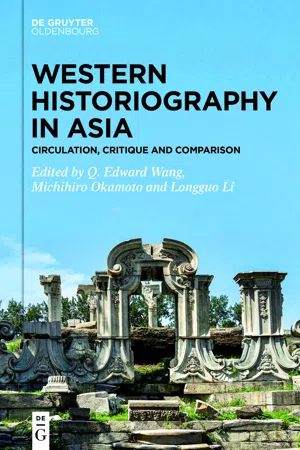
This volume provides a unique and critical perspective on how Chinese, Japanese and Korean scholars engage and critique the West in their historical thinking. It showcases the dialogue between Asian experts and their Euro-American counterparts and offers valuable insights on how to challenge and overcome Eurocentrism in historical writing.
eBook - ePub
Western Historiography in Asia
Circulation, Critique and Comparison
- 654 pages
- English
- ePUB (mobile friendly)
- Available on iOS & Android
eBook - ePub
Western Historiography in Asia
Circulation, Critique and Comparison
About this book
Information
Subtopic
Asian HistoryIndex
HistoryPart I: Tradition and Transformation
On How Herodotus’ Historia Became History
Wu Xiaoqun
Note: Translation from the Chinese text, with author’s revision, “Lun Xiluoduode de ‘tanjiu’ heyi chengwei ‘lishi’ de,” Shijie lishi (World history) 3 (2013) by Mengxi Li Seeley.
In Herodotean studies, scholars such as Arnaldo Momigliano1 have always placed Herodotus and his works within the context of the development of Western historical writing, emphasizing the foundational role classical historians such as Herodotus and Thucydides played in modern Western historiography.2 However, amidst comprehensive post-modernist critiques of the study of history since the latter half of the twentieth century and the resulting questioning of classical historiography, this traditional school of thought has faced great challenges.3 Many Western scholars questioned the veracity of the historical writings of Herodotus and Thucydides from the aspects of writing style, narrative model, use of sources, and motives for writing, furthermore even denying their status as historians and the continuities between classical historiography and modern historiography. For example, in 1986 W. Robert Connor noted in an academic conference on Herodotus that perhaps his purpose for writing was not as traditionally imagined, which is to advocate or put in practice narration of past events as accurately as possible.4 Another example is A.J. Woodman, who in the introduction of his work quoted R.F. Atkinson’s words from Knowledge and Explanation in History:
From outside one tends to think of history as continuing from classical times to the present today; but many professional historians seem rather to think that their subject underwent a major change around the beginning of the nineteenth century. It may even be thought that history ‘proper’ began about that time.5
In other words, in their opinion, Western historiography since modern times bears no substantive relation to classical historiography.
This kind of shift in research is not necessarily due to questions regarding the veracity or credibility of Herodotus’ records. As a traditional topic of research, the facts of Herodotus’ writings have already been thoroughly examined, but perhaps because there is no way to make more significant progress in this path of research, scholars have begun to turn to Herodotus’ writing style and language. Actually, in the field of classics, the discussion on the “factualness” of Herodotus’ Histories has never stopped.
However, the discussion on the spirit of the times, issue consciousness, and standards of assessment is a different story. Because historical writing in different time periods were endowed and laden with different meaning, people considered questions from different angles and had different problems to solve. Thus Western scholars had different evaluations of the same issue. The cause of these divergences certainly is not a change in Herodotus or his works, but rather a fundamental difference in researchers’ understanding and expectations regarding history and the specialized discipline of historical study–historiography.6 Doubtlessly, the new research direction widened our understanding of classical writers. At the same time, however, this questioning discourse has also presented a very serious challenge to the position of their writings as historical works. It is in this context that this article explores how exactly the new narrative model started; by Herodotus constituting an historia(inquiry), was this new method of understanding simply a textual change? If we acknowledge it as a new method of understanding, then can we determine whether it already acquired the characteristics of “historical research”? Does this method of inquiry bear any material relationship to modern historiography?
1 The Implications of Historia
Usually, after ancient writers completed their works, they would add a short introduction to the beginning of the volume to make known the purpose of their work and thus introduce the main topic. During the Hellenistic era, editors in Alexandria customarily selected one or two important terms in the first paragraph of the work as the title of the book. Historia was the key term they selected from the first paragraph of Herodotus’ work. In total, Herodotus used the word historia in his work a total of 22 times. As is widely known, the English word “history” comes from the ancient Greek word historia. As early as Homer’s time, the epic poem the Iliad volume 18 and volume 23 mention the word histor, referring to people who would investigate and determine the truth from the statements of two parties to a lawsuit; their status was like that of arbiters who earn remuneration through this work. Hesiod in his poems also used the term to refer to people who understood situations or possessed certain skills. Historia was the noun form of the verb historein, which referred to “investigative studies” or “inquiry.” historein could be seen as the characteristic activities of a histor, namely, finding the facts in a lawsuit, “to inquire” or “ask after.”
The first people to use historia to refer to a new method of understanding were Ionian thinkers, the most representative being Thales of Miletus. In the sixth century BCE, philosophers in Ionia in Asia Minor commonly used historein methods to study the origins of the universe and matter. They would then record the conclusions they reached through rational evaluation in prose essays. This became known as the Ionian intellectual revolution. The Ionian methods influenced others, who became known as essay chroniclers or logographers, one of whom was Hecataeus. However, the latter’s interests and focus were not on the order or laws of the universe, but rather human society. They began to explore the geography and customs of foreign lands and nations. They also recorded the results of their research in essays by screening and evaluating the sources they collected not only through observation but also through obtaining evidence from witnesses. Without the limitations of metrical verse, the expression of thoughts became more free. Hecataeus openly declared in his work, Genealogies: “I write what seems to me to be true, for the stories (logoi) of the Greeks appear to me to be many and laughable.”7 It can be said that Hecataeus pursued continuous human achievement in a way completely different from Homer and Hesiod.
If Hecataeus’ generation of essayists was influenced by the Ionian philosophers and their works had already begun to exhibit a sort of discourse of inquiry based on human actions, then by Herodotus’ time this spirit and method of inquiry had become an even more self-aware kind of activity. “Inquiry” not only appeared at the beginning of his work but also throughout Histories. Herodotus emphasized this attitude of “inquiry” from beginning to end, continuously noting: “What I have mentioned above all originate from the results of my personal observations, judgments, and exploration” (Histories 2.99); “I have written according to my own beliefs” (Histories 2.120); “But I do not think this was caused by the reasons listed above, but rather there were other reasons” (Histories 7.133). As for problematic areas, he would candidly express: “However, I personally think this is inexplicable” (Histories 4.30); “My narration is now unreliable” (Histories 7.152).
Herodotus listened, selected, and recorded the content he heard, but also retained his right to critique. In situations where there was no circumstantial evidence to compare, he would tentatively record what he knew. However, he would not easily believe it, but rather put forward his own views, asking readers to take caution and decide for themselves. This could be seen as the most desirable and most critical attitude at the time.8
However, after Herodotus, historia did not become a specialized technical term. Thucydides did not use the term, but used other terms to express the same attitude of inquiry. The term Thucydides used to describe his study of early Greek history was “discovery.” For contemporary studies of Greece the term he used meant “collect and record.” As can be seen, Thucydides did not simply repeat myths or the memories of others, but rather added narration and interpretation to the subject he chose himself. Regarding why Thucydides did not use the term historia, Simon Hornblower believes there ...
Table of contents
- Title Page
- Copyright
- Contents
- Acknowledgement
- Introduction
- Part I: Tradition and Transformation
- Part II: Critiques and Challenges
- Part III: Comparative Perspectives
- Contributors
- Index
Trusted by 375,005 students
Access to over 1.5 million titles for a fair monthly price.
Study more efficiently using our study tools.
Frequently asked questions
Yes, you can cancel anytime from the Subscription tab in your account settings on the Perlego website. Your subscription will stay active until the end of your current billing period. Learn how to cancel your subscription
No, books cannot be downloaded as external files, such as PDFs, for use outside of Perlego. However, you can download books within the Perlego app for offline reading on mobile or tablet. Learn how to download books offline
Perlego offers two plans: Essential and Complete
- Essential is ideal for learners and professionals who enjoy exploring a wide range of subjects. Access the Essential Library with 800,000+ trusted titles and best-sellers across business, personal growth, and the humanities. Includes unlimited reading time and Standard Read Aloud voice.
- Complete: Perfect for advanced learners and researchers needing full, unrestricted access. Unlock 1.5M+ books across hundreds of subjects, including academic and specialized titles. The Complete Plan also includes advanced features like Premium Read Aloud and Research Assistant.
We are an online textbook subscription service, where you can get access to an entire online library for less than the price of a single book per month. With over 1.5 million books across 990+ topics, we’ve got you covered! Learn about our mission
Look out for the read-aloud symbol on your next book to see if you can listen to it. The read-aloud tool reads text aloud for you, highlighting the text as it is being read. You can pause it, speed it up and slow it down. Learn more about Read Aloud
Yes! You can use the Perlego app on both iOS and Android devices to read anytime, anywhere — even offline. Perfect for commutes or when you’re on the go.
Please note we cannot support devices running on iOS 13 and Android 7 or earlier. Learn more about using the app
Please note we cannot support devices running on iOS 13 and Android 7 or earlier. Learn more about using the app
Yes, you can access Western Historiography in Asia by Q. Edward Wang,Okamoto Michihiro,Longguo Li,Li Longguo in PDF and/or ePUB format, as well as other popular books in History & Asian History. We have over 1.5 million books available in our catalogue for you to explore.