This book will explore a new approach to airport planning that better captures the complexities and velocity of change in our contemporary world. As a result, it will lead to higher performing airports for users, business partners, investors and other stakeholders. This is especially pertinent since airports will need to come back better from the Covid-19 pandemic.
The book explains the importance of articulating a clear strategy, based on a rigorous analysis of the competitive landscape while avoiding the pitfalls of ambiguity and 'virtue signalling'. Having done so, demand forecasts can be developed that resemble S-curves, not simple straight lines, that reflect strategic opportunities and threats from which a master plan can be developed to allocate land and capital in a way that maximizes return on assets and social licence. The second distinctive feature of this book is the premise that planning an airport as an island, a fortress even, does not work anymore given how interconnected airports are with other components of the transportation system, the economies and communities they serve and the rapid pace of social and technological change. In summary, the book argues that airport planning needs to move beyond its traditional boundaries.
The book is replete with real examples from airports of all sizes around the world and includes practical advice and tools for executives and managers. It is recommended reading for individuals working in the airport business or the broader air transport industry, members of airports' board of directors, who may be new to the business, elected officials, policy makers and urban planners in jurisdictions hosting or adjacent to airports, regulators, economic development professionals and, finally, students.
In 1946, the Government of Canada started assembling land for a second, north runway at Vancouver International Airport, Canada. That runway opened 50 years later in 1996 after decades of land assembly, expropriation, litigation, community opposition and a formal environmental impact assessment. When it did go into service, it was restricted to arrivals only, with a few exceptions. Frankfurt Airport’s fourth runway first appeared in a Master Plan in 1997 and it opened 14 years later, with operating restrictions, while Amsterdam Schiphol’s fifth runway, the ‘Polderbaan’, was 18 years between planning and the first aircraft landing on it. Meanwhile, Heathrow’s third, northern runway is not scheduled to open until 2030 having first being announced as government policy in 2009.
Passenger terminals can have long gestation periods too. London Heathrow’s Terminal 5 was first mooted in 1982 and finally opened 26 years later in 2008.
In some cases, it can take less time to build a completely new airport than add a runway or terminal to an existing one, especially if there is a greenfield site and approvals and permits are expedited. Dubai’s Al Maktoum International Airport opened in 2010, five years after it was first conceived. The new Istanbul Airport was announced in 2012; the construction of the airport started in 2015 and was opened fully in 2019.
Berlin’s Brandenburg Airport (BER) opened on October 31, 2020, 14 years after construction started and 20 years after official planning was launched.
Immovable Objects and Irresistible Forces
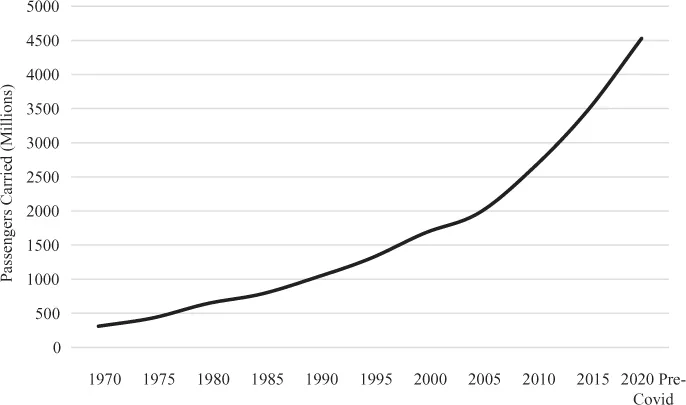
What makes airport planning challenging is that it’s where irresistible force of the demand for air transportation meets the science of aeronautics which ordains that we need immovable long, straight and flat pieces of concrete, free of obstacles at each end, to launch and land aircraft. Figure 1.1 shows the accelerating rate of growth in air travel, pre-pandemic.
Figure1.1 Global Demand for Air Travel.
Source: International Civil Aviation Organization, Civil Aviation Statistics of the World and ICAO staff estimates.
Airports rightly and necessarily devote considerable time and energy to planning their investments to ensure they are the right ones, at the right time and in the right place. All that remains true, but the theme of this book is about how we need to cast a wider net in this process, beyond the traditional boundaries of airport planning. Why? Airports themselves are becoming ‘distributed’ in that lots of things we used to do at the airport, like checking in or shopping, we now do from home or in an Uber on our way to the airport. They are also part of larger air transport ecosystem which includes aircraft and air navigation and are magnets in their metropolitan areas shaping land values and uses in their immediate vicinity but also for many miles beyond. Planning an airport as an island, a fortress even, does not work anymore.
By any definition, the airport industry is a capital intensive one, that is, the amount of capital required to generate $1 of revenue is high and much more than the amount of labour. Based on a sample of 126 airports, the average capital intensity was $8.39 in total assets per dollar of revenue in 2015.1 In contrast, labour costs were only $0.23 per dollar of revenue.
Planning is important not only because of the quantity of capital consumed by airports but also because of the characteristics of that capital. First, it’s very long-lived. Terminal buildings and runways are not pop-up structures but substantial ones that must be ‘built to last’ to minimize the risks of physical and functional obsolescence. Second, it’s immobile, so cannot be disassembled and relocated to a new and growing market, in contrast with airlines whose capital assets are ultimately mobile. Third, it’s very difficult to build a modular runway, so airport capital tends to be monolithic or ‘lumpy’. Fourth, it’s not easily transferable in the way that a regular office building could be converted into shops, a hotel or apartments. Finally, it has externalities because the aircraft that arrive and depart on a runway create noise and emissions that can negatively affect surrounding communities. This last point leads us to the other reason to plan: maintaining social licence, defined2 as broad public support for the airport’s strategy and the major infrastructure projects that flow from it.
It is reasonable to say that social licence is difficult to earn requiring years, if not decades, of transparency, engagement and openness, as well as clear and consistent messaging on the benefits that the airport confers. As hard as it is to gain, social licence can be very easily lost but undeniably its importance will be magnified as the industry recovers from the pandemic. Arguably to retain and rebuild their social licence, airports will have to come back: cleaner, greener, leaner and keener.
Cleaner as in Covid sanitation protocols will outlast the pandemic;
Greener in that concern about the impact of air travel on climate change has not gone away plus the collective sense of achievement in conquering Covid will spill over into renewed vigour in tackling emissions;
Leaner in that margins will be under pressure because our customers expect continuous improvement in processes and ‘virtual’ represents real competition; and
Keener in terms of being even more actively engaged in the community’s economic and social well-being, for example, working to repair some of the socio-economic inequities that the pandemic has exposed.
The Pyramid of Planning
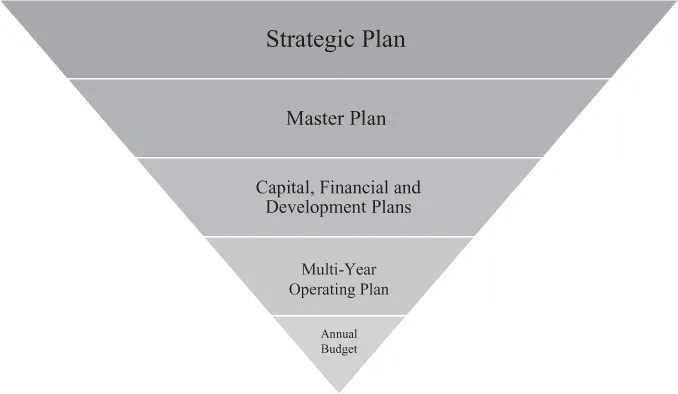
‘Planning’ is a big, generic term, so it can be helpful to break it down into five interlinked levels each with different time horizons and levels of granularity. Think of it as a Pyramid of Planning (see Figure 1.2) and an aid to successful execution.
Figure1.2 Pyramid of Planning.
Source: Vancouver Airport Authority, modified by author.
At the top level, there is a strategic plan. This is not where specific projects are itemized but instead articulates the business strategy of the airport based on assessment of the competitive landscape. It says: ‘we have looked at the options available to us and this is the airport we intend to be’. Spoiler alert: many airports fudge this part of the process and end up trying to be all things to all people.
A Master Plan is the next level down on the Pyramid of Planning and is a document with typically a 20-year time horizon that takes that demand forecast and translates into the land and facilities necessary to accommodate it. Most airports have a Master Plan because it is a legislated requirement but regardless it’s just good business practice.
Below the Master Plan sits two sets of ten-year plans: a capital and financial plan which takes the major investments identified in the Master Plan and turns them into discrete projects with more accurate cost estimates and a series of sub-area development plans that specify servicing, development options and uses in more detail. This is the link between a broad recommendation in the Master Plan, for example, the requirement to add ten international gates, into a specific project which will need to be designed, funded and approved. For land zoned generically as ‘airside commercial’ in the master plan, a sub-area plan can be developed for various precincts such as air cargo, business aviation or aircraft maintenance. Without these linking plans, a Board of Directors can be faced with a series of projects or developments to approve but without a clear idea of how they related back to the Master Plan and the strategy.
The bottom two layers of the pyramid are multi-year and one-year operating plans and budgets. The multi-year version can have a horizon of two to five years as it usually takes this long for any operational or commercial project to cycle through the phases of conception, planning, testing and implementation.
The point is that linking the five tiers of planning increases the probability of synchronizing the airport’s strategy with the operating plan for the current year. It would be a mistake to underestimate the forces that can cause a misalignment, which can include miscommunication, misunderstanding, conflicting incentives, ‘pet’ projects, ones that are ill-conceived or those with powerful advocates. For example, an airport makes a strategic choice to reduce greenhouse gas emissions; yet in another part of the organization, negotiations are underway to lease a piece of orphaned land to a used-car dealership.
Summary and Conclusions
Airport planning has never been more challenging, nor more important. It is really a risk management exercise. It is really a risk management exercise, that is, minimizing the possibility of building underperforming assets and losing social licence. Arguably these risks are much higher with societal disquiet about aviation’s impact on climate change, the pace of technological development, the emergence of new business models and the Covid-19 pandemic. The antidote to this challenge is to take airport planning beyond its traditional boundaries to capture a broader set of influences, deploy new frameworks and adopt different ways of thinking.
Notes
Author’s calculation.
Gunster and Neubauer, “From Public Relations”.
Bibliography
Gunster, Shane, and Robert Neubauer. “From Public Relations to Mob Rule: Media Framing of Social Licence in Canada”. Canadian Journal of Communication 43, no. 1 (2018): 11–32. https://doi.org/10.22230/cjc.2018v43n1a3342.
2 Strategic Planning
DOI: 10.4324/9781003173267-2
Introduction
Strategic planning conjures up visions of war rooms where grand plans are hatched and executed or, in a corporate setting, a two-day meeting at a country resort where the company’s strategy is hammered out with the aid of a facilitator and large Post-It notes plastered on the conference room walls.
Strategy is about choice, of the difficult and sometimes controversial variety and, yes, you can and should decide what kind of airport you want to be. For example, some small airports will desperately hang on to their one daily scheduled service, bearing all the fixed costs of a passenger terminal and fire fighting capabilities as a matter of civic pride rather than a rational strategy.
The Strategic Trilemma
A trilemma is a triangle of desired outcomes, only two of which are possible. We find them in business, politics, economics and the environment.
The most common strategic trilemma in business is: ‘fast, cheap and good’. A company can offer a fast and good service, for example, the guaranteed overnight package delivery services of FedEx or UPS, but it is not cheap. Or it can offer cheap and good service, which means that the package will be delivered intact but not by a specific date or time, so a reasonable characterization of regular postal service. Finally, there may be a service offering that is fast and cheap but not very good, meaning the package may be damaged in transit, the tracking system is non-existent or you must collect your item at a distant and dingy depot.
Another example comes from human resources. In many companies’ performance management systems for senior staff, a high performing employee is described as somebody who gets things done, demonstrates creativity and innovation as well as being a great team player and leader. While such individuals undoubtedly exist, m...
Table of contents
Cover
Half Title
Series Page
Title Page
Copyright Page
Dedication
Table of Contents
List of Figures
List of Tables
Acknowledgements
1 Why Plan?
2 Strategic Planning
3 Demand Forecasting
4 Master Planning for Passengers
5 Master Planning for Cargo
6 Airport Area Planning
7 Economic Impact
8 Looking Ahead
9 Summary and Conclusions
Index
Trusted by 375,005 students
Access to over 1.5 million titles for a fair monthly price.
Study more efficiently using our study tools.
Frequently asked questions
Yes, you can cancel anytime from the Subscription tab in your account settings on the Perlego website. Your subscription will stay active until the end of your current billing period. Learn how to cancel your subscription
No, books cannot be downloaded as external files, such as PDFs, for use outside of Perlego. However, you can download books within the Perlego app for offline reading on mobile or tablet. Learn how to download books offline
Perlego offers two plans: Essential and Complete
Essential is ideal for learners and professionals who enjoy exploring a wide range of subjects. Access the Essential Library with 800,000+ trusted titles and best-sellers across business, personal growth, and the humanities. Includes unlimited reading time and Standard Read Aloud voice.
Complete: Perfect for advanced learners and researchers needing full, unrestricted access. Unlock 1.5M+ books across hundreds of subjects, including academic and specialized titles. The Complete Plan also includes advanced features like Premium Read Aloud and Research Assistant.
Both plans are available with monthly, semester, or annual billing cycles.
We are an online textbook subscription service, where you can get access to an entire online library for less than the price of a single book per month. With over 1.5 million books across 990+ topics, we’ve got you covered! Learn about our mission
Look out for the read-aloud symbol on your next book to see if you can listen to it. The read-aloud tool reads text aloud for you, highlighting the text as it is being read. You can pause it, speed it up and slow it down. Learn more about Read Aloud
Yes! You can use the Perlego app on both iOS and Android devices to read anytime, anywhere — even offline. Perfect for commutes or when you’re on the go. Please note we cannot support devices running on iOS 13 and Android 7 or earlier. Learn more about using the app
Yes, you can access Strategic Airport Planning by Mike Brown in PDF and/or ePUB format, as well as other popular books in Technology & Engineering & Business General. We have over 1.5 million books available in our catalogue for you to explore.