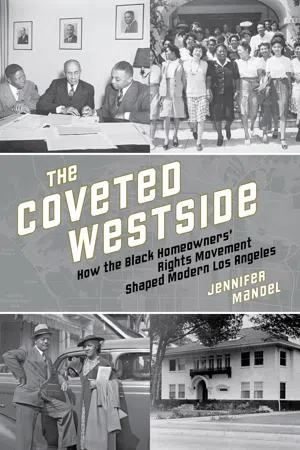
From the middle of the nineteenth century, as Euro-Americans moved westward, they carried with them long-held prejudices against people of color. By the time they reached the West Coast, their new settlements included African Americans and recent Asian immigrants, as well as the indigenous inhabitants and descendants of earlier Spanish and Mexican settlers. The Coveted Westside deals with the settlement and development of Los Angeles in the context of its multiracial, multiethnic population, especially African Americans.
Mandel exposes the enduring struggle between Whites determined to establish their hegemony and create residential heterogeneity in the growing city, and people of color equally determined to obtain full access to the city and the opportunities, including residential, that it offered. Not only does this book document the Black homeowners' fight against housing discrimination, it shares personal accounts of Blacks' efforts to settle in the highly desirable Westside of Los Angeles. Mandel explores the White-derived social and legal mechanisms that created this segregated city and the African American-led movement that challenged efforts to block access to fair housing.
eBook - ePub
The Coveted Westside
How the Black Homeowners' Rights Movement Shaped Modern Los Angeles
- English
- ePUB (mobile friendly)
- Available on iOS & Android
eBook - ePub
The Coveted Westside
How the Black Homeowners' Rights Movement Shaped Modern Los Angeles
About this book
Information
PART ONE
The Pioneers of Housing Integration in Los Angeles
Chapter One
Demarcating the Westside from the Eastside
IN 1924, DURING A DECADE when Whites in northern cities harnessed the power of racial restrictions to impede on Black migration and harden residential segregation, a working-class African American couple, William H. and Eunice Long, took a risk and put a down payment on a small bungalow at 771 East Forty-First Street in Los Angeles’s Entwistle tract, a few blocks west of Central Avenue. Even though the deed included a long-established occupancy clause, the Longs made the purchase, knowing that Blacks had been living in the community for years without facing any legal challenges. In 1905 Lulu Nevada Entwistle Hinton (later Letteau) subdivided the land south of Fortieth Street, between Avalon Boulevard, and Vernon and McKinley Avenues. Born to James and Ellen Entwistle, the city’s early wealthy White landowners, and a new widow of real estate broker John W. Hinton, Lulu Hinton continued her family’s business of land development, and as other developers had begun to do, attached racial restrictive clauses to most of the tract’s deeds that mandated the properties “never at any time be sold[,] rented to[,] or occupied by any person of Negro descent.” A few years later, despite the occupancy clauses, African Americans began moving into the tract, and by the mid-1920s, they accounted for roughly half of the population. It was not until years after Lulu Hinton (then Letteau) died, when the Longs moved into the community, that her heirs, led by her second spouse, real estate broker George H. Letteau, tried to enforce the restriction.1
Initially inhabited by indigenous populations, the state of California and the city of Los Angeles were founded amid European and American competition for land and power. The Spanish arrived in the late 1700s, traveling northwestward from Mexico along the Pacific Coast and setting up missions (religious outposts), presidios (fortified settlements), and pueblos (agricultural villages), including El Pueblo de Nuestra Señora La Reina de Los Ángeles de Porciúncula, in 1781. Mexico became a sovereign nation and took control of the land, after winning the Mexican War of Independence in 1821, and then the United States obtained it in the Mexican American War in 1848. Each nation sought to claim the land, extract its natural resources, exploit or expel the indigenous populations, and attain access to the trade networks in the Pacific Ocean. After annexing much of the West and Southwest in the Treaty of Guadalupe Hidalgo, and mandating all Spanish and Mexican citizens living in the territory to either become US citizens or leave within one year of the treaty’s ratification, the US government encouraged eastern and midwestern Americans with the prospect of gold, Manifest Destiny, and the Homestead Acts to travel westward, following the overland trails, through inclement weather and harsh conditions. The American effort to colonize California and Los Angeles continued through the 1900s as United States–supported citizens settled more of the city, expunged its multiethnic past, relegated people of color to certain areas, and asserted control over its social, political, legal, and economic structures.2
Land-locked and centered at the Plaza in the downtown core, Los Angeles in the late 1800s and early 1900s expanded its margins in all of the cardinal points, setting itself up to become a leading world city in the modern era. Entrepreneurs installed individual horse-drawn streetcar lines and then cable- and electric-powered systems that initially connected downtown to the adjoining neighborhoods and eventually radiated northward into Pasadena, southward to Long Beach, eastward across the Los Angeles River, and westward to the Pacific Ocean. Los Angeles increased its size with the 1906 shoestring annexation that connected the city to San Pedro through a corridor between downtown and the harbor. The city expanded again with its annexation of greater Hollywood in 1910 and the San Fernando Valley (including Burbank) in 1915. Amid expansion, developers and landowners paved roads, constructed residences and businesses, installed sewerage systems and street lighting, and incorporated towns. The city’s total population multiplied nine times from 11,183 in 1880 to 102,479 in 1900, and then more than five times to 576,673 in 1920.3
Between the late 1800s and early 1900s, in what scholars call the golden era of Black Los Angeles, African Americans had some freedom to settle in many developing parts of the city, engage in local affairs, and seek economic advancement. The small Black population which, at the time, Whites believed posed only a minor threat, established businesses and churches, headed political groups and local newspapers, and participated in an emerging cultural life. African Americans settled on their own, in family units, and in small clusters in the developed and undeveloped areas of the city and lived among mostly Whites and some Asians, Mexicans, and Jews, who also had some freedom of movement. Some African Americans lived around the Plaza and railroad depots or moved into the adjoining neighborhoods or across the Los Angeles River to Brooklyn Heights or Boyle Heights. Others traveled westward to the Temple Street section or across Hoover Street and into West Jefferson and West Adams, what would become the early Westside neighborhoods, or they migrated even farther westward to the developing outskirts of Beverly Hills and Santa Monica. The majority migrated from the business district southward along the main roadway of Central Avenue and its adjacent ascending blocks from First Street to Ninth Street and beyond. By 1910 they were residing largely north of Washington Boulevard, and by 1920 they had made their way to Thirty-Fifth Street. Like Blacks in the Entwistle tract before the Longs moved in, many lived in properties covered by racial restrictions that Whites had let lapse, ignored, or forgotten about.4
But in the early 1900s, as the city developed and offered more opportunities for advancement, Whites imposed greater restrictions on land use. It is unclear if the Letteau heirs felt compelled to enforce the property restrictions because of racism, financial need, or financial reward, but they joined a nationwide movement of White property owners who sought to block or remove Blacks from their neighborhoods.5 They attempted to hinder Black migration southward on Central Avenue around the same time other Whites implemented measures to divide the city between the Eastside and the Westside. While the racial border shifted over time, in the early 1900s Main Street (named Calle Principal in the Spanish and Mexican eras and situated several blocks west of Central Avenue) initially served as the unofficial White buffer zone to separate what would become the multiethnic and multiracial Eastside from the mostly White Westside. Whites used overt methods of intimidation and violence to curb the advancement of people of color and worked artfully within the legal system to persuade the initially unsupportive courts to back discriminatory housing policies. Los Angeles city officials established the nation’s first use-based zoning ordinances in 1908 that formally delineated the Eastside as mostly industrial, for manufacturers and more-affordable multi-unit dwellings, and the Westside as mainly residential, for low-density, single-family housing.6 For added defense, White homeowners also signed clauses or covenants to their property records that prohibited, often for decades, what they called non-Whites and oftentimes non-Christians, except for service staff, from renting, purchasing, or residing in the neighborhood.7
In the first decades of the legal battle over racial restrictive covenants, African Americans endured the constant stress of losing their home and financial investment, and while they fought forcefully in the courts, they lost the early challenge and bore witness to judicial sanctioning of residential segregation. NAACP attorney Edward Burton Ceruti took the lead on William and Eunice Long’s case. A graduate of St. Lawrence University in New York in 1910, Ceruti moved to California, passed the state bar exam in 1912, opened a law office, and, in 1914, helped found and serve as attorney for the Los Angeles NAACP. One decade before the Longs made their purchase, the Los Angeles NAACP set out to combat early White efforts to restrict Black movement and advancement in the city. Ceruti and several other local Black leaders took their inspiration to establish the branch from W.E.B. Du Bois, a founding member of the national organization, and at the time, director of publicity and research, who traveled to the city in 1913 to promote the nascent group. Shortly after his visit, Du Bois lauded the opportunities Los Angeles offered African Americans in the July 1913 issue of The Crisis: “Nowhere in the United States is the Negro so well and beautifully housed.” While Los Angeles had the highest rate of Black homeownership in the nation at 36.1 percent in 1910, Black Angelenos could not escape racial discrimination.8 The motivations underlying westward migration and Jim Crow segregation came slithering into the western city.
Before the Los Angeles NAACP tried the Long’s case in the Los Angeles Superior Court, it waited for the US Supreme Court to hand down its decision in the Washington, DC, lawsuits, docketed as Corrigan v. Buckley. “A favorable decision there will effect [sic] such cases here,” the local branch wrote in the January 1926 California Eagle, “and an unfavorable decision would leave us helpless.” Events took a turn for the worse and in fact the decision was unfavorable. The high court sanctioned racial restrictive covenants, seeing them as private contracts. Pledged and registered Republicans, the party of Abraham Lincoln, the Longs attempted to carry on with their lives, with William working as a cook and Eunice as a homemaker. But while they awaited their trial, under the weight of losing their home, their health suffered, and first William and then Eunice checked into a hospital. At the end of the year, the lower court ruled in favor of the Letteau heirs and endorsed occupancy clauses. William never recovered and passed away, and Eunice suffered a mental breakdown. The high court’s decision emboldened the Letteau heirs to bring more lawsuits against other Black homeowners and White proprietors who rented to Blacks in the Entwistle tract. Ceruti promised Eunice Long he would appeal her case, but the following year, after Ceruti unexpectedly died of heart failure, as historian Douglas Flamming chronicles, the local NAACP neglected her paperwork, and Eunice was evicted from her home.9 As Whites intended, African Americans saw their options decline. Whites blanketed the Westside with occupancy clauses and covenants and gave the city’s multiethnic and multiracial population little option but to live on the Eastside.
WESTWARD AGGRESSION, WESTWARD EXPANSION
The history of the western United States and the origins of Los Angeles have been blurred in popular memory by ethnocentric tales of Indian warfare and cowboy heroism, rugged overland trails and pioneer resilience, the gold rush and economic opportunity, taking place on the uncharted and wild frontier. Mid-nineteenth century America believed in Manifest Destiny, and expanded its territory, its Christian tenets, and its power to the western corners of North America. Land acquisitions west of the Mississippi River, and the compromises that resulted in free and slave states, authorized easterners to settle the region. The Mexican American War, sparked by United States’ annexation of Texas in 1845, typified American aggression and takeover. While abolitionists argued that proslavery states were using the war to extend slavery into the West, transcendentalist Henry David Thoreau refused to pay his poll tax to support the war, and then-Representative Abraham Lincoln proclaimed the federal government had carried out an unprovoked attack against Mexico, President James Polk pursued his long-standing dream to expand the United States from shore to shore. Polk triumphed in a Mexican retreat and annexed more than five hundred thousand square miles of western land. California came under United States rule in 1848 and received statehood in 1850, under the premise of aggression and expansion.10
Long before California became part of the United States, the region underwent the settlement and occupation of peoples from around the world. At least fifteen thousand years ago, hunter-gatherers migrated into California; over time they established hundreds of small, semi-autonomous, agrarian societies and, without the livestock that later came with European colonization, remarkably established and sustained trade as well as political and religious systems. Upon European settlement, California served as home to one of the largest indigenous populations in North America with 20 percent of North America’s total languages.11 In the late eighteenth century the Spanish Empire forged an effort to claim the territory along the Pacific Coast by sponsoring its subjects to travel northwestward from Mexico and set up Franciscan missions to convert the indigenous population to Roman Catholicism; presidios to defend their land claims; and pueblos to cultivate crops, rear animals, and stabilize colonial and indigenous relationships. Among the pueblos, Spanish governor Felipe de Neve, in 1781, founded El Pueblo de Nuestra Señora La Reina de Los Ángeles de Porciúncula on the edge of the Río Porciúncula (later Los Angeles River) and next to the Tongva village of Yaanga. Following de Neve’s instructions, the pobladores (settlers) took possession of the land and laid out the settlement.12
De Neve expressed his vision for the pueblo. He mandated the pobladores to construct a plaza at the center of town that would draw together the village’s political, economic, and cultural activities. From there, de Neve directed four main streets extend outward following the four compass points. The pueblo’s earliest map, created by Sergeant José Arguello in the 1780s, who traveled to the village to confirm land titles, shows the pobladores encircling the Plaza with a guard house, a granary, two royal buildings, and several homes of the founding families. The right-hand side of the map indicates that the pobladores grouped their lands between the zanja (irrigation canal) and the Río Porciúncula, a reflection of de Neve’s orders to centralize the location of work and supervise the settlers. Severe floods in the 1810s and 1820s blocked the Los Angeles River channel with trees, rocks, and debris, and rerouted the water flow from Santa Monica Bay to San Pedro Bay. By the time the pobladores had rebuilt the village northwest of the first site on higher ground, Mexico had won its War of Independence and taken control of the region.13
While the policies of Mexican Los Angeles restructured the dynamics of the pueblo, the newly built Plaza continued to serve as the center of social, economic, and political life. The Mexican government implemented a secularization program in the 1830s and 1840s that emancipated Native Americans residing in the missions and converted properties to self-governing ranchos. A landowning class of Spanish-speaking Californios, many of whom received land grants from Spain and Mexico in exchange for settling the land and amassed their fortune from cattle ranching on rancho land, took control, and a large labor class of Native Americans had to yield to the new hierarchy. As at the Spanish Los Angeles location, the wealthiest settlers clustered their homes around the Plaza, but, in the Mexican era, Californios extended their landholdings beyond the ranchos and purchased the most highly prized property in town. In 1822 José Antonio Carillo, the alcalde (mayor) of Mexican Los Angeles, built his home directly across from the Plaza. During the subsequent decades, around a dozen wealthier Californios settled near Carillo’s home, including Pío Pico and Agustín Olvera. The location of their homes around the Plaza served as a symbol of their high status.14
The early Spanish-led pobladores had ancestral backgrounds from societies around the world and established a richly diverse population in the Spanish pueblo and later the Mexican republic. When they made their way to the Americas in the late 1400s, Spaniards themselves came from mixed race or mestizo families of European, African, and Middle Eastern descent who had commingled with Jews and Muslims alike. The Spanish Empire had gained much of its diverse population by acquiring subjects and enslaved people from those same regions, intermarrying and integrating them into the empire, and giving many the opportunity to help settle distant territories. More than half of Los Angeles’s first pobladores in the 1780s claimed either African or part-African ancestry, while the others came from Spanish, American Indian, Chinese, or mixed-race families. In the regions of the Spanish frontier, including parts of what became the western United States, Spanish subjects suffered injustices but had some opportunities to serve in leadership roles. The early African pioneers in California, all of whom had their freedom, most likely served the empire as soldiers or settlers.15 Then, in the decades following statehood, and as the gold rush and Manifest Destiny inspired American westward migration, Anglo Americans not only became the majority population, but also took the most advantageous areas of the city and developed public facilities and amenities in those areas to benefit only themselves.
LOS ANGELES’S EARLY SEGREGATION PATTERNS
In the 1860s, as Los Angeles was transitioning from a Mexican town to an American city, three residential and commercial areas emerged that highlighted its early residential segregation patterns and racialized geography. By then, the culture of violence, including mob rule and lynch law, had become commonplace. Guns were widespread and often used as a first resort to settle disputes, seek justice, or assert dominance.16 Los Angeles had only a three-mile radius, conducive for traveling to work, conducting business, and visiting friends and family, yet the settlers and their adjoining neighborhoods were becoming geographically divided. The Plaza continued to serve as the ruling elite’s domain, yet, during this liminal phase, it deteriorated into a contentious and rundown area. Buildings and homes were unfinished or in disrepair, and the unpaved roads brushed up dust in the warm weather and turned into mud in the rain. The three primary areas extending from the Pl...
Table of contents
- Cover Page
- Title Page
- Copyright Page
- Dedication
- Contents
- Abbreviations
- Introduction
- Part I. The Pioneers of Housing Integration in Los Angeles
- Part II. Post-Shelley Westward Migration and the Case for Crenshaw
- Acknowledgments
- Notes
- Bibliography
- Index
- About the Author
- Illustrations
Trusted by 375,005 students
Access to over 1.5 million titles for a fair monthly price.
Study more efficiently using our study tools.
Frequently asked questions
Yes, you can cancel anytime from the Subscription tab in your account settings on the Perlego website. Your subscription will stay active until the end of your current billing period. Learn how to cancel your subscription
No, books cannot be downloaded as external files, such as PDFs, for use outside of Perlego. However, you can download books within the Perlego app for offline reading on mobile or tablet. Learn how to download books offline
Perlego offers two plans: Essential and Complete
- Essential is ideal for learners and professionals who enjoy exploring a wide range of subjects. Access the Essential Library with 800,000+ trusted titles and best-sellers across business, personal growth, and the humanities. Includes unlimited reading time and Standard Read Aloud voice.
- Complete: Perfect for advanced learners and researchers needing full, unrestricted access. Unlock 1.5M+ books across hundreds of subjects, including academic and specialized titles. The Complete Plan also includes advanced features like Premium Read Aloud and Research Assistant.
We are an online textbook subscription service, where you can get access to an entire online library for less than the price of a single book per month. With over 1.5 million books across 990+ topics, we’ve got you covered! Learn about our mission
Look out for the read-aloud symbol on your next book to see if you can listen to it. The read-aloud tool reads text aloud for you, highlighting the text as it is being read. You can pause it, speed it up and slow it down. Learn more about Read Aloud
Yes! You can use the Perlego app on both iOS and Android devices to read anytime, anywhere — even offline. Perfect for commutes or when you’re on the go.
Please note we cannot support devices running on iOS 13 and Android 7 or earlier. Learn more about using the app
Please note we cannot support devices running on iOS 13 and Android 7 or earlier. Learn more about using the app
Yes, you can access The Coveted Westside by Jennifer Mandel in PDF and/or ePUB format, as well as other popular books in History & African American History. We have over 1.5 million books available in our catalogue for you to explore.