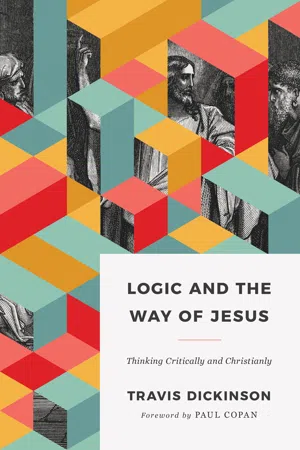
In Logic and the Way of Jesus, philosophy professor Travis Dickinson recaptures the need for a Christian view of reality, highlighting the use of reason and evidence to develop and defend Christian beliefs. He demonstrates how Jesus employed logic in his teachings, surveys the basic concepts of logic, and marries those concepts with practical application. While Dickinson contends that Christians have failed to engage the culture deeply because they have failed to emphasize and value a Christian intellect, he offers encouragement that embracing the life of the Christian mind can impact the world for the cause and kingdom of Christ.
- 384 pages
- English
- ePUB (mobile friendly)
- Available on iOS & Android
eBook - ePub
About this book
Information
Topic
Theologie & ReligionSubtopic
Christliche Theologie
The Intellectual Pursuit of God
Our world, today, is post-Christian. What this means is that Christianity deeply influenced our culture here in the globalized West,1 but the culture has moved on. The culture has embraced a broadly secular worldview. This has been a sweeping change. There are, of course, still remnants of a Christian culture including many churches and Christians. But the cultural influencers in the globalized West do not today express a Christian worldview.
Losing Our Minds
An early pioneer of Christian rock music once asked, “Why should the devil have all the good music?”2 The line of this 1970s song laments the fact that Christians produced none of the popular music at the time. The “good” rock music was to be found only in secular bands. Well, we might also ask why the devil should have the whole culture. Why are Christian beliefs and values so diminished in the world around us?
Again, it hasn’t always been this way. There was once a time when Christians indeed had good music. The church also had good art, philosophy, literature, science, and so on, and occasionally Christians produced culture-shifting masterpieces.
We could note many examples. Take sixth-century Roman statesman and philosopher Boethius as an example. Along with being a member of the Roman senate, Boethius was a devout Christian and wrote a variety of influential philosophical works. But he also wrote works in music theory, geometry, and arithmetic. His manual for music theory and composition lasted as a central text for centuries of scholars. In the fourteenth century, we have the Italian poet Dante Alighieri. His epic poem, The Divine Comedy, which is an allegorical vision of the Christian life, is regarded as one of the world’s greatest works of literature. In the scientific revolution of the sixteenth and seventeenth centuries, many of the primary figures were devout Christians, including Francis Bacon, Robert Boyle, Johannes Kepler, and Isaac Newton. Finally, there is the eighteenth-century songwriter Isaac Watts, who wrote such classic hymns as “Joy to the World” and “When I Survey the Wondrous Cross.” Watts also wrote a textbook on logic, the full title of which is Logick: or, the Right Use of Reason in the Enquiry after Truth, with a Variety of Rules to Guard Against Error, in the Affairs of Religion and Human Life, as well as in the Sciences. This book had not only an impressive title but was the standard logic textbook at universities all over the Western world for nearly 200 years. This is only a sampling of the long and varied tradition of Christians who saw their Christian faith as not only consistent with influencing and producing culture but also motivating this cultural work.
Consider also that Christians founded most of the world’s greatest universities, with overt Christian teaching as a primary part of the curriculum. This includes Oxford, Cambridge, Harvard, Yale, Princeton, and Columbia universities, as well as many others throughout Europe and the United States. Christian thought dominated the idea centers of the culture. For better or worse, it was sometimes difficult to be successful in areas of scholarship and the arts without being a Christian.
To be clear, the church’s deep influence on the culture sometimes led to abuses of power. When Galileo Galilei (1564–1642) became convinced the earth orbited the sun, he was served a sentence of life imprisonment because this idea was taken to be in conflict with the idea of a fixed and immovable earth in the Bible.3 Even though there were abuses of power, the point is that Christianity was a major player in the creation of the culture of what is today the globalized Western world.
Sadly, today, Christianity has lost much of its cultural influence. Not only is the Christian worldview no longer dominant in the universities, the arts, science, philosophy, literature, and so forth, it doesn’t always even get a hearing. When Christians are too public and enthusiastic about their Christian faith, especially in scholarship or art, they are met with suspicion and sometimes scorn. This is the modern world in which we live. Where are the Christian artists, musicians, writers, and thinkers who are producing culture-shifting masterpieces that express a Christian worldview? There are some who are doing good and faithful work, to be sure, and we need lots more of these. But things have shifted and, in this shift, the Christian impact on culture has greatly diminished.
How Did We Get Here?
Why has our impact on culture become so paltry?
It’s certainly not because we lack the numbers to have an impact. In the United States, as of 2015, evangelical Christians alone made up around 25 percent of the population.4 Combining all other broadly Christian views (Roman Catholic, mainline Protestant, etc.), the percentage jumps up to around 70 percent of the US population. That means one out of four people in this country is an evangelical, and close to three out of four are broadly Christian. That is a large majority of the population, yet Christian values and beliefs are radically underrepresented in culturally important areas.
In his insightful book Love Your God with All Your Mind, J. P. Moreland explains how the culture has shifted to a post-Christian one. He, along with others,5 identifies a major shift in the church that occurred in a variety of revivals and awakenings in the seventeenth and eighteenth centuries in America. The shift was to an emphasis on a more emotional and experience-based conversion rather than one with a reflective and intellectual emphasis. One came to Christ on the basis of momentary feelings of conviction rather than on the basis of a deep consideration of the truth of Christianity. Though tremendous good came from these spiritual awakenings, this marked a distinct change in how people came to be Christians and has had a deep impact on the church today.
Let’s be clear: coming to faith in Christ in repentance is going to be an emotional experience. This is to be expected. Emotions, however, are fickle things, and they are not—by themselves—a good way to determine truth and maintain belief and commitment. Emotional moments may cause us to change our minds and make commitments, but they do not necessarily entail a lasting commitment. In big emotional moments we may not even know to what we are committing. As we are swept up in the emotions of a movement, we have to stop and ask whether it is a good idea. It is noteworthy that two of what are now worldwide religious movements, Mormonism and Jehovah’s Witnesses, came out of a certain area that was, in effect, ground zero of the Second Great Awakening, called the “burned over district” in upstate New York. Many recent converts to Christianity, in turn, converted to these alternative Christian views. It seems they didn’t have the theological depth to understand the differences between these views and traditional Christianity.
The point is that when it is all about emotion and fervor, then we fail to have a guide to truth. Emotions simply are not good indicators of truth. And if you can be emotionally drawn into joining Christianity, you can be drawn into another community with similar emotional appeal perhaps without even realizing you’ve made a change. Even all those converts who remained in Christian communities didn’t necessarily remain because they had good reasons to believe Christianity was true. For many, the commitment had nothing to do with having good reasons for belief, let alone a foundation of deep knowledge of the Bible and Christian doctrine. It was, at bottom, an emotional and sentimental commitment they didn’t want to give up.
Therefore, the church, though having grown in number, became dominated by a less intellectually grounded faith. This became especially problematic because the church was unable to meet the significant intellectual challenges it inevitably came to face from a world that looked to throw off previous eras’ shackles of religious dogma. There were, for example, a variety of scholarly attacks on the historicity of the Bible (focused especially on miracles and supernatural events). Though these were scholarly and there were difficult challenges along the way, the critiques were often extremely speculative. For example, one eighteenth-century German scholar, Karl Friedrich Bahrdt, denied Jesus’s resurrection and instead proposed an elaborate conspiracy. Bahrdt claimed that Jesus only pretended to die, having been given medication from Luke, who was a physician, to withstand the pain of the crucifixion. Shortly thereafter, Joseph of Arimathea resuscitated Jesus to pull off the ruse that he rose from the dead.6 Now, this is a theory that’s hard to take seriously, but Christians weren’t in the game to offer a response to claims such as this and a defense of the claims of Scripture.7
The world attacked, and most Christians weren’t ready for it. In this situation, the church, it seems, had three options. First, it could have attempted to intellectually face down the challenges. Second, it could have simply conceded that Christianity is false on the basis of these challenges. Neither of the first two options were tenable for the church. As we’ve said, a new popular majority wasn’t prepared to face down the challenges, and of course the church was not interested in conceding that Christianity was false. There was only one option left if the church was to survive. The third option is to detach faith from reason. Here one would be saying the challenges don’t matter because faith has nothing to do with intellectual reasons. With this view of faith, intellectual pursuits are not only unnecessary for Christians, but they may even be harmful. After all, this is where all the challenges are.
The church may have survived but this had devastating effects. The problem is that if faith is detached from reason, then, by definition, people do not have a reason to consider what Christians have to say. There is no point to (ratio...
Table of contents
- Acknowledgments
- Foreword by Paul Copan
- 1 The Intellectual Pursuit of God
- 2 Jesus the Logician
- 3 Critical Thinking and Worldview
- 4 The Argument from Reason
- 5 Logic: The Basics of Critical Thinking
- 6 Deductive Standards of Logic
- 7 Truth Tables
- 8 Categorical Logic
- 9 Nondeductive Standards of Logic
- 10 Science and Inference to the Best Explanation
- 11 Evidence
- 12 Fallacies
- 13 Intellectual Virtues and the Art of Persuasion
- 14 Conclusion: Thinking Christianly
- Appendix: Practice Problems
- Subject Index
Trusted by 375,005 students
Access to over 1.5 million titles for a fair monthly price.
Study more efficiently using our study tools.
Frequently asked questions
Yes, you can cancel anytime from the Subscription tab in your account settings on the Perlego website. Your subscription will stay active until the end of your current billing period. Learn how to cancel your subscription
No, books cannot be downloaded as external files, such as PDFs, for use outside of Perlego. However, you can download books within the Perlego app for offline reading on mobile or tablet. Learn how to download books offline
Perlego offers two plans: Essential and Complete
- Essential is ideal for learners and professionals who enjoy exploring a wide range of subjects. Access the Essential Library with 800,000+ trusted titles and best-sellers across business, personal growth, and the humanities. Includes unlimited reading time and Standard Read Aloud voice.
- Complete: Perfect for advanced learners and researchers needing full, unrestricted access. Unlock 1.5M+ books across hundreds of subjects, including academic and specialized titles. The Complete Plan also includes advanced features like Premium Read Aloud and Research Assistant.
We are an online textbook subscription service, where you can get access to an entire online library for less than the price of a single book per month. With over 1.5 million books across 990+ topics, we’ve got you covered! Learn about our mission
Look out for the read-aloud symbol on your next book to see if you can listen to it. The read-aloud tool reads text aloud for you, highlighting the text as it is being read. You can pause it, speed it up and slow it down. Learn more about Read Aloud
Yes! You can use the Perlego app on both iOS and Android devices to read anytime, anywhere — even offline. Perfect for commutes or when you’re on the go.
Please note we cannot support devices running on iOS 13 and Android 7 or earlier. Learn more about using the app
Please note we cannot support devices running on iOS 13 and Android 7 or earlier. Learn more about using the app
Yes, you can access Logic and the Way of Jesus by Travis Dickinson in PDF and/or ePUB format, as well as other popular books in Theologie & Religion & Christliche Theologie. We have over 1.5 million books available in our catalogue for you to explore.