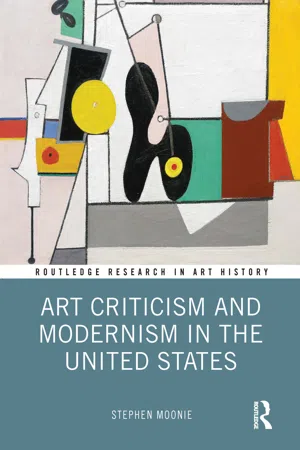
This study is an analysis of 'high' and 'late' modernist criticism in New York during the 1960s and early 1970s. Through a close reading of a selection of key critics of the period—which will expand the remit beyond the canonical texts—the book examines the ways that modernist criticism's discourse remains of especial disciplinary interest.
Despite its alleged narrowness and exclusion, the debates of the 1960s raised fundamental questions concerning the nature of art writing. Those include arguments around the nature of value and judgement; the relationship between art criticism and art history; and the related problem of what we mean by the 'contemporary.' Stephen Moonie argues that within those often-fractious debates, there exists a shared discourse. And further, contrary to the current consensus that modernists were elitist, dogmatic, and irrelevant to contemporary debates on art, the study shows that there is much that we can learn from reconsidering their writings.
The book will be of interest to scholars working in art history, modern art, art criticism, and literary studies.
1 Clement Greenberg: ‘A Critic on the Side of History’
DOI: 10.4324/9781003098270-2
Greenberg is so over-determined by the subsequent critical and scholarly analysis that it is difficult, if not impossible, to recover his criticism for the purposes of dispassionate examination (Figure 1.1). This is partially a matter of reception: Greenberg influenced a clutch of fledgling writers in the 1960s, such as Michael Fried and Rosalind Krauss; he also befriended and influenced curators such as E.C. Goosen, William Rubin, and Maurice Tuchman. However, this influence is itself no simple matter, and it is apt to be overstated by art historians. On the other hand, in the 1980s, Greenberg functioned negatively as a counterpoint for post-modern articulations of the ‘anti-aesthetic.’1 This history is further complicated by disagreements over which ‘Greenberg’ is at issue. The early Greenberg was described by T.J. Clark in 1982 as an ‘Eliotic Trotskyist' who called urgently in ‘Avant-Garde and Kitsch’ (1939) for socialism to preserve the best of high culture.2 Clark's coinage is suitably paradoxical, but in retrospect Greenberg was more Eliotic than Trotskyist. In 1993, John O’Brian—a former Ph.D. student of Clark's—would describe the later Greenberg's position as ‘Kantian anti-Communism’ (CE, III, xxvii). Here, Greenberg's involvement in the American Congress for Cultural Freedom, and his writing for U.S.-funded journals such as Horizon and Commentary, placed Greenberg's calls for aesthetic autonomy within the context of a burgeoning post-war U.S. hegemony. Since then, Thierry de Duve has split Greenberg into three as ‘dogmatist,’ ‘critic,’ and ‘theorist.’3
The tripartite structure of Greenberg's project is set out most lucidly and comprehensively by Peter Osborne in his review of O’Brian's anthology of Greenberg's essays in 1992.4 Osborne, like de Duve, split the critic's career into three phases. The first, mapping onto Clark's ‘Eliotic Trotskyism,’ set out a historical defence of the avant-garde and of modernist culture during 1939–40. The second phase, from 1941 to 1961, applied and developed this theory during Greenberg's heyday as a critic for Partisan Review, The Nation, Horizon, and Commentary, up to and including the publication of Art and Culture. The third phase, from 1962 onwards, marks the ossification of Greenberg's project into dogma. However, rather than to dismiss this phase as irrelevant or inconsequential, Osborne pays particular attention to it, breaking it into three further subsections: the first, Greenberg's attack on what he termed ‘Novelty Art’; the second, Greenberg's use of Heinrich Wölfflin to support Post Painterly Abstraction; and third, a quasi-philosophical definition which Osborne describes as:
A meta-critical defence of formalist aesthetics in the form of a positivistic vindication of the objectivity of a Kantian concept of ‘taste’ and the explicit denial of the rational contestability of critical judgments through argument.5
These past two moments outlined by Osborne will concern us in this chapter. But before we do so, it is necessary also to acknowledge Caroline A. Jones’ monumental study Eyesight Alone (2005). Jones’ study, along with Donald Kuspit's Clement Greenberg: Art Critic (1979), remains the only monographic study of Greenberg.6 Jones also splits Greenberg, but into two: the first is a ‘bodily’ Greenberg: a (sweaty) ‘obscure adolescent’ obsessed with sexual conquests, and consumed with poetic ambition, who later becomes an ‘office functionary.’7 The second is Greenberg the ‘proper name’: the critic who is both the subject and effect of discourse, regulating what Jones calls the ‘modernist visibility’: a discourse which Jones rarely defines in any substantial particulars, but which can be taken roughly as a means by which to cultivate and regulate the self. According to Jones, following Gilles Deleuze, Greenberg both shapes and is enfolded within this discourse. This complex argument is problematic to the extent that Jones’ study largely takes the form of a standard intellectual biography, with Greenberg placed at the centre of events.
Although Jones’ argument is wide-ranging, provocative, and ambitious, it is not entirely clear how it helps us to better understand Greenberg as a critic, even though it does much to historicise him. As Lane Relyea has argued in a critically astute review, Jones fetishises Greenberg, who is both ‘emptied and overinvested’ by her analysis.8 Emptied, that is, by Jones’ obsessive recounting of the critic's personal foibles: his sweat, his body; but Jones also makes much of Greenberg's lack of formal art-historical training, and of his critical lapses. The main faux pas is his erroneous description of the colours in Piet Mondrian's Broadway Boogie-Woogie (1942–3).9 Jones goes further to regard this glaring error as a process of Foucauldian subjectivation. But in over-investing Greenberg, Jones acknowledges the peculiar relationship which art historians have towards him: he is both a nemesis, and yet, as Relyea remarks, his criticism is formative of the discipline of contemporary art history. Relyea notes that this formative character is disavowed by Jones, who fails to acknowledge her own position by positing herself as the ‘objective’ art historian in relation to the all-too-human Greenberg. Relyea argues that to acknowledge this relation would be to ‘admit some common ground between academic expert and pedestrian scribe.’10
Greenberg's writing at its best is far from pedestrian, but it is this very inter-relationship between art history and art criticism which is the subject of this chapter. More specifically, it is the way in which the two terms are inter-related at the juncture of the ‘third phase’ of Greenberg's project as outlined by Osborne. Unlike Jones’ ambitious attempt to delineate the modernist sensorium, my interest is both more modest and more specific: that is, my interest lies in Greenberg as a writer, rather than as a critical nemesis, or a conduit for the modernist ‘visibility.’
It is the aim of this chapter, then, not to recapitulate the debates on Greenberg's writings which are now overly familiar, but rather to look at the transition which takes place in his writings during the late 1950s and 1960s. As Osborne has noted, this period is important in two respects: first, it marks the beginning of the decline of Greenberg's historical narrative of modernism outlined in ‘Avant-Garde and Kitsch’ (1939) and ‘Towards a Newer Laocoon’ (1940), and it marks a shift towards his defence of a formalist method which suppresses its own historical grounding.
But the second significant aspect of the cusp of the 1960s was the publication of Art and Culture in 1961. For almost 30 years, this anthology would be the standard reference point, but the collection was highly selective, and the essays were mostly revised, some of them substantially (AC, vii). In a rarely cited review of Art and Culture in 1962, Hilton Kramer remarked that the collection ‘is less a history of its author's opinions than a catalogue of his present views’: adding that ‘One must respect Mr. Greenberg's decision to cast this work in the present tense, as it were….’11 Kramer's remarks highlight that Greenberg's revisions were not merely a matter of expediency. In fact, they signalled a much more important conflict in his writing between criticism and history. Kramer noted that Greenberg's ‘critical intelligence was formed in the crucible of Marxian dialectics,’ and adds the following eloquent summation of those formative cultural attitudes which shaped Greenberg's position:
Foremost among these was the assumption that critical judgments, if they are to carry the authority and force of something more than a merely personal taste, must be made in the name of history. Every critic faces the responsibility of having to discriminate between his own irrational preferences and the application of meaningful principles ….12
However, here lies the rub. For Kramer's crisp prose elegantly conceals the underlying problem: that is, how one goes about the practice of criticism. What are the ‘meaningful principles’ of criticism, and how does one adhere to them? One might also ask: is it true, as Kramer suggests, that critical judgements must be made ‘in the name of history’? It might be countered here that Greenberg's ‘historical’ criticism was in fact novel, and that the very notion of judgement buttressed by an overarching trajectory was a quality not evident in the work of earlier critics such as Baudelaire, Fry, or Ruskin.13 More problematically still, Greenberg was not always consistent in this respect of his practice as a critic. Kramer's account acknowledges as much when he notes that in Greenberg's writings ‘[artists] exist as impersonal exponents of aesthetic laws—or they would if Mr. Greenberg's sensibility did not intervene from time to time to save him from the logic of his own doctrine.’14
One such intervention—not republished in Art and Culture—is instructive here. Greenberg crossed swords in Partisan Review with the artist and critic George L.K. Morris in June 1948. Morris attacked Greenberg's essay ‘The Present Prospects of American Painting and Sculpture’ (1947) as a ‘truly disgraceful report on American art.’15 But he took issue with ‘The Decline of Cubism’ (1948) at greater length. Morris claimed that it did not deserve to be called criticism, claiming instead that ‘it is an appraisal sheet built around a thesis.’ Partly, Morris’ complaints were a matter of taste. Greenberg, Morris argued, wrongly devalued Picasso and Georges Braque's later work, while praising the later Matisse and Pierre Bonnard. He mocked Greenberg's criticism of contemporary art for having ‘the semblance of a tournament,’ with ‘Umpire Greenberg chart[ing] the last rounds.’ Persisting with the tennis analogy, Morris contended that Matisse ‘pass[ed] out of the tournament in love sets around 1917.’16
Greenberg's reply, published in the same issue, defended Matisse's sensual post–1917 work. Ironically, he accused Morris of consulting ‘literal a priori dogmas about the historically necessary… instead of the pleasure and exaltation to be experienced from painting’: adding, ‘[h]istorical necessity does operate, but not with the consistency here expected of it’ (CE, II, 242). Referring to Matisse's Woman Before an Aquarium (1924: Figure 1.2) and Lemons on a Pewter Plate (1927: Figure 1.3), he asks, ‘who, with a real sensitivity to painting could say they are intrinsically inferior as art to the much more historically important pictures Mondrian and Picasso were turning out around the same time?’ (CE, II, 242). Kramer understood Greenberg's criticism to invoke history as a ‘brake against private enthusiasms.’17 But here, taste, and the private ‘pleasure and exaltation’ of Matisse over-rides any ‘inevitable’ process of historical development suggested in Greenberg's essays of 1939–40.18
1 Clement Greenberg: ‘A Critic on the Side of History’
2 Michael Fried: ‘Restoring Modernism to Health’
3 Rosalind Krauss: ‘A Broader Modernist Sensibility’
4 Annette Michelson: ‘A Rigorous Dialectic of Seeing and Reading’
5 Harold Rosenberg: Action, Criticism, and History
6 Leo Steinberg: ‘My Secret Life’
7 Lawrence Alloway and the Complex Present
Conclusion
Bibliography
Index
Trusted by 375,005 students
Access to over 1.5 million titles for a fair monthly price.
Study more efficiently using our study tools.
Frequently asked questions
Yes, you can cancel anytime from the Subscription tab in your account settings on the Perlego website. Your subscription will stay active until the end of your current billing period. Learn how to cancel your subscription
No, books cannot be downloaded as external files, such as PDFs, for use outside of Perlego. However, you can download books within the Perlego app for offline reading on mobile or tablet. Learn how to download books offline
Perlego offers two plans: Essential and Complete
Essential is ideal for learners and professionals who enjoy exploring a wide range of subjects. Access the Essential Library with 800,000+ trusted titles and best-sellers across business, personal growth, and the humanities. Includes unlimited reading time and Standard Read Aloud voice.
Complete: Perfect for advanced learners and researchers needing full, unrestricted access. Unlock 1.5M+ books across hundreds of subjects, including academic and specialized titles. The Complete Plan also includes advanced features like Premium Read Aloud and Research Assistant.
Both plans are available with monthly, semester, or annual billing cycles.
We are an online textbook subscription service, where you can get access to an entire online library for less than the price of a single book per month. With over 1.5 million books across 990+ topics, we’ve got you covered! Learn about our mission
Look out for the read-aloud symbol on your next book to see if you can listen to it. The read-aloud tool reads text aloud for you, highlighting the text as it is being read. You can pause it, speed it up and slow it down. Learn more about Read Aloud
Yes! You can use the Perlego app on both iOS and Android devices to read anytime, anywhere — even offline. Perfect for commutes or when you’re on the go. Please note we cannot support devices running on iOS 13 and Android 7 or earlier. Learn more about using the app
Yes, you can access Art Criticism and Modernism in the United States by Stephen Moonie in PDF and/or ePUB format, as well as other popular books in Art & Art Theory & Criticism. We have over 1.5 million books available in our catalogue for you to explore.