Transformative Teaching Around the World compiles inspiring stories from Fulbright-awarded teachers whose instructional practices have impacted schools and communities globally. Whether thriving or struggling in their classrooms, instructing in person or online, or pushing for changes at high or low costs and risk levels, teachers devote intense energy and careful decision-making to their students and fellow staff. This book showcases an expansive variety of educational practices fostered across international contexts by real teachers: active and empowering learning strategies, critical thinking and creative problem-solving, cultural responsiveness and sustainability, humanistic integration of technology, and more. Pre- and in-service teachers, teacher educators, online/blended instructors, and other stakeholders will find a wealth of grounded, motivating approaches for transforming the lives of learners and their communities.
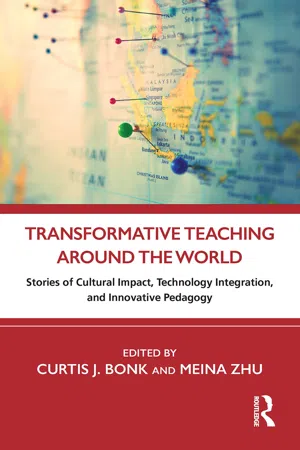
eBook - ePub
Transformative Teaching Around the World
Stories of Cultural Impact, Technology Integration, and Innovative Pedagogy
- 298 pages
- English
- ePUB (mobile friendly)
- Available on iOS & Android
eBook - ePub
Transformative Teaching Around the World
Stories of Cultural Impact, Technology Integration, and Innovative Pedagogy
About this book
Information
1 Time for Making Impact
DOI: 10.4324/9781003213840-1

Curtis J. Bonk is Professor in the Instructional Systems Technology Department in the School of Education and Adjunct in the School of Informatics at Indiana University. He teaches and researches at the intersection of educational psychology and educational technology. Curt can be contacted at [email protected]. His homepage is http://curtbonk.com/.
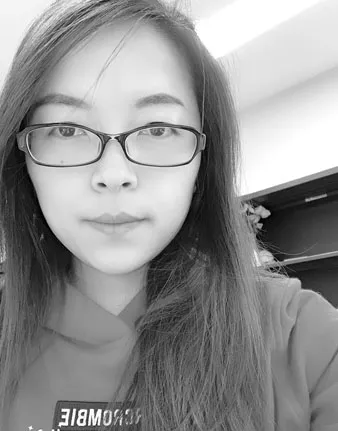
Meina Zhu is Assistant Professor of Learning Design and Technology in the College of Education at Wayne State University. Meina can be reached at [email protected] or [email protected].
Learning Transformations
Since the early 1980s, countless reports have detailed the shift toward an information-based economy and the need for a more technologically sophisticated workforce. Life in 2022 is much different from 1982. The skills and experiences required to succeed today are vastly different from four decades ago. A modern-day workforce clearly demands skills such as creativity, flexibility in thought, the ability to make decisions based upon incomplete information, complex pattern recognition abilities, and synthesis skills. Those who cannot keep up with the perpetual changes in skill demands and competencies often find themselves redundant and replaced by robots or intelligent agent technology (Arantani, 2020; Kelly, 2020; Semuels, 2020).
Such changes are occurring faster than most individuals and organizations can adapt. They are also accelerating the massive transformations in teaching and learning environments seen today across all sectors of education. Make no doubt, learning is changing. And it is changing for every member of this planet, young to old, self-directed to teacher-reliant, budding chemist to violinist. Whether you have limited means at your disposal to acquire a high-quality education or are financially quite well off, your learning resource and educational delivery options are radically changing. For many, learning today is often more game-like, hands-on, immersive, and visual in nature than it was a decade ago (Bonk, 2016b).
That is only a start. Learners also find that their learning avenues are more informal, online, blended, massive, and mobile too. These same learners are simultaneously being encouraged to learn new things by their peers through social media and various global collaborations and exchanges. At the same time as these online social influencers take hold, learning today is increasingly personalized and self-directed wherein a quality educational experience is highly reliant on learners taking responsibility for much of their own learning, whether one attends a local high school, virtual school, community college, or has successfully found entrance to Harvard or Indiana University.
These are just a few of the ways in which learning is changing today; there are dozens more (Bonk, 2016b), and there likely will be just as many more in the coming decades. If just one of those learning trends, let’s say mobile or blended learning, had impacted life here in the 21st century, it would likely have been proclaimed a learning revolution unlike no other. However, with the dozens of major technology trends occurring simultaneously all around us, we must stop and think about how best to prepare learners for a rich and successful learning life on this planet.
Finding Education 4.0
In response to the emerging global marketplace, there has been a renewed interest in innovation and creativity. It does not matter if one is in a public school, a higher education setting, or in a military or corporate training environment. The shift in perspective from the reception of learning from some type of expert toward an emphasis on learner choice and options is the same. Every educator is seeking the Holy Grail and hoping to become more inventive and productive than the next person or organization. Some are labeling this new age “Education 3.0.” In fact, countries such as Thailand are creating national policies and models for Education 3.0 ecosystems and communities (Songkram, Chootongchai, Khlaisang, & Prakob, 2021). Others speak more boldly about “Education 4.0” (Salmon, 2019).
You might ask how to find or identify an Education 3.0 environment. The markers of this time are tinkering, making things, invention and innovation, human-to-human and idea-to-idea connectedness, seeking and finding meaning, collaborative knowledge construction, the open exchange of ideas, and the utilization of and contribution to free and open educational resources (see Bonk, 2016a; Keats & Schmidt, 2007). Additional components of the emerging Education 3.0 world or new generation in teaching and learning are freedom to explore ideas and make mistakes, flexibility and choice in assignments, play, convenience, expanded resources, meaningful and authentic learning, imagination, global collaboration, engagement, passion and purpose, perpetual support and feedback, and empowerment and autonomy. Add to that a resource rich instructional space and a caring and committed instructor who displays collegiality, passion, spontaneity, and optimism and you find yourself in a learning transformation.
There are more elements to this transformation, of course, but these will do for now. You will see many of them explicitly and implicitly stated and becoming substantiated, cultivated, and even duplicated in the upcoming chapters. You might try growing your instructional gardens with a few of them.
But perhaps we are being conservative. We may be entering Education 3.0 today, but is Education 4.0 around the corner? If so, what does it look like? Gilly Salmon (2019) in the United Kingdom offers a peek. She argued that the development of the Web has paralleled the way we think about the progressive shifts to more advanced educational levels or generations. As she points out, the Web has significantly evolved during the past few decades.
Salmon suggests that the Web was transformed from the Web 1.0 version when it found a vital role as a giant conduit for the transmission of information and ideas to the often celebrated and, at the same time, bantered label of the Web 2.0 for social exchange and collaboration. Salmon also argues that we are now in the Web 3.0 or the “Semantic Web” that pervades our lives with never-ending movement to and from our digital lives that rely heavily on learner mobility. For instance, as young members of Gen Z move back and forth between their physical and digital lives, they are said to be phigital learners (Stansbury, 2017). Salmon argues that soon we will find ourselves in the Web 4.0 where there is a symbiotic relationship between artificial intelligence and human intelligence. She relates these generations of Web technology to educational shifts from 1.0 to 4.0.
Consequently, we challenge you to begin to craft a vision for your own Education 4.0 space when reading the various chapters of this book; just what does Education 4.0 represent for you and your educational community? Each reader might find his or her own sense of meaning or philosophy of this next generation of teaching and learning in the pages of this book.
In Education 4.0, people will no longer tolerate a curriculum that emphasizes the rote memorization of facts over problem-solving and creativity. Instead, innovative instructors and trainers engage learners with more authentic and active learning experiences. Even with such renewed interest and resources, most teachers still lack the time and resources to adequately deal with the proliferation of instructional practices and associated ideas regarding educational change. The ideas in this book can change all that for you.
This opening chapter should help you begin to understand overlapping trends in education related to creative thinking, critical thinking, motivation, and cooperative and collaborative learning, as well as how to design an active learning pedagogical system using technology-enhanced learning. Throughout this book, you will be exposed to ways to use technology to increase student thinking skills and teamwork. In starting on this path, specific techniques and ideas will be described as well as implementation steps. At times, advice will be offered for getting started using some of these alternative instructional strategies. A set of reflection questions at the end of each chapter should help you ponder the pedagogical opportunities and challenges in front of you.
Finding the Holy Grail
We, humans, are goal-driven creatures. Among the key goals of educators is making an impact on learners of any age level and learning in all its various stripes, formal or informal, passive or hands-on, mobile or stationary, self-directed or expert scaffolded, personalized or standardized, online or classroom-based, or perhaps some hybrid or blended combination. The next 42 chapters of this book touch on a diverse array of learning formats or situations. They will allude to instructional techniques employed to foster robust learning from Costa Rica to Morocco to Cyprus to Yemen to Uzbekistan to India to Thailand to China to Korea to Mexico and on to myriad other exciting destinations.
Each of these award-winning educators has been on a quest to find a magic lamp that can be rubbed for assorted powers to engage learners. They are searching for the Holy Grail of learning and instruction. We don’t think we are spoiling the secret when we admit that no one found that particular Grail; at least not yet. All of these educators embarked on this teaching and learning journey long before they enrolled in the R546 course of “Instructional Strategies for Thinking, Collaboration, and Motivation” during the past decade. Theirs is a hunt that will not likely ever end; yet, with their determination, passion, innovation, and inspiration, it will likely produce delicious fruits at many stops along the way.
The chapters are relatively brief stories of how these 40+ educators have made an impact in their local communities; preferably using one or more of the instructional strategies learned in the Saturday class at Indiana University. The book contains eight sections: (1) Personal Transformations, (2) Innovative Education, (3) Teaching With Technology, (4) Pandemic Practices, (5) English Education and Collaboration, (6) Active Learning Strategies, (7) Global Education, and (8) Overcoming Challenges. We recommend sampling from all and focusing your energy on sections that are the most delightful to your palette. We will reappear when appropriate to introduce each of the eight sections of the book and again at the end.
As you read the chapters in these eight sections, you may notice that the Holy Grail of learning and instruction might be right in front of your eyes. It often exists in the humble strategies instructors utilize in their classes. Many of the instructional strategies highlighted in the upcoming 41 chapters include the use of flipped classrooms, project-based learning, brainstorming and reverse brainstorming, technology-enhanced concept mapping, and experiential learning. A few other chapters involve role play, cross-cultural exchanges, multimedia storytelling projects, crafting storybooks, and poem anthologies. These same methods are among the hundreds of strategies discussed in R546. Strategies such as super summaries, anchored instruction, public tutorials, real-time cases, an online séance, the starter-wrapper technique, collaborative video editing, oral history interviews, and so on permeate this particular book but are not explicitly mentioned.
The reason why so little in the present book is devoted to specific instructional techniques is that the first author (Bonk) has already produced two theory-to-practice books with models or frameworks for online teaching. Each of these books contains more than 100 activities for online instruction, most of which can be also used in face-to-face instruction or blended environments (Bonk & Khoo, 2014; Bonk & Zhang, 2008). One of those books (Bonk & Khoo, 2014) is free to download in both English and Chinese (http://tec-variety.com/). And a third such book is on the way (Pawan, Daley, Kou, & Bonk, 2022).
Accordingly, the present book will not be a rehash of previous work or a guide in such strategies and approaches. And there will not be a step-by-step instructional techniques guide. Instead, there will be a series of stories with embedded use of dozens of powerful instructional approaches designed to enhance learner creativity, critical thinking, cooperative and collaborative learning, and overall motivation, many of which will entail the use of different technology tools and resources. As such, this is not meant to be another “how-to” type of book. Of course, the Grail has never had a how-to guide to find it.
Finding the Principles
While not explicated, you can perhaps find the learning and instruction principles that underly the stories in this book. Simply put, when opening this amalgamation of stories, one will immediately find innovation and uniqueness as well as an integrated pattern of progressive educational practices. When reading this series of short narratives, there will likely be a set of instructional principles that emerges that can serve as models, frameworks, or templates for others. We do not explicate these principles, but, rather, want you to discover them in the chapters that you find interesting and inspiring to read. Simply put, we do not want to ruin the epiphanies that are to come.
But we do recommend that you take out a pen or marker when you start reading. These short anecdotes of hope and transformation contain perhaps ten, perhaps 20, or perhaps even more instructional principles and learning guidelines to foster critical and creative thinking, motivation, collaborative learning, and innumerable aspects of technology integration. In effect, these chapters should shed light not only on how to prepare learners to become skillful critical thinkers but also on how to prepare teachers to become effective reflective practitioners. When that happens, educators will have a better chance of preparing students for the jobs of tomorrow while finding instructional success today.
Finding the Entry Ramp
It is now time for you to venture into the 42 wondrous stories and think about how you can start to make an impact. We have laid out the goals and intended audiences of this book. Now it is time to read some of it so that you too can make a difference. Yes, you can make an impact that is most likely local, but for many of you, it will be global. Write to us when y...
Table of contents
- Cover
- Half Title Page
- Title Page
- Copyright Page
- Dedication Page
- Contents
- Foreword: The Power of Story
- Preface: Before Making Impact
- 1 Time for Making Impact
- Section 1 Personal Transformations
- Section 2 Innovative Education
- Section 3 Teaching With Technology
- Section 4 Pandemic Practices
- Section 5 English Education and Collaboration
- Section 6 Active Learning Strategies
- Section 7 Global Education
- Section 8 Overcoming Challenges
- Afterword: The Power of Planning
- Acknowledgments
- References
- Index
Trusted by 375,005 students
Access to over 1.5 million titles for a fair monthly price.
Study more efficiently using our study tools.
Frequently asked questions
Yes, you can cancel anytime from the Subscription tab in your account settings on the Perlego website. Your subscription will stay active until the end of your current billing period. Learn how to cancel your subscription
No, books cannot be downloaded as external files, such as PDFs, for use outside of Perlego. However, you can download books within the Perlego app for offline reading on mobile or tablet. Learn how to download books offline
Perlego offers two plans: Essential and Complete
- Essential is ideal for learners and professionals who enjoy exploring a wide range of subjects. Access the Essential Library with 800,000+ trusted titles and best-sellers across business, personal growth, and the humanities. Includes unlimited reading time and Standard Read Aloud voice.
- Complete: Perfect for advanced learners and researchers needing full, unrestricted access. Unlock 1.5M+ books across hundreds of subjects, including academic and specialized titles. The Complete Plan also includes advanced features like Premium Read Aloud and Research Assistant.
We are an online textbook subscription service, where you can get access to an entire online library for less than the price of a single book per month. With over 1.5 million books across 990+ topics, we’ve got you covered! Learn about our mission
Look out for the read-aloud symbol on your next book to see if you can listen to it. The read-aloud tool reads text aloud for you, highlighting the text as it is being read. You can pause it, speed it up and slow it down. Learn more about Read Aloud
Yes! You can use the Perlego app on both iOS and Android devices to read anytime, anywhere — even offline. Perfect for commutes or when you’re on the go.
Please note we cannot support devices running on iOS 13 and Android 7 or earlier. Learn more about using the app
Please note we cannot support devices running on iOS 13 and Android 7 or earlier. Learn more about using the app
Yes, you can access Transformative Teaching Around the World by Curtis Bonk, Meina Zhu, Curtis Bonk,Meina Zhu,Curtis J. Bonk, Meina Zhu, Curtis J. Bonk in PDF and/or ePUB format, as well as other popular books in Education & Classroom Management. We have over 1.5 million books available in our catalogue for you to explore.