In this multidisciplinary book, Sanda Iliescu articulates a rich, multi-faceted approach to the aesthetic experience. Through in-depth discussions of her own lived encounters with art, architecture, and the world around her, she advocates a way of looking that blends sensory perception, formal analysis, social and political consciousness, and personal memory. Focusing special attention on the aesthetic concept of the figure-ground problem, the author challenges this foundational principle's presumed hierarchies and shows how a new and more dynamic understanding of it can enhance our way of looking at and understanding art and architecture. Works discussed in the book include a wide range of contemporary and historic art and architecture, among them artworks by Rembrandt, Matisse, Eva Hesse, and David Hammons; architecture by Zaha Hadid, Peter Zumthor, and Weiss/Manfredi; and non-Western works such as a thirteenth-century Chinese vase and the Ry?anji dry garden in Kyoto, Japan.
Personal and engaging, this book is for a wide audience of those practicing, studying, or with an interest in the creative fields, from beginners to seasoned professionals.
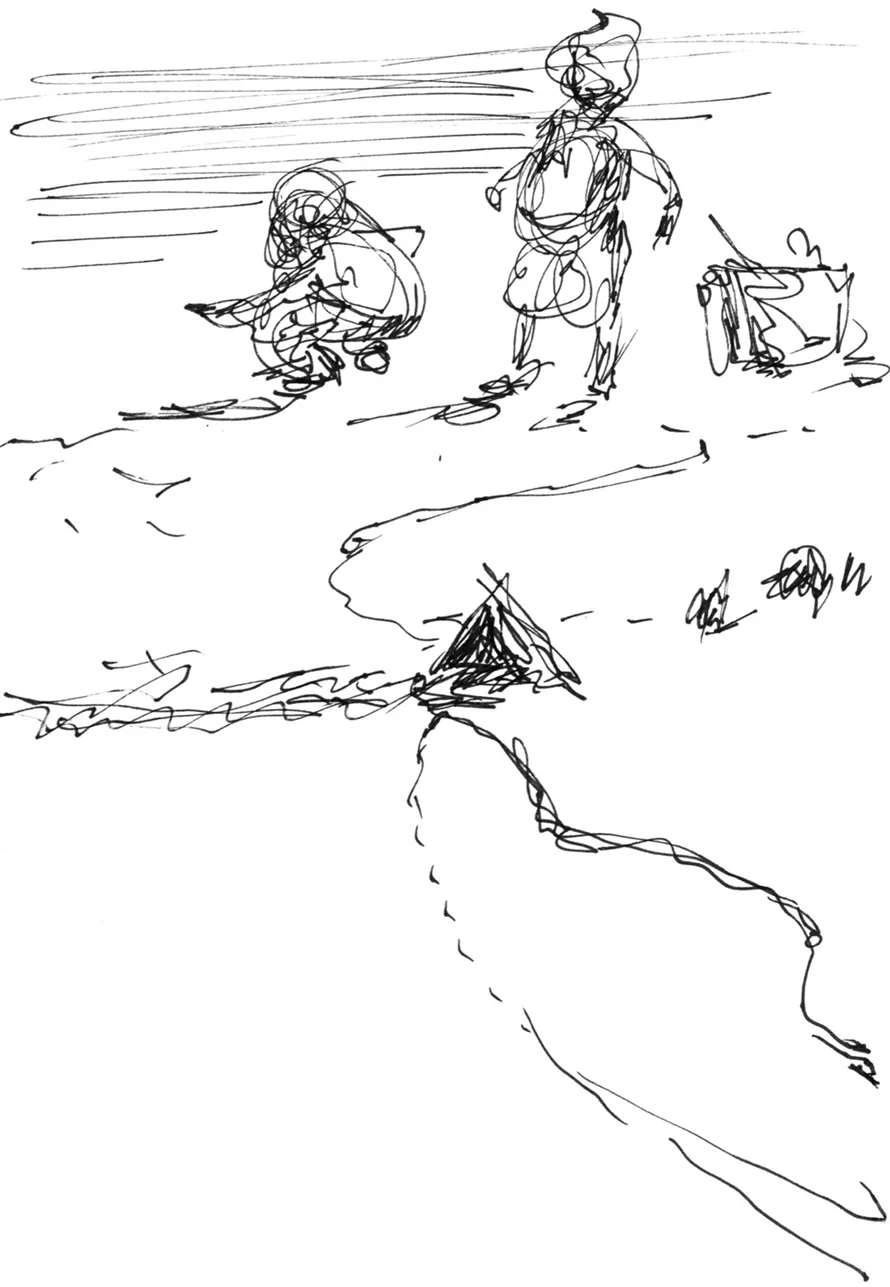
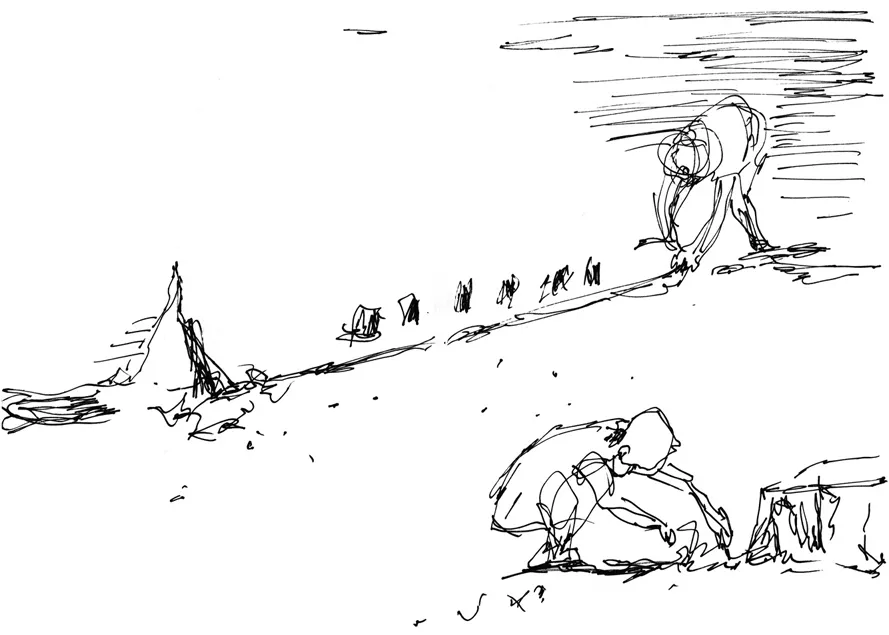
Sometimes when I am at the beach, I like to watch children building sandcastles. Not all children do this, of course—building a sandcastle takes time and there are so many other temptations to distract a child at the beach: water to splash in, seashells to collect, a ball to throw into the waves. But when I do come upon a child who is deeply immersed in the building of a sandcastle, it is a special thing to see. Sometimes, in their intense and joyful energy, these young builders remind me of adult artists and designers at work (illustrations 1.1, 1.2).
Illustration 1.1Children Building Sandcastles, 2012. Drawing by author
Illustration 1.2Children Building Sandcastles, 2012. Drawing by author
I have one child in mind when I say this: a little boy I came across at Virginia Beach a few years ago. He was a very small child, probably not more than five years old, but the intensity with which he worked impressed me. The sandcastle he had set out to build was quite large, yet the labor did not seem to tire him; nor did he get frustrated when a wave rushed in and swept away parts of his growing creation. He was a determined little builder, but a happy one too. His sandcastle was work for him, but pleasure too. And it was pleasure for me to see it taking shape.
The more I watched this little boy, the more it struck me that he had a particular way of working—a design method, you might say. His decisions were neither taken at random nor driven by some preconceived vision of an ideal sandcastle but were connected to and even inspired by the project unfolding before him. It was as if his creation spoke to him and gave him new ideas. For instance, he made a hole and used the sand he had dug out to create a carefully shaped mound right next to it. He made the mound like the hole, in the shape of a cone, almost as a reflection of it. As the hole got deeper, the mound got taller. The sand could only be packed so well though, and so eventually the mound began to spread out and became a plateau. On this plateau the boy now began to build a tower. The hole meanwhile began to expand too, becoming a moat encircling the plateau. An offshoot of this moat reached toward the ocean as a deep canal, which the boy dug with both his hands and feet.
To deal with the threat of the onrushing waves, the boy built a dam across the canal. In time, the dam got taller and broader, becoming a mighty hill. But it was not mighty enough: suddenly, a powerful wave rushed in and swept it away, along with most of his sandcastle. The boy laughed and set to work again. To him this dramatic collapse suggested new possibilities. He transformed the broken plateau and tower into a low thick wall. An opening in this wall led to a sunken pathway that meandered away from the waves, to higher, drier, and safer ground, where the boy rebuilt his castle. Here he also created something else that interested me: a walkway, for people coming to his castle, I suppose. He lined it with twigs and small bits of driftwood he found lying in the sand, arranging them carefully alongside one another, like trees lining a promenade.
Where did the boy get his ideas for his sandcastle? It was hard to say. Obviously, his design responded to the environment around him and what it had to offer, but he was driven as well by an evolving vision he had as he worked. It was as if he was playing a back-and-forth game between the two—between what he saw with his eyes and what he envisioned in his mind—shaping and imagining, shaping and imagining again, and again, and again.
We tend to think of play as escapist and purely imaginary, but the way this boy played was different. He was not escaping from physical reality into a world of fantasy and make-believe, but the opposite. Intensely and imaginatively, he was sensing and making sense of the tangible, physical world. All artists and designers do this when they work. With passion and intensity, they see the world around them and use what they see—and smell and touch and hear—to imagine and create new forms.
Toward the end of his life, the French artist Henri Matisse created a set of exuberantly colorful works he called his “cut-outs.” These now famous collages recall Baudelaire’s statement that “genius is nothing more nor less than childhood recovered at will.”1 As he labored on this most monumental project of his life’s work, Matisse suffered from poor health and was sometimes confined to a wheelchair or bed. Yet the sense of joy and elation that comes with the creative process did not fail him. He wrote that he “could at last sing like a child following the impulses of his heart from the top of the mountain he has climbed.”2
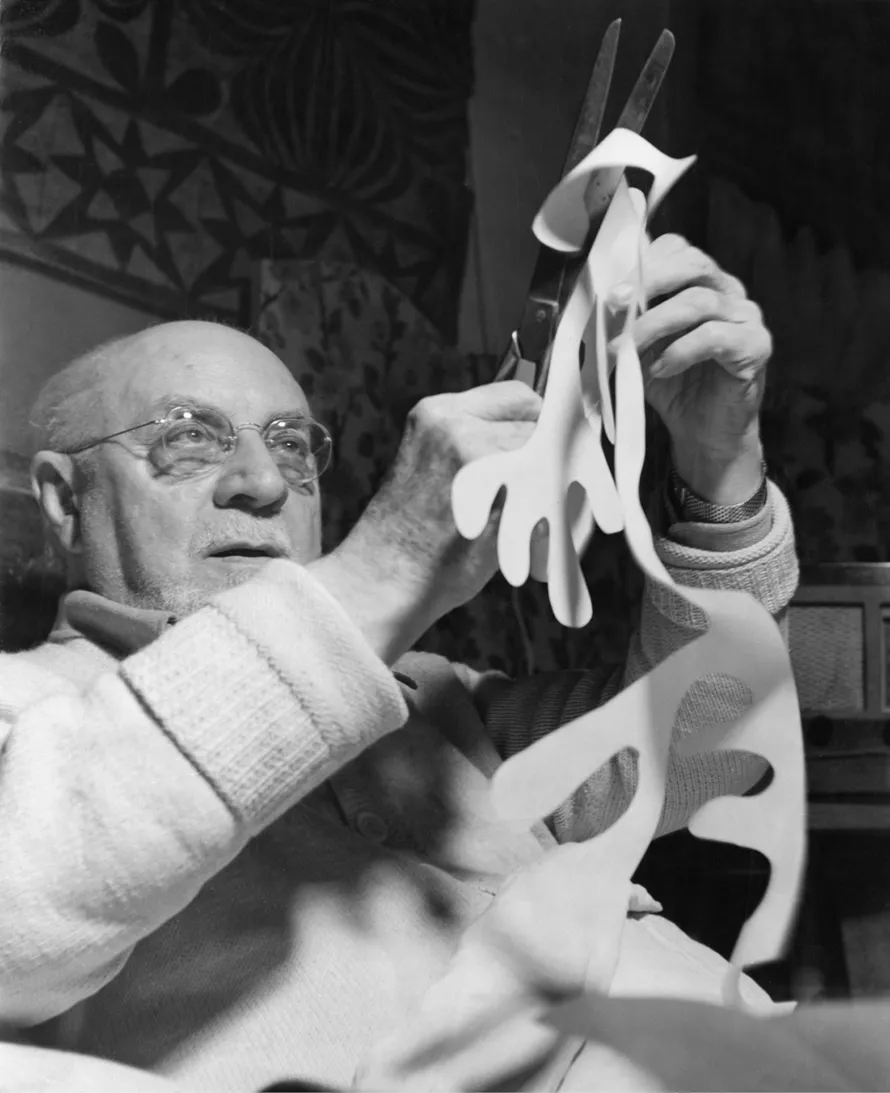
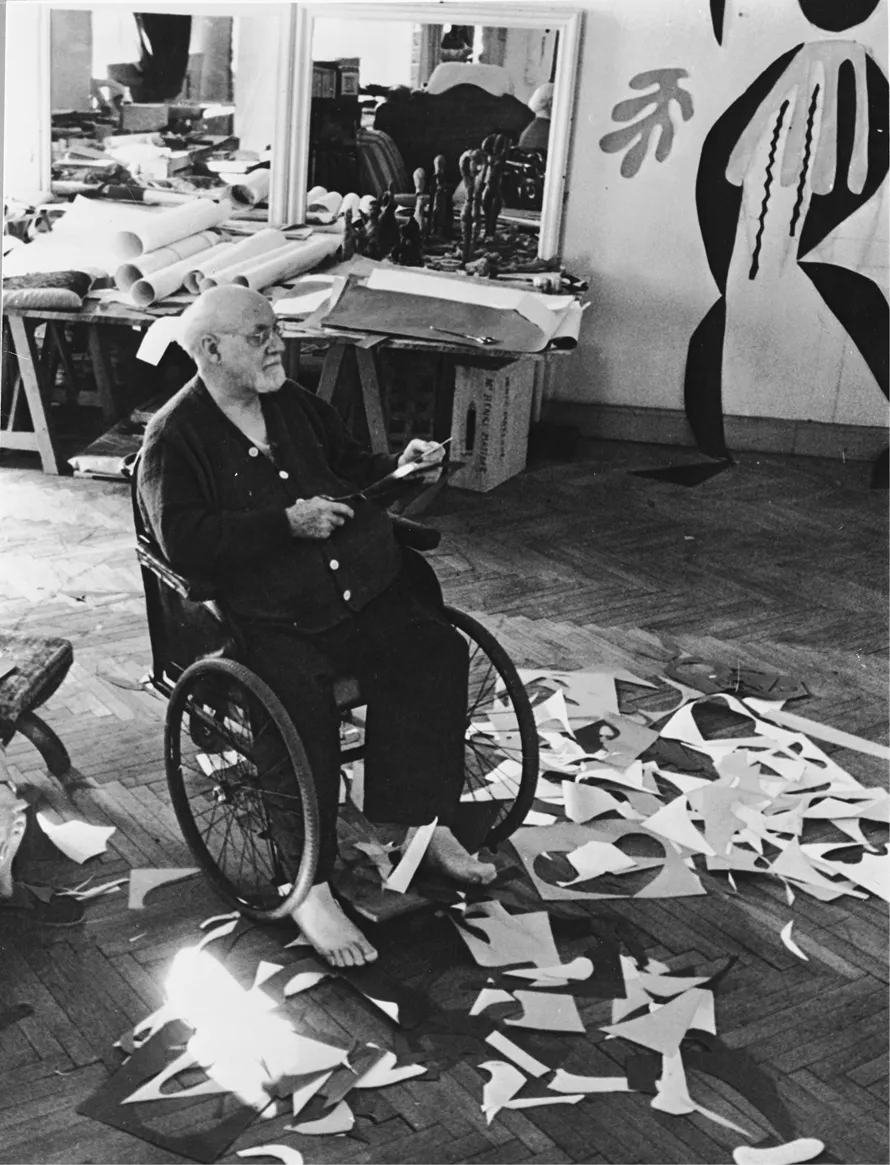
Photographs of Matisse in his studio, amidst hundreds of cut-out shapes strewn all over the floor, or deeply absorbed in cutting colored paper with a giant pair of scissors suggest making art is indeed a special kind of play: a serious and extraordinarily absorbing play (illustrations 1.3, 1.4). Like a child exploring sand and water and delighting in their color, texture, sound, and movement, Matisse was engrossed in an exciting, unpredictable, and at times deeply rewarding process.3
Illustration 1.3Henri Matisse making paper cut-outs at his home in Vence, ca. 1947
Illustration 1.4Henri Matisse at work on paper cut-outs in his studio in Nice, early 1952
Forms
When contemplating a Matisse collage, we too can feel some of the playfulness and pleasure that Matisse experienced. But how exactly does this happen? Why does a Matisse collage delight us? Why is it so playful and moving?
One way to answer these questions is to think more carefully about what artists sometimes call an artwork’s formal qualities—that is, to pay closer attention to the lines, shapes, and colors of Matisse’s artworks, and to the ways these basic visual elements relate to one another. As we study a Matisse collage in this way, we may discover that what we find so enjoyable in the artwork is exactly what we find enjoyable in a much simpler, more everyday composition like the child’s sandcastle. Both show the same responsiveness to the demands of physical materials, tools, and the making process, and the same back-and-forth game of shaping and reshaping, imagining and reimaging the work at hand.
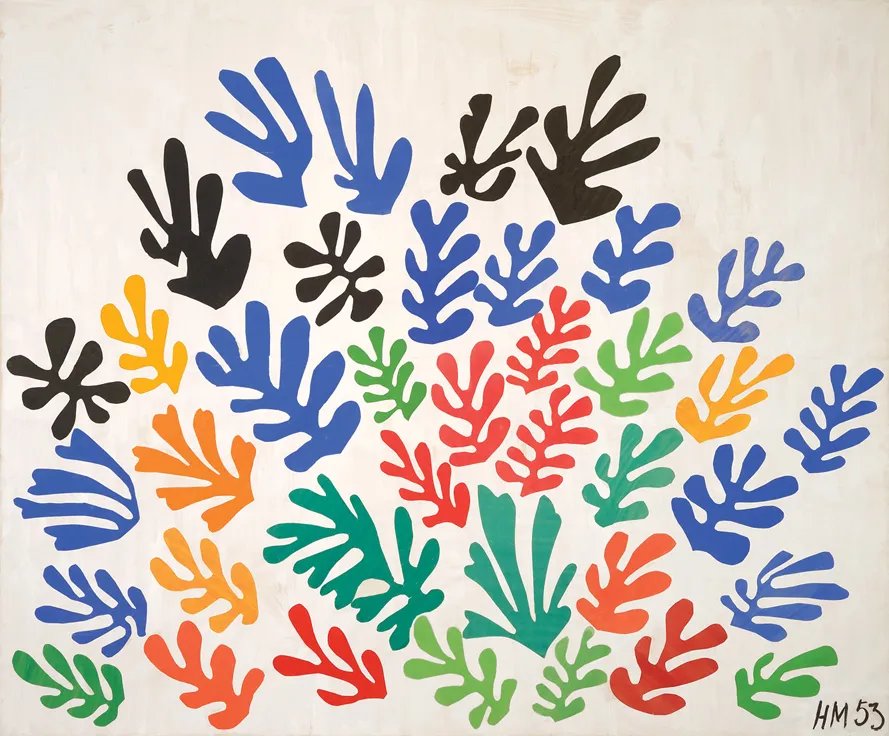
Let’s look closely at Matisse’s collage The Sheaf, Maquette for a Ceramic Mural of 1953 (illustration 1.5). To create this collage, Matisse used scissors to cut a basic shape resembling a leaf with many lobes. He did this over and over again, producing many similar leaves. Using this simple, repetitive process, Matisse created a wonderfully exuberant visual rhythm in the collage. Each colored leaf acts as a stepping-stone for our eyes. Our gaze meanders from one brilliantly colored leaf to another and then another just as Matisse himself progressed from the cutting of one shape to another and then another.
Illustration 1.5Henri Matisse, The Sheaf, Maquette for a Ceramic Mural, 1953. Gouache on paper, cut and pasted on paper, and mounted on canvas; 293.4 cm x 350.5 cm x 3.2 cm. Hammer Museum, Collection University of California, Los Angeles
As our gaze travels across Matisse’s collage, and as we see all the leaves spread out in their delightful array, we discover the value of repetition in art and design. But if we look closely, we see that Matisse’s shapes, while similar to one another, are not exact copies of each other. Each shape is a unique creation, individually shaped by the artist’s hand. In the same way, the child’s sand pathway lined with twigs displayed repetition combined with variations. Just as each leaf in Matisse’s collage is different yet similar to every other, so too each little twig planted by the boy was unique yet sufficiently similar to others to give his promenade a sense of continuity and rhythm. Here is how Matisse, writing in the early 1940s, described this condition of variety combined with repetition:
No leaf of a fig tree is identical with any other of its leaves, each has a form of its own but they all proclaim: Fig tree!4
Remember how imaginatively the child responded to the onrushing waves? Or his ingenious idea to make his tree-lined promenade out of sticks and bits of driftwood he found on the beach? There is a similar responsiveness in Matisse’s collage. The artist arranged his leaves not haphazardly but intentionally, letting each leaf defer to and adjust itself in response to its neighbors, and spacing them evenly across the field, so that they create a sense of steady, though rhythmic flow. When seen together, Matisse’s leaves form a marvelous spreading pattern that resembles the fanning tail of a peacock or the spray of a fountain. It is a wonderfully dynamic continuity, one that gives this image, which is in reality quite still, a sense of flowing motion.
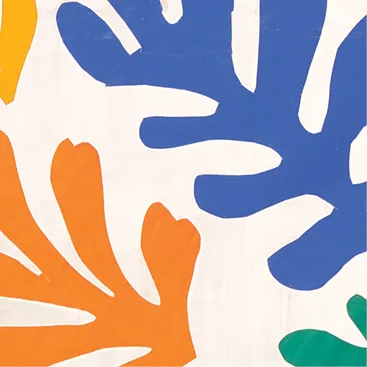
Let’s consider for a moment the hole that the child dug in the sand. Since it was empty—made by removing rather than adding material—it is what artists call a subtractive or negative form, while the hill made of sand is its additive or positive counterpart. While playing with his scissors and colored paper, Matisse also created positive and negative shapes. Look carefully at the detail of Matisse’s Sheaf collage shown in illustration 1.6. Do you see the white leaf-like shape between the blue and orange leaf? It is a negative form since no material has been added here: this white shape is made of the leftover, background paper. Its positive counterparts are the colored leaves, which Matisse added to the white paper, and which are thus akin to the boy’s mound of sand. To create his negative shape, however, Matisse did not literally carve into the white paper, the way the boy dug into the sand. Rather, the artist carefully arranged his colored leaves so that the empty white space between them is itself shaped like a lobed leaf: an incomplete, suggestive leaf-like shape made of white background paper.
Illustration 1.6Detail of The Sheaf
Now let’s look at the shape of just one colored leaf in the collage. Like the overall pattern, it too is repetitive and rhythmic for it has multiple lobes. As they repeat, these lobes create negative white lobes whose shapes are echoes of the positive colored lobes. Each colored lobe and the white lobe nestled beside it are a pair of yin-yang partners that both mirror and oppose each other. Just as in the boy’s negative hole and positive mound example, Matisse’s negative and positive lobes are interdependent. In the Matisse collage, the grand rhythmic movement of the overall fan-like spray of leaves is thus accompanied by the smaller negative to positive rhythms within each lovingly shaped leaf.
The creation of negative and positive forms—of absences and presences—emerges naturally when we work with physical materials, whether they are sand and water or colored paper. For instance, when the boy dug his hole in the wet sand, he had leftover material: the sand he removed which he then used to shape his mound. Similarly...
Table of contents
Cover
Endorsements Page
Half-Title Page
Title Page
Copyright Page
Dedication
Contents
List of Illustrations
Foreword
Acknowledgments
Introduction
1 Play
2 Architecture
3 Emptiness
4 The Space Between
5 Fields
6 Mistakes
7 Transparency
8 The Past
9 Abundance
Illustration Credits
Index
Trusted by 375,005 students
Access to over 1.5 million titles for a fair monthly price.
Study more efficiently using our study tools.
Frequently asked questions
Yes, you can cancel anytime from the Subscription tab in your account settings on the Perlego website. Your subscription will stay active until the end of your current billing period. Learn how to cancel your subscription
No, books cannot be downloaded as external files, such as PDFs, for use outside of Perlego. However, you can download books within the Perlego app for offline reading on mobile or tablet. Learn how to download books offline
Perlego offers two plans: Essential and Complete
Essential is ideal for learners and professionals who enjoy exploring a wide range of subjects. Access the Essential Library with 800,000+ trusted titles and best-sellers across business, personal growth, and the humanities. Includes unlimited reading time and Standard Read Aloud voice.
Complete: Perfect for advanced learners and researchers needing full, unrestricted access. Unlock 1.5M+ books across hundreds of subjects, including academic and specialized titles. The Complete Plan also includes advanced features like Premium Read Aloud and Research Assistant.
Both plans are available with monthly, semester, or annual billing cycles.
We are an online textbook subscription service, where you can get access to an entire online library for less than the price of a single book per month. With over 1.5 million books across 990+ topics, we’ve got you covered! Learn about our mission
Look out for the read-aloud symbol on your next book to see if you can listen to it. The read-aloud tool reads text aloud for you, highlighting the text as it is being read. You can pause it, speed it up and slow it down. Learn more about Read Aloud
Yes! You can use the Perlego app on both iOS and Android devices to read anytime, anywhere — even offline. Perfect for commutes or when you’re on the go. Please note we cannot support devices running on iOS 13 and Android 7 or earlier. Learn more about using the app
Yes, you can access Experiencing Art and Architecture by Sanda Iliescu in PDF and/or ePUB format, as well as other popular books in Art & Architecture Criticism. We have over 1.5 million books available in our catalogue for you to explore.