Shortlisted for the PQ Best Publication Award in Performance Design & Scenography 2023
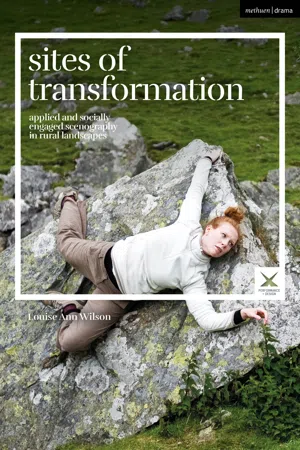
In this book practitioner and researcher Louise Ann Wilson examines the expanding field of socially engaged scenography and promotes the development of scenography as a distinctive type of applied art and performance practice that seeks tangible, therapeutic, and transformative real-world outcomes. It is what Christopher Baugh calls 'scenography with purpose'.
Using case studies drawn from the body of site-specific walking-performances she has created in the UK since 2011, Wilson demonstrates how she uses scenography to emplace challenging, marginalizing or 'missing' life-events into rural landscapes – creating a site of transformation – in which participants can reflect upon, re-image and re-imagine their relationship to their circumstances. Her work has addressed terminal illness and bereavement, infertility and childlessness by circumstance, and (im)mobility and memory. These works have been created on mountains, in caves, along coastlines and over beaches. Each case-study is supported by evidential material demonstrating the effects and outcomes of the performance being discussed.
The book reveals Wilson's creative methodology, her application of three distinct strands of transdisciplinary research into the site/landscape, the subject/life-event, and with the people/participants affected by it. She explains the 7 'scenographic' principles she has developed, and which apply theories and aesthetics relating to land/scape art and walking and performance practices from Early Romanticism to the present day. They are underpinned by the concept of the feminine 'material' sublime, and informed by the attentive, autotopographic, therapeutic and highly scenographic use of walking and landscape found in the work of Dorothy Wordsworth and her female contemporaries. Case studies include Fissure (2011), Ghost Bird (2012), The Gathering (2014), Warnscale (2015), Mulliontide (2016), Dorothy's Room (2018) and Women's Walks to Remember: 'With memory I was there' (2018-2019).
eBook - ePub
Sites of Transformation
Applied and Socially Engaged Scenography in Rural Landscapes
- 248 pages
- English
- ePUB (mobile friendly)
- Available on iOS & Android
eBook - ePub
Sites of Transformation
Applied and Socially Engaged Scenography in Rural Landscapes
About this book
Information
Table of contents
- Cover
- Halftitle Page
- Title Page
- Contents
- List of figures
- Acknowledgements
- Introduction: Setting the scene – Sites of Transformation
- 1 Scenography with purpose – seven scenographic principles
- 2 Walking-performance – emplacing a life-event: Fissure
- 3 Creating a scene – centring the visual: Ghost Bird
- 4 Site and materials – centring the metaphor: The Gathering
- 5 Mapping-walks – centring the subject: Warnscale
- 6 Giving a voice – centring people and place: Mulliontide
- 7 Applied scenography – multiple applications: Dorothy’s Room and Women’s Walks to Remember
- Appendices
- References
- Index
- Imprint
Trusted by 375,005 students
Access to over 1.5 million titles for a fair monthly price.
Study more efficiently using our study tools.
Frequently asked questions
Yes, you can cancel anytime from the Subscription tab in your account settings on the Perlego website. Your subscription will stay active until the end of your current billing period. Learn how to cancel your subscription
No, books cannot be downloaded as external files, such as PDFs, for use outside of Perlego. However, you can download books within the Perlego app for offline reading on mobile or tablet. Learn how to download books offline
Perlego offers two plans: Essential and Complete
- Essential is ideal for learners and professionals who enjoy exploring a wide range of subjects. Access the Essential Library with 800,000+ trusted titles and best-sellers across business, personal growth, and the humanities. Includes unlimited reading time and Standard Read Aloud voice.
- Complete: Perfect for advanced learners and researchers needing full, unrestricted access. Unlock 1.5M+ books across hundreds of subjects, including academic and specialized titles. The Complete Plan also includes advanced features like Premium Read Aloud and Research Assistant.
We are an online textbook subscription service, where you can get access to an entire online library for less than the price of a single book per month. With over 1.5 million books across 990+ topics, we’ve got you covered! Learn about our mission
Look out for the read-aloud symbol on your next book to see if you can listen to it. The read-aloud tool reads text aloud for you, highlighting the text as it is being read. You can pause it, speed it up and slow it down. Learn more about Read Aloud
Yes! You can use the Perlego app on both iOS and Android devices to read anytime, anywhere — even offline. Perfect for commutes or when you’re on the go.
Please note we cannot support devices running on iOS 13 and Android 7 or earlier. Learn more about using the app
Please note we cannot support devices running on iOS 13 and Android 7 or earlier. Learn more about using the app
Yes, you can access Sites of Transformation by Louise Ann Wilson, Scott Palmer, Joslin McKinney, Stephen A. Di Benedetto, Scott Palmer,Joslin McKinney,Stephen A. Di Benedetto in PDF and/or ePUB format, as well as other popular books in Media & Performing Arts & Theatre Stagecraft & Scenography. We have over 1.5 million books available in our catalogue for you to explore.