'An extraordinary account of heroism and sacrifice. An unexpected and important story, rivetingly told. Rip roaring stuff. Get this into the paws of the sea dog in your life.' - Griff Rhys Jones
'A book that had to be written' - Let's Talk
'People ashore don't realise what a grim war we are waging at sea with the Germans. A cold-blooded war, in a way I think requiring the maximum of bravery from the men of both sides in the long run, as it is so ceaseless and intangible. You just don't know whether the next moment will be your last.' Robert Hichens, RNVSR
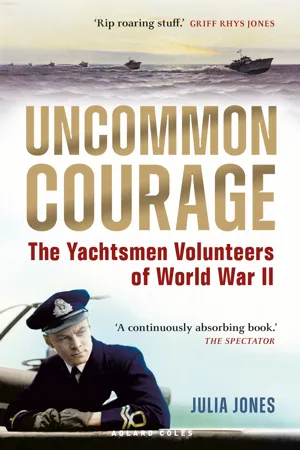
Several years ago, Julia Jones was searching through long-forgotten items stored at her house and discovered some suitcases of old written material, which turned out to be accounts by her father of his experiences in the RNVSR (Royal Naval Volunteer Supplementary Reserve). She realised that as a child she'd met some of the people mentioned, and although she was too young to truly know them, these youthful impressions spurred her on to rediscovery and understanding.
In this absorbing book Julia tells the compelling stories of the yachtsmen. Some were famous (such as Sir Peter Scott), others were wealthy (such as August Courtauld, who returned his pay to help with the war effort) but the majority were just 'ordinary' professionals such as publishers, lawyers and advertising agents, who signed up because they loved sailing. Few could ever have dreamed that they would end up acting in areas that were so far beyond their normal lives, as they found themselves commanding destroyers and submarines, and undertaking covert missions of sabotage. Some undertook the dangerous daily drudgery of minesweeping; others tackled unexploded bombs, engaged the enemy in high-speed attacks or played key roles in Ian Fleming's famous intelligence commandos.
This varied crew of men were given tasks vital to the war effort, requiring endurance, extraordinary bravery, resourcefulness and quick thinking. Some died in the process, but for the ones who survived, Julia asks how their experiences changed them. Could their love of sailing and the sea survive the harsh realities of war?
- 304 pages
- English
- ePUB (mobile friendly)
- Available on iOS & Android
eBook - ePub
About this book
Information
1
‘There must be hundreds of chaps like me’1
1903–1918: The formation of RNVR and WWI
When I told friends about my discovery of my father’s typescript and my surprise at his activities, several people commented ‘It’s like The Riddle of the Sands!’ For those who haven’t read Erskine Childers’ yachting masterpiece (his only novel, published in 1903), it tells the tale of two young men, not naturally congenial, who get over snobbery and social awkwardness to search the sands and creeks of the Frisian Islands. Davies and Carruthers show bravery, physical endurance, meticulous chart work, independence and imagination. They steer a careful course between reconnaissance and spying, and in doing so, foil plans for a German invasion of England. Childers’ style is not that of the action-packed thriller. Some readers might share Carruthers’ feelings as he reads Dulcibella’s logbook: ‘The bulk dealt with channels and shoals with weird and depressing names […] “Kedging-off” appeared to be a frequent diversion; “running aground”, an almost daily occurrence. It was not easy reading.’2 The central action of the novel is the day-to-day practical challenge of handling a small, relatively comfortless yacht in shallow waters and bad weather. It’s enlivened by the interplay of character, an indefinable tension and the central mystery.
Erskine Childers (1870–1922) surprised his colleagues in the House of Commons clerks’ department when they discovered his enthusiasm for the muddy creeks of the English East Coast or for blowing across to France in an 18ft semi-open boat with a tent. He was a member of the Royal Cruising Club (RCC) and had spent three months during 1897 exploring the Baltic in Vixen (aka Dulcibella), a converted ship’s lifeboat. His time in Kiel and nearby Flensburg had alerted him to significant developments in the Imperial German Navy and the potential threat these posed to Britain. He wrote up his cruise for the RCC Journal, as well as for Yachting Monthly magazine. The resulting novel, The Riddle of the Sands, was both a warning against Germany at a time when she was not thought to be Britain’s natural enemy, and an advocacy of irregular small boat warfare with a plea for the special skills of yachtsmen. Childers sets out an invasion scenario in which precise knowledge of coasts and depths is crucial for an amphibious landing. He imagines defensive tactics involving a swarm of shallow-draught boats. Specialist knowledge – and the right type of person – would be essential for success: ‘Reckless pluck is abundant in the British Navy but expert knowledge of the tides and shoals in these waters is utterly lacking. The British charts are of no value and there is no evidence that the subject has been studied in any way by the British Admiralty.’3
This is where Childers’ hero, Arthur Davies, small boat sailor and amateur hydrographer, sees an opportunity. In early youth, he had failed to gain acceptance into the Navy: ‘And I can’t settle down to anything else,’ he said. ‘I read no end about it and yet I am a useless outsider. All I’ve been able to do is to potter about in small boats, but it’s all been wasted until this chance came.’ Carruthers is sympathetic: ‘There ought to be chances for chaps like you,’ I said, ‘without the accident of a job such as this.’4
Davies insists he’s just one of many: ‘There must be hundreds of chaps like me – I know a good many myself – who know our coasts like a book – shoals, creeks, tides, rocks; there’s nothing in it, it’s only practice. They ought to make some use of us as a naval reserve.’
On 4 March 1903, the Naval Forces Bill was introduced ‘to provide for the Constitution of a Royal Naval Volunteer Reserve’. The Riddle of the Sands was published in May. The Bill became law in June. Plenty of campaigners then and since have pinned their hopes on government guidance, only to experience disillusion as officialdom crushes the spirit of the enterprise. And so it was with the RNVR in the years before WWI: it bore little resemblance to Davies’ (or Childers’) concept of expertise and individual initiative. Early volunteers were drilled on military lines and rarely got to sea. Their dedication ensured that they made impressive progress against establishment prejudice but Davies wouldn’t have wanted to join. It was not until the formation of the RNVSR in 1936 that ‘chaps like him’ would be welcomed for their specific skills as yachtsmen.
Nevertheless, The Riddle of the Sands was immediately influential on publication. It also inspired plenty of young men with ‘reckless pluck’ to turn their cruises into reconnaissance trips. Maldwin Drummond quotes a tongue-in-cheek article that calls for its suppression: ‘Too many young men of patriotic instincts in whom the love of adventure is strong have chartered small boats and cruised stealthily among the islands in question to the great scandal of the authorities of the Fatherland in whose blood the microbe of spy-mania flourishes exceedingly.’ The yachtsmen get arrested, sales of the book go up, more young men are inspired to set out and the writer foresees a time when ‘the key of a German prison will turn on the last able-bodied Englishman, and when our country, defended only by women, infants and invalids, will be at the mercy of any unneighbourly neighbour who may choose to attack it.’5
Gordon Shepherd (b. 1885) was just such an enthusiast. Erskine and Molly Childers invited him sailing on their Colin Archer-designed yacht Asgard (a wedding present from Molly’s wealthy father) and Shepherd was soon hooked. In 1912, he explained his position to the First Lord of the Admiralty, Winston Churchill:
I am a yachtsman of much experience and have during the past few years made extended trips in a twelve-ton sailing yacht along the German coast and in the Baltic. As I am an officer in the Regular Army, a friend of mine who is an officer in the Naval Intelligence Department at the Admiralty suggested to me that any information I could procure regarding coast defences and channels in foreign waters would be of great service [...] During my last trip I had the misfortune to be arrested at Emden, but I had carried out investigations in a sufficiently prudent manner to prevent the German authorities having any grounds for taking legal proceedings, and after four days’ detention I was released.6
Lieutenant Vivian Brandon RN and Captain Bernard Trench (Royal Marines) were less fortunate. In 1909, they had both been in Kiel serving on the training ship HMS Cornwall, where they had successfully assisted Captain Reginald Hall with some undercover photography. They had changed out of their uniforms, borrowed a private motorboat, then sped round the harbour, ‘breaking down’ at the site that Captain Hall wanted to investigate. Subsequently, however, the two young men used their own initiative to go on a yachting holiday to the Frisian Islands. Brandon was arrested far too close to a coastal battery on Borkum, and photographs of coastal areas and defence installations were discovered under the mattress in Trench’s hotel room in Emden. They were both charged with spying. At their trial in Leipzig, the prosecution waved a copy of The Riddle of the Sands at them. ‘Yes,’ said Lieutenant Brandon, ‘I’ve read it. I’ve read it three times.’7 They were sentenced to four years in prison. The Admiralty refused to make any contribution to their legal fees, or the cost of prison subsistence, until 1914 when their former captain, now admiral, ‘Blinker’ Hall, became the Director of Naval Intelligence (DNI). Brandon and Trench then joined his unorthodox and successful Room 40 team, which made a significant contribution to victory in WWI.
In the months immediately before WWII, Admiral Hall came out of retirement to give the new DNI, Admiral John Godfrey, the benefit of his advice. One of his recommendations was that Godfrey should appoint a ‘fixer’ – someone with contacts, imagination and unofficial unscrupulousness who would be effective at getting things done. He suggested that the City of London might be a good place to look. In July 1939, Godfrey appointed Ian Fleming, then a stockbroker, giving him a Special Branch commission in the RNVR. Fleming wasn’t a yachtsman but he often made use of the amateur sailors’ skills in ways Childers would have approved. As I had sorted through my father’s attic suitcase, I had felt puzzled by the different timescales with which his and Bill’s Naromis photographs were accepted by the NID. I didn’t guess that the creator of James Bond would provide the answer.
In 1906, with the Anglo-German naval arms race intensifying, Childers had become more interested in the possibility of Britain occupying the Frisian Islands than in Germany invading England. He sent a discussion paper, ‘Remarks on the German North Sea Coast in its Relation to War between Great Britain and Germany’,8 to a friend, Sir George Clarke, then secretary for the Committee for Imperial Defence. Though little came of this, the idea would be picked up again in the early months of WWI.
Meanwhile, Childers had demonstrated ‘the innate subversiveness of small boat sailing’9 in a much more controversial manner through his involvement with the Howth gun-running. In July 1914, Childers and Gordon Shepherd, with Childers’ wife Molly and his Irish cousin Mary Spring Rice, had used Asgard to deliver 1,500 rifles and ammunition to the Irish Volunteers. Part of the load was carried by yachtsman Conor O’Brien, another Spring Rice cousin, on his yacht Kelpie.
In August 1914, Childers was recalled to London by the Admiralty and given a commission in the RNVR and the task of looking again at plans for the invasion and occupation of Borkum and Juist. He accepted gladly. It appears, however, this was an official stitch-up: a means of diverting the over-enthusiastic First Lord of the Admiralty, Winston Churchill, who had put the idea forward at a Cabinet meeting. Childers was set to work with no professional support. When he produced his report, Captain Herbert Richmond, the Assistant Director of Naval Operations, who had requested it, wrote: ‘It is quite mad. The reasons for capturing it are NIL, the possibilities about the same. I have never read such an idiotic, amateur piece of work as this outline in my life.’10 Childers had attached a personal note to his report: ‘The writer ventures to hope that he may have the honour of being employed, if the service permits, whether in aeroplane work or in any other capacity if any of the operations sketched in this memo are undertaken.’
He was seconded to the Royal Naval Air Service and despatched to HMS Engadine, a former cross-Channel railway ferry. She had been modified to carry seaplanes and was being sent to Harwich. On 4 August, the first night of the war, the former Hamburg–Heligoland excursion boat, Königin Luise, had left her home port of Emden and headed for the English coast. She began laying her mines at dawn. These were the moored variety, lying concealed below the surface, some of them about 30 miles from Orford Ness off the Suffolk coast. Next day, destroyer leader HMS Amphion and the 3rd Flotilla left Harwich Harbour to patrol across to the Dutch Island of Terschelling and discovered her at work. They attacked and sank her, managing to rescue most of her crew. Returning from patrol the following morning, however, the Harwich destroyers crossed the minefield. HMS Amphion struck a mine and sank with the loss of 169 people, including the 18 German prisoners rescued earlier.
HMS Engadine’s task was to use her three seaplanes to try to spot mines, with Childers helping to identify likely areas and instruct the Royal Naval Air Station (RNAS) pilots in navigation. He resurrected the North Sea charts that he’d been annotating and correcting since his first cruises in Vixen, together with the photographs and coastal postcards that he’d also been collecting. He flew with the pilots as often as he could, though this was not part of his job spec. On one occasion, bobbing 20 miles off the coast with engine failure, dusk approaching and no real hope of rescue, he felt impelled to write Molly a letter of apology for these unnecessary forays into danger: ‘You must forgive me if I was wrong to fly. You must trust me that I decided it was my duty as the only way of making real use of myself.’11
The ‘regular’ RNVR volunteers, meanwhile, who had conscientiously committed their free time and hard-earned money to weekly drill, often subsidising their own equipment and premises, had been formed into the Royal Naval Division and marched away to land-based warfare. The London Division, feeling betrayed, ceremonially interred a marlinspike and a copy of the Admiralty Manual of Seamanship next to their headquarters as a symbol of their lost ambitions.
On Christmas Day 1914, Childers flew as an observer on the Cuxhaven Raid. This was seen as a new type of warfare; a pre-emptive strike by air and sea against suspected Zeppelin sheds near the mouth of the Elbe, with the additional motive of luring the German High Seas fleet out to an old-style naval battle. Although the raid itself was unsuccessful, Childers’ contribution to the navigation planning was appreciated by the expedition commander, Roger Keyes. A copy of The Riddle of the Sands was sent to every ship in the fleet.
By the spring of 1916, Childers was back in England, where he and Molly learned, with shock and distress, that the weapons they had landed in Howth in 1914 had been used by Sinn Féin extremists as they proclaimed a republic in Dublin on Easter Monday.
The schoolboy Nevil Shute Norway (b. 1899) was in Dublin then. His elder brother Fred had died in France the previous year and their father, director of the postal service, had decided to store his son’s most precious personal relics in the General Post Office for safekeeping. The building became the headquarters of the leaders of the Rising and was later destroyed by fire. Seventeen-year-old Nevil, meanwhile, volunteered with the first aid services and dashed around the city. News from his mother made its way back to his prep school, Lynams in Oxford.
30/4/16. This week has been a wonderful week for Nevil, never before has a boy of seventeen had such an experience. Yesterday morning he was at the Automobile Club, filling cans of petrol from casks for the Red Cross Ambulances. In the afternoon he went round in an ambulance with the Lord Mayor collecting food for forty starving refugees harboured in the Mansion House, and then went out for wounded, and brought in an old man of 78 shot through the body. He was quite cheery and asked Nevil if he thought he would get over it? So Nevil said, ‘Good Lord, yes! Why not?’ and bucked the old man up.
The headmaster (Blue Dragon yachtsman CC Lynam) commented: ‘You might wonder at Nevil’s pluck, but nowadays at the Public Schools the Officer Training Corps are preparing the boys for war and Nevil will have had two years of training, so that he was in readiness for such events as occurred in Dublin.’12
Childers, meanwhile, was making unsuccessful attempts to learn to fly so he could undertake additional reconnaissance for the new fast motorboat raids that were being planned. A new ‘small ship’ Navy was developing as trawlers, drifters, padd...
Table of contents
- Cover
- Title
- Contents
- Introduction: A riddle in the attic
- 1 ‘There must be hundreds of chaps like me’
- 2 ‘I happened to look around and he was gone’
- 3 ‘They ought to make some use of us’
- 4 ‘Are there many like you in England?’
- 5 ‘Do you think you’ll like this sort of thing?’
- 6 ‘I hardened to the life’
- 7 ‘So casual and quiet in the extraordinary things that you do’
- 8 ‘I couldn’t help noticing that it wasn’t quite what you expected’
- 9 ‘He helped me out of a bit of a mess’
- 10 ‘The last strongholds were battered, stormed and overwhelmed’
- 11 ‘I sign articles’
- 12 ‘Small things sidled out of dark hiding places’
- 13 ‘The dark spaces of the North Sea’
- 14 ‘Mosquitoes with stings’
- 15 ‘The very splash of the surf and the bubble of the tides’
- 16 ‘Distracted by the multiplicity of its functions’
- 17 ‘Every inch of it must be important’
- 18 ‘It’s a dirty-looking night and I don’t like this swell’
- 19 ‘Would you care to join me in a little yachting?’
- 20 ‘Multitudes of seagoing lighters, carrying full loads of soldiers’
- 21 ‘There was an outburst of shouting which soon died away’
- 22 ‘Goodbye Old Chap’
- 23 ‘From that point our personal history is of no concern’
- Endnotes
- Acknowledgements
- Bibliography
- Index
- Copyright
Trusted by 375,005 students
Access to over 1.5 million titles for a fair monthly price.
Study more efficiently using our study tools.
Frequently asked questions
Yes, you can cancel anytime from the Subscription tab in your account settings on the Perlego website. Your subscription will stay active until the end of your current billing period. Learn how to cancel your subscription
No, books cannot be downloaded as external files, such as PDFs, for use outside of Perlego. However, you can download books within the Perlego app for offline reading on mobile or tablet. Learn how to download books offline
Perlego offers two plans: Essential and Complete
- Essential is ideal for learners and professionals who enjoy exploring a wide range of subjects. Access the Essential Library with 800,000+ trusted titles and best-sellers across business, personal growth, and the humanities. Includes unlimited reading time and Standard Read Aloud voice.
- Complete: Perfect for advanced learners and researchers needing full, unrestricted access. Unlock 1.5M+ books across hundreds of subjects, including academic and specialized titles. The Complete Plan also includes advanced features like Premium Read Aloud and Research Assistant.
We are an online textbook subscription service, where you can get access to an entire online library for less than the price of a single book per month. With over 1.5 million books across 990+ topics, we’ve got you covered! Learn about our mission
Look out for the read-aloud symbol on your next book to see if you can listen to it. The read-aloud tool reads text aloud for you, highlighting the text as it is being read. You can pause it, speed it up and slow it down. Learn more about Read Aloud
Yes! You can use the Perlego app on both iOS and Android devices to read anytime, anywhere — even offline. Perfect for commutes or when you’re on the go.
Please note we cannot support devices running on iOS 13 and Android 7 or earlier. Learn more about using the app
Please note we cannot support devices running on iOS 13 and Android 7 or earlier. Learn more about using the app
Yes, you can access Uncommon Courage by Julia Jones in PDF and/or ePUB format, as well as other popular books in History & Military Biographies. We have over 1.5 million books available in our catalogue for you to explore.