The New Labour government first elected in 1997 had a defining influence on the development of the modern UK constitution. This book combines legal and political perspectives to provide a unique assessment of the way in which this major programme of constitutional reform has changed the nature of the UK constitution. The chapters, written by leading experts in UK public law and politics, analyse the impact and legacy of the New Labour reform programme some 20 years on from the 1997 general election, and reveal the ways in which the UK constitution is now, to a significant extent, the 'New Labour constitution'.
The book takes a broad approach to exploring the legacy of the New Labour years for the UK constitution. The contributors evaluate a range of specific substantive reforms (including on human rights, devolution, freedom of information, and the judicial system), changes to the process and method of constitutional reform under New Labour, the impact on key institutions (such as the judiciary and Parliament), and a number of wider constitutional themes (including national security, administrative justice, and the relationship between the Labour Party and constitutionalism). The book also reflects on the future challenges for the constitution constructed by New Labour, and the prospects for further constitutional reform.
In bringing together this range of perspectives to reflect on the implications of the New Labour era of reform, this book offers a critical examination of a foundational period in the development of the contemporary UK constitution.
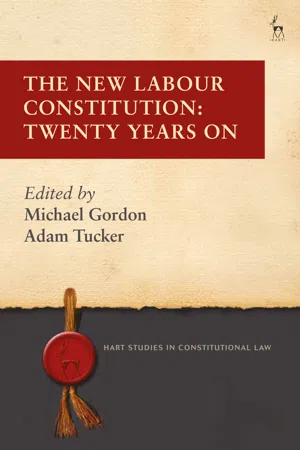
eBook - ePub
The New Labour Constitution
Twenty Years On
- 480 pages
- English
- ePUB (mobile friendly)
- Available on iOS & Android
eBook - ePub
About this book
Information
1
Labour’s Constitutional Changes 1997–2010: Time for More
LORD FALCONER OF THOROTON
I.INTRODUCTION
Labour very significantly changed the constitution of the UK between 1997 and 2010. There was an overarching drive to those changes – to bring government much closer to the people, and to shift the balance of power much more towards the citizen and away from the executive. We believed it would promote more connected government and better-quality government. And it did.
Devolution gave Scotland and Wales direct power over huge swathes of domestic policy, and the Good Friday Agreement installed a government in Northern Ireland which could and did bring peace. The Human Rights Act gave the citizen enforceable protections, in the UK courts, for their human rights. The Freedom of Information Act exposed the executive to much more profound scrutiny: real scrutiny so often comes from seeing the documents which break through a government refusing to give any information about how they came to a decision. The Constitutional Reform Act 2005 created a Supreme Court as the final court of appeal for the UK, made it properly visible to the public, ensured an impartial method of judicial appointments, and removed the chief judge of England and Wales from the Cabinet. The Equalities Act provided widespread protection for the citizen against a whole range of discriminations. The removal of the hereditary peers from the Lords transformed the second chamber from being a deeply Conservative, largely irrelevant legislative chamber to an effective reviser of legislation. The Regional Development Agencies drove strategic change for the regions of England. And the introduction of mayors in our major cities has provided new dynamic leadership for the crucially important city-regions which drive economic growth.
The list is long and significant. These changes have affected our constitution hugely and in irreversible ways, but they remain in many aspects contested. For example, the Human Rights Act provokes opposition from sections of the community who believe it has tilted the balance too much in favour of the unmeritorious citizen and too far away from the state, and devolution is blamed by some for the strength of the independence movement in Scotland and by others for not going far enough. The Freedom of Information Act is said to restrict too much the executive’s ability to have open discussions internally, and the Supreme Court, it is said, has strayed too much into the area of politics.
These details do show a very stark dividing line on the constitution now. The current government is strongly against continuing the process of bringing government closer to and empowering the people. Brexit aimed to do that. Taking back control is a good description for many of the constitutional changes Labour delivered. And the power and aptness of that message is shown by the electoral success of Brexit. Having taken back control from Brussels, the real battle now is about how much control the executive should cede from itself to the devolved institutions, to the regions, to Parliament and to the individual.
Against this backdrop, this chapter reflects on the key achievements of the Labour reform programme, as well as the constitutional priorities for the future. This piece is written in a pure personal capacity and does not reflect current Labour Party policy.
Labour’s constitutional reforms need to be understood in the context of the wider package of social, economic and political change delivered by that Labour government. The constitutional reform package was, like these other reforms, driven by 18 years of Thatcherism and Conservative constitutional neglect.
The direction of travel of the Labour reforms were right. There needs to be more constitutional change now, to prevent an ‘elective dictatorship’ deciding everything from Westminster1 – to ensure that the underlying principle of taking back control does not get hijacked by a government determined to concentrate power as much as possible on the elected Westminster government to the detriment of the nations and regions, and of individuals.
The financial crisis, the constitutional strains of Brexit, the response to the coronavirus pandemic and the election in December 2019 of a Conservative majority government led by Boris Johnson willing to govern in a blinkered majoritarian way have left the whole of our constitutional settlement exposed. The government attacks on the judiciary, the optional nature of the rule of law, the subversion of the independent role of the law officers, the refusal to accept the impartiality of the civil service, the breakdown of trust between the UK government and the devolved governments, the decrease in support for the Union throughout the whole of the UK, the disrespect for the Ministerial Code, the disregard by the executive for the Commons, and the failure of Parliament and the executive to provide a solution to the Brexit issue until the 2019 general election have all left the constitution looking in need of change – to better connect the people to the government, to provide effective government, to preserve the Union between Scotland and Wales and the rest of the UK, to ensure the continued success of the Good Friday Agreement, and to provide appropriate checks and balances on the executive.
II.KEY FEATURES OF LABOUR’S CONSTITUTIONAL CHANGES
A.Constitutional Modernisation
The constitutional reforms implemented by Labour were the product of 18 years of constitutional conservatism on the part of the preceding Conservative governments. A number of weaknesses had been ignored, or developed, or increased in that time: first, a profound sense of resentment in Scotland and to a lesser extent in Wales about the distance of Westminster from those it governed; second – although I do not say this was the fault of the Conservatives’ lack of constitutional change – violence and sectarianism in Northern Ireland; and third, the failure of the constitution to catch up with the desire for individual empowerment which was reflected around the world in the strengthening of individual rights. The Labour government’s constitutional changes reflected this latter point in, among other things, the Human Rights Act 1998, the Freedom of Information Act 2000 and the Equality Act 2010, all of which embedded enforceable individual rights.
Although there are similarities between devolution in Scotland and Wales and the model of devolution in Northern Ireland, they are dealing with different problems. In Scotland and Wales, the issue was less discrimination against a particular community within the nation than a sense of disconnect between the drivers of the Westminster government and the concerns of Scotland and Wales. The aim of devolution was to bring the government closer to the people in Scotland and Wales. This has been successful. Devolution is irreversible. Without it, alienation would have grown hugely. But the cultural and political divides between England and the other nations have grown not because of devolution, but for a variety of other factors. The question now is what further change is required.
B.Is Parliamentary Sovereignty Still Accepted as the Key to UK Democracy?
The reform programme was designed to retain parliamentary sovereignty, in particular in relation to human rights and devolution. Brexit was driven by a desire to take back control from the EU, but it has introduced into the constitutional debate question marks over parliamentary sovereignty. And there are now a range of questions about parliamentary sovereignty, going beyond Brexit, which affect our constitutional debate. To what extent should a referendum trump whatever Parliament might want? Should the devolution settlements have greater entrenchment than simply a piece of primary legislation? And to what extent do our checks and balances, in particular the rule of law, the impartiality of the civil service, and human rights, require greater protection than random Acts of Parliament vulnerable to a big Commons majority?
The first of these three questions has, constitutionally, been resolved by the first Miller case in the Supreme Court which made clear the Brexit referendum did not trump parliamentary sovereignty.2 That a majority had voted for Brexit in the 2016 referendum did not obviate the need for Parliament to decide and pass legislation to determine whether we left, and on what terms.
The Supreme Court may have determined the constitutional question. But Brexit raised brutally the sense amongst many in the electorate of a disconnect between judges and politicians on the one hand and the people on the other.
These pressures are reflected in all three of the big questions on parliamentary sovereignty raised in this section. And they need addressing if our constitution is to prove durable in the long term. It may be that our fundamental constitutional values – the protection of minority views, the rule of law, the primacy of the electorate, the rejection of majoritarianism – need to be protected by a written constitution.
III.THE CONSEQUENCES OF LABOUR’S REFORMS
A.The Constitution as Driver and Framer of Politics
The modernised constitution has become controversial. In particular, it now frames the political debate in Scotland.
The creation of the Scottish Parliament sought to address the disconnect between the wishes of the Scottish people and the UK government by, in effect, giving very substantial control over domestic policy, although not economic policy, to the Scottish people. And over 20 years that has been a success. But the thing which accelerated support for that devolution, namely Thatcher’s government, which was very out of tune with Scotland, has re-emerged in the current UK government, which is culturally out of tune with Scottish sensibilities and with a majority of the Scottish electorate on Brexit. One can debate which comes first – the cultural divide or the difference of view on Brexit. Whichever it is, the two together fuel the argument for independence. Polling support for independence grew, but, from the beginning of 2021, it now appears to be falling back, and for some time (up until November 2021 when this chapter was finalised) there has been a consistent lead for the union.3 The polling is in the context of no imminent referendum – the views expressed to pollsters demonstrate much anger, but not a settled choice.
The effect of Labour’s devolution settlement was demonstrated by the result in the 2014 referendum, where there was a 10 per cent lead for the Union. This was a big lead when the government of the day in Scotland was using everything it possibly could to campaign against it, and there was a Conservative government at Westminster.
The new facts of a UK government, culturally deaf to Scottish sensibilities, and Brexit mean we must readdress the question of what the relationship is between the UK and Scotland, but also readdress the relationship between the Scottish Labour Party and the UK Labour Party.
A party whose membership is only in Scotland, and whose only concern is Scotland has a huge advantage over Great British national parties whose concerns are the whole of the United Kingdom, a UK in which a substantial majority of parliamentary seats are in England. But the fact that the SNP are best placed to press Scottish issues, and may most easily argue only they are exclusively concerned about Scotland, does not mean a majority of the Scots, by voting SNP, want independence. I suspect the contrary. A party which has engagement on both sides of the border can deliver best for Scotland, meaning in practice a Labour Party in power in Westminster and Holyrood is the best combination for Scotland, but one where there is a much higher degree of independence for the Scottish Labour Party from its English and Welsh Labour Party partners.
I do not believe a second referendum would be lost by those who support the union. But equally, I do not think there should be a second referendum now or in the foreseeable future. The constant focus on constitutional issues reduces both political stability and improvement in public services. The constitution is a big dividing line in Scottish politics. The big question is how to bring constitutional debate to an end and turn the focus to other issues. It is difficult to see that switch in focus occurring without further constitutional change.
It may be that the next stage in the constitutional process is a more federal constitution which embeds sovereignty on some issues in the Scottish Parliament under the terms of a written constitution which can be construed by the Supreme Court and cannot be changed simply by an Act of the UK Parliament, as is the current position. As with the EU, it may be that a position should be evolved where if the UK Parliament sought by primary legislation to legislate in a way which was contrary to the devolution settlement, the Supreme Court of the UK could strike that legislation down. The significance of that change would be to provide constitutional protection to the devolution settlement which it currently lacks – there are in practice no constitutional inhibitions on the UK Parliament passing primary legislation affecting Scotland which encroaches on devolved areas, to any degree the UK Parliament chooses.
Working out how that constitutional evolution since 1998 might be captured in further reform designed to embed devolution will be very significant in future attempts to sustain the Union.
IV.THE VULNERABILITY OF THE CONSTITUTION
A.Constitution in Crisis
Despite the success of the 1997–2010 reform programme, which has had a positive impact on the constitution, we currently have a constitution in crisis.
There are two main threads to the crisis: first, the preservation of the UK because of the real threat of Scottish independence and the government’s weakened commitment to the rule of law; and secondly, abandonment of checks and balances by the government.
B.Preservation of the Union and the Rule of Law
I set out the position in Scotland above. The Good Friday Agreement is also in play because of the extent to which it has been regarded as secondary to achieving Brexit, and the changes to the relationship between the British mainland and Northern Ireland effected to facilitate Brexit. To leave the Single Market meant the EU would insist there had to be compliance with the rules of the Single Market and the Customs Union either by a hard border within the island of Ireland or by checks on goods coming from Great Britain to Northern Ireland. Agreement has been reached on a border through the North Sea, although the longevity of these arrangements is uncertain in light of the UK government’s continuing resistance to them.
Before the deal was agreed there was an impasse, and in prioritising a hard Brexit, the UK government put the UK in a situation where the status of Northern Ireland and the stability of the open border between the North and the Republic of Ireland was threatened. The current inability of the EU and the UK to reach a stable landing on the position of Northern Ireland, despite having negotiated the Northern Ireland Protocol less than two years ago, raises big questions over the constitutional position of Northern Ireland. The clash between the desire to preserve the integrity of the Single Market and yet have no border between Great Britain and Northern Ireland, and the desire to preserve the key principle of the Good Friday Agreement of an open border between North and South, remains unresolved. For there to be integrity over the Single Market arrangements means there have to be some checks on goods coming into Ireland, either at the border with the North which offends the GFA, or between GB and NI, which offends the integration of NI into the UK. A compromise is required. It exists in the protocol. It has to be made to work. How it affects, in the long term, support for the border within Northern Ireland remains to be seen.
The future of Northern Ireland and its constitutional position will therefore inevitably be influenced by the ability of the EU and the UK to make the Northern Ireland Protocol work in a way which preserves the constitutional status quo.
The referendum vote for Brexit, and then the delivery of Brexit, initially delayed by the politicians but then delivered after the 2019 election, has rocked the constitution. The unwritten constitution, dependent for success on the acceptance of loosely defined convention, has been massively unsettled by that delay. The split between Parliament and the electorate over what to do about Brexit, and the range of constitutional steps taken to delay Brexit, undermined confidence in the constitution. The constitution is now associated by some with standing in the way of what they would see as true democratic delivery of change. The Good Friday Agreement, the rule of law and the Supreme Court were each characterised as obstructing the change the government...
Table of contents
- Cover
- Title Page
- Acknowledgements
- Table of Contents
- List of Contributors
- Table of Legislation
- The New Labour Constitution: Twenty Years On: Introduction
- 1. Labour’s Constitutional Changes 1997–2010: Time for More
- 2. Britain’s New Labour Constitution: Causes and Consequences
- 3. The Human Rights Act 1998: Two Decades Swimming Upstream
- 4. The Unintended Consequences of Legislative Constitutionalism: The Common Law Constitution and Judicial Comparativism
- 5. Judicial Policy and New Labour’s Constitutional Project
- 6. Devolution: A New Fundamental Principle of the UK Constitution
- 7. The ‘Evolution’ of Devolution: Assessing Labour’s Legacy in England
- 8. ‘Three Harmless Words’: New Labour and Freedom of Information
- 9. What Was New Labour’s Vision for Parliament? And Did It Succeed?
- 10. New Labour’s Judicial Power Project
- 11. New Labour’s Secret National Security Constitution
- 12. Individual Terrorist Suspects as the New Folk Devil: New Labour, Rights Tokenism and Security Compulsions
- 13. Revisiting the Administrative Justice Legacy of New Labour
- 14. Referendums and New Labour’s Constitutional Reforms
- 15. Neoliberalism, Labour Law and New Labour’s Turn to Constitutionalism
- 16. The Legacy of the New Labour Constitution and the Future of Labour Constitutionalism
- Index
- Copyright Page
Trusted by 375,005 students
Access to over 1.5 million titles for a fair monthly price.
Study more efficiently using our study tools.
Frequently asked questions
Yes, you can cancel anytime from the Subscription tab in your account settings on the Perlego website. Your subscription will stay active until the end of your current billing period. Learn how to cancel your subscription
No, books cannot be downloaded as external files, such as PDFs, for use outside of Perlego. However, you can download books within the Perlego app for offline reading on mobile or tablet. Learn how to download books offline
Perlego offers two plans: Essential and Complete
- Essential is ideal for learners and professionals who enjoy exploring a wide range of subjects. Access the Essential Library with 800,000+ trusted titles and best-sellers across business, personal growth, and the humanities. Includes unlimited reading time and Standard Read Aloud voice.
- Complete: Perfect for advanced learners and researchers needing full, unrestricted access. Unlock 1.5M+ books across hundreds of subjects, including academic and specialized titles. The Complete Plan also includes advanced features like Premium Read Aloud and Research Assistant.
We are an online textbook subscription service, where you can get access to an entire online library for less than the price of a single book per month. With over 1.5 million books across 990+ topics, we’ve got you covered! Learn about our mission
Look out for the read-aloud symbol on your next book to see if you can listen to it. The read-aloud tool reads text aloud for you, highlighting the text as it is being read. You can pause it, speed it up and slow it down. Learn more about Read Aloud
Yes! You can use the Perlego app on both iOS and Android devices to read anytime, anywhere — even offline. Perfect for commutes or when you’re on the go.
Please note we cannot support devices running on iOS 13 and Android 7 or earlier. Learn more about using the app
Please note we cannot support devices running on iOS 13 and Android 7 or earlier. Learn more about using the app
Yes, you can access The New Labour Constitution by Michael Gordon, Adam Tucker, Michael Gordon,Adam Tucker in PDF and/or ePUB format, as well as other popular books in Law & Public Law. We have over 1.5 million books available in our catalogue for you to explore.