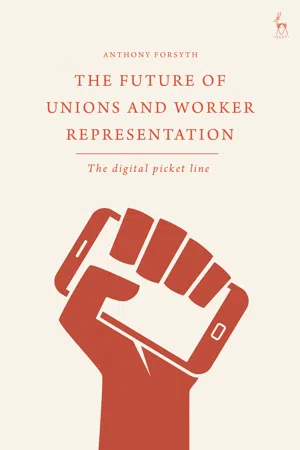
This book charts the path to revitalisation for trade unions in Australia, the USA, the UK, and Italy. It examines the examples of innovation and digital campaigning that are enabling unions to build new forms of worker power – and overcome decades of declining membership wrought by neoliberalism, globalisation, and hostility from employers and the state.
The study evaluates the responses of unions in each country to falling membership levels since the 1980s. It considers the US 'organising model' and its adoption in Australia and the UK, comparing this with the strategies of Italian unions which have been more deliberately focused on precarious and migrant workers. The increasing reliance of US unions on community alliances, as seen in the 'Fight for $15' and similar campaigns, is scrutinised along with new union prototypes like Hospo Voice in Australia, the Independent Workers' Union of Great Britain and SI Cobas in Italy. The book includes an in-depth analysis of union responses to the gig economy in the four countries, and the emergence of self-organised worker collectives to combat this exploitative business model. The vital role played by unions in defending the interests of workers during the COVID-19 pandemic is also examined.
As well as highlighting the most successful union initiatives to meet the challenges of the past 30 years, the book assesses the strengths and deficiencies of the legal framework for union representation in the four nations. It identifies the labour law reforms needed to rebuild collectivism, but argues that more is needed than favourable laws. This cross-national study provides a rich basis for identifying the combination of reforms, strategies and linkages required to ensure that unions can remain relevant for a new generation of digitally-active workers.
- 368 pages
- English
- ePUB (mobile friendly)
- Available on iOS & Android
eBook - ePub
About this book
Information
1
Introduction
I.Unionising Big Tech
Amazon, the multinational e-commerce behemoth, is renowned for its anti-unionism. The company has pioneered a model of work in its ‘fulfilment centres’ based on surveillance, oppressive performance targets and precarious labour with a heavy reliance on third-party agencies.1 Trade unions are not welcome, because Amazon does not want any interference with its ability to retain maximum managerial control.2 This is a familiar refrain, sung by corporations all over the world from the 1980s on. However, it is one thing to resist union involvement in the business. The last couple of years have shown more clearly the lengths Amazon will go to, in countering efforts to unionise its workforce. In 2020, the company posted advertisements in the United States for two intelligence analysts whose role would include monitoring ‘labor organizing threats’ (Amazon subsequently deleted the job postings, claiming they were erroneous).3 Leaked internal documents showed the extent of Amazon’s surveillance of labour, environmental and social justice groups in Europe, including the use of operatives from the notorious Pinkertons spy agency.4 The intelligence provided to the company’s Global Security Operations Centre covers intricate details of labour-organising activities at Amazon distribution centres, including the numbers of workers involved, types of campaigning or protests undertaken and their ‘risk level’ to the business.5
In the early stages of the COVID-19 pandemic, Amazon fired at least six workers (and disciplined others) who had taken a stand on inadequate safety precautions at its US warehouses.6 Chris Smalls, who led a walkout at the Staten Island, New York facility, was the subject of personal denigration by Amazon management following adverse media publicity of his termination.7 Then, in late 2020, Amazon workers in Bessemer, Alabama instigated the National Labor Relations Board process for a vote on recognition of their chosen representative, the Retail, Wholesale and Department Store Union (RWDSU).8 In what became an epic contest over the right to unionise in America’s deep south, the world saw the full panoply of the company’s obstructive tactics on display. As the vote on union recognition at the Bessemer warehouse loomed in the early months of 2021, Amazon urged staff to vote down the union drive through text messages and a specially created website (#DoItWithoutDues), telling them: ‘We’ve got you covered with high wages, health care, vision, and dental benefits, as well as a safety committee and an appeals process.’9 These messages were reinforced on posters installed in bathrooms at the warehouse10 and at mandatory employee meetings (known in the US as ‘captive audience’ meetings).11 Newly elected US President, Joe Biden, spoke publicly in support of the rights of American workers to a ‘free and fair choice’ about whether to unionise (although without naming Amazon).12 Despite this and a number of celebrities getting behind the union cause, the workers voted against recognition of the RWDSU for collective bargaining: 1,798 to 738, out of 5,876 eligible voters.13 Amazon’s no-holds-barred effort to thwart the union organising drive won out.
Although the company’s actions are just another chapter in the long history of union-busting by US employers,14 the Amazon example illustrates the depth of the challenges faced by unions in the modern world of globalised capital. Indeed, it has been argued that with five of the leading US technology companies union-free (Amazon, Apple, Microsoft, Facebook and Alphabet, Google’s parent entity): ‘The tech industry is the biggest failure of the union movement in the 21st century.’15 However, this does not tell us the full story. Even at Amazon, workers and their unions are fighting back. As will be recounted in Chapter 8, Italian unions utilised strike activity during the ‘Black Friday’ sales in late 2017 to extract a world-first collective agreement at Amazon’s warehouse in Piacenza. Unions in many countries (including Germany, Bangladesh and Australia) have since organised collective actions impacting Amazon at peak sales periods.16 Britain’s GMB Union is organising around a campaign called ‘Amazon workers are not robots’.17 In the US, Chris Smalls has drawn on the profile generated by his dismissal to kick-start a protest movement demanding higher pay and improved safety protections for the company’s warehouse workers.18
Other parts of the tech industry have seen significant worker mobilisation in recent years,19 such as the walkouts in late 2018 of thousands of Google employees concerned about sexual harassment and racial inequality.20 That was a largely spontaneous action, without union involvement.21 But in early 2021, around 400 Google workers voted to form the Alphabet Workers Union (an affiliate of the Communication Workers of America), providing stronger support to worker activism at Google – albeit without engaging in collective bargaining.22 In the wake of this, the Professionals Australia union declared it was ramping up its organising of tech-workers at Google and Apple (based on concerns over unpaid overtime and discrimination) and forming an alliance with the new micro-union for video game developers.23 Union organising drives in the digital media sector in the US since 2015 have resulted in collective bargaining contracts at news outlets including BuzzFeed, Vice, Slate, Vox and the Huffington Post.24 As shown in Chapters 9 and 10 of this book, unions are making headway in organising and representing workers in the uniquely hostile terrain of the gig economy.
II.Aims and Scope
Trade unions have acted as the main form of representation for workers and the primary vehicle for countering managerial power for more than 200 years. Spurred on by the industrial revolution in Britain, unions came to occupy a highly influential position in the economies of many countries in the post-war period of the twentieth century. However, the power of the unions has taken a markedly downward turn since the 1980s. Neoliberal economic and political thought has laid down fundamental challenges to the legitimate role (and sometimes, the very existence) of trade unions. The intense competitive pressures brought to bear by globalisation have unleashed successive waves of economic restructuring, eroding traditional mainstays of union strength such as manufacturing industries. Businesses have engaged in various strategies of re-invention through new business models, to avoid traditional forms of protective employment regulation and the representative role of unions. At the same time, unions have had to contend with deregulatory labour law reforms, prioritising individualised employment relationships and removing long-standing support for collective organisation. This shifting role of the state has been accompanied by and has enabled growing employer hostility to unions. As if all that were not enough, the COVID-19 pandemic has presented major new tests for unions: pushing them into the primary role of defender of workers’ basic rights to income security and a safe workplace and requiring nimble adaptation to digital organising on a massive scale.
This book explores the recent experience and future prospects of unions and newer forms of worker representation in four countries: the United States of America, Australia, the United Kingdom and Italy. It considers the extent of union membership decline in each nation and its causes. The book illustrates the differing strengths and deficiencies in the legal frameworks for union representation in the four countries. It also explores employer opposition to unions and the impact of business models, including agency/labour hire arrangements, independent contractor relationships (whether genuine or ‘sham’ in nature), supply chains and the gig economy. The book examines how unions in the four nations have sought to meet these various tests through a range of strategies. These include the ‘organising model’, which originated in the US and its adoption in Australia and the UK; union mergers and new approaches to union structures and membership models; lobbying for more favourable legislation; running litigation in the courts to contest various business models and expand recognition and bargaining rights; concerted efforts to engage with the hardest-to-recruit groups (precarious, migrant and younger workers); and innovative forms of campaigning, both in the workplace and in the broader communities, that unions inhabit.25 The book also considers other manifestations of collectivism which are filling the gap left by the retreat or absence of unions. Among these are self-organised worker coalitions (some of which exist only online), worker centres and ‘alt-labour’ groups.26 These phenomena are now widespread in the US, with green shoots starting to appear in the other three nations considered in this study (eg, the spontaneous collectives of food delivery riders and new independent unions which have emerged in Italy and the UK).
Drawing on this account and assessment of developments in the four countries – and an in-depth examination of the role of unions in the gig economy – a central purpose of the book is to identify how the revitalisation of unions can be achieved and what collectivism must look like to ensure the effective representation of workers’ interests into the future. In an important contribution to the scholarly debate on these issues in 2019, Visser outlined ‘four possible futures’ for trade unions globally.27 First, marginalisation: ‘the continuation of present trends with decreasing rates of unionization and trade unions becoming less relevant or powerless in shaping the newly emerging labour markets.’28 Secondly, dualisation: ‘unions will defend their positions and resist where they are currently strong’, but this will lead to ‘a sharper distinction between unionized and non-unionized firms and a smaller share for the former’.29 Thirdly, replacement: ‘Unions will gradually give way to other forms of social action and representation’, including those based on legislation (...
Table of contents
- Cover
- Dedication
- Title Page
- Foreword
- Preface
- Contents
- Table of Abbreviations
- Table of Cases
- Table of Legislation
- 1. Introduction
- 2. A Snapshot of Union Decline in the Four Countries
- 3. The Legal Framework for Unions and Worker Representation in the Four Countries
- 4. Unions in the USA: From the Organising Model to Alt-Labour
- 5. Australian Unions: From the Accord to ‘Change the Rules’
- 6. Australian Unions: Innovations, Amalgamations and Organising Beyond the Workplace
- 7. The UK: From ‘New Unionism’ to Indy and Digital Unions
- 8. Italian Unions: Fighting for the Marginalised
- 9. Unions and the Gig Economy: Advocacy, Campaigning, Mobilising
- 10. Unions and the Gig Economy: Misclassification Test Cases and Collective Bargaining
- 11. What is the Future of Unions and Worker Representation? What Changes are Needed in Labour Laws?
- 12. The COVID-19 Pandemic: The Undeniable Case for Unions
- Bibliography
- Index
- Copyright Page
Trusted by 375,005 students
Access to over 1.5 million titles for a fair monthly price.
Study more efficiently using our study tools.
Frequently asked questions
Yes, you can cancel anytime from the Subscription tab in your account settings on the Perlego website. Your subscription will stay active until the end of your current billing period. Learn how to cancel your subscription
No, books cannot be downloaded as external files, such as PDFs, for use outside of Perlego. However, you can download books within the Perlego app for offline reading on mobile or tablet. Learn how to download books offline
Perlego offers two plans: Essential and Complete
- Essential is ideal for learners and professionals who enjoy exploring a wide range of subjects. Access the Essential Library with 800,000+ trusted titles and best-sellers across business, personal growth, and the humanities. Includes unlimited reading time and Standard Read Aloud voice.
- Complete: Perfect for advanced learners and researchers needing full, unrestricted access. Unlock 1.5M+ books across hundreds of subjects, including academic and specialized titles. The Complete Plan also includes advanced features like Premium Read Aloud and Research Assistant.
We are an online textbook subscription service, where you can get access to an entire online library for less than the price of a single book per month. With over 1.5 million books across 990+ topics, we’ve got you covered! Learn about our mission
Look out for the read-aloud symbol on your next book to see if you can listen to it. The read-aloud tool reads text aloud for you, highlighting the text as it is being read. You can pause it, speed it up and slow it down. Learn more about Read Aloud
Yes! You can use the Perlego app on both iOS and Android devices to read anytime, anywhere — even offline. Perfect for commutes or when you’re on the go.
Please note we cannot support devices running on iOS 13 and Android 7 or earlier. Learn more about using the app
Please note we cannot support devices running on iOS 13 and Android 7 or earlier. Learn more about using the app
Yes, you can access The Future of Unions and Worker Representation by Anthony Forsyth in PDF and/or ePUB format, as well as other popular books in Law & Comparative Law. We have over 1.5 million books available in our catalogue for you to explore.