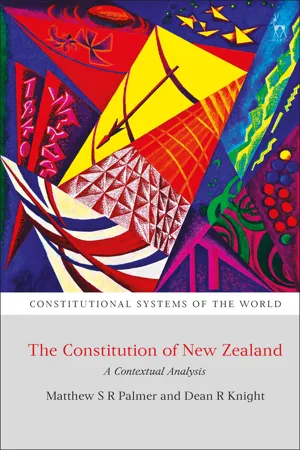
This book examines New Zealand's constitution, through the lens of constitutional realism. It looks at the practices, habits, conventions and norms of constitutional life. It focuses on the structures, processes and culture that govern the exercise of public power – a perspective that is necessary to explore and account for a lived, rather than
textual, constitution.
New Zealand's constitution is unique. One of three remaining unwritten democratic constitutions in the world, it is characterised by a charming set of anachronistic contrasts. "Unwritten", but much found in various written sources. Built on a network of Westminster constitutional conventions but generously tailored to local conditions. Proudly independent, yet perhaps a purer Westminster model than its British parent.
Flexible and vulnerable, while oddly enduring. It looks to the centralised authority that comes with a strong executive, strict parliamentary sovereignty, and a unitary state. However, its populace insists on egalitarian values and representative democracy, with elections fiercely conducted nowadays under a system of proportional representation. The interests of indigenous Maori are protected largely through democratic majority rule. A reputation for upholding the rule of law, yet few institutional safeguards to ensure compliance.
- 336 pages
- English
- ePUB (mobile friendly)
- Available on iOS & Android
eBook - ePub
About this book
Information
1
New Zealand Constitutionalism
Introduction – Constitutional Essence – Constitutional Perspective – Constitutional Culture – Constitutional Dialogue – Conclusion
I.INTRODUCTION
New Zealand’s constitution is a charming set of anachronistic contrasts in the twenty-first century. Its practitioners and commentators think of it as ‘unwritten’ although its contents are found in various written sources. It can change dramatically overnight but has retained its essential character for over 150 years. It proudly asserts its independence but is now a purer Westminster model than that in Westminster. It still looks to the centralised authority that comes with a strong executive, strict legislative supremacy and a unitary state, while its populace insists on egalitarian values and representative democracy. It aims to protect the interests of indigenous Māori through democratic majority rule. It is proud of its reputation for upholding the rule of law but has few institutional safeguards to ensure that happens.
These contrasts make New Zealand’s constitution a rich area for exploration. Its distinctive features hark back to an age of public trust in government institutions and the power of convention. They are flexible and vulnerable but oddly enduring. They also make exploration of a lived, rather than textual, constitution a necessity rather than a choice. New Zealand’s constitution resides in the practices, habits, conventions and norms of constitutional life. That is not just how this book explores it: that is how New Zealand constitutional practitioners and commentators conceive of it. Constitutional lawyers in New Zealand do not study a text. They study the life and times of the constitution as performance art. As authors of this book, we are explicit about our approach: constitutional realism. In this introductory chapter we explain our approach and use it to explore constitutional concepts, New Zealand constitutional culture. But first, we provide an overview of the essence of New Zealand’s constitution.
II.CONSTITUTIONAL ESSENCE
A.Constitutional Collision and Evolution
The cultural and legal collision in New Zealand in the first half of the nineteenth century was between British law and Māori law. British settlers brought their legal traditions to a land occupied by Māori and governed in accordance with their tikanga, as we explain further in Chapter 2.
From Cook’s three visits in 1769–1779 until the 1830s, there was increasing contact and trade between Europeans and Māori iwi (tribes) and hapū (sub-tribes), especially once Sydney was established in 1788. There were engagements, tensions and conflict between the differing interests of British commercial, religious and government groups and the differing interests of iwi in the 1830s. They culminated in 1840 in the negotiation of te Tiriti o Waitangi / the Treaty of Waitangi and a British assertion of sovereignty. 1840 was the closest New Zealand got to a constitutional ‘moment’ of the kind identified in many foreign constitutional textbooks.1 It marked the point at which the coercive force of the British Crown began to be brought to bear in New Zealand, through establishment of British government in New Zealand.
The relationships between the Crown, Māori and other New Zealanders have continued to be fundamental to New Zealand culture and society and to constitutional dynamics. They have, as could be expected, bubbled up through whatever legal system developed, as seen in other colonised nations. The relationships between Māori and the Crown have been a live wire, charged with tension and often generating sparks. There have been painful and dark passages in time that today provide embarrassment, regret and fodder for grievance. More recently there has been a growing willingness to recognise both world views.
In recent times, the primary constitutional avenue in which this constitutional collision has been manifested in New Zealand constitutional dialogue is te Tiriti o Waitangi. From the 1970s to the 1990s, the meaning and legal status of te Tiriti was reinterpreted through iterative constitutional dialogue between the Waitangi Tribunal, the executive, the courts and Parliament (as we detail in Chapter 10). The resulting relational meaning of te Tiriti has become a settled part of New Zealand’s constitutional landscape. Its legal force has been uncertain, accidental and politically charged, but has grown inexorably.
There are other legal manifestations of the constitutional collision between Māori and the Crown, as also outlined in Chapter 10. The common law of customary rights is the subject of constitutional dialogue that is ongoing. Fiduciary rights are also sometimes litigated, relying on traditional common law conceptions. Perhaps most important, as we speculate in Chapter 7, is the recognition and/or enforcement of Māori tikanga by the common law that has now begun. Whatever directions these developments take, there is no doubt that they relate to an enduringly significant dimension of the character of the New Zealand constitution.
Since 1840, there have not been many constitutional moments of the same intensity. Rather, New Zealand’s constitution has evolved in fits and starts, with a couple of more intense periods of constitutional realignments, from the 1840s to 1860s and the 1980s to 1990s. We provide only a very potted outline here, but more details are provided where relevant in each chapter.
British forms of governance followed its assertion of sovereignty in 1840. The 1840s to the 1850s saw the British settlers largely wrest control of government from the Colonial Office through their demands for representative and responsible government. They achieved this through the Imperial Parliament’s establishment of a New Zealand Parliament and the Colonial Office acceptance of a doctrine of ministerial responsibility in 1854–56. In 1858, around the time settlers began to outnumber Māori, the New Zealand Parliament gained the ability to amend parts of its constitutive statute, the New Zealand Constitution Act 1852 (Imp).
The increasing political power of settlers reflected and engendered increasing armed conflicts between the Crown and many Māori iwi, from the mid-1840s to the late 1860s.2 The Crown, with the assistance of other iwi, eventually got the better of these conflicts. But it was probably not until the 1920s that the government effectively controlled all of New Zealand. There were significant difficulties of communication and transportation around the two main islands of New Zealand – which stretch from the equivalent of around Brittany, France to North Africa. Accordingly, early British governance was based on a series of provincial divisions, until these were eventually abolished in 1875. Since then, New Zealand has been a unitary state.
From then, there were only isolated significant constitutional changes for around 100 years. There was a period of political and social ferment in the 1870s to 1890s, with government establishment of national infrastructure and a significant welfare state. These were accompanied constitutionally by the establishment of the first political party (the Liberal Party) in 1891; women’s suffrage in 1893; the decision not to join the Australian federation in 1901; and establishment of a politically neutral public service in 1912.
The reaction to the 1930s depression saw the consolidation of the welfare state and development of a two-party electoral system contested by the Labour and National parties. Even the acquisition of independence from Britain was a hesitant series of specific steps, including the acquisition of dominion status in 1907; the passage of the Statute of Westminster by the United Kingdom allowing effective independence in 1931; and New Zealand’s eventual adoption of independence under the Statute of Westminster in 1947. The latter move was motivated at least partly by domestic political considerations, in particular the desire to abolish the appointed upper house (the Legislative Council), which was effected in 1950. From then until the 1990s, New Zealand’s Cabinet government effectively exercised unbridled power.3 A small number of ministers dominated the Cabinet, which dominated the governing party, which always had a majority in the small House of Representatives, which exercised legislative supremacy.
The Muldoon administration from 1975 to 1984 demonstrated the autocratic potential of unbridled power, causing an economic crisis. A constitutional backlash followed in the mid to late 1980s. Measures introduced by subsequent governments included restructuring of the public service by the State-Owned Enterprises Act 1986, State Sector Act 1988, Public Finance Act 1989 and Fiscal Responsibility Act 1994. The Constitution Act 1986 brought together the scattered constitutional provisions in the statute book in one ordinary statute. Changes to parliamentary procedures made the House of Representatives more effective. The New Zealand Bill of Rights Act 1990 protected civil and political rights and freedoms with the power of an ordinary statute. From 1986 to 1996, politics was fundamentally restructured as the electoral system was changed from first-past-the-post (FPP) to mixed-member-proportional (MMP). And over all this period of relatively intense constitutional activity, te Tiriti o Waitangi was given legal recognition by the establishment of the Waitangi Tribunal in 1975; the Tribunal’s reinterpretation of the principles of te Tiriti from 1983 to 1986; passage of legislation recognising those principles in various Acts from 1986; and court confirmation and enforcement of the principles from 1987. Overall, executive power has been significantly bridled.4
Since the 1990s, the pace of constitutional development has slackened, as all these measures have been reviewed, confirmed, tweaked and bedded in. The removal of the Judicial Committee of the Privy Council as New Zealand’s highest court in favour of a patriated Supreme Court, in 2003, has been the main additional development. Two current developments that may prove significant are the adoption of well-being as a public finance yardstick and the increasing recognition and enforcement of tikanga by the courts.
B.Constitutional Sketch
The bare essence of the resulting series of contemporary constitutional relationships can be sketched in seven points. These are relationships between the people, Parliament, the Sovereign, Cabinet, ministers, the public service and the judiciary. They are encapsulated in principle and convention and reinforced by legislation and interpretations. But these relationships are not bound up in, or overridden or constrained by, superior legal rules.
(a)Representative democracy: New Zealanders have a deep attachment to democracy, manifested through the election of members to the relatively small (120 member) House of Representatives, which is the only house of Parliament. Since 1990, the introduction to the Cabinet Manual, written by one of New Zealand’s foremost constitutional scholars, Sir Kenneth Keith, has presented democracy as the ‘underlying principle’ of New Zealand’s constitution.5 The primacy of this principle is reinforced by the rare entrenchment of a handful of electoral laws. Changes to the franchise and electoral system have been central to New Zealand’s constitutional story over time. Māori men got the vote in 1867 and Māori and Pākehā women in 1893. The change from a FPP electoral system to a MMP system is the most fundamental constitutional reform of recent times. We explain the nature and significance of representative democracy in Chapter 4 (Democratic Government).
(b)Legislative supremacy (parliamentary sovereignty): In New Zealand, Parliament may still ‘make or unmake any law whatever’.6 Parliament may also make and unmake governments. The legislative power of Parliament is not subject to formal constraint and, despite occasional extra-judicial musings,7 the judiciary is not supposed to be able to strike down legislation for any reason. This legislative supremacy flows on from the strong commitment to representative democracy. Historical struggles – initially for representative and responsible government and later to shake off the law-making limits of a colonial legislature – have also reinforced the centrality of legislative supremacy vested in Parliament. We explain the principle of legislative supremacy and its realisation in New Zealand in Chapter 6 (Parliament).
(c)Sovereign’s obligation to act on ministerial advice: This convention is fundamental to the democratic nature of New Zealand’s constitution. Legislation confers on the Governor-General, as local representative of the Sovereign, many legal powers which, if exercised without check, would revive the monarchical nature of government. But convention requires that almost all of the Sovereign’s powers may only be exercised on the advice of ministers. In so doing, this convent...
Table of contents
- Cover
- Title Page
- Preface and Acknowledgements
- Contents
- Table of Cases
- Table of Legislation
- Table of International Instruments
- 1. New Zealand Constitutionalism
- 2. Aotearoa New Zealand
- 3. Head of State and the Crown
- 4. Democratic Government
- 5. Executive
- 6. Parliament
- 7. Judiciary
- 8. Accountability and Transparency
- 9. Human Rights
- 10. Te Tiriti o Waitangi
- 11. Local and Global Governance
- 12. Constitutional Futures
- Index
- Copyright Page
Trusted by 375,005 students
Access to over 1.5 million titles for a fair monthly price.
Study more efficiently using our study tools.
Frequently asked questions
Yes, you can cancel anytime from the Subscription tab in your account settings on the Perlego website. Your subscription will stay active until the end of your current billing period. Learn how to cancel your subscription
No, books cannot be downloaded as external files, such as PDFs, for use outside of Perlego. However, you can download books within the Perlego app for offline reading on mobile or tablet. Learn how to download books offline
We are an online textbook subscription service, where you can get access to an entire online library for less than the price of a single book per month. With over 1.5 million books across 990+ topics, we’ve got you covered! Learn about our mission
Look out for the read-aloud symbol on your next book to see if you can listen to it. The read-aloud tool reads text aloud for you, highlighting the text as it is being read. You can pause it, speed it up and slow it down. Learn more about Read Aloud
Yes! You can use the Perlego app on both iOS and Android devices to read anytime, anywhere — even offline. Perfect for commutes or when you’re on the go.
Please note we cannot support devices running on iOS 13 and Android 7 or earlier. Learn more about using the app
Please note we cannot support devices running on iOS 13 and Android 7 or earlier. Learn more about using the app
Yes, you can access The Constitution of New Zealand by Matthew SR Palmer,Dean R Knight in PDF and/or ePUB format, as well as other popular books in Law & Comparative Law. We have over 1.5 million books available in our catalogue for you to explore.