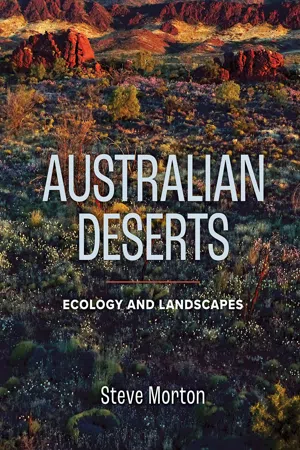
Australian Deserts: Ecology and Landscapes is about the vast sweep of the Outback, a land of expanses making up three-quarters of the continent – the heart of Australia. Steve Morton brings his extensive first-hand knowledge and experience of arid Australia to this book, explaining how Australian deserts work ecologically.
This book outlines why unpredictable rainfall and paucity of soil nutrients underpin the nature of desert ecosystems, while also describing how plants and animals came to be desert dwellers through evolutionary time. It shows how plants use uncertain rainfall to provide for persistence of their populations, alongside outlines of the dominant animals of the deserts and explanations of the features that help them succeed in the face of aridity and uncertainty.
Richly illustrated with the photographs of Mike Gillam, this fascinating and accessible book will enhance your understanding of the nature of arid Australia.
Winner, The Royal Zoological Society of NSW 2022 Whitley Medal
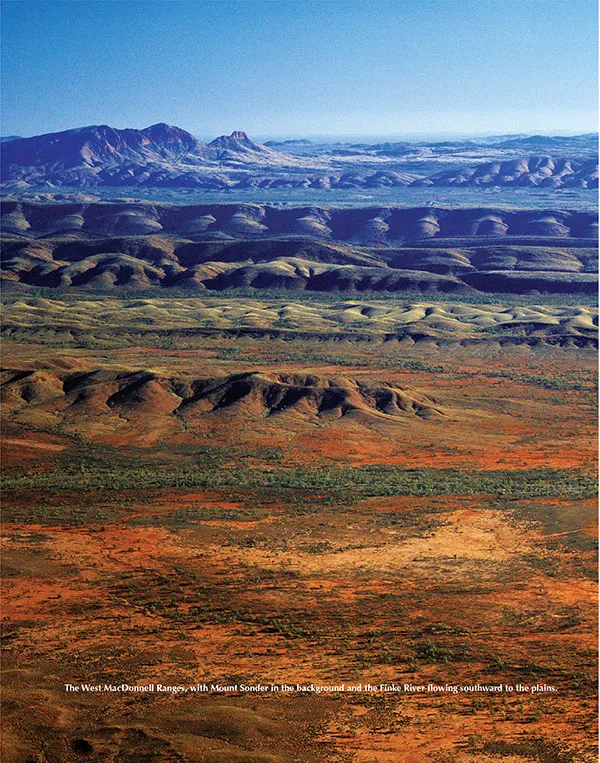
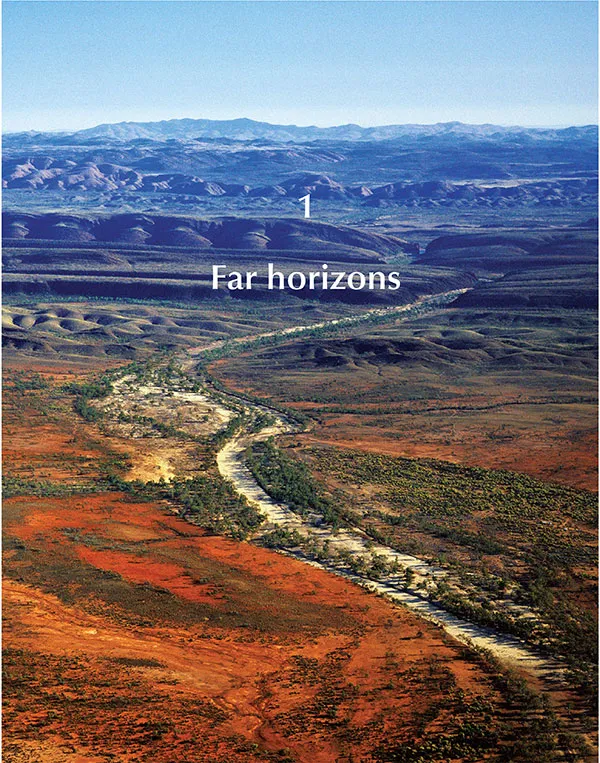
A light plane took us from Alice Springs to Lajamanu, a settlement near the Western Australian border some 600 kilometres away. The MacDonnell Ranges fell behind as we flew to the north-west, past the creeks and floodplains pushing out into the mulga plains to the north of the ranges, and on to the stretches of spinifex grassland that make up the Tanami Desert. Half an hour went by. I looked up from my reading and out of the window, to find our aircraft suspended 2 kilometres above a plain so flat that the entire horizon was unblemished by irregularity, a pure panorama of horizontal space. Flatness is such an unusual experience in our human world of serrated and vertical edges. And what a gigantic flatness this was, for in the clear air we could see for 100 kilometres around. This is the vast sweep of the Outback, a land of expanses making up three-quarters of the continent, the heart of Australia.
A human being shrinks to a pinprick within such a space: how do you make sense of all that horizontal landscape? The question confronts ecologists as much as it does other observers. Yet, in looking down from the plane, my eye was caught by patterns in vegetation written in swirls and curving lines across the superficially featureless sandplain. The patterns revealed responses by plants to variations in soil type and subtle changes in topography and drainage, and to the fires that sweep occasionally across the Tanami Desert. The ecologist in me delighted in this variety shining through the superficial plainness. Such patterns are seen wherever you might be, from the rocky Pilbara in the north-west to the riverine plains of the south-east, because a suite of similarities in climate, soil and vegetation spreads throughout the 5 million square kilometres of the arid zone. It is satisfying to learn how to read this country, to fathom its immensity.
The book aims to share my understanding of how the Australian deserts work. When brought together, answers to numerous questions about the lives of plants and animals allow us to grasp the ecological essence of the arid zone. How do plants use uncertain rainfall to provide for persistence of their populations? What is the significance of the landscape pattern formed by vegetation in response to soil type? What animals are most abundant and diverse, and why are they so? Are special adaptations required to prosper in the face of aridity and uncertainty? Do plants and animals reproduce regularly or irregularly under conditions of uncertain rainfall? How did plants and animals come to be desert dwellers through evolutionary time? Scientists have been investigating such questions for decades, and here I do my best to distil the knowledge emerging from their studies. Many ecological relationships remain unstudied because scientists are scarce in the vastness of arid Australia, but I take pleasure in what we know and am tantalised by what remains obscure. As the book unfolds, I hope that you, too, will feel this way.
Navigating a continental landscape
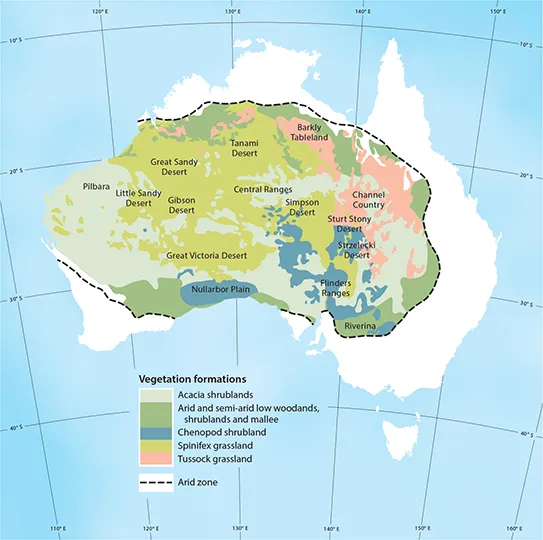
A broad overview is needed to comprehend these stretches of desert, beginning with regional landscapes. Many parts bear the name ‘desert’ – the Gibson, Great Sandy, Great Victoria, Little Sandy, Simpson, Strzelecki, Sturt Stony and Tanami Deserts. Further regions have names that do not imply aridity – the Barkly Tableland, Central Ranges, Channel Country, Flinders Ranges, Nullarbor, Pilbara and Riverina (Fig. 1.1). The term ‘desert’ is applied to those regions where our society has found minimal ways of making a living, regardless of how dry it might be. The word is not used where cattle and sheep can be pastured; here, the term ‘rangelands’ may be applied. In the book, the terms ‘arid zone’, ‘desert’ and ‘Outback’ are used interchangeably despite the distinctions just noted, for what is shared in topography, climate and vegetation far outweighs the differences among regions. The entire place is hot and dry, and that matters more than terminology. For those interested in formal definitions, deserts are terrestrial ecosystems controlled by infrequent, discrete and largely unpredictable inputs of water.1
Fig. 1.1. Map of Australia showing regions within the arid zone and five vegetation types throughout them.2
The arid zone is defined meteorologically as that part of the continent where rainfall divided by evaporation is less than 0.4, a description allowing for the fact that although more rainfall is received in the north it is hotter and evaporation is greater there. Disjunctions between regions are often vague, and the arid zone itself grades into coastal regions without abrupt ecological change. The best way to understand the nature of the arid zone is through the vegetation that forms its texture. Five vegetation types are characteristic, and they combine in different mixtures throughout each region. Only brief details of the dominant plants are given here, as their lifestyles are discussed in Chapter 3.
Vegetation types
Arid woodland and shrubland
Woodlands dominate the fringes of the arid zone: this is what you notice as you drive inland from the coast. There are low eucalypts and acacia shrubs, interspersed with grassy plains and river courses. In the south-west, mulga is the dominant acacia and eucalypts are uncommon. The northern woodlands possess diverse eucalypt trees over a grassy understorey. In the south-east, sparsely distributed callitris pine and bimble box are found with mulga shrubs. Across the south, multi-stemmed mallee eucalypts characterise the shrublands.
Acacia shrubland
The shrublands almost always contain mulga as well as many other acacias. There is an understorey of grass and often a mid-layer of eremophila shrubs. Rivers and creeks wind through the country supporting strips of riverine woodland containing coolibahs and river red gums. Acacia shrublands extend from the plains up onto the rocky outcrops that are widespread throughout the deserts. Their grey-green tint is the most common hue of arid Australia.
Saltbush shrubland
Saltbush and bluebush, sparse plants up to 1 metre high, grow on plains and rolling downs in the southern arid zone, known also botanically as chenopod shrubland. Over extensive areas there are myriads of these modest plants and virtually no other shrubs or trees. The Nullarbor Plain is a huge saltbush shrubland, as is the expanse of the Hay Plain well known to travellers between Sydney and Adelaide.
Spinifex grassland
Spinifex country is Australia’s unique desert landscape, this type of grassland being found nowhere else in the world. The spiky hummocks of spinifex grow over 2 million square kilometres of sandplains and dunefields; spinifex grows also on the hard ground of mountain ranges and rocky outcrops. Spinifex grassland always contains numerous shrubs of acacias, eremophilas, eucalypts and grevilleas. In the south, mallees are the dominant shrubs over a spinifex understorey. Throughout, abundant bushes provide an impression of a shrubland as much as a grassland.
Tussock grassland
Mitchell grass grows on clay soils in an arc of gently undulating plains from south-west Queensland into Western Australia. The clays swell when wet then shrink while drying into blocks with deep cracks, but the vertical roots of Mitchell grass align with the soil columns and remain intact. It seems that the dynamic clay shears off the lateral roots of woody plants and prevents them from establishing, so that most of this country is uninterrupted by tree or shrub. At the drier end of its distribution in the Sturt Stony Desert, Mitchell grass grows sparsely on bare plains. In the north the grasses are dense and after rainfall look splendid in their productivity.
Intersections
The different forms of vegetation intergrade and interdigitate in ways peculiar to each region of the arid zone. For example, the dunes of the Simpson Desert support spinifex grassland, while sparse gidgee shrubland grows on claypans and stony plains in the swales. Similarly, eucalypt shrublands in the mallee are often broken up by patches of blue-grey saltbush growing on firmer soils. Contrary to the initial impression, uniformity is the exception and shifting patterns are the norm. Even among the vast expanses of the Mitchell grass plains it is usual to see distant winding lines of woodland, where coolibahs and acacia shrubs grow along the creeks. A parade of variety greets the traveller, the vegetation shifting subtly in composition and intergrading in type as the country unfolds.
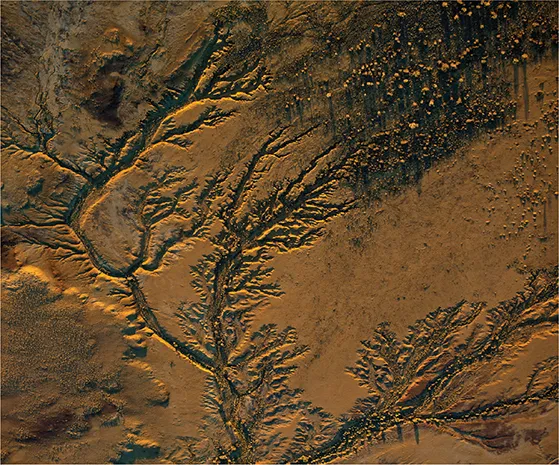
A dendritic drainage system near Oodnadatta, containing some shrubby gullies and with dawn light highlighting the exposed banks of those without vegetation.
The vegetation embodies a map of the ground beneath it, for most plants will grow only on a specific range of soil types determined by texture, water-holding capacity and chemistry, as will be discussed in Chapter 3. Such effects result both from surface and sub-surface soil features, as the roots of plants penetrate hidden layers beneath the surface called soil horizons. These relationships are not unique to Australian deserts, but are especially marked here because, over long periods of time, the only force at work has been erosion by wind and water, which has brought about marked differentiation of soils.
Some of the major relationships between soil and plants have been mentioned already. Mitchell grasses grow on clay, and it is almost impossible to find them elsewhere. The largest areas of spinifex occur on sand; yet further species grow on rocky hills where there is barely any soil. Saltbush shrublands prefer calcareous soils. Acacia shrublands grow best on soils rich with red oxides. At a broad scale, soil is the foremost determinant of vegetation type. Within any region, too, different soils weave in and out among each other in expansive patches and swirls, each with its distinctive plant life.
From my hometown, Alice Springs, the airline routes radiate outward towards the coastal cities in spokes across the continent. When flying along these pathways, I admire the picture laid out below in a mosaic of ochre, red or brown soil and grey-green vegetation. From on high it is also evident that Aboriginal artists of the deserts represent their Country from an aerial perspective. Their paintings reflect patterns of soil and vegetation in aggregated dots and splashes of colour, in curves and undulations, revealing intimate knowledge of the layout of the land. Artists working with Aboriginal people note how quickly they grasp the essence of a satellite image – traditional people may even talk about ‘flying’ over...
Table of contents
Cover
Title Page
Copyright
Contents
Preface
1 Far horizons
2 Blue skies, occasional rain
3 Plant life
4 Harvesting plant life
5 Waste not
6 Invertebrate predators
7 Vertebrate predators
8 By the waterhole
9 Life in the Australian deserts
Glossary
Common and scientific names
Endnotes
Index
Trusted by 375,005 students
Access to over 1.5 million titles for a fair monthly price.
Study more efficiently using our study tools.
Frequently asked questions
Yes, you can cancel anytime from the Subscription tab in your account settings on the Perlego website. Your subscription will stay active until the end of your current billing period. Learn how to cancel your subscription
No, books cannot be downloaded as external files, such as PDFs, for use outside of Perlego. However, you can download books within the Perlego app for offline reading on mobile or tablet. Learn how to download books offline
Perlego offers two plans: Essential and Complete
Essential is ideal for learners and professionals who enjoy exploring a wide range of subjects. Access the Essential Library with 800,000+ trusted titles and best-sellers across business, personal growth, and the humanities. Includes unlimited reading time and Standard Read Aloud voice.
Complete: Perfect for advanced learners and researchers needing full, unrestricted access. Unlock 1.5M+ books across hundreds of subjects, including academic and specialized titles. The Complete Plan also includes advanced features like Premium Read Aloud and Research Assistant.
Both plans are available with monthly, semester, or annual billing cycles.
We are an online textbook subscription service, where you can get access to an entire online library for less than the price of a single book per month. With over 1.5 million books across 990+ topics, we’ve got you covered! Learn about our mission
Look out for the read-aloud symbol on your next book to see if you can listen to it. The read-aloud tool reads text aloud for you, highlighting the text as it is being read. You can pause it, speed it up and slow it down. Learn more about Read Aloud
Yes! You can use the Perlego app on both iOS and Android devices to read anytime, anywhere — even offline. Perfect for commutes or when you’re on the go. Please note we cannot support devices running on iOS 13 and Android 7 or earlier. Learn more about using the app
Yes, you can access Australian Deserts by Steve Morton in PDF and/or ePUB format, as well as other popular books in Biological Sciences & World History. We have over 1.5 million books available in our catalogue for you to explore.