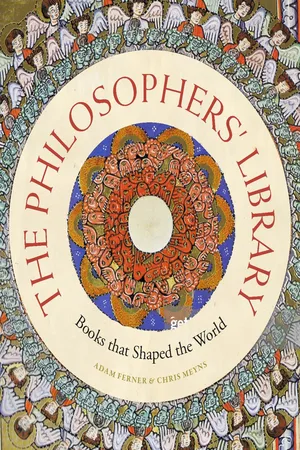
The Philosophers' Library features the most important philosophy manuscripts and books as stepping stones to take your through the history of philosophy.
By cataloguing the history of philosophy via its key works, this book reflects the physical results of human thinking and endeavour; brilliant thought manifested in titles that literally changed the course of knowledge, sometimes by increments, and sometimes with revolutionary impact.
This is a unique book of books, all as beautiful as they are important, whether they be ancient, modern or those in-between. Eye-catching antique fonts on leather covers, inked illustrations on vellum, and inspiring graphics on well-worn jackets draw the reader in.
Each book is detailed with publication date and title, the author is described, his or her key work outlined, and its context highlighted. The text brings these books as artefacts to life, telling the story of what philosophy was and is, how it appeared and when
Where should a book about books begin? The first printed paper books only start to appear at the very end of the first millennium of the Common Era. Beginning there, we would neglect a whole range of philosophical texts from Babylonia, Greece, the Indian subcontinent and many other places besides. But how far back can we feasibly reach? There is no ‘dawn of civilization’: humans have gathered into sophisticated social groups for hundreds of thousands of years, right back to and beyond the Sangoan culture in present-day Uganda in 65,000 BCE. Yet the further back we stretch the more gestural our histories become. Artefacts from the earliest human cultures are few and far between; the stories they tell are partial and often ambiguous.
Histories start stabilising (relatively speaking) around 3000 BCE. Thanks to new archaeological methods, we are beginning to get a much better sense of this period. We know, for instance, that the islands we call ‘Britain’ were little more than a network of swamps populated by a few people and some hardy boars. North America was much the same, though with more bison than boars, and slightly less bog.
On the continent of Africa, however, technologically developed societies already had an impressive cultural output. Nubian kingdoms, in the region of modern-day Sudan and southern Egypt, had already been around for centuries. Further north, Pharaoh Mnj (‘Menes’ or ‘Narmer’) and his court were ushering in the Dynastic Period of Egyptian history, from which emerged the pyramids, hieroglyphic writing and the Sphinx of Giza. The Nile played a significant part in the east African economy, making the region immensely fertile and rendering it the ‘breadbasket’ of the world.
Around the same time, the Sumerian and Akkadian Empires were established in Mesopotamia, a region covering present-day Iraq. Here the empires expanded and contracted along the similarly fertile Tigris and Euphrates rivers. Further east, in modern-day Pakistan, the Harappān civilization was spreading throughout the Indus Valley and traces of its deep roots still remain today.
These were highly advanced civilisations with their own cities, political systems and distinctive cultures. They should give pause for thought to those seduced by the idea of history as a process of linear progression from lesser societies to more advanced ones. These empires were far from ‘primitive’, and their cultural and social procedures shape much of the so-called modern world.
Proto-Cuneiform tablet, c. 3100–2900 BCE, Mesopotamia.
The pictographs on this Sumerian clay tablet record details of barley distribution and include an impression of a male figure, hunting dogs and boars. The marks were drawn in the clay with a pointed implement, perhaps a reed pen or a stylus with a wedge-shaped tip. It is currently housed in the Metropolitan Museum of Art after it was purchased from the collection of the Swiss antiquarians Marie-Louise and Hans Erlenmeyer. The routes by which these objects fall into public or private ownership are fascinating and often troubling, but unfortunately largely outside the ambit of this book.
Among the technologies developed at the time was writing. Tally systems and pictograms have existed for millennia, but the emergence of these vast governing bodies, alongside the associated expansion of cities, meant that record keeping had to adapt to keep pace with trade. Writing systems became more and more complex. The Sumerians used a wedge-like script called cuneiform, which by the middle of the third millennium BCE had shifted from pictograms to more abstract figures, closer to the characters in which this book is written. The Egyptians employed hieroglyphs and a cursive writing system called hieratic, often written with reed quills on papyrus. And it is from papyrus, a material produced from the malleable pith of the papyrus plant, that our first philosophical text, The Maxims of Ptahhotep, was made.
Detail from the Stele of Zezen-nakht, c. 2000 BCE, Egypt
A ‘stele’ is an upright stone slab, which typically bears a commemorative inscription or relief design. This one, uncovered in Naqādah, is rendered in stucco and paint and portrays the nobleperson Zezen-nakht, wearing a curled wig, sandals and a white kilt. It presently resides in the Toledo Museum of Art.
The Seated Scribe, c. 3800–1710 BCE, Egypt.
This Egyptian statue portrays an unknown figure in a white kilt, holding a partially rolled papyrus scroll. The inlaid eyes consist of red-veined white magnesite with truncated rock crystal. Taken out of Egypt by the French archaeologist Auguste Mariette in the nineteenth century, it is currently housed in the Louvre.
2 Divine instructions
One of the world’s earliest examples of systematic ethical thought hails from the Nile Valley in north Africa, in the Old Kingdom of ancient Egypt (or ‘Kemet’). It involves sets of instructions or teachings (sebayt) and offers both theoretical insight and a guide to practical action, with the aim of moral and spiritual uplift. The intention was to encourage people to speak truly, act correctly and contribute to the community.
The Maxims of Ptahhotep (c. 2000 BCE) was written by pth-htp, or ‘Ptahhotep’, a high-ranked official, for his son (also named Ptahhotep). It provides practical, ethical guidelines for proper conduct. What should you do, for instance, if someone behaves aggressively towards you? Show restraint and humility, advises the author. Avoid behaving in ways that might irritate others. Be humble. Take responsibility if friends entrust things to you. Do not be selfish or greedy. Do not gossip. Foreshadowing today’s self-help manuals, the Maxims recognize the value of self-promotion. ‘If you give heed to these things about which I have spoken to you’, says the author, ‘all your affairs will be successful.’
A core concept that underpins these instructions is that of ‘Ma’at’. Ma’at is concerned with moral values and doing what is right; it means truth, justice and uprightness. However, the word also means evenness, straightness and correctness, and as such reflects the order and regularity in the world. An ethical and a metaphysical principle, Ma’at upholds both the laws of the universe and of human society.
Great is Ma’at, and its foundation is firmly established
It has not been shaken since the time of Osiris
And he who violates the laws must be punished.
We are told in the Maxims that the wise are lovers of Ma’at. Their learning allows them to gain insight into the natures of things. As a result, they are well placed to provide instructions about how to behave, revealing that order in nature and order in society are intertwined.
But who exactly are ‘the wise’ here? In the tradition of the time (as in many subsequent ages), those with the luxury to engage in abstract ...
Table of contents
Cover
Title Page
Contents
Introduction
1 Natural Divides (2500 BCE–300 BCE)
2 Boundary Crossings (300 BCE–200 CE)
3 Assimilation (200 CE–600 CE)
4 Regimes of Truth (600–1000)
5 Balanced States (1000–1450)
6 Open Borders (1450–1850)
7 Grand Narratives (1850–2000)
Conclusion: Possible Futures (2000–)
Addendum
Glossary
Further Reading
Notes on Names and Translations
Index
Picture Credits
Acknowledgements
About the Authors
Credits
Copyright
Trusted by 375,005 students
Access to over 1.5 million titles for a fair monthly price.
Study more efficiently using our study tools.
Frequently asked questions
Yes, you can cancel anytime from the Subscription tab in your account settings on the Perlego website. Your subscription will stay active until the end of your current billing period. Learn how to cancel your subscription
No, books cannot be downloaded as external files, such as PDFs, for use outside of Perlego. However, you can download books within the Perlego app for offline reading on mobile or tablet. Learn how to download books offline
Perlego offers two plans: Essential and Complete
Essential is ideal for learners and professionals who enjoy exploring a wide range of subjects. Access the Essential Library with 800,000+ trusted titles and best-sellers across business, personal growth, and the humanities. Includes unlimited reading time and Standard Read Aloud voice.
Complete: Perfect for advanced learners and researchers needing full, unrestricted access. Unlock 1.5M+ books across hundreds of subjects, including academic and specialized titles. The Complete Plan also includes advanced features like Premium Read Aloud and Research Assistant.
Both plans are available with monthly, semester, or annual billing cycles.
We are an online textbook subscription service, where you can get access to an entire online library for less than the price of a single book per month. With over 1.5 million books across 990+ topics, we’ve got you covered! Learn about our mission
Look out for the read-aloud symbol on your next book to see if you can listen to it. The read-aloud tool reads text aloud for you, highlighting the text as it is being read. You can pause it, speed it up and slow it down. Learn more about Read Aloud
Yes! You can use the Perlego app on both iOS and Android devices to read anytime, anywhere — even offline. Perfect for commutes or when you’re on the go. Please note we cannot support devices running on iOS 13 and Android 7 or earlier. Learn more about using the app
Yes, you can access The Philosophers' Library by Adam Ferner,Chris Meyns in PDF and/or ePUB format, as well as other popular books in Philosophy & Graphic Design. We have over 1.5 million books available in our catalogue for you to explore.