Most of us are either too enamoured or too intimidated with the internet and other cyber infrastructure and tend to take extreme views, declaring it the panacea for all ills or the mother of all evils. Cyber crime, cyber warfare and cyber terrorism have been so intricately embedded in the current 'security zeitgeist' that any discourse, technology integration and capability assimilation without multifaceted foci on these, remains diffused and inchoate. Strategists, decision-makers, practitioners and scholars study cyber warfare and each group is saddled with its own peculiar and intractable problems. Strategists and decision-makers, despite their many insights, struggle with neologism coined to describe new developments in cyber space. And practitioners and scholars, despite their cyber skills and proficiency in quick understanding of complex technical concepts, are incapable of providing a disciplined framework for policy enunciation. The study of cyber warfare suffers from too many unsubstantiated assertions and unwarranted assumptions which tend to be subjective and heterogeneous. The unique characteristics of this new domain warrant conceptualisation of new expositions, fresh interpretations of traditional concepts and studies of events that contributed to the current cyber zeitgeist.The ubiquitous dependence of a nation on cyber space makes the disruption of cyber space a cause of grave concern. The conventional rules and legal norms associated with crime control and criminal justice struggle to keep pace with the changing dynamics of the challenges of policing, regulating and enforcing the provisions of statutory laws in cyber space. The laws newly enacted or amendments made to existing laws are still lagging behind when it comes to governing and regulating the cyber realm.
- English
- ePUB (mobile friendly)
- Available on iOS & Android
eBook - ePub
About this book
Information
Subtopic
Politics1
Cyber War: Quantum of Problem
.. attaining one hundred victories in one hundred battles is not the pinnacle of excellence. Subjugating the enemy’s army without fighting is the true pinnacle of excellence.
— Sun Tzu, The Art of War
Since the evolution of mankind, recourse to war has been viewed as a rational alternative for the preservation or furtherance of the state’s interests. Justification or condemnation of war and its characterisation as just or unjust, depends on the success or failure of achievement of anticipated objectives. Defending or waging war requires aggrandisement of resources and power. The confronting belligerents leave no stone unturned in their efforts to secure favourable outcomes concomitant with anticipated objectives, in spite of expected damage to property and life. With such high stakes involved, a nation commits a sizeable amount of resources to defend its national interests from a number of present, potential and perceived threats. The breakthroughs in technology may come from unexpected fields, largely disconnected from traditional warfare domains. However, depending on their potential in furtherance of existing and aspirational military capabilities, the new technology and its spinoffs are adopted, assimilated and integrated in one or the other domains of warfare. In the face of profound and powerful breakthroughs, capabilities are developed, refined and used in creating a domain without intersecting and overlapping linkages with existing domains. The “domain approach” is an important and often defining aspect of military thinking and the underlying rationale for accruing strategic, operational and tactical advantages over potential adversaries.
Two decades ago, juxtaposition of the two seemingly incongruous terms ‘cyber’ and ‘warfare’ would have appeared esoteric and arcane. Back then, the acquired computational power by using computers was viewed as an instrument in furtherance of peripheral efforts and not as a force enabler or multiplier for shaping the operational environment. The development and adoption of an entirely new paradigm that emanated, as a result of the all-pervasive use of the Internet and cyber space, with its tentacles encompassing and entwining almost all the facets of the world’s commercial, military and political activities, has turned cyber space into a potential venue for warfare. In military culture, technology is viewed as a panacea for dealing with a myriad challenges and technological solutions as a logical extension of strategic planning. To gain and maintain qualitative superiority by leveraging new technologies to develop new systems to counter a potential adversary, is one of the cardinal principles of military planning. The defence systems of most of the nations are being woven into the fabric of ‘system of systems’, thereby emerging as a new centre of gravity. It is paradoxical, yet true, that the more critical cyber space becomes to a nation’s economy and defence, the more vulnerable it becomes. Even a nation possessing formidable military might, may find the exploitation of cyber space, as its Achilles had especially by non-state players. Cyber space has joined air and outer space as a new medium of conflict.1
The term “cyber space” was coined by William Gibson, who used it in his book, Neuromancer, written in 1984. The main protagonist in the book, Henry Dorsett Case, a low-level computer hacker in the dystopian underworld of Chiba City, Japan, was caught stealing from his employer and was punitively barred from accessing the global computer network in cyber space; a virtual reality data space, the “Matrix”, by the administration of a drug damaging his central nervous system. Gibson defines cyber space as “a consensual hallucination experienced daily by billions of legitimate operators” and “a graphic representation of data abstracted from the banks of every computer in the human system.”2. Gibson’s fictitious character and apocryphal plot presciently described the present cyber ecosystem comprising millions of millions of computers networked on fibre-optical cables, wireless links and the ubiquitous Internet. It gained further currency due to its conceptualisation in compelling detail in Neal Stephenson’s Snow Crash.
Cyber Space, Cyber Warfare, and Cyber Attacks
Exchange of information in cyber space facilitated through information technology, computers, networks and telecommunications is considered as the ontological keystone of war in any domain. The dynamism, sustainability, survivability and mission accomplishment of a functioning war-fighting entity is directly linked with reliable, secure, resilient and survivable cyber space. As of now, there is only a loose consensus on what constitutes an act of war in cyber space. As a precursor to understanding cyber war, it is worth dwelling over the concept of cyber or cyber space in the context of the military environment. According to the International Telecommunications Union (ITU)of the United Nations, cyber space is “the physical and non-physical terrain created by, and/or composed of, some or all of the following: computers, computer systems, networks and their computer programs, computer data, content data, traffic data, and users.”3The US National Military Strategy for Cyber Space Operations defines cyber space as the domain “characterised by the use of electronics and the electromagnetic spectrum to store, modify, and exchange data via networked systems and associated physical infrastructures.”4
The US Department of Defence (DoD) defines cyber space as the “notional environment in which digitised information is communicated over computer networks, consisting of an interdependent network of information technology infrastructures, including the Internet, telecommunications networks, computer systems, and embedded processors and controllers.”5Cyber operations employ cyber space capabilities primarily to achieve objectives in or through cyber space. The United Nations (UN) defines cyber as “the global system of systems of Internetted computers, communications infrastructures, online conferencing entities, databases and information utilities generally known as the Net.” This mostly means the Internet; but the definition can aptly be applied in the context of a digitally interconnected network of computers and other devices, operating in the bounded electronic information environment of an organisation, either the military, government or public/private owned corporations.
An attempt to capture the essence of an activity as complex and exponentially evolving as cyber warfare within the confines of a definition will fail to capture its essence and distinct nuances. A better elucidation of cyber warfare needs much more than encapsulation in a definition. By invoking the work of seminal figures that shaped both antiquated and modern warfare, it may be possible to get an insightful view into the domain of cyber warfare. In the 6th century B.C., the great military expert of ancient China, Sun Tzu, succinctly summed up that “the best form of warfare is to take down the enemy without fighting with him”. The eloquence, relevance and importance of these words reverberate much more loudly in the realm of cyber space and cyber warfare. The ongoing shifts in discourses and practices of dominant and emergent structures of cyber warfare are shaping the strategic intent and direction, on the one hand, while, on the other, emerging as a definite force multiplier at the tactical level.
Edward Luttwak in his book, Strategy: The Logic of War and Peace,makes a convincing argument that equating war and peace is disparagingly flawed. During war, the methods adopted in peace time pursuits such as economy of scale, concentration of equipment and amassing of personnel are often inconsequential — even detrimental to the overall war effort. A favourable outcome in war requires adoption and execution of decisions diametrically opposed to the peace time methods in terms of redundancy, dispersal and surprise. Surprise, a key determinant of success in war, is the consequence of shock and confusion induced by the deliberate or incidental introduction of the unexpected. Cyber warfare tenets fit in snugly with these conceptual patterns. The deliberate infiltration of cyber weapons into the enemy’s network and systems may cause disruption, confusion, and chaos, resulting in degeneration of its war-waging potential. Carl von Clausewitz6, the Prussian military theorist, while articulating his version of warfare, stated: “Wars in every period have independent forms and independent conditions, and, therefore, every period must have its independent theory of war”. With the advent of the information age, cyber space has evolved as a domain of war. Clausewitz provides a timeless framework for reasoning about war, independent of temporal, spatial and technological imperatives. Clausewitz said that he “intended to provide a thinking man with a frame of reference . . . rather than to serve as a guide, which at the moment of action lays down precisely the path he must take”7. Thus, for better understanding of cyber warfare, each tenet associated with it needs to be within territorial, technological or temporal boundaries. Clausewitz, while formulating the ‘trinity’, an interactive set of three elements that shape the events of war, declared that these three dominant tendencies hold the key to success in war. These are “primordial violence, hatred, and enmity; the play of chance and probability within which the creative spirit is free to roam; and its element of subordination, as an instrument of policy, which makes it subject to reason. . . .” The interactive and dynamic interplay of these three elements will sustain the efforts to address even the most severe and debilitating threats. If we provide an analogous framework to these abstractions, it broadly translates into “the will to fight a war in terms of resources, finances and manpower; the means in term of military prowess across the full spectrum of conflict; and the able leadership with a sense of purpose and direction.”All of these components have inherent resilience and capability to mutually revive each other in case of individual destruction or degradation. However, in case they are simultaneously attacked and destroyed, a resulting strategic paralytic effect will derail all the war-fighting efforts and make victory an elusive allegory. Initiation of attacks in cyber space with the intent to simultaneously degrade or destroy all the three tendencies will facilitate accomplishment of strategic objectives.
The interpretation of these indelible and inalienable concepts in the digital dimension and in the context of the virtual world will provide a framework for multi-disciplinary and multi-organisational engagements and participations in planning, developing and implementing policies and procedures to operate in cyber space. In the present conflicts, one foresees a battle space characterised by ‘hide-and-seek’ warfare rather than a ‘force-on-force’ experience.8 Alvin Toffler explicitly stated: “The wars of the future will increasingly be prevented, won or lost based on information superiority and dominance.”9 Christopher Coker proclaims that the ultimate manifestation of post-modern war is “humane warfare”, in which the mission is to neutralise rather than kill.10This implicit reduction of friction and violence perhaps reinforces the beliefs in cyber war operations in the future.
While defining the virtual world, it is crucial to accommodate the views emerging from current discourses and to explore the technological underpinnings. Accordingly, the virtual world can be defined as, “A persistent, simulated and immersive environment, facilitated by networked computers, providing multiple users with avatars and communication tools with which to act and interact in-world and in real-time.”11New technologies of communication and information exchange have built up a scenario, in which all the existential entities are not only to be thought of in terms of their physical forms, geographical locations, demographic influences and socio-economic underpinnings, but also in terms of their cyber footprints, cyber resilience and cyber criticality. While the physical world has become much more fragmented and more differentiated, the virtual world, enmeshed by a network of computers, has become one congruent, virtually connected entity, permitting unhindered flow and exchange of information.
Boundaries in Cyber Battlefield
The boundaries of the battlefield in the real world are usually well defined and could be a geographical feature separating the two battle ready opponents. The clear distinction and demarcation of boundaries in the battlefield is a prerequisite for active combat among two nations likely to engage in a war. In the war on terrorism, the battlefronts are accidental or contingent upon the presence of some specific armed groups with certain ideological differences with established religious, political, social or military institutions. Still, even in this kind of war, there is physical use of weapons and possible exchange of ammunition between warring groups. In cyber space, the traditional boundaries akin to terrestrial boundaries just do not exist.12
The chief challenge in dealing with this new paradigm is the difficulty in attributing induced activities within a particular geographical confine. In cyber space, reconnaissance can be carried out by using systems and networks distributed across the world. Planning can be done by group of individuals who do not bear any possible resemblance in relation to typical combatants. The Internet can be both: a resource repository and an attack vector. The potential of the uncharted territories of cyber space are being exploited to create new opportunities and capabilities for preserving and strengthening national security in all its dimensions. For better elucidation, a closer look a...
Table of contents
- Cover
- Half Title
- Title
- Copyright
- Contents
- Dedication
- Acknowledgements
- Preface
- Introduction
- 1. Cyber War: Quantum of Problem
- 2. Coming of Age of Cyber War
- 3. Enunciation of the Principles of Cyber Deterrence
- 4. Cyber-Military Doctrinal and Functional Convergence
- 5. Cyber Surveillance, Espionage and Exploitation
- 6. Cyber Security and Critical Information Infrastructure Protection
- 7. Cyber Defence: Prevention and Mitigation Against Cyber Attacks
- 8. War Over Internet Governance: Oxymoronic or Opportunistic?
- 9. Offensive Potential of Cyber Attacks
- 10. Internet of Things: A New Paradigm for Military Operations
- 11. Shaping The Cyber Zeitgeist in India: Challenges, Prospects and Opportunities
Trusted by 375,005 students
Access to over 1.5 million titles for a fair monthly price.
Study more efficiently using our study tools.
Frequently asked questions
Yes, you can cancel anytime from the Subscription tab in your account settings on the Perlego website. Your subscription will stay active until the end of your current billing period. Learn how to cancel your subscription
No, books cannot be downloaded as external files, such as PDFs, for use outside of Perlego. However, you can download books within the Perlego app for offline reading on mobile or tablet. Learn how to download books offline
Perlego offers two plans: Essential and Complete
- Essential is ideal for learners and professionals who enjoy exploring a wide range of subjects. Access the Essential Library with 800,000+ trusted titles and best-sellers across business, personal growth, and the humanities. Includes unlimited reading time and Standard Read Aloud voice.
- Complete: Perfect for advanced learners and researchers needing full, unrestricted access. Unlock 1.5M+ books across hundreds of subjects, including academic and specialized titles. The Complete Plan also includes advanced features like Premium Read Aloud and Research Assistant.
We are an online textbook subscription service, where you can get access to an entire online library for less than the price of a single book per month. With over 1.5 million books across 990+ topics, we’ve got you covered! Learn about our mission
Look out for the read-aloud symbol on your next book to see if you can listen to it. The read-aloud tool reads text aloud for you, highlighting the text as it is being read. You can pause it, speed it up and slow it down. Learn more about Read Aloud
Yes! You can use the Perlego app on both iOS and Android devices to read anytime, anywhere — even offline. Perfect for commutes or when you’re on the go.
Please note we cannot support devices running on iOS 13 and Android 7 or earlier. Learn more about using the app
Please note we cannot support devices running on iOS 13 and Android 7 or earlier. Learn more about using the app
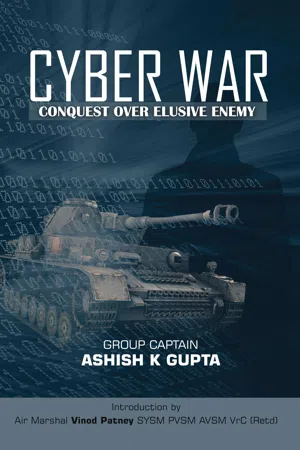
Yes, you can access Cyber War by Ashish K Gupta in PDF and/or ePUB format, as well as other popular books in Politics & International Relations & Politics. We have over 1.5 million books available in our catalogue for you to explore.