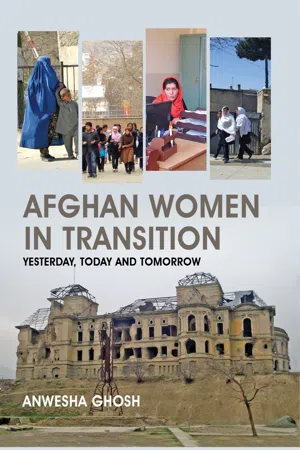
The Government of Afghanistan specified gender equality to be one of the most important cross cutting themes in Afghanistan National Development Strategy (ANDS) 2008-2013, by committing to measurable improvement in women's economic opportunities and access to and control over productive assets and income. That was undoubtedly a remarkable progress considering, Afghan women were denoted as the "vanished gender" during Taliban period, indicating the plight of this oppressed and deprived section of Afghan society. The developments of the past decades have impacted all possible spheres of Afghan existence, specifically gender. After more than fifteen years of international intervention, it can be said that, Afghanistan has gone through another few years of upheaval, which has produced a mixed situation of progress and regress. This book seeks to explore the plight of Afghan women during their country's turbulences across a broad spectrum of almost a century – how they have sought to protect themselves and tried to improve their situation in the course of that socio-political turmoil. In order to understand how the changes, achievements and challenges of women have altered overtime, attempts have been made through this study to review the position enjoyed by women in the remote past (Yesterday), starting from the monarchies up to the present generation of women (Today) and also what sort of challenges and obstacles the future generations of women are likely to face in Afghanistan in the days after the complete withdrawal of International Forces (Tomorrow). An important aim has been to understand the correlation between conflict, poverty, economic deprivation with gender issues in Afghanistan. In the last few years, women used different initiatives to make alliances at various levels of the society to achieve their goals and defend their gains which will also be reviewed before posing the fundamental questions: Has there been any significant change in the plight of Afghan women? Was there any genuine attempt to hear their voices in various spheres of personal and public life? Does women's right exist mostly on paper in Afghanistan? Can the women ever become a powerful force and an important resource in Afghanistan's future?
- English
- ePUB (mobile friendly)
- Available on iOS & Android
eBook - ePub
About this book
Information
Chapter-I
A HISTORICAL OVERVIEW OF POSITION OF WOMEN IN AFGHANISTAN
“As for those who lead a righteous life, male or female, while believing, they
enter Paradise; without the slightest injustice.”
—Al Qur’an [4:124]65
“Religion does not require women to veil their hands, feet and faces or enjoin
any special type of veil. Tribal custom must not impose itself on the free will of
the individual.”
—Amanullah Khan, King of Afghanistan (1919–29)66
Over the past decades, Afghan women have been the subject to unprecedented levels of interest and international attention. There is a need to recognise the diversity of capacities and aspirations that exists within a group that comprises half a nation. Nancy Dupree describes this diversity in the following way:
“It is useful perhaps to view the totality of Afghan women as a pyramid. The sound base is broad and consists of a majority who live in rural areas cherishing aspirations that are almost exclusively oriented towards children and family. Their needs lie in all aspects of basic and non-formal education, in health and in skill training for better family welfare. Here some progress, albeit slow, is taking place in a non-confrontational manner.At the tip are the small members of Western-oriented, assertive working women who have taken a leading part in the emancipation process begun in 1959. They have become accustomed to formal employment in mixed environments, often in association with foreigners who are now joined in battle on their behalf. These women call for the right to participate fully at all levels of decision-making. They bear the full brunt of Taliban ire.In the centre is the solid core of professional teachers, medical practitioners, engineers, judges, administrators, businesswomen, social worker and civil servants of every sort which has grown in magnitude and strength since the beginning of the century. Largely from middle class, conservative but progressive families, these women neither wish to deny their society’s values nor compromise Islam. Over the years they have shown by their comportment that Afghan women can function in the public sphere with no loss of dignity to themselves, their families or nation. Tragically, many have been lost to Afghanistan through resettlement. Many thousands remain, nevertheless, and thousands of others are being trained even though opportunities for utilizing their training look bleak. It is this strong central core that most urgently needs to be uncaged if Afghanistan is to recover and move forward.”67
Afghan society traditionally has been characterised by conservative cultural norms in respect to women. This particular tradition of segregation, known as “purdah” among Afghans can be described as an effort to maintain separation between men and women in public, and regulate the association between two sexes to different locations. This norm has traditionally assigned domestic roles in private spheres to women and public spheres to men. The practice of female seclusion has varied with circumstances like age, education, class, wealth and ethnicity. Geography has also played its share of role as there has been considerable variation in practice between urban and rural areas. Indigenous concepts of ‘honour’ and ‘shame’ traditionally have been reinforced in times of war and exile, with the honour and standing of men being determined, in the eyes of their peers, by the protection and modesty of “their” women.68
Afghan leaders have addressed themselves to the subject of reform for women for over a hundred years. These spokespersons, predominantly male, have held that nationalist ideology encompassing emancipation for women is essential to the creation of a progressive image for the nation.
Modern Monarchies
The birth if modern Afghanistan is attributed to Abdur Rahman Khan who ruled from 1880 to 1901. He was a descendant from a line of Pashtuns who largely controlled Afghanistan. Amir Abdur Rehman was the first ruler to attempt consolidation of the nation into a centralised state. He ruled with a ruthless hand that led to him being termed as the “Iran Amir”. Yet, he attempted to alter some of the customary laws that were detrimental to women’s status. He introduced many laws in an attempt to align customary social practices with the prescription of Islam.69 He forbade child marriages, forced marriages, exorbitant bride prices and marriage gifts. He restored hereditary rights to widows and permitted women to seek divorce. He granted freedom in case of non-support and authorised the “mehr” (marriage gift) according to dictates of Quran. Even though he considered women subservient to men, he still felt that they were “due just treatment”.70 Nancy Hatch Dupree surmises that his liberal wife Bobo Jan may have influenced the Amir, pointing out that, “In fact, she was the first Afghan queen to appear in public in European dress without a veil. She rode horses and trained her maidservants in military exercises. She had keen interest in politics and went on numerous delicate missions to discuss politics between contending parties.”71 However, it was Abdur Rahman Khan who imposed the death penalty for adulterous women (which was contrary to the Quran) and decreed that men were entitled to full control over their women because “... the honour of the people of Afghanistan consists in the honour of their women.”72
Upon the death of Amir, his son Amir Habibullah Khan took over and reigned for ten years. Habibullah continued his father’s progressive agenda by putting a ceiling on extravagant marriage expenses that often caused poverty in many families. His wives wore western clothes and were seen without veils in public. In 1903, Habibullah established the first collage in Afghanistan, Habibiya Collage, employing foreign teachers from India, Turkey and Germany.73 His other achievements included setting up of the first hospital, the first hydro electric plant, factories and construction of reads in Afghanistan and improved trade with Central Asia and India.74
The concept that women should be considered as contributing members of society beyond motherhood was first introduced during the reign of Amir Habibullah (1901-1919). Another significant contribution of Habibullah was the return of Afghan exiles including Majmud Beg Tarzi around the turn of the century. Mahmud Beg Tarzi, who was one of Afghanistan’s greatest intellectuals and is regarded as the ‘Father of Afghan Journalism’ argued against overly protective restrictions on women and for education, pleading that egalitarian Islam does not deny women education and that is an Islamic duty to provide them with the opportunity to function fully in society. Only with educated women in the home, he said, could the family remain strong and the nation progress. To bolster his arguments, he published accounts of famous women through history in his news paper Seraj-ul-Akhbar i Afghan (The lamp of the news of Afghanistan).75 Tarzi returned from Syria and became the editor of a modernist-nationalist newspaper which advocated political views critical to Western imperialism and in a subtle way the monarchy.76
Educated in Syria and Turkey, Tarzi was strongly influenced by modern interpretations of Islamic jurisprudence and by the liberties afforded to women in these countries. Convinced of women’s abilities to engage in public professions, Tarzi viewed women as people who deserved full citizenship; he claimed that educated women were an asset to future generations and concluded that Islam did not deny equal rights. He devoted a special section on women’s issues in his newspaper entitled “Celebrating Women of the world”, which was edited by his wife Asma Tarzi. As Schinasi concludes, “no one before Tarzi had pronounced such words as ‘liberty’, ‘respect for the homeland and religion’, ‘union’, ‘progress’ or ‘ school’ in Afghanistan.”77
Habibullah, because of Tarzi’a liberal influence, opened a school for girls with English curriculum which tribal leaders and mullahs saw as going against the grain of tradition. Unfortunately as reflected by Magnus and Naby, “the liberalization of nation through education and modernization of even the ‘tiny elite’ spawned an opposition movement.”78 The religious leaders read Tarzi’s articles and essays with increasing displeasure and contented that education for women would lead to the breakdown of the family, sexual anarchy and the ultimate degradation of women. They feared that this trend would lead to loss of honour of the nation. Education for women and state’s interference in marriage institutions challenged the power of tribal leaders and their patrilineal and patrilocal kinship systems, resulting is Habibullahs’s assassination in 1919.79 Schinasi sums up Habibullah’s reign perfectly, “Habibullah is sometimes referred to as the forgotten king, but it was Habibullah who was keen to maintain Afghanistan’s position on the international as well as on the Muslim scene, but he was unable to control both with the same skill.”80
The First Era of Change
After the assassination of Habibullah, his son Amanullah was placed on throne and his reign proved to be a turning point which saw full fledged modernization period of Afghanistan. His foremost attempt was to completely liberate Afghanistan from the British control and succeeded by defeating the British in the third and final Anglo-Afghan war in 1919. He relentlessly wanted to escort Afghanistan to the path of modernization and his agenda included liberation of Afghan women from tribal cultural norms. His exuberance and perseverance in enforcing these changes were heavily influenced by the modernization agenda operating in Turkey and his impressions from his travels in Europe.
Conservative aversion erupted into open revolt as King Amanullah attempted to institutionalize reform for women during his decade long tenure at the throne. Despite Amir Abdur Rahman’s efforts, unjust and customary laws and practices continued to function in Afghanistan. He, therefore once again pressed to abolish child marriages, forced marriages, the leverite and to assure widow’s rights.81Exorbitant marriage gifts were ordered curtailed. In addition, Amanullah attempted to go further by advocating monogamy, the removal of the veil, the end of seclusion and compulsory education for girls.82
In 1923, Amanullah drew up the first constitution, establishing the basis for the formal structure of the government and setting up the role of the monarch within the constitutional framework.83 He was also influenced by Tarzi’s sophisticated intellectual ideology in his endeavours. Tarzi was specifically instrumental in designing and implementing changes pertaining to women through his personal example of monogamy, education and employment of family members and their unveiled public appearances.84 Later King Amanullah even married Mahmud Tarzi’a daughter Soraya.
Queen Soraya and his sister, Seraj-ul-Banat, were the first Afghan women to speak out publically on the subject. They had learnt their lessons well from the liberal-minded men around them. Speaking in 1923, Seraj ul-Banat said :
“Some people are laughing at us, saying that women know only how to eat and drink. Old women discourage young women by saying their mothers never starved to death because they could not read or write... But knowledge is not man’s monopoly. Women also deserve to be knowledgeable. We must on the one hand bring up healthy children and on the other hand, help men in their work. We must read about famous women in this world, to know that women can achieve exactly what men can achieve.”85
Queen Soraya, spoke to women during the 1926 Jeshyn (Independence Day Celebration) even more forthrightly:
“Independence has been achieved. It belongs to all of us...Do not think, however, that our nation needs only men to serve it? Women should also take part as women did in early years of our nation and Islam. The valuable services rendered by women are recounted throughout history from which we learn that women were not created solely for pleasure and comfort. From their examples we learn that we must all contribute towards the development of our nation and that this cannot be done without being equipped with knowledge. So, we should all attempt to acquire as much knowledge as possible in order that we may render our services to society in the manner of women of early Islam.”86
Amanullah publicly campaigned against veil, against polygamy and encouraged education of girls not just in Kabul but also in country side. Amanullah even said that Islam did not require women to cover their bodies or wear any special kind of veil at a public function and by the time he finished his speech, Queen Soraya tore off her veil in public and apparently wives of other important officials who were present there also did the same. Many women from Amanullah’s family publicly participated in different organizations and went on to become government officials later in their lives. Amanullah’s sister, Kobra, who formed the Anjuman-i-Himayat-i-Niswan, (organization for women’s protection) in 1920s. This organization worked towards injustices against women and encouraged them to bring their complaints to the organization and to unite to contest the oppressive institutions. Another sister founded a hospital for women. Queen Soraya along with her mother initiated the first magazine for women called Ershad-i-Nishan (Guidance for Women). Education of women was taken very seriously and to give impetus to this endeavour fifteen young women were sent to Turkey to acquire Higher Education in 1928. Soraya’s contribution can hardly be exaggerated as far as enforcing changes in the lives of Afghan women are concerned. She encouraged and inspired women of her times to actively participate in the nation building process.
During the later part of Amanullah’s reign, the King and Queen visited Europe where they were honoured and felicitated. During his ‘Grand Tour’ in 1927, he and the Queen visited India, Egypt, Italy, France, Germany, Britain, Soviet Union and Iran. Martin Ewans write that in all these countries, they made a considerable impression, if only because Afghanistan was a relatively unknown country and it came as a pleasant surprise to find it is ruled by an engaging amiable and outgoing king, accompanied by an attractive consort.87 In 1928 Oxford University even awarded them honorary degrees.88 They were particularly impressed by Europe and changes in Turkey. After returning to Afghanistan they attempted to implement some of the social and cultural changes they had experienced in the western society to their own society back home. He was determined to transform Afghanistan into a ‘Modern’ society. This was also a time when some other Muslim countries like Turkey and Egypt were also going through the process of transformation and were on the path of modernization. The elite section of the Afghan society was particularly impressed to witness these changes in other countries, attempted to emulate their development models. However Afghanistan was not ready for such changes. While the King and the Queen were away from the country a British source distributed pictures of the Queen without veil, dining with foreign men, and having her hand kissed by the leader of France among tribal regions of Afghanistan. Conservative mullahs and regional leaders took the images and details from the royal family’s trip to be a flagrant betrayal of Afghan culture, religion and ‘honour’ of women.89 Some of the historians have even viewed the circulation of picture from foreign source as an evidence of British effort to destabilize the Afghan monarchy as first of many international att...
Table of contents
- Cover
- Half Title
- Title
- Copyright
- Contents
- Acknowledgements
- Glossary
- Acronyms
- Introduction
- 1. A Historical Overview of Position of Women in Afghanistan
- 2. Barriers and Bridges: Women in Rural and Urban Afghanistan
- 3. The Afghan State, Society and Gender Politics up to 2001
- 4. Afghan Women since the fall of the Taliban
- 5. Women’s Voices in Contemporary Afghanistan
- Conclusion
- Notes
- Annexure
Trusted by 375,005 students
Access to over 1.5 million titles for a fair monthly price.
Study more efficiently using our study tools.
Frequently asked questions
Yes, you can cancel anytime from the Subscription tab in your account settings on the Perlego website. Your subscription will stay active until the end of your current billing period. Learn how to cancel your subscription
No, books cannot be downloaded as external files, such as PDFs, for use outside of Perlego. However, you can download books within the Perlego app for offline reading on mobile or tablet. Learn how to download books offline
Perlego offers two plans: Essential and Complete
- Essential is ideal for learners and professionals who enjoy exploring a wide range of subjects. Access the Essential Library with 800,000+ trusted titles and best-sellers across business, personal growth, and the humanities. Includes unlimited reading time and Standard Read Aloud voice.
- Complete: Perfect for advanced learners and researchers needing full, unrestricted access. Unlock 1.5M+ books across hundreds of subjects, including academic and specialized titles. The Complete Plan also includes advanced features like Premium Read Aloud and Research Assistant.
We are an online textbook subscription service, where you can get access to an entire online library for less than the price of a single book per month. With over 1.5 million books across 990+ topics, we’ve got you covered! Learn about our mission
Look out for the read-aloud symbol on your next book to see if you can listen to it. The read-aloud tool reads text aloud for you, highlighting the text as it is being read. You can pause it, speed it up and slow it down. Learn more about Read Aloud
Yes! You can use the Perlego app on both iOS and Android devices to read anytime, anywhere — even offline. Perfect for commutes or when you’re on the go.
Please note we cannot support devices running on iOS 13 and Android 7 or earlier. Learn more about using the app
Please note we cannot support devices running on iOS 13 and Android 7 or earlier. Learn more about using the app
Yes, you can access Afghan Women in Transition by Anwesha Ghosh in PDF and/or ePUB format, as well as other popular books in Politics & International Relations & International Relations. We have over 1.5 million books available in our catalogue for you to explore.